Can I Add Solar to Existing Street Lights? Complete Guide 2025
Dec 16, 2025
“Can I add solar to an existing street light?” This is a common question among municipal operation and maintenance personnel, property managers and rural builders. Under the global trend of energy conservation and carbon reduction, solar energy, as a clean and renewable energy source, has become the preferred direction for street light renovation.
Compared with building a complete set of solar street lights, installing solar systems on existing street lights can not only significantly reduce the initial investment, but also quickly achieve the goals of energy conservation, consumption reduction and reduced reliance on the power grid. This article will comprehensively address this core issue, providing you with one-stop professional guidance from feasibility confirmation, key considerations, implementation steps to renovation advantages.
Can I Add Solar to An Existing Street Light?
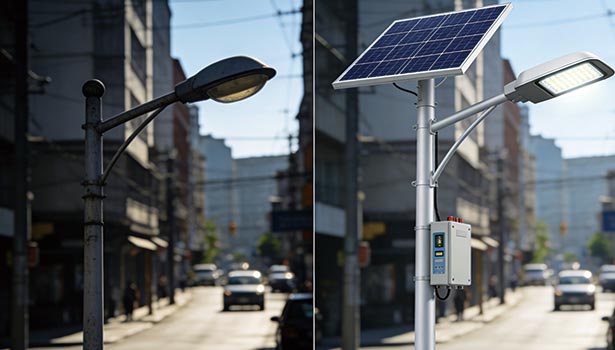
The answer is clear: Yes, you can! In most cases, solar energy systems can be successfully installed by making targeted renovations to existing street lights.
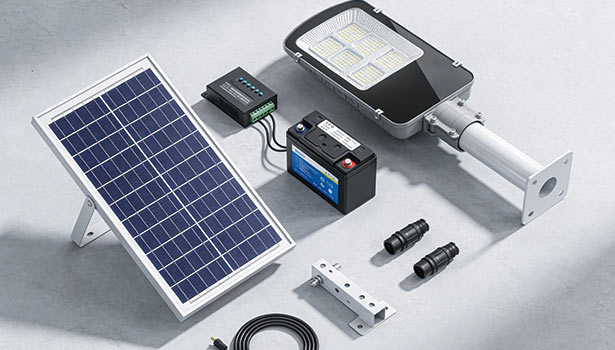
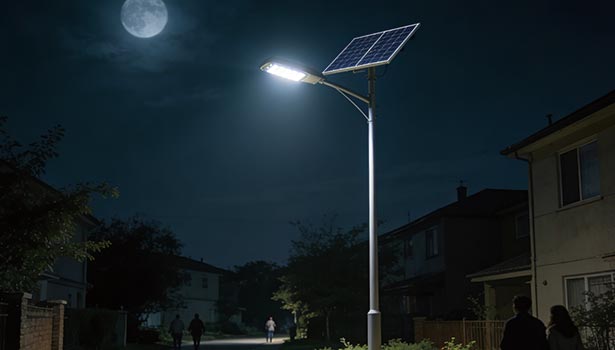
The core renovation logic is not complicated: on the basis of the existing light poles, solar panels and energy storage batteries are installed, and at the same time, LED lights that are compatible with the solar system are replaced. The entire renovation process does not require the reconstruction of the light pole foundation and can make the most of the existing facilities.
Depending on the different renovation requirements and scenarios, it is mainly divided into two mainstream directions: one is the simple and convenient "integrated solar equipment" solution, and the other is the flexible and adaptable "grid-connected/off-grid customized system" solution, which can meet the needs of different budgets and usage scenarios.
4 Points Determine the Success or Failure of the Existing Street Light Retrofit
Light Pole Strength
After the installation of the solar energy system, the light pole needs to bear the weight of additional components such as solar panels and batteries, and at the same time, it must also withstand the wind load pressure caused by the increase in the windward area of the solar panels. This is the foundation for ensuring the long-term safe operation after the renovation. The core requirements include two aspects:
First, the light pole must be able to bear the total weight of the newly added components (usually the weight of solar panels plus batteries is between 15 and 50 kilograms, depending on the power);
Second, the wind resistance grade of the light pole should be matched with the local meteorological conditions to avoid structural damage in strong wind weather.
Practical advice:
It is essential to hire professional technicians to conduct a comprehensive assessment of the light pole, with a focus on checking the material of the light pole (steel/concrete), service life, degree of aging, and the firmness of the welding/connection parts. If the light pole has problems such as rust or cracking, it needs to be repaired or replaced first.
Light Compatibility
Traditional street lights (such as high-pressure sodium lights and mercury lights) have high power consumption and low energy efficiency ratio, and cannot adapt to the low-power power supply characteristics of solar systems. Even if they are used with difficulty, they will result in extremely poor endurance and fail to meet the lighting requirements at night. Therefore, replacing the lights is a necessary step in the renovation.
The selection criteria are clear: It is necessary to replace it with low-power LED lights specifically designed for solar energy. This type of lighting fixture has three major advantages: First, it has low energy consumption. Under the same brightness, its power consumption is only 1/3 to 1/5 of that of traditional lighting fixtures. Second, it has a long service life, with a normal service life of 5 to 10 years, reducing subsequent maintenance costs. Thirdly, the starting current is small, which has a higher compatibility with solar energy storage systems and can effectively enhance the overall battery life and stability of the system.
Solar Street Light System Type Selection
Different usage scenarios, budgets and energy demands correspond to different types of solar systems. The following table clearly compares the core information of the three mainstream systems to facilitate quick selection:
|
Solar Street Light System Type |
Key Definition |
Main Benefits (SEO Focus) |
Best Application Scenarios |
|
Integrated solar panel, battery, and LED in one unit |
Easy installation; no wiring; fast deployment; low upfront cost; ideal for off-grid use |
Rural roads, walkways, parks, scenic areas, small projects with limited budget |
|
|
Grid-Tied Solar Street Light |
Solar panels generate power and feed electricity into the grid |
Electricity bill savings; subsidy eligibility; stable power supply; strong long-term ROI |
Municipal roads, commercial parks, residential communities with grid access |
|
Off-Grid Solar Street Light |
Fully independent system powered by solar energy and batteries |
No grid dependency; high reliability; suitable for remote locations |
Rural areas, remote scenic spots, mining sites, border or security zones |
Selection of Core Components
A complete solar street light renovation system must be equipped with core components and auxiliary accessories, none of which can be missing. Among them, the compatibility and quality of core components directly determine the operational effect and service life of the system.
List of essential components
Solar panels (it is recommended to choose monocrystalline silicon material, which has high conversion efficiency and is suitable for different lighting conditions);
Charging controller (the core function is to protect the battery, prevent overcharging and overdischarging, and extend the battery life);
Storage batteries (commonly used are lithium batteries or gel batteries. Lithium batteries are light in weight and have a long lifespan, while gel batteries are resistant to low temperatures and have good stability);
Solar-specific LED light head (needs to match system voltage and power);
Install hardware (including brackets, fixing bolts, waterproof joints, etc.).
Key points for selection
The first is component compatibility. Components of the same brand or those verified by the manufacturer as compatible should be selected to avoid system failures caused by voltage and interface mismatches.
Second, it is necessary to adapt to local lighting conditions. For instance, in areas with abundant sunlight, 200-300W solar panels can be selected, while in areas with weaker sunlight, the power should be increased to 300-400W.
Third, match the battery life requirements. Determine the battery capacity based on the local night lighting duration (such as 8 to 12 hours) and the number of consecutive rainy days (such as 3 to 7 days).
4-step Guide from Street Light System Assessment to Installation
Step 1: Light Pole Assessment to Solidify the Safety Foundation
This is the core prerequisite for the transformation and is directly related to the safety of subsequent use. Professional mechanical and electrical or structural engineers need to be hired to conduct a comprehensive inspection of the existing light poles. The key points of the inspection include:
The material strength of the light pole, the degree of rust, the firmness of the welding parts, and the stability of the foundation.
At the same time, calculate the weight and wind load of the newly added components to confirm whether the light pole can bear the load.
In addition, parameters such as the height, diameter and installation position of the light pole need to be recorded to provide a basis for the subsequent component selection and installation plan design. If the assessment finds that the light pole cannot meet the load-bearing requirements, reinforcement treatment or replacement of the light pole should be carried out first.
Step 2: System Selection to Match Actual Needs
Based on the results of the previous assessment and the actual usage requirements, determine the appropriate system type. When making decisions, three key dimensions can be focused on:
Usage scenarios
Is there power grid coverage? If it is a remote area without power grid, directly choose an off-grid system. If the power grid coverage is stable, grid-connected systems or integrated systems can be considered.
Budget range: If the budget is limited (within $1,000 per set), an integrated system should be given priority. If long-term benefits are pursued, a larger budget can be invested to choose grid-connected systems.
Battery life requirements
If continuous rainy weather is to be dealt with, large-capacity batteries and high-power solar panels should be selected, and the corresponding system cost will increase.
Tips:
Prioritize convenience and low cost, and choose an integrated system. Prioritize long-term benefits and power grid backup, and select grid-connected systems. If there is no grid coverage, choose an off-grid system.
Step 3: Equipment Procurement, Strictly Controlling Quality and Compatibility
Based on the selection results, purchase the corresponding equipment. It is recommended to follow the principle of "priority for complete set procurement" and directly purchase complete sets of systems from professional solar street light manufacturers. This can ensure the compatibility of components to the greatest extent and reduce the risks of subsequent debugging and faults.
When purchasing, pay attention to product quality:
For solar panels, choose products with a conversion efficiency of ≥18% and possess protection capabilities such as wind resistance and hail resistance.
The battery should be selected with a cycle life of ≥ 1,500 times to ensure its service life.
LED light heads must comply with international lighting standards and possess features such as water resistance (IP65 or above) and lightning protection.
At the same time, it is required that manufacturers provide product quality inspection reports and after-sales service commitments to avoid purchasing inferior products.
Step 4: Professional Installation to Ensure Efficiency and Safety
The installation process of solar street light renovation has relatively high technical requirements and must be operated by a professional installation team to avoid system failures or potential safety hazards caused by improper installation. Key points for installation:
Component fixation
The solar panel support must be firmly fixed to the top of the light pole, ensuring a reasonable Angle (usually consistent with the local latitude to obtain the best light), and facing south (in the Northern Hemisphere) or north (in the Southern Hemisphere). The battery should be installed in a waterproof and well-ventilated box to avoid direct sunlight or immersion.
Wiring specification
All circuits must use waterproof cables, and the interfaces should be sealed with waterproof joints to prevent rainwater from seeping in and causing short circuits. At the same time, make good line markings to facilitate subsequent maintenance.
Debugging and operation
After installation is completed, system debugging is required to check the power generation efficiency of the solar panels, the charging and discharging status of the battery, and whether the brightness of the LED lights and the switch control (light control, time control) are normal. After successful debugging, it can be put into formal use.
Why Prioritize the Solar Energy Transformation of Existing Street Lights?
Cost Advantage and Reduces Investment
Compared with building a complete set of solar street lights, renovating existing street lights can save the costs of purchasing light poles and foundation construction. The cost of building a new set of solar street lights, including the light pole and foundation construction alone, can reach 500 to 1,000 US dollars. However, this part of the investment is not required for the renovation of existing street lights, and the cost of a single set of renovation can be reduced by 30% to 50%. For large-scale renovation projects (such as hundreds or thousands of street lights), it can save a huge amount of initial investment.
Energy-saving effect, Long-term Benefits
The renovated solar street lights, which are completely or partially disconnected from the power grid, can significantly reduce electricity bills. Take a single 100W street light as an example. The annual electricity cost for traditional power grid supply is about 150 to 200 US dollars, while solar street lights only require a small amount of maintenance costs. Long-term use can save a lot of money. If a grid-connected system is chosen, electricity is generated during the day to supply power to the grid, and electricity bill deductions or government subsidies can also be obtained, further increasing profits.
The Construction Period is Short and the Impact on the Environment is Small
The renovation of existing street lights does not require large-scale earthwork construction (such as excavating the light pole foundation). The renovation cycle for a single street light usually only takes 1 to 2 hours, and the entire project can be completed in a short period of time. Meanwhile, during the construction process, it will not have a significant impact on road traffic or surrounding greenery, making it suitable for implementation in existing municipal roads, residential areas, scenic spots and other regions.
In Line with Policy Guidance and Enjoying Policy Dividends
At present, most countries and regions around the world are implementing energy conservation and carbon reduction policies, providing subsidies or tax incentives for renewable energy projects such as solar energy. Existing solar energy renovation projects for street lights can usually apply for relevant policy support to further reduce renovation costs and enhance the cost-effectiveness of the projects.
FAQ
Q1: Can solar energy be installed on all existing street lights?
A: Not all. The core prerequisite is that the light pole must be capable of withstanding the weight of the newly added components and wind loads. If the light pole has severe rust, cracking, aging and other problems, or the material strength is insufficient and cannot meet the load-bearing requirements, it cannot be directly modified. The light pole needs to be repaired or replaced first. It is recommended to conduct a professional assessment first before making a decision.
Q2: Which is more cost-effective, an integrated system or a customized system (grid-connected/off-grid)?
A: It needs to be judged based on the scale of the renovation and the usage requirements. For small-scale renovations (such as within 10 units), with limited budgets and a pursuit of convenience, choosing an integrated system is more cost-effective (with a single set cost ranging from 300 to 800 US dollars). For large-scale renovations (such as over 100 units), those pursuing long-term benefits or having special battery life requirements, choosing a customized system (grid-connected/off-grid) is more cost-effective. Although the initial investment is higher, the long-term operating cost is lower, and the cost can be recovered through grid connection benefits and policy subsidies.
Q3: Is the maintenance cost of the renovated solar street lights high?
A: Not high. The lifespan of solar modules (solar panels, batteries) and LED lights is relatively long. Under normal usage conditions, only regular inspection and cleaning are required (such as cleaning the dust and debris on the surface of the solar panels once every quarter to ensure power generation efficiency). The annual maintenance cost is usually only 20 to 50 US dollars per light, which is much lower than the maintenance cost of traditional street lights (such as replacing traditional lights and repairing circuits, etc.).
Q4: Can solar street lights work normally during continuous rainy weather?
A: Yes. As long as a battery of the appropriate capacity is chosen, the lighting needs during continuous rainy days can be guaranteed. It is generally recommended to design the battery capacity based on 3 to 7 consecutive days of overcast and rainy weather. The specific number can be adjusted according to the local climate conditions. For instance, in rainy areas, batteries with larger capacity can be chosen to ensure the normal operation of street lights.
“Can I add solar to an existing street light?” The answer is clear: As long as the light pole assessment is done well, the right system type is selected, the quality of components is guaranteed and professional installation is ensured, the existing street lights can definitely be successfully equipped with solar systems.
If you have any needs for street light renovation, it is recommended that you contact professional solar street light renovation service providers such as NOKIN immediately to obtain one-on-one on-site assessment and customized plans, making the renovation process more worry-free and efficient, and enjoying the energy-saving benefits brought by solar energy as soon as possible.