Solar Parking Lot Lights vs. Grid Power: Which is Better for Parking Lot Lighting?
Aug 18, 2026
For commercial parking lot managers, property management companies, commercial real estate developers, schools, hospitals, retail centers, industrial parks, and municipal projects, parking lot lighting is not only a safety infrastructure but also a long-term operating expense.
Choosing between Solar Parking Lot Lights or Grid-Powered Lighting directly affects the initial investment, installation difficulty, long-term electricity costs, maintenance costs, and reliability in case of power outages. In this next blog, NOKIN will conduct a comprehensive comparison from the dimensions of cost, installation, energy, maintenance, reliability, and lighting performance, and provide an original 5-year total cost of ownership calculation case.
What Are the Differences Between Solar Parking Lot Lights and Grid-Powered Lighting?
How Do Solar Parking Lot Lights Work?
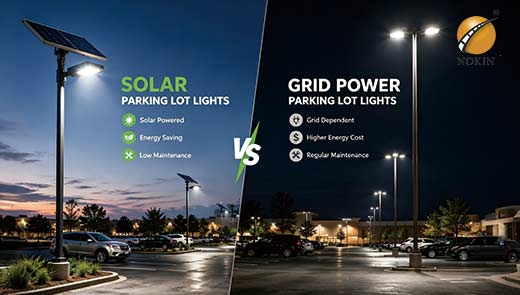
Solar parking lot lights are an independent system: during the day, solar panels generate electricity and store it in batteries, and at night, the batteries power LED lights for illumination. The entire system does not rely on the public power grid.
How Does Grid-Powered Parking Lot Lighting Work?
Grid-powered parking lot lighting directly takes power from the public grid and transmits it to the LED lights on each pole through underground cables, conduit pipes, and distribution boxes.
What Is the Main Difference Between Solar and Grid Parking Lot Lights?
The most fundamental difference between the two lies in: the core advantage of the grid system is continuous and stable external power supply, while the core advantage of the solar system is self-sufficiency in energy, zero electricity costs, and flexible deployment.
Which Has a Lower Initial Cost: Solar Parking Lot Lights or Grid Power?
Why Does the Purchase Price of Grid Lights Seem Cheaper?
If only comparing the purchase price of individual lights, grid LED lights are usually cheaper - it does not require solar panels and batteries, and the system structure is simpler.
But comparing fixture price is prone to incorrect judgment because the true project cost also includes hidden costs such as trenching, conduit, wiring, labor, and utility coordination.
Why Is the Equipment Cost of Solar Parking Lot Lights Higher?
A complete set of solar parking lot lights includes solar panels, batteries, controllers, LED lights, installation structure, and poles, so the equipment-level upfront cost is usually higher. The equipment purchase price of the solar system is often 50% to 200% higher than that of the same power LED lights with grid power.
Why Can Solar Parking Lot Installation Cost Less?
The key insight is: Fixture Cost ≠ Total Project Cost.
A grid lighting project may require: earthwork excavation, trenching, underground cables, conduit pipes, distribution boxes, electrical contractors, power company connection, permits and inspections. In new parking lots or remote sites, these infrastructure costs may far exceed the lights themselves.
The solar system can reduce or avoid these costs - each pole light operates independently and does not require long-distance underground cables and complex distribution networks. In sites with high trenching costs and difficult power access, the total installation cost of the solar system is often lower than that of the grid system.
Which Has a Lower 5-Year Total Cost of Ownership (TCO)?
What Does Total Cost of Ownership (TCO) Include?
The basic formula for total cost of ownership is:
TCO = Equipment + Installation + Electricity + Maintenance + Replacement
A 5-year comparison is conducted from dimensions such as fixture, pole, trenching, electrical labor, utility connection, electricity, and maintenance.
What Are the Long-Term Costs of Grid-Powered Parking Lot Lights?
The long-term operating cost of the grid-connected parking lot includes: continuous electricity bills, wiring maintenance, electrical equipment repair, light replacement, and potential infrastructure upgrades.
Taking the United States as an example, the average retail electricity price for commercial users in the US in 2025 is approximately 13.41¢/kWh, but there are significant differences between states - from less than 10¢/kWh in some states to over 30¢/kWh in Hawaii. The actual ROI must be calculated using the electricity price in the location of the project.
What Are the Long-Term Costs of Solar Parking Lot Lights?
The long-term cost of the solar system mainly includes battery replacement (usually 5-10 years), solar panel cleaning and inspection, and regular maintenance of LED and controllers. However, it usually does not require continuous payment of grid electricity bills, which is the core of its long-term cost advantage.
Solar Parking Lot Lights vs. Grid Power: 5-Year Cost Comparison Example
Here is a 5-year cost calculation case to make the comparison more specific and verifiable.
|
Parameter |
Value |
|
Number of light Poles |
10 |
|
LED Power per Pole |
100 W |
|
Operating Time per Night |
12 hours |
|
Annual Operating Days |
365 days |
|
Evaluation Period |
5 years |
|
Average U.S. Commercial Electricity Price (2025) |
$0.1341/kWh |
Grid system annual electricity bill calculation:
100W × 10 poles × 12 hours × 365 days = 438,000 Wh = 4,380 kWh/year
4,380 kWh × $0.1341/kWh ≈ $587/year
Total 5-year electricity bill: $587 × 5 ≈ $2,935
Please note that this $2,935 is only the electricity bill and does not include trenching construction, wiring materials and labor, electrical contractor fees, daily maintenance, and light replacement. If these are included, the 5-year TCO of the grid system will be significantly higher than this figure.
What Factors Affect the Payback Period?
The above calculation uses the average commercial electricity price in the US in 2025 as an example, and does not represent the actual electricity price in all regions. In regions with higher electricity prices (such as California, New York, and Hawaii), the electricity expenditure will be much higher than this example.
Payback depends on electricity rates, solar resource, system price, installation conditions and operating hours. The economic viability of solar projects is highly dependent on infrastructure conditions and local resources.
Can Solar Parking Lot Lights Really Reduce Electricity Bills?
The energy path of off-grid solar parking lot lights is: solar panels → battery → LED. The entire system does not directly draw power from the public grid, so there will be no electricity bill based on electricity consumption. Pure off-grid solar lighting has zero grid electricity expenses during operation. The grid electricity cost for the system during the operation phase is zero.
How Do Motion Sensors and Dimming Improve Solar Lighting Efficiency?
For solar systems that already have zero electricity bills, the core value of motion sensor and dimming is not "saving money", but optimizing the way solar energy is used: dimming during low-flow periods (down to 30%-50% brightness), and increasing to full power when vehicles or pedestrians are detected. This can reduce nighttime energy consumption by 40%-60%, extend battery life, and provide more autonomous operation days in consecutive rainy days.
Is Solar Parking Lot Lighting Easier to Install Than Grid Lighting?
What Is Required to Install Grid-Powered Parking Lot Lights?
The installation of electric lighting for mains power usually involves site survey, trenching, laying conduit and cables, electrical connections, installation of light posts and lights. In hardened parking lots, cutting the road surface and restoring the ground will significantly increase costs and construction time. However, if the parking lot already has a complete power infrastructure (conduit, distribution box, and wiring), this disadvantage will be significantly reduced.
What Is Required to Install Solar Parking Lot Lights?
The installation of solar lighting usually does not require long-distance underground cables or coordinating the connection point with the power company. Each light pole operates independently and is ready to use immediately. In sites that need to build new electrical infrastructure, the installation cycle of the solar system is usually shorter.
Which Parking Lots Are Suitable for Solar Lighting?
- New parking lots: No need to lay complex underground cables
- Remote parking areas: The cost of grid connection may be very high
- Expansion/overflow parking lots: Avoiding large-scale expansion of power infrastructure for a small number of new lightposts
- Areas with high trenching costs: Rock geology, hardened pavement, historical protection areas, etc.
- Areas without existing grid connection: Completely off-grid sites
- Campus, warehouse sites, industrial facilities: Distributed lighting can reduce the load on the distribution system
Which Has Better Lighting Performance: Solar or Grid Parking Lot Lights?
Power source does not determine lighting quality by itself. What truly determines the lighting effect is luminous flux, optical design, beam angle, pole height and spacing, uniformity, glare control and photometric design, rather than the energy source.
Why Is Photometric Design More Important Than Wattage?
Don't ask "Is 200W better than 150W?" Instead, you should ask: Does the lighting layout provide the required illuminance and uniformity? Power only reflects energy consumption, not directly the lighting effect. The IES RP-8-25 standard emphasizes determining the light layout through professional photometric calculations rather than simply comparing power figures.
How Can You Avoid Dark Spots in Parking Lots?
Avoiding dark areas requires comprehensive consideration of pole spacing, beam distribution (Type III/IV/V optics), installation height, and verifying the layout rationality through photometric simulation before construction. Parking lots need to achieve uniform lighting through optics, pole height, spacing and photometric design.
When Is Grid Power Better for Parking Lot Lighting?
When Existing Grid Infrastructure Makes Grid Lighting More Competitive
If the site already has conduit pipes, distribution boxes, wiring and convenient power access, the installation cost of Grid LED may be very competitive - adding or replacing lights only requires connecting to the existing system, without the need for large-scale civil construction.
When Continuous High-Power Lighting Is Required
24-hour high-security parking lots, large logistics facilities, high-traffic areas, etc., require full-power lighting around the clock. The continuous power supply capacity of Grid may be more suitable. Solar systems need to support long-term high-power output, which requires larger solar panels and battery packs, resulting in a significant increase in equipment costs.
When Severe Shading Limits Solar Panel Performance
High-rise buildings, trees, dense urban environments, etc., where Solar access is insufficient, the daily average power generation of solar panels decreases, requiring a larger battery capacity to compensate, and the equipment cost and design difficulty will increase.
When Are Solar Parking Lot Lights More Advantageous?
- New parking lots: No need to lay complex underground cables for lighting
- Remote parking areas: High costs for long-distance grid access
- Expansion parking lots: Avoiding large-scale expansion of electrical systems for a small number of poles
- Commercial properties requiring reduced long-term OPEX: retail centers, hotels, schools, hospitals, warehouses, industrial parks, office parks
- Areas prone to power outages: Solar systems with sufficient battery autonomy can reduce reliance on grid power outages
How Do Solar Parking Lot Lights Compare in Maintenance Costs?
Solar system maintenance includes: solar panel cleaning, battery health check, controller check, LED check and pole foundation check. Maintenance of the power supply system includes: LED lights, electrical wiring, conduit pipes, junction boxes, distribution boxes and public power infrastructure.
What needs to be focused on is the system lifecycle rather than the single maintenance cost. Efficient LED lighting not only reduces energy costs but also lowers maintenance costs due to a longer service life. Solar reduces some infrastructure-related maintenance, but batteries and solar components still require periodic inspection and eventual replacement.
Do Solar Parking Lot Lights Work on Cloudy Days and During Continuous Rain?
The design of the solar system needs to comprehensively consider solar irradiance, panel efficiency, battery capacity, nighttime operation time, weather conditions and seasonal changes. The solar power assembly needs to be configured based on the light power, operation time and local solar resources.
How Can Solar Parking Lot Lights Improve Reliability During Continuous Rain?
- Larger battery capacity (Larger Battery Capacity)
- High-Efficiency PV Panels (High-Efficiency PV Panels)
- Appropriate Lighting Schedule (Appropriate Lighting Schedule)
- Adaptive Dimming (Adaptive Dimming)
- Motion Sensors (Motion Sensors)
- Adequate Autonomy Days (usually reserved for 3-5 days)
- Proper Solar Orientation (Proper Solar Orientation)
If the project requires high output, long-term operation and limited solar exposure on the site, Grid power may be a more reliable option.
How Do You Calculate the Payback Period of Solar Parking Lot Lights?
Payback Period = Additional Initial Investment ÷ Annual Operating Cost Savings
Among them: Annual Savings = Grid Electricity Savings + Infrastructure Savings + Maintenance Savings
The ROI of Solar cannot be determined solely by the purchase price of the lights. The additional initial investment refers to the equipment price difference between the solar system and the grid power system, while the annual savings need to be calculated comprehensively across electricity costs, infrastructure, and maintenance.
What Factors Affect the Payback Period of Solar Parking Lot Lights?
|
Factor |
Effect on ROI |
|
Electricity Rate |
Higher electricity rates mean a faster return on investment. |
|
Number of Light Poles |
More light poles create a stronger scale effect and can increase overall savings. |
|
Nightly Operating Hours |
Longer operating hours result in greater electricity savings. |
|
Trenching Distance |
Longer trenching distances increase the installation cost of grid-powered lighting systems. |
|
Local Solar Resource |
Greater solar availability allows for a more economical solar system configuration. |
|
System Cost and Installation Cost |
Lower system and installation costs lead to a faster return on investment. |
Solar Parking Lot Lights vs. Grid Power: Comparison Table
|
Comparison Dimension |
Solar Parking Lot Lights |
Grid-Powered LED Lights |
|
Initial light Cost |
Higher |
Lower |
|
Installation Cost |
Usually lower when trenching is difficult |
May be higher |
|
Electricity Cost |
Extremely low grid electricity cost |
Continuous electricity consumption |
|
Trenching Construction |
Usually not required |
Usually required |
|
Wiring Requirements |
Minimal |
Required |
|
Power Outage Performance |
Battery can support continued operation |
No backup power; operation may be affected |
|
Maintenance Requirements |
Battery + solar panel + LED |
Electrical system + LED |
|
Remote Areas |
Excellent |
Challenging |
|
Existing Grid Infrastructure |
Financial advantage is smaller |
Significant advantage |
|
Shaded Areas |
May have limitations |
Better choice |
|
Long-Term Operating Costs (OPEX) |
Low |
High |
|
Deployment Speed |
Usually faster |
Slower when new wiring is required |
|
Best Applications |
Remote, new construction, and expansion parking lots |
Existing grid-connected parking lots |
How to Choose Between Solar Parking Lot Lights and Grid Power
Step 1 — Does the Parking Lot Already Have Grid Power?
Existing grid → Compare the retrofit costs. Grid power may be more competitive.
No grid → Solar becomes more attractive. It avoids the high costs associated with grid connection.
Step 2 — Is Trenching Expensive?
Excavating trenches is expensive → The solar advantage is obvious.
Excavating trenches is cost-effective → The grid remains competitive, and the infrastructure costs will not significantly increase the total price.
Step 3 — Does the Site Receive Sufficient Sunlight?
Abundant sunlight → Solar option.
Insufficient sunlight → Consider Grid or Hybrid systems. Pure solar energy might require an excessively large battery configuration.
Step 4 — What Is the Required Nightly Runtime?
Regular nighttime operation (approximately 8-12 hours) → Solar can meet this requirement.
Extremely high continuous output demand → The grid might be better, and the costs of solar system's batteries and panels will significantly increase.
Step 5 — Compare 5–10 Year Total Cost of Ownership
The final decision should not be based on the unit price, but rather compared as follows: Initial Cost + Installation + Energy + Maintenance + Replacement.
Which Is More Worthy of Investment: Solar Parking Lot Lights or Grid Power?
Solar is more suitable for: new parking lots, remote areas, expansion areas, projects with high trenching costs, areas with good sunlight, projects that prioritize reducing operating costs, and areas with unstable power grids.
The Grid is more suitable for: existing electrical infrastructure, dense urban areas, severely shaded locations, high-output applications, and continuous high-load lighting demands.
Solar parking lot lights are not inherently cheaper than grid power. Only when electricity costs, trenching, wiring, labor for installation, and long-term maintenance are included in the total ownership cost will solar become financially attractive.
FAQ: Solar Parking Lot Lights vs. Grid Power
Are Solar Parking Lot Lights Cheaper Than Grid-Powered Lights?
Not necessarily. At the equipment level, the initial cost of solar lights is usually higher. However, when the costs of trenching, wiring, and the connection with the power company are high, the total cost of the solar system project may be lower.
How Long Does It Take for Solar Parking Lot Lights to Pay for Themselves?
The payback period varies depending on the project. Factors such as electricity prices, installation conditions, the number of lights, solar resources, and system costs should all be taken into consideration. The case of Hykoont shows that some projects can pay back the investment within 2 to 3.3 years, but this is only an example under specific conditions and should not be regarded as a universal standard in the industry.
Do Solar Parking Lot Lights Work During Power Outages?
Yes. Off-grid solar parking lights can continue to operate by relying on the stored battery energy, provided that the system has sufficient battery capacity and is properly designed.
Are Solar Parking Lot Lights Suitable for Large Commercial Parking Lots?
Yes, provided that the system has been professionally designed based on the required illumination level, the distance between light poles, solar resources, battery capacity, and the operation schedule.
Are Solar Parking Lot Lights Suitable for Large Commercial Parking Lots?
There is no universal answer. The choice should be based on the existing infrastructure, trenching costs, sunlight conditions, required lighting output, operating time and long-term TCO (Total Cost of Ownership) in a comprehensive assessment.
Conclusion
Grid-powered lighting usually wins on simplicity when electrical infrastructure already exists. Solar parking lot lights become increasingly attractive when trenching, wiring, utility connection and long-term electricity costs are significant.
The final decision should be based on: Site Conditions + Lighting Requirements + Installation Cost + Electricity Cost + Maintenance + 5-10 Year Total Cost of Ownership, rather than simply comparing the prices of Solar Lights vs. Grid Lights.