What are the causes of solar LED street lighting decay?
Dec 15, 2025
Solar LED street lights have become the mainstream choice for urban and rural lighting due to the core advantages of energy-efficient LEDs, their eco-friendly attributes, and low maintenance requirements. However, many users report that outdoor LED street lights gradually lose brightness over time—a phenomenon known as “lumen depreciation.” Lumen depreciation not only compromises lighting effectiveness but also shortens the operational lifespan of LED street lights. This article will thoroughly dissect the core causes of lumen depreciation in solar LED street lights and provide targeted solutions to help industry practitioners and procurement parties precisely mitigate risks.
LED chip quality and aging
The LED chip serves as the light-emitting core of solar LED street lights. Its quality directly determines the rate of lumen depreciation and is the most critical influencing factor.
Low-quality chips
Substandard LED chips often suffer from insufficient semiconductor material purity and uneven crystal structures. This leads to unstable current conduction, impairing the luminaire's light output efficiency. Additionally, subpar packaging processes can cause poor contact between the chip and external circuits, resulting in localized overheating that further compromises the core performance of low-light-decay LED street lights. Moreover, such chips generally exhibit poor heat resistance. Rapid internal energy accumulation during operation accelerates PN junction aging, causing a gradual decline in light output efficiency.
Natural aging patterns of high-quality chips
Even high-quality chips meeting industry standards will experience natural aging over extended use—an unavoidable industry phenomenon. Industry data indicates the following light decay patterns for standard LED chips:
|
Operating Time (Hours) |
Lumen Maintenance |
Lumen Depreciation |
|
10,000 |
Approx. 90% |
10% |
|
30,000 |
Approx. 80% |
20% |
|
50,000 |
Approx. 70% |
30% |
External factors accelerating chip aging
Beyond natural aging, external environments and usage patterns can accelerate chip deterioration. Prolonged overload operation is a common culprit, where operating currents exceed rated values, overburdening the chips. Harsh conditions like high temperatures and humidity directly corrode chips, accelerating aging by 2-3 times—particularly affecting solar street lights in coastal regions. Furthermore, extreme voltage surges caused by power supply fluctuations can inflict irreversible damage on chips, accelerating light decay.
Inadequate heat dissipation design
LED chips have limited energy conversion efficiency, converting only 20%-30% of electrical energy into light energy, while the remaining 70%-80% is released as heat. If heat cannot dissipate promptly, the chip junction temperature will rise sharply, directly accelerating the light decay process of solar street lights with efficient heat dissipation.
Inappropriate choice of heat dissipation materials
The quality of heat dissipation materials directly impacts cooling effectiveness. To control costs, some products use materials with low thermal conductivity, such as ordinary plastics or inferior aluminum alloys, significantly reducing heat transfer efficiency. Luminaires lacking high-efficiency thermal materials like graphene or thermally conductive ceramics cannot rapidly dissipate heat generated by the chip. This leads to heat accumulation, failing to meet the thermal management demands of high-protection solar street lights.
Unreasonable thermal structure design
Defects in thermal structure design are another major cause of insufficient heat dissipation. For instance, openings in the luminaire housing that are too small or obstructed can block heat dissipation pathways, preventing hot air from escaping smoothly. Inadequate contact between the chip and heat sink, resulting in insufficient contact area, impedes heat transfer pathways. Additionally, the absence of auxiliary thermal materials like thermal grease or thermal pads increases thermal resistance, further compromising heat dissipation efficiency. This is a critical consideration during the selection process for municipal solar street lights.
Compounding effects of ambient temperature
Outdoor street lights endure prolonged exposure to natural environments where summer temperatures can exceed 40°C, inherently straining heat dissipation. Certain poorly designed enclosed luminaires trap internal temperatures 15-25°C higher than ambient levels, further elevating chip junction temperatures. This accelerates chip aging and light decay, significantly shortening the lifespan of street lights in high-temperature environments.
Unstable solar power supply systems
Battery degradation and capacity deficiencies
Battery aging and insufficient capacity are common causes of power supply instability. Battery performance degradation manifests as increased internal resistance, reduced charge/discharge cycle efficiency, actual capacity falling below rated capacity, and significantly shortened endurance—failing to provide stable power to LED fixtures.
This unstable power supply directly and significantly impacts light decay. When battery voltage falls below the LED's rated value, LEDs operate at low current, causing immediate brightness reduction. Excessive voltage fluctuations may damage LED driver circuits, resulting in permanent light decay. Insufficient battery charging keeps the system in a prolonged low-power state, further degrading power stability and creating a vicious cycle—a problem particularly pronounced in solar street lights in remote areas.
Solar panel efficiency degradation
Solar panel efficiency degradation directly impacts power generation capacity, subsequently triggering light decay. External contamination is a major cause of efficiency loss. Accumulation of dust, bird droppings, leaves, and other debris on solar panel surfaces can reduce light transmittance by 10%-30%. Salt spray corrosion in coastal areas and dust accumulation in industrial zones further block light, impairing power generation efficiency and significantly affecting the power supply stability of industrial area street lights.
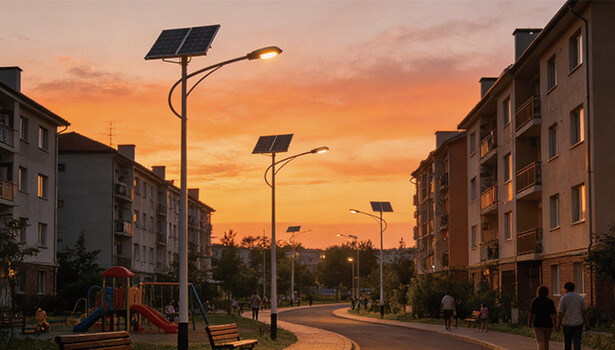
Simultaneously, internal component aging contributes to efficiency loss. Photovoltaic cells degrade annually, reducing conversion efficiency by 0.5%-1% per year. Aging junction boxes and cables increase contact resistance, heightening electrical energy loss. Scratches on tempered glass surfaces impair light transmission performance.
Poor performance of LED drivers
LED drivers are a critical component of power supply systems. Low-quality drivers exhibit numerous issues, such as poor voltage and current regulation accuracy, with current fluctuations exceeding ±3%, failing to provide stable current to LEDs. Low conversion efficiency results in partial electrical energy being converted into heat, exacerbating luminaire overheating.
These issues directly impact LED lumen depreciation. Unstable current reduces LED chip luminous efficiency, while prolonged overcurrent operation accelerates chip aging. Driver failure may cause LEDs to extinguish or experience sudden brightness drops—making voltage and current regulation a core consideration in street light selection.
Environmental factors and improper installation
The impact of external environments and installation standards on light decay is often overlooked, yet it directly affects the lifespan of various street light applications, including corrosion-resistant solar street lights.
Humidity and corrosion
Humidity and corrosion represent major environmental challenges for outdoor street lights. High humidity environments cause internal condensation within fixtures, which corrodes LED chip encapsulation and degrades chip performance. Water ingress into the driver circuit may cause short circuits or component corrosion, triggering failures. Poorly sealed fixtures allow moisture to penetrate core components more easily, exacerbating damage.
Corrosion risks vary by environment. Coastal salt spray corrodes metal parts and circuits of LED street lights, accelerating equipment aging—a critical protection concern for solar lights in coastal areas. Acidic or alkaline gases in industrial zones erode encapsulation materials, reducing light transmission. In rainy regions, prolonged humidity can cause internal components to mold, compromising overall performance.
Dust accumulation and light blockage
The impact of dust accumulation and light blockage on lumen depreciation cannot be overlooked. Dust buildup on the lens surface directly obstructs light emission, reducing brightness by 5%-15%. Dust on heat sinks impairs heat dissipation, raising chip junction temperatures and accelerating light decay. Dust accumulation on solar panels reduces power generation efficiency, leading to insufficient power supply and consequently diminished LED brightness.
This creates a vicious cycle of “brightness decline - insufficient power generation.” In specific scenarios, dust issues become more pronounced. For instance, in remote areas or with high-mast street lights, infrequent cleaning allows dust to accumulate over extended periods. In windy and dusty regions, street lights can accumulate significant dust in a short time, rapidly impacting luminaire performance.
Unreasonable installation angle
For solar panels, failure to adjust the optimal tilt angle according to local latitude can reduce annual power generation by 10%-20%. Severe shading at the installation site (e.g., from trees or buildings) shortens sunlight exposure time. Incorrect panel orientation—failing to face directly toward the sun—also impacts power generation efficiency. These factors collectively cause insufficient power supply, affecting LED brightness, with particularly noticeable impacts on lighting effectiveness for urban main road lamps.
For LED fixtures, installation at excessively low heights increases vulnerability to collisions from pedestrians or vehicles, damaging the lens and impairing light transmission. Angled fixtures may cause light to be blocked by surrounding objects, leading users to mistakenly attribute this to light decay. Additionally, wiring errors during installation can cause abnormal driver loads, directly affecting LED operating conditions and accelerating light decay.
How to mitigate light decay in solar LED street lights?
Optimize high-quality core components
Controlling quality at the source is key to delaying light decay. Selecting LED chips with a Color Rendering Index (CRI) ≥70 and luminous efficacy ≥130 lm/W ensures luminous efficiency and stability. Choosing solar panels with conversion efficiency ≥18% and a warranty period of no less than 10 years reduces the impact of efficiency decay. Selecting high-efficiency drivers with voltage/current regulation accuracy within ±1% provides stable power to LEDs, preventing current fluctuations that cause light decay. This is a core criterion for selecting low-light-decay solar LED street lights.
Enhance heat dissipation design standards
Heat dissipation optimization requires addressing both material and structural aspects. Prioritize luminaires made from highly efficient thermal materials like aluminum alloy and graphene to ensure rapid heat removal. Simultaneously, guarantee unobstructed heat dissipation pathways, increase the contact area between the chip and heat sink, and ensure tight bonding. Outdoor luminaires must incorporate adequate ventilation gaps, avoiding sealed designs to mitigate the effects of excessive internal temperatures, thereby meeting the operational requirements for high-efficiency solar street lights.
Regular cleaning and inspection
Routine maintenance is crucial for slowing light decay. It is recommended to clean dust and debris from the solar panel and lampshade surfaces every 3-6 months to ensure the light transmission and light absorption efficiency of solar street lights. Annually inspect battery condition and promptly replace any batteries with capacity degradation exceeding 30% to prevent power supply instability. Regularly check wiring terminals to prevent loosening or oxidation, ensuring stable circuit connections—particularly vital for long-term reliable operation of solar street lights in remote areas.
Enhanced protection performance
Select appropriate fixtures based on the operating environment. Coastal and high-humidity areas require solar street lights with a protection rating ≥IP67 to enhance waterproofing and moisture resistance. Industrial zone fixtures require additional anti-corrosion coatings to improve weather resistance and withstand acid/alkali gas erosion, adapting to industrial lighting environments. Outdoor fixtures should uniformly use UV-resistant, anti-aging encapsulation adhesives and lens materials to reduce environmental damage to auxiliary components, prevent “false light decay,” and meet UV-resistant lighting requirements.
Light decay in solar LED street lights results from multiple factors including chip quality, thermal design, power supply systems, and environmental installation. Comprehensive control is required throughout selection, design, and maintenance. By optimizing core components, enhancing thermal protection, standardizing installation, and implementing regular maintenance, the light decay process can be effectively slowed, extending the luminaire's lifespan. This not only ensures stable lighting performance but also reduces long-term operational costs, providing a sustainable solution for urban and rural outdoor lighting.