What to Expect From Commercial LED Street Light Longevity
Dec 17, 2025
For municipal departments and commercial property managers, street lights are not only a vital component of urban infrastructure but also directly impact operational cost control and public safety. Frequent fixture replacements, high maintenance costs, and safety hazards caused by sudden lighting failures have long been persistent pain points with traditional street lights. The advent of commercial LED street lights has fundamentally redefined longevity standards in the industry. This article comprehensively analyzes the expected lifespan of commercial LED street lights, their core differences from traditional fixtures, key factors affecting longevity, and actionable strategies for extending lifespan—providing professional guidance for procurement and operational decisions.
How Long Do Commercial LED Street Lights Last?
Basic Lifespan Data
Commercial LED street lights boast a rated lifespan of up to 50,000 hours—significantly exceeding traditional lighting technologies. Based on an average daily operation of 12 hours, 50,000 hours equates to approximately 11.5 years of continuous use. Even under high-load scenarios (16 hours daily), the lifespan reaches 8.6 years.
Unique Advantages
Unlike traditional fixtures that fail abruptly (“sudden burnout”), LED street lights gradually dim over time rather than extinguishing instantly. This characteristic effectively prevents localized lighting interruptions caused by single-lamp failures, ensuring continuous and reliable road illumination. This makes them particularly suitable for high-safety-demand scenarios like urban main roads and commercial complexes.
Lifespan Adaptation in Practical Applications
Actual lifespan performance varies across different application scenarios. Municipal roads operating 10-12 hours daily can achieve stable lifespans exceeding 10 years. Commercial complexes/parking lots operating 16-18 hours daily typically last 8-9 years. Even in extreme environments like high temperatures, humidity, or dust, proper maintenance can extend LED street light lifespans to 6-8 years.
LED vs Traditional Commercial Street Light Lifespan Comparison
Commercial LED Street Lights
Commercial LED street lights boast a lifespan of up to 50,000 hours. Their primary disadvantage is a slightly higher initial purchase cost. They exhibit no significant limitations in applicable scenarios and can be widely adapted to most lighting environments, including municipal roads, commercial complexes, and parking lots.
High-Pressure Sodium Lamps (HPS)
High-pressure sodium lamps have a lifespan of approximately 25,000 hours. They suffer from slow start-up times, require ballasts or transformers to regulate current, and carry a risk of sudden burnout failures. They are better suited for secondary roads with no start-up speed requirements and struggle to meet the efficient lighting demands of core areas.
Fluorescent Lamps / Compact Fluorescent Lamps (CFL)
Fluorescent and compact fluorescent lamps have a lifespan of approximately 10,000 hours. Their performance degrades significantly in low-temperature or windy environments, with brightness declining midway through their lifespan. Some models require additional independent ballasts. They are only suitable for secondary lighting in indoor parking lots or warm climates and cannot withstand complex outdoor environments.
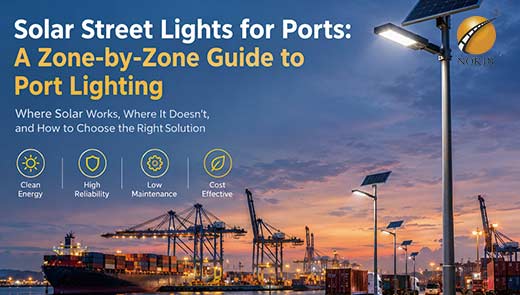
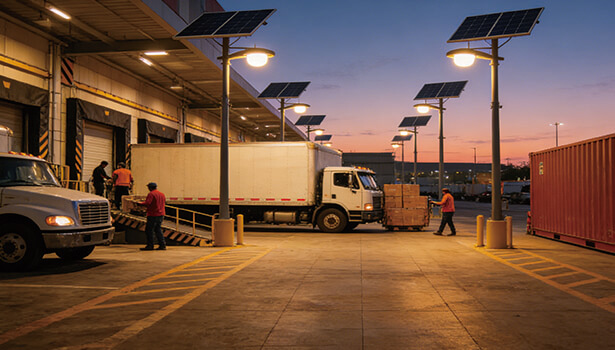
Solar Street Lights
Solar street lights boast an exceptionally long lifespan of 20,000-30,000 hours, offering far greater durability than traditional lighting equipment. Powered by clean, environmentally friendly solar energy, they eliminate the need for complex cable installations. Their storage batteries require only periodic maintenance and replacement every 3-5 years, ensuring simple and convenient daily operation and maintenance.
Solar street lights safeguard nighttime travel in remote areas. Even in densely populated urban cores, they deliver exceptional energy-saving illumination when paired with optimized lighting solutions, making them an excellent choice balancing environmental benefits and practical performance.
Core Factors Affecting Commercial LED Street Light Lifespan
Component Quality
The lifespan of LED street lights is determined by the quality of their core components. High-quality LED chips exhibit slower light decay rates, ensuring long-term brightness stability. Inferior chips, however, experience noticeable brightness reduction within a short period, directly shortening the luminaire's lifespan. A stable driver power supply prevents voltage fluctuations from damaging the chips. Poor-quality drivers can reduce lifespan by over 30% and even cause circuit failures.
Housing materials with excellent thermal conductivity, such as aluminum alloy, effectively reduce operating temperatures, further extending overall component lifespan. Poorly heat-dissipating materials keep chips in prolonged high-temperature conditions, accelerating aging and failure.
Usage Patterns
The Role of Smart Control
By adjusting brightness based on traffic flow and time periods (e.g., automatically dimming by 30% during late night hours), the smart lighting system not only conserves energy but also reduces thermal stress on LED chips, effectively extending their lifespan by 15-20%.
The smart control system also monitors fixture operation in real time, promptly alerting to issues like abnormal voltage or excessive temperature. This prevents lifespan degradation from unaddressed faults, making it particularly suitable for urban thoroughfares and commercial complexes with fluctuating traffic volumes. It achieves dual objectives: meeting lighting demands while protecting product longevity.
Impact of Operating Mode
LED fixtures operate more efficiently and generate lower thermal loads during short, frequent on/off cycles. Compared to continuous 24-hour operation, intermittent operation (e.g., sensor-activated lighting in underground garages) can extend LED street light lifespan by approximately 25%. This occurs because continuous operation keeps chips and drivers under sustained high stress, causing heat accumulation that accelerates component aging. Intermittent operation allows components to dissipate heat fully during shutdown periods, maintaining stable performance. This mode offers significant advantages in areas with non-continuous dense traffic or pedestrian flow.
Best Practices for Extending Commercial LED Street Light Lifespan
Routine Inspection and Cleaning
LED street lights on urban thoroughfares should be cleaned every 6 months to prevent dust and exhaust particle buildup. These contaminants adhere to lampshade surfaces, reducing light transmission, and can clog ventilation holes, causing internal temperature increases. Coastal areas affected by salt spray require cleaning every 3 months. Salt spray is corrosive, eroding lamp housings and wiring terminals, leading to poor contact or housing damage. In industrial zones with high dust and chemical exposure, cleaning intervals should be shortened to every 2 months. This reduces buildup of sulfides, dust, and other harmful substances that corrode optical components and circuitry.
Electrical Connection Maintenance
Regularly inspect LED street light terminals for looseness or corrosion, tightening them quarterly. Loose terminals increase contact resistance, causing localized overheating that damages drivers and chips. After rainfall, prioritize inspecting the sealing integrity of outdoor junction boxes to prevent water ingress causing short circuits. Sealing gaskets in junction boxes require periodic replacement; aged gaskets lose waterproofing effectiveness and can trigger circuit failures. If aging or damaged cables are detected, replace them promptly to prevent unstable current from damaging the driver power supply. When replacing cables, select weather-resistant models suitable for complex outdoor climatic conditions.
Professional Training for Maintenance Personnel
Conduct specialized LED technology training to ensure maintenance staff fully understand the structure and key maintenance points of LED fixtures. They must grasp the working principles of drivers, chips, and heat dissipation systems to prevent damage from improper operation. Guide personnel to avoid common mistakes, such as arbitrarily replacing non-matched drivers or using corrosive cleaning agents during maintenance. Non-matched drivers with incompatible voltage/current parameters can directly burn out chips and shorten fixture lifespan.
Equip maintenance teams with professional diagnostic tools (e.g., luminance meters, voltage testers) to enhance maintenance precision. These tools enable rapid fault localization, reducing troubleshooting time and maintenance costs while identifying potential issues early to prevent minor faults from escalating.
Commercial LED street lights, with a lifespan of up to 50,000 hours and stable performance, represent the optimal choice for municipal and commercial lighting. Selecting premium components, implementing intelligent control systems, and adhering to standardized maintenance protocols can further extend their lifespan, maximizing return on investment. For municipal departments and commercial property managers prioritizing cost-effectiveness, safety, reliability, and sustainability, prioritizing commercial LED street lights and executing scientifically sound operation and maintenance plans are critical decisions for enhancing lighting quality and reducing long-term costs.