How Long Can a Solar Parking Lot Light Last?
Aug 20, 2026
Many parking project purchasers are most concerned about the core issue: How long can the solar parking lights in the parking lots last? Can they cover the long-term operating costs of the parking lot and reduce the frequent replacement of labor and material expenses?
The industry standard answer is: The lifespan of a commercial parking lot solar light is 10–15 years. But this figure is misleading and cannot be determined solely by the lifespan of the entire light.
Parking lot solar lights are not a single component device, but are composed of four core components. The lifespan of each component varies greatly. The actual lifespan of the entire light and the replacement rhythm are completely determined by the component with the shortest lifespan.
The priority ranking of the four components' lifespans: Solar panel (20–25 years) > LED light beads (10–15 years) > Controller (8–10 years) > Lithium battery (5–8 years).
In simple terms, the battery is the weakest link in the entire light's lifespan and is the only core component that needs to be replaced in the middle of its use cycle.
Solar Parking Lot Light Lifespan: How Long Do the Four Core Components Last?
To facilitate the purchasing party of parking lot solar lights to quickly compare and select and calculate the later operation and maintenance costs, the following has been sorted out: the lifespan, determination criteria and replacement cost details of the four core components of parking lot solar lights. The data is in line with the commercial project market benchmark.
|
Core Component |
Service Life |
Key Lifespan Determination Indicators |
One-Time Replacement Cost |
|
Solar Panel |
20–25 years |
Output power attenuation to 80% of the initial value reaches the lifespan limit. Mainstream brands generally provide full warranty coverage, so self-funded replacement is basically not required. |
Usually no replacement |
|
LED light Bead Module |
10–15 years |
Based on international IES TM-21 and IEC 62717 standards, with L70 as the determination criterion. Brightness attenuation to 70% of the initial value indicates the effective lifespan, typically 50,000–100,000 hours. |
$200–$400 |
|
Smart Controller |
8–10 years |
Core protection functions such as overcharge, overdischarge, and short-circuit protection fail, or equipment control accuracy decreases significantly. |
$50–$150 |
|
LiFePO4 (Lithium Iron Phosphate) Battery |
5–8 years |
After completing 2,000–3,000 charge-discharge cycles, capacity attenuates to below 80% of the initial value and can no longer meet nighttime lighting requirements. |
About $600 |
What Is L70 LED Lifespan in Solar Parking Lot Lights?
Many novice purchasers are prone to fall into a misunderstanding: They think that LED light beads will completely break down and stop lighting when they reach the marked lifespan. This is not the case.
L70 is a common lifespan determination standard in the outdoor lighting industry, referring to the brightness attenuation to 70% of the initial value, not the complete failure of the light.
After reaching the L70 standard, the light can still light normally, but the brightness and lighting uniformity will decrease. For parking lots that require stable illumination and ensure driving safety, at this time, it is necessary to replace the light bead module to avoid lighting not meeting the standards and causing safety hazards. Not understanding this standard can easily be avoided by merchants as "the light is not damaged" to evade warranty responsibilities.
Solar Parking Lot Light Battery Lifespan: Why Is the Battery the Weakest Component?
From the parameters, the lifespan of the solar panel, LED light beads, and controller can all support 10 years or more of use, but only the battery needs to be replaced after 5–8 years, which is not a quality issue, but determined by the parking lot's usage scenario and the battery's cycling characteristics.
How Long Does a Solar Parking Lot Light Battery Last?
Parking lot lighting is mostly a continuous working mode at night, with a stable operation pattern, and can accurately calculate the battery cycling loss.
Conventional parking lot lighting: Each night lasts for 12 hours, with no interruption throughout the year. It seems to work for a long time every day, but in fact, it only completes one full charge-discharge cycle.
The standard cycle life of the battery is approximately 2500 times. Considering the frequency of daily use: 2500 cycles ÷ 365 times/year ≈ 6.8 years.
This is the core basis for the industry to uniformly set the service life of lithium iron phosphate batteries at 5–8 years, which perfectly aligns with the actual usage scenarios of commercial parking lots.
What Causes Solar Parking Lot Light Batteries to Fail Early?
Under normal operating conditions, the battery can have an approximate lifespan of 8 years. In most projects, the batteries age prematurely and fail after 3–5 years, both of which are influenced by environmental factors.
High Temperature and Solar Light Battery Degradation
Outdoor parking lots have no shading, and continuous exposure to high summer temperatures will continuously raise the temperature inside the battery compartment. Industry real data shows that for every 10°C increase in working temperature, the overall lifespan is directly halved. High temperature is the core factor causing the fastest battery degradation.
Deep Discharge and Excessive Depth of Discharge (DOD)
If the controller parameters are set improperly, if the battery discharges at a depth exceeding 80%, it will significantly increase cell loss, directly shorten the number of charge and discharge cycles, and lead to the premature scrapping of the battery.
Continuous Rainy Days and Battery Cycle Loss
For 3 consecutive days or more of continuous rainy days, the solar panel's power generation is insufficient, and the battery needs to discharge at full load to support nighttime lighting. After the sunny days, it needs to be fully charged and reset. This full discharge and full charge working condition will double the battery's cycle loss and accelerate aging.
Solar Parking Lot Light Battery Replacement: When, How, and How Much Does It Cost?
As the shortest-lasting component of solar street lights in parking lots and the only one that needs to be replaced in the middle stage, mastering the timing and norms for battery replacement can maximize the 15-year lifespan of the entire light and reduce operation and maintenance costs.
When Should You Replace a Solar Parking Lot Light Battery?
No professional testing is required. Judging from the on-site usage status, any of the following situations requires immediate replacement:
- Significant reduction in range: originally 12 hours of stable range, shortened to less than 6 hours, unable to meet the needs of overnight parking lighting;
- Significantly dimmer brightness: the night lighting brightness drops sharply, with severe flickering, and the illuminance does not meet the standards for parking passage;
- Physical abnormalities in the battery compartment: bulging, overheating, leakage, which are high-risk safety hazards, and need to be immediately stopped and replaced urgently.
Solar Parking Lot Light Battery Replacement Cost and Long-Term TCO
The single replacement cost of the battery for parking lot solar street lights is approximately $600, including a brand-new lithium iron phosphate battery pack, on-site installation and commissioning fees.
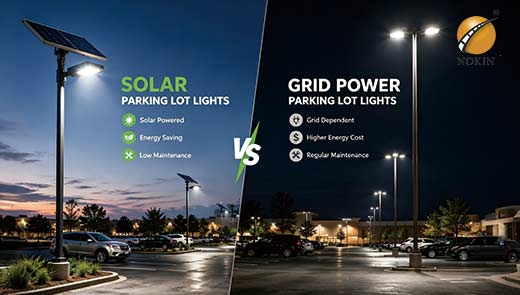
From the perspective of 10-year long-term ownership cost (TCO): solar street lights only need to replace the battery once within the 10-year cycle, without electricity costs or line maintenance costs.
While traditional grid-based street lights have continuous electricity costs, line maintenance, and light repair costs over 10 years, the overall cost is much higher than that of solar street lights, with a significant long-term cost advantage.
How to Choose the Right Replacement Battery for Solar Parking Lot Lights
It is strictly prohibited to randomly replace third-party non-brand batteries. The battery sizes, voltages, communication protocols, and protection parameters of different brands of lights are not unified.
Non-brand batteries are prone to parameter mismatch issues, which not only cause abnormal charging and discharging, non-compliant range, but also burn the controller, trigger short circuits, and fires. It is recommended to prioritize choosing original factory or officially authorized channels for replacement parts.
Solar Parking Lot Light Warranty: What Should Buyers Negotiate?
Many procurement disputes are centered around merchants' general labeling of "whole light warranty for X years", which is vague about the quality guarantee differences of each component. When purchasing solar street lights for parking lots, it is necessary to specify component-level warranties. The following are industry benchmark quality guarantee standards, and those below this standard can be directly judged as non-standard and inferior products.
|
Core Component |
Service Life |
Key Lifespan Determination Indicators |
One-Time Replacement Cost |
|
Solar Panel |
20–25 years |
Output power attenuation to 80% of the initial value reaches the lifespan limit. Mainstream brands generally provide full warranty coverage, so self-funded replacement is basically not required. |
Usually no replacement |
|
LED Lamp Bead Module |
10–15 years |
Based on international IES TM-21 and IEC 62717 standards, with L70 as the determination criterion. Brightness attenuation to 70% of the initial value indicates the effective lifespan, typically 50,000–100,000 hours. |
$200–$400 |
|
Smart Controller |
8–10 years |
Core protection functions such as overcharge, overdischarge, and short-circuit protection fail, or equipment control accuracy decreases significantly. |
$50–$150 |
|
LiFePO4 (Lithium Iron Phosphate) Battery |
5–8 years |
After completing 2,000–3,000 charge-discharge cycles, capacity attenuates to below 80% of the initial value and can no longer meet nighttime lighting requirements. |
About $600 |
4 Solar Parking Lot Light Warranty Terms Buyers Should Check
Require Component-Level Warranty Terms
Require the supplier to separately provide warranty terms for solar panels, LED light beads, batteries, and controllers, clearly stating the warranty duration and responsibility scope for each component.
Check Battery Capacity Retention Requirements
Distinguish between "no damage warranty" and "capacity warranty", and must require the specification to indicate: within the 3-year/5-year warranty period, the battery capacity retention rate should be ≥ 80%, to avoid merchants only guaranteeing no damage but not performance degradation.
Clarify Battery Replacement and After-Sales Responsibilities
Confirm the repair method for faults in advance: whether to send it back for repair or replace it on-site. Clearly define the party responsible for logistics and labor costs during the warranty period to avoid hidden charges in the future.
Keep Complete Purchase and Product Records
Archive the serial numbers, factory parameters, installation dates, and purchase contracts of each batch of lights as the core evidence for later warranty protection.
How to Extend the Lifespan of Solar Parking Lot Lights
The lifespan of the entire light is 10–15 years. It requires a standardized selection and operation mode. By doing the following practical operations, you can effectively avoid premature aging of components and maximize the equipment's service life.
Improve Heat Dissipation in Summer
Optimize the installation method by using shading structures and perforated ventilation design to avoid the solar panels being close to the light body and the battery compartment being sealed and accumulating heat. This reduces the loss of battery capacity at the source.
Use Smart Dimming to Reduce Battery Stress
Set up intelligent dimming by time period. During the late night when there is less traffic and people, reduce the light power by 30%–50%. This can meet the basic lighting needs and significantly reduce the battery charging and discharging pressure, delaying the aging of the battery cells.
Clean Solar Panels Regularly to Maintain Power Generation
Parking lots have a lot of dust and dust, and the accumulation of dust on the panels will cause a 10%–25% loss in power generation. Long-term insufficient power generation will lead to continuous undercharging of the battery, accelerating capacity degradation. It is recommended to clean the panels regularly every quarter.
Choose Solar Parking Lot Lights with Rainy-Day Battery Capacity
When purchasing, refuse to only select low-end products that are compatible with 1 day of rainy weather. Prioritize choosing lights with redundant design that support 3 days of continuous rainy weather and have battery capacity support.
How to Identify Low-Quality Solar Parking Lot Lights Before Buying
Low-cost commercial solar street lights on the market often have parameter mislabeling issues. They seem to have high cost performance, but actually will fail in batches within 3–5 years. When purchasing, if you see the following four red flags, you can directly eliminate the supplier.
4 Red Flags in Solar Parking Lot Light Specifications
- The battery is only labeled with "3-year lifespan" without any charging and discharging cycle parameters, making it impossible to verify the actual lifespan;
- The LED light beads are only labeled with power watts, without labeling the lumen value or L70 lifespan, hiding the problem of rapid light attenuation and insufficient brightness;
- The warranty terms are extremely general, only stating "warranty for the entire light for 1 year", without any component-specific warranty explanations;
- The price is much lower than the market benchmark. The average price of commercial-grade parking lot solar street lights is $3000–$5000 per set. Low-priced products are likely to reduce materials and mislabel parameters.
How to Verify Solar Parking Lot Light Specifications Before Procurement
Before purchasing, require the supplier to provide a complete component specification sheet (Specifications). Focus on verifying the three core parameters: battery cycle times, LED light bead L70 lifespan, and the working temperature range of the entire machine. If the parameters are complete and comply with industry standards, the project can be approved for procurement.
Solar Parking Lot Light Lifespan: Key Takeaways for Buyers
In conclusion, the 10–15-year lifespan of the entire light for parking lots is achievable in reality, but the lifespan shortcoming is concentrated in the 5–8-year replacement of the battery.
The core logic of procurement: Do not focus on the single lifespan of the entire light, but focus on verifying the independent lifespan parameters of the four components and the component-specific warranty clauses; In the later operation and maintenance, focus on the battery status and timely maintenance and replacement, which can maximize the service life of the equipment and reduce long-term operation and maintenance costs.
Want to accurately calculate the long-term cost of the project and standardize the procurement standards? If you need to adapt to your own project scenarios, you can contact NOKIN at any time to obtain free selection and installation plans, as well as detailed warranty information and parameter reports at the component level for the corresponding models.