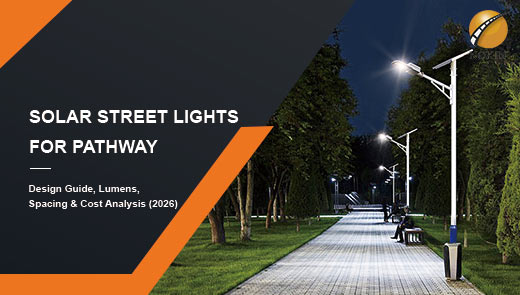
Solar Street Lights for Pathway: Design Guide, Lumens, Spacing & Cost Analysis (2026)
Mar 21, 2026
Whenever night falls, whether on the main roads of the city, in the small paths of parks, or beside the square of residential areas, street lights will light up one after another. High-quality road lighting environment can not only enhance the safety of people's nighttime activities, reduce the risks of falls and collisions, but also beautify the night landscape. Compared with traditional street lights, many scenarios now choose solar street lights, especially on narrow pathways, solar pathway lights, with zero electricity cost, no wiring, easy installation, and low maintenance, have become the mainstream choice for outdoor lighting in 2026.
In this next blog, NOKIN will focus on the issues that everyone is most concerned about: how to select the brightness of the pathway solar street lights, how to design the spacing, how to choose the products, and whether the cost is reasonable. It will solve all the problems of the entire process of selecting pathway solar street lights in one place.
What Are Solar Street Lights for Pathways?
Pathway solar street lights are integrated solar lighting equipment specifically designed for small outdoor scenarios such as paths, pathways, and courtyards. They rely on solar photovoltaic conversion to achieve autonomous power supply, without the need for external power sources. They are suitable for various scattered and non-grid-connected pathway scenarios.
Core System Components of Solar Pathway Lighting Systems
A complete set of pathway solar street lights consists of four core components, each performing its own function to ensure stable operation:
|
Component |
Functional Description |
|
LED Lighting Fixture |
The core lighting component, using energy-saving and high-brightness LED chips. It offers high luminous efficiency and long service life, serving as the primary light source for pathway lighting. |
|
Solar Panel |
The core power generation component that converts sunlight into electricity. Common materials include monocrystalline and polycrystalline silicon. Its photovoltaic conversion efficiency directly affects charging speed. |
|
Energy Storage Battery |
Stores the electricity generated during the day and provides power for nighttime lighting. It determines the system’s runtime and performance during rainy or cloudy days. |
|
Smart Controller |
The control center of the system, enabling automatic light on/off (light control), charge and discharge protection, and brightness adjustment without manual intervention. |
Pathway Solar Street Lights vs Traditional Pathway Lights
|
Comparison Dimension |
Pathway Solar Street Lights |
Traditional Pathway Lights |
|
Power Supply Method |
Solar autonomous power supply, no need for grid |
Depend on municipal grid, must be wired |
|
Operation Control |
Light control automatic start and stop, intelligent operation |
Manual switch or timing control, more cumbersome operation |
|
Installation Difficulty |
No need to dig trenches or lay wires, can be quickly installed by one person |
Requires wiring and electrical connection, complex construction, longer installation period |
|
Applicable Scenarios |
Small pathways, courtyards, off-grid or remote areas |
Main roads, areas with complete grid infrastructure |
Why Choose Solar Street Lights for Pathways?
Improve Pathway Safety at Night
Nighttime pathways have low visibility, which is a high-risk scenario for falls, collisions, etc. Solar street lights can effectively improve road visibility and eliminate blind spots. Industry standards show that ordinary pathways only need 100–200 lumens of brightness to meet basic visibility requirements, significantly reducing the risk of nighttime walking and safeguarding pedestrian safety.
Energy Saving and Environmental Benefits
Solar street lights for pathways are powered by 100% solar energy, consuming no electricity from the grid and emitting zero carbon emissions and pollution. Compared to traditional lighting, they can reduce a significant amount of carbon emissions annually, which is in line with global environmental protection policies and can create green communities and ecological parks, enhancing project reputation.
Low Installation Cost
The biggest cost of traditional street lights is the infrastructure construction such as digging trenches, wiring, and connecting electricity. Solar street lights completely eliminate this cost. They do not require road damage or cable laying. Installation can be completed by simply unpacking and fixing within a day by one person, saving time, effort, and money.
Zero Electricity Cost in the Long Term
Solar street lights do not generate electricity costs when illuminated. Long-term use has zero electricity expenses. At the same time, the product adopts an integrated sealing design with no vulnerable components. Daily maintenance is not required. Cleaning the solar panels of dust is sufficient for regular maintenance. The total life cycle cost is much lower than traditional street lights.
How Many Lumens Do You Need for Pathway Solar Lights?
Lumens (Lumens) is the core indicator for measuring light brightness. Choosing the wrong lumens can either result in insufficient brightness affecting safety or excessive brightness wasting energy. The following are the industry-standard brightness standards for pathways in 2026, which can be directly selected based on the requirements.
Recommended Lumens for Different Pathway Scenarios
|
Usage Scenario |
Recommended Lumens (lm) |
Applicable Description |
|
Decorative / Garden Pathway |
10–50 lm |
Mainly used for atmosphere creation; strong lighting is not required, soft illumination is sufficient. |
|
Ordinary Residential / Community pathway |
100–200 lm |
Meets daily walking needs and provides basic safety lighting. |
|
Park / Public Community pathway |
400–600 lm |
Suitable for areas with high foot traffic; balances safety and visibility. |
|
High-Traffic Areas / Main Road pathway |
800+ lm |
Designed for highly crowded areas; requires high-intensity lighting to ensure safe passage. |
How to Choose Brightness Based on Application
- Safety priority: Recommend lumens ≥ 300 lm to ensure no dark corners on the road and clear visibility for pedestrians.
- Atmosphere creation priority: Choose 100–200 lm for soft light to create a warm pathwayatmosphere, not dazzling, and more comfortable.
- Security monitoring priority: Choose 600+ lm for high-intensity lighting combined with monitoring equipment to enhance regional security level.
Solar Pathway Lighting Design Guide
How to Design Light Spacing for Pathway Lighting
The spacing of the lights directly affects the uniformity of lighting. Different brightness levels of lights require different spacing arrangements:
- Low-brightness decorative lights (10–50 lm): The spacing should be controlled within 1.2–1.8m
- Medium-brightness regular lights (100–200 lm): The spacing should be controlled within 1.8–2.5m
- High-brightness public lights (400+ lm): The spacing should be controlled within 2.5–3.5m
Following this standard can ensure a continuous light distribution on the pathway without obvious dark areas, enhancing the walking comfort.
How to Ensure Lighting Uniformity
High-quality pathway lighting refuses the "bright one moment, dark the next" discontinuity. When designing, it is necessary to ensure that the light coverage areas overlap, making the entire pathway have uniform brightness. This not only enhances the visual experience but also avoids visual fatigue for pedestrians due to alternating light and dark, further ensuring safety.
How to Choose Color Temperature
|
Lighting Application |
Recommended Color Temperature |
Lighting Effect |
|
Safety function lighting |
5000–6000K (cool white light) |
Bright and highly penetrating, clearly illuminates road details |
|
Comfortable atmosphere lighting |
3000–4000K (warm white light) |
Soft and warm, ideal for courtyards and landscape pathways |
Solar Panel Installation Best Practices
The power generation efficiency of the solar panel directly determines the lifespan of the street lights. When installing, two points must be noted:
- Avoid obstruction: The installation location should avoid the shadows of trees and buildings to ensure continuous direct sunlight throughout the day.
- Angle optimization: Adjust the tilt angle of the solar panel according to the local latitude to maximize the light collection area and improve charging efficiency.
How to Choose Solar Street Lights for Pathways
Battery Capacity Selection
When purchasing, make sure to choose a product that can provide continuous lighting for more than 8 hours after being fully charged. At the same time, pay attention to the battery life during rainy days. High-quality solar street lights for trails can withstand 2-3 rainy days without power failure and ensure normal lighting, avoiding the situation of power outage and no lighting during continuous rainy days.
IP Rating and Protection Level
Outdoor lights are exposed to wind and rain all year round, so the protection grade is a mandatory indicator. It is necessary to choose products with a protection grade of IP65 or above. These products have strong waterproof, dustproof, and corrosion-resistant capabilities, are suitable for various harsh weather conditions such as rain, snow, and sandstorms, and can extend the service life.
Housing Material Selection
- Aluminum alloy / Stainless steel: Corrosion-resistant, anti-aging, durable, suitable for long-term outdoor use, and have high cost-performance.
- Engineering plastic: Lower cost, lighter weight, suitable for scenarios with limited budget and short-term use.
Smart Lighting Features
Solar street lights with smart functions have better user experience and stronger energy-saving effects. It is recommended to prioritize the selection of:
- Human body sensing control: Low brightness for low power consumption when no one is present, automatic high brightness when someone passes by, energy-saving and practical.
- Light control automatic switch: Automatically turn off the lights during the day for charging, and automatically turn on at dusk, no need for manual control.
Common Mistakes in Solar Pathway Lighting Design
Choosing Low-quality Products
Low-quality street lights with falsely labeled luminous flux, the actual brightness is far lower than the advertised value, unable to meet the basic lighting requirements, and thus ineffective.
Incorrect Lighting Spacing
Too wide light spacing results in many dark areas on the pathway, while too close light spacing leads to waste of light and increased costs, and it is necessary to set the light spacing according to the brightness standards.
Poor Solar Panel Placement
Trees and buildings block sunlight, resulting in insufficient charging, and the lighting duration at night is significantly shortened, or even no lighting at all.
Insufficient Battery Capacity
The battery capacity is too small, unable to support the lighting throughout the night, and the street lights go out in the early hours of the night, losing their lighting significance.
Best Applications of Solar Pathway Lighting
The solar-powered street lights for pathways are suitable for a wide range of scenarios. The core application scenarios include:
- Park leisure pathways: Create ecological lighting to enhance the night-time experience for visitors
- Community pathways: Ensure residents' safety during nighttime travel and beautify the community environment
- Campus pathways: Guard the safe passage of teachers and students, and create a green campus
- Courtyard/landscape paths: Balance atmosphere and practicality, and improve the appearance of the courtyard
- Tourist pathways in scenic areas: Achieve full-area lighting without power grids, reducing operating costs
Solar Pathway Lighting Cost Analysis
Initial Cost vs Long-Term Benefits
The initial purchase cost of solar-powered pathway street lights is slightly higher than that of traditional simple pathway lights, but it saves on large infrastructure expenses such as wiring, construction, and electricity connection. As a result, the overall initial investment is actually lower.
Based on the market situation in 2026:
- Entry-level decorative model: $20 - $50 per light
- Mid-range regular model: $50 - $150 per light
- High-end intelligent model: $150 - $300 per light
ROI of Solar Pathway Lighting
Traditional pathway street lights require annual electricity bills and maintenance fees, while solar-powered street lights have zero electricity costs and low maintenance. Generally, the difference in cost can be recovered within 1-2 years.
Based on a 5-year lifespan, the total operating cost of solar street lights is only one-third or even lower than that of traditional street lights, and the long-term benefits are extremely significant.
FAQ About Solar Pathway Lighting
Q1: What is the best lumen for solar pathway lighting?
For ordinary residential pathways, 100-200 lm is the preferred range. For public parks and areas with high foot traffic, 400-600 lm is suitable. For purely decorative scenes, 10-50 lm will suffice. Q2: How far apart should solar pathway street lights be?
The spacing of low-brightness lights is 1.2 - 1.8 meters, medium-brightness lights are 1.8 - 2.5 meters, and high-brightness lights are 2.5 - 3.5 meters. Fine-tuning can be done based on the actual brightness.
Q3: How long do solar pathway street lights last?
High-quality solar-powered street lights, with LED lifespan up to 50,000 hours, battery lifespan of 3-5 years, and the entire product can be used normally for 5-8 years without replacement.
Q4: Are solar pathway lights worth it?
Absolutely worth it. No electricity bills, easy installation, environmentally friendly, extremely low long-term usage cost, compatible with the vast majority of off-grid hiking trail scenarios, and its cost-effectiveness far exceeds that of traditional street lights.
Are Solar Pathway Lights Worth It?
For the lighting selection of the hiking trail in 2026, solar street lights are the optimal solution that combines safety, environmental protection, and cost-effectiveness. As long as you focus on the four core parameters of lumen, light spacing, protection level, and battery capacity, and avoid common misunderstandings, you can select a cost-effective product that suits your specific scenario.
related