Industrial Outdoor Lighting with Solar: A Planning Guide for Factory Roads, Yards, and Perimeter
Oct 08, 2026
When many factories upgrade their industrial outdoor lighting, they often fall into a common mistake: they directly choose the same type of lights and uniformly set the lighting spacing throughout the entire factory area. This simple and crude lighting arrangement often leads to excessive brightness in some areas, insufficient illumination in key operation areas, severe glare, and high total energy consumption, failing to meet the safety production requirements of industrial scenarios.
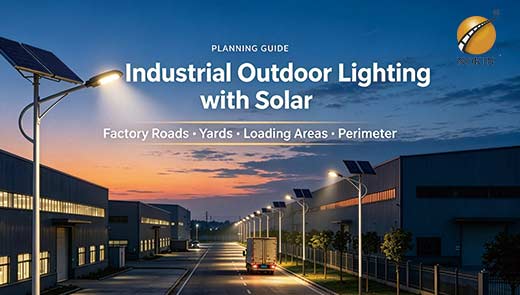
The core idea of industrial outdoor lighting is not simply to brighten the environment, but to conduct refined zoning design based on the functional requirements of the scene. The outdoor area of a factory includes various independent functional zones: main roads of the factory, internal branch roads, material yards, loading and unloading operation areas, parking lots, factory perimeters, and pedestrian paths.
The operation modes, passing vehicles, and personnel activities in different areas are completely different, and the corresponding illumination standards, light pole heights, light projection angles, and lighting spacing have significant differences. A single configuration covering the entire factory area not only causes financial waste but also lays down multiple hidden dangers for traffic safety, on-site operations, and security monitoring.
Based on GB 50582-2010 (Standard for lighting design of outdoor work places) and ISO/CIE 8995-3:2018 (Lighting of work places — Part 3: Lighting requirements for safety and security of outdoor work places), this article delivers a professional solar industrial outdoor lighting zoning planning solution for factory roads, yards, loading areas, and facility perimeters. The article gives the selection of lights for each area, installation parameters, and deployment key points, helping facility managers, EHS managers, and engineering contractors to create a safe, compliant, and economically viable factory outdoor lighting renovation plan.
Why Is Industrial Outdoor Lighting Divided into Zones?
Many project plans directly apply urban road lighting schemes, which is the most common pitfall in industrial area lighting design. Urban roads are mainly for small passenger vehicles, with a simple scene and low risks; while the outdoor environment of an industrial factory is complex, and the functional and safety requirements for lighting are higher. The unique characteristics of industrial sites determine that industrial outdoor lights must adopt zoning design. The main differences lie in three points:
Different Vehicle Types Require Different Factory Lighting Designs
In addition to private cars, there are also heavy trucks, forklifts, engineering cranes, and transfer trucks. The driving sight height, driving speed, and turning radius of each type of vehicle are different, and the requirements for light heights, anti-glare performance are completely different.
Different Factory Operations Have Different Lighting Requirements
Urban roads only need to meet basic visibility requirements. However, industrial outdoor lighting includes material stacking, goods loading and unloading, equipment inspection, vehicle dispatching, and security duty. Only the basic lighting is required for the passing scenarios, while the operation scenarios require precise lighting with high uniformity and controllable glare.
Mixed Pedestrian and Vehicle Traffic Increases Lighting Safety Risks
Factories lack strict separation of pedestrians and vehicles, and during shift changes and peak operation periods, the probability of pedestrian, forklift, and heavy truck intersections is high. Zoning-based industrial outdoor lighting can eliminate visual blind spots, reduce collision accidents, and support the EHS management goals of the factory.
Industry-recognized zoning logic: scene function × user. According to the four major functions of passage, operation, storage, and security, combined with the visual needs of vehicles, pedestrians, and on-site operators, separate independent lighting areas are divided to achieve precise matching of lights.
Industrial Outdoor Lighting Planning Standards for Factory Sites
Referencing GB 50582-2010, Standard for lighting design of outdoor work places and ISO/CIE 8995-3:2018, Lighting of work places — Part 3: Lighting requirements for safety and security of outdoor work places, NOKIN sorted out the full-scene parameter table for industrial outdoor lighting.
Note: The parameters in the table below are industry general reference values. The final scheme needs to be adjusted based on on-site measurement of site dimensions, obstructions, combined with optical simulation and local safety supervision requirements.
Recommended Lighting Levels, Pole Heights, and Solar Light Types by Factory Area
|
Functional Area of the Factory Site |
Recommended Lighting Level |
Recommended Pole Height |
Suitable Solar Light Type |
Core Planning Points |
|
Main Road of the Factory Site (Freight Main Road) |
Medium–High (50–75 lx) |
8–10 m |
Anti-Glare Solar Street Lights |
Strictly control glare to accommodate the elevated line of sight of heavy truck drivers and ensure clear visibility during long-distance travel. |
|
Branch Roads / Internal Passages |
Medium (30–50 lx) |
6–8 m |
Conventional Solar Lights |
Set lighting spacing at approximately 2–3 times the pole height to ensure uniform illumination and minimize large dark areas. |
|
Pedestrian Passages |
Low–Medium (20–30 lx) |
4–5 m |
Small Integrated Solar Lights |
Physically separate pedestrian lighting from lane lighting to prevent strong direct light from shining into pedestrians’ eyes and improve pedestrian safety. |
|
Storage / Material Storage Areas |
Medium–High (50–80 lx) |
8–10 m |
Solar Spotlights + High-Pole Street Lights |
Arrange lighting points according to the storage area layout to eliminate blind spots around stacked materials and support inventory and material-handling operations. |
|
Loading and Unloading Areas |
High (75–100 lx) |
6–8 m |
Adjustable-Angle Solar Spotlights |
Focus illumination on operating areas while avoiding glare into drivers’ fields of vision and supporting loading, unloading, and counting operations. |
|
Factory Parking Lot |
Medium (30–50 lx) |
6–8 m |
Solar Street Lights + Small Spotlights |
Position lights according to the parking-space layout to balance vehicle parking, passenger movement, and security visibility. |
|
Factory Perimeter (Safety Area) |
Medium (50 lx at Key Sections) |
6–8 m |
Waterproof Solar Spotlights |
Prioritize coverage of the main gate, fence blind spots, and the rear side of warehouses to eliminate lighting blind spots and improve perimeter security. |
Factory Road Lighting: Main Roads vs. Branch Roads
Factory roads are the core scenarios of industrial outdoor lighting and also high-risk locations for accidents. Many lighting defects in factory outdoor lighting projects stem from not distinguishing between main roads and branch roads, using the same type of pole, lights, and lighting spacing.
Factory Freight Main Road Lighting
Responsible for over 80% of the freight traffic of the factory, is the main passage for heavy trucks and large engineering vehicles. Such roads require high-level industrial outdoor lights: higher pole height to raise the light projection angle, reduce glare to the driver's cab; higher illumination to meet night meeting, turning, and long-distance passage vision; larger lighting spacing to reduce light overlap, reduce equipment and maintenance costs.
Branch Road and Internal Passage Lighting
Mainly for forklifts, small transfer vehicles, and personnel, have slow speeds, small loads, and simple scenarios. No high-level lights are needed, using 6-8m conventional solar street lights, set the lighting spacing at 2-3 times the pole height, can meet basic passage lighting, and is more cost-effective.
Pedestrian and Vehicle Lighting Separation
The pedestrian passage of the factory site is close to the lane. If using the same lighting for both, the strong light of the lane will cause a brief glare blindness for pedestrians. Separately setting 4-5m small solar lights to achieve separation of pedestrian and vehicle lighting is a low-cost solution to improve factory passage safety and also a basic requirement for EHS compliance.
Loading and Unloading Area Lighting
The loading and unloading area is the most intense area for operations within the factory and has the strictest lighting requirements. It is also the most prone to ineffective lighting in the industrial area lighting. Many factories often make a mistake: they only illuminate the ground, ignoring the core operation area, resulting in insufficient visibility during night loading and unloading operations.
Lighting the Loading and Unloading Operation Area
Prioritize illuminating the operation area rather than simply the ground. The effective lighting range needs to cover the cargo platform surface, the side of the truck compartment, the cargo transfer operation area, and the equipment operation points, supporting the visual needs of workers for loading, counting, and equipment operation.
Glare Control for Heavy Truck Drivers
Heavy truck drivers sit at a high position and have relatively fixed lines of sight. If the lights are horizontally direct or have an excessive downward angle, the strong light will directly enter the driver's cabin, creating a visual blind area, and easily causing scratches and collisions.
Using Solar Lighting for Loading and Unloading Areas
Adjustable-angle solar floodlights can precisely adjust the illumination direction to avoid the driver's regular line of sight range. Combined with high color rendering light sources to restore the true colors of the goods, it reduces night misloading and mispacking, and improves the efficiency and safety of loading and unloading operations.
Factory Perimeter Lighting for Security
Factory perimeter lighting does not belong to ordinary pass-through lighting; it is the basic hardware facility of the industrial security system, having dual values of deterrence and monitoring supplementary lighting, and is an important part of the factory's security closed loop.
Perimeter Lighting for Visual Deterrence
Uniform and stable night lighting eliminates the hidden spaces in the dark areas of the fence, reduces the risks of unauthorized entry and material theft, and forms active security deterrence.
Perimeter Lighting for Security Cameras
Industrial surveillance in low-light environments results in blurry images, high noise, and ineffective recognition. Qualified plant perimeter security lighting can ensure clear and recognizable surveillance video images, achieve 24-hour evidence collection, and improve the factory's security system.
Prioritizing Key Areas in Factory Perimeter Lighting
The first priority is to cover factory gates, blind spots at fence corners, the back of the warehouse, the rear side of the material storage area, and remote fences. There is no need to evenly install lights around the entire fence; differentiated installation achieves precise security, controlling the initial investment and subsequent maintenance costs.
Factory Safety Lighting for Pedestrian and Vehicle Conflict Points
Most factory lighting deficiencies are concentrated in human-vehicle conflict points, which are also key items for EHS safety inspections. In these positions, industrial outdoor lighting is not a decorative facility but a safety engineering hardware that directly affects factory safety compliance.
The high-risk human-vehicle conflict points in the factory include: road intersections, right-angle turns, forklift operation areas, workshop entrances and exits, shift change peak pedestrian passages, and material transfer intersections. These positions have dense intersections of people and vehicles, with many obstructions, and a high risk of collision.
For these points, industrial outdoor lights do not blindly pursue extremely high brightness; they focus on achieving no blind areas, no glare, and uniform lighting. Reasonable placement of solar lights eliminates visual blind areas, allowing drivers and pedestrians to predict the road conditions in advance, reducing the risk of human-vehicle collisions at the hardware level.
A complete conflict point lighting system can reduce the accident rate in the factory, help the factory achieve EHS safety production goals, smoothly pass safety supervision and park compliance inspections, and avoid penalties and shutdown risks.
Benefits of Solar Lighting for Industrial Outdoor Areas
Compared with traditional city street lights, solar industrial outdoor lighting is more suitable for complex factory conditions. It has advantages in construction costs, implementation difficulty, long-term operation, and environmental tolerance, and is an ideal solution for green factory renovations.
No Trenching Required for Factory Lighting Upgrades
Most of the ground in old factory areas is hardened, with cables, water supply and drainage, and process pipelines laid underground. Traditional cable lighting requires trenching, laying cables, connecting power distribution boxes, which takes a long time and also poses risks of damaging existing pipelines and halting production for construction.
Solar lights have zero wiring and no trenching, and do not need to be connected to the municipal power grid. Installation can be completed by erecting poles. Factory renovation projects can save a lot of labor, cable, and construction costs. The overall project budget can be reduced by 30%-40%. During construction, normal production is not disrupted.
Solar Power Supply Configurations for Different Factory Areas
Energy storage can be configured differently based on the importance of the area: core safety areas such as perimeter security zones, loading and unloading operation zones, and main freight roads can be equipped with large-capacity photovoltaic energy storage systems to ensure continuous lighting for 3-5 days of continuous rain; non-core areas such as secondary passageways and parking lots can use conventional power supply configurations to balance safety and budget.
Phased Solar Lighting Installation for Factory Sites
The upgrade of industrial area lighting does not need to be completed throughout the area at once. When the budget is limited, priority should be given to renovating conflict points involving vehicles and pedestrians, factory perimeters, main freight roads, and loading and unloading operation zones, which are high-risk and have high compliance priority areas. Subsequent areas can be gradually upgraded based on the budget, reducing the pressure of one-time capital investment.
Solar Lighting for Dust, Corrosion, and Coastal Industrial Conditions
Many factory areas have constant dust, and chemical parks and coastal factory areas have corrosion and salt fog. Industrial-specific solar lights use dust-proof, waterproof, and corrosion-resistant shells, can withstand high and low temperatures, dust, and salt fog, operate stably, and have low maintenance workload.
Factory Solar Outdoor Lighting Planning Checklist
It is convenient for facility managers and engineering contractors to quickly verify the completeness of the plan. Before procurement and construction, each item should be checked item by item to avoid design loopholes and safety hazards.
- Has it fully covered the 7 core outdoor areas of the factory, including main roads, branch roads, pedestrian paths, storage areas, loading and unloading areas, parking lots, and perimeters?
- Are the illuminance, pole height, and lighttypes of each area matched with the scene function and national standards?
- Is the loading and unloading area focused on the operation area lighting, rather than only doing ground-based lighting, and is the glare control in place?
- Have all high-risk points of vehicle and pedestrian conflicts, such as intersections, turns, and forklift operation areas, been covered with special lighting?
- Are there no lighting dead zones in key security segments of the perimeter, such as factory gates, blind areas of walls, and the rear side of warehouses?
- Has the energy storage and power supply configuration of the lights matched the nighttime operation duration and emergency needs during rainy weather in the area?
- Has a phased implementation plan been formulated, prioritizing the implementation of high-safety and high-compliance priority areas?
Conclusion: Planning Industrial Outdoor Lighting by Zone
The key to doing well in industrial outdoor lighting is to first divide areas and then configure lights. Abandoning the "installing the same type of lights throughout the factory area" rough thinking, combining the scene function, safety requirements, and security standards for detailed zoning planning, can balance lighting effect, production safety, compliance requirements, and long-term costs.
Solar lighting, with the advantages of no wiring, low cost, flexible deployment, and strong environmental adaptability, perfectly meets the upgrade needs of green factory outdoor lighting, and is a high-quality solution for industrial outdoor lighting renovation.
Free technical consultation: If you are planning to renovate the outdoor lighting of the factory area, we can provide the factory site floor plan. The NOKIN professional technical team will mark the specific light configuration, pole height parameters, and lighting layout for each area, and customize an exclusive solar lighting planning scheme for you.