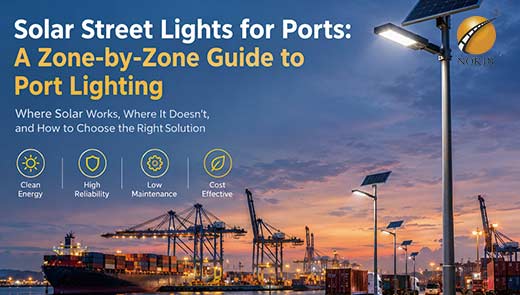
Solar Street Lights for Ports: Where It Works & Where It Doesn’t
Sep 28, 2026
If you are in charge of engineering and facility management for ports, docks, or container storage yards, you must be aware that the complexity of port lighting design is far greater than that of ordinary municipal roads or parking lots. The environment is extreme, operations are continuous, and safety requirements are high. Any mistake in any aspect could affect the entire operation chain.
Next, NOKIN will adhere to the principle of objectivity and pragmatism, neither exaggerating the advantages of solar lighting nor denying its core value. We will use an exclusive zone-by-zone judgment method to clearly break down the solar lighting suitability of different areas in the port. After reading this, you will know:
- Which areas in the port are suitable for solar street lights (including configuration ideas);
- Which areas must use grid or tall pole solutions (and understand why);
- How to make the right decision under the constraints of hardened ground, 24/7 operations, and salt fog corrosion.
Why Standard Street Light Solutions Fail in Ports
Many suppliers directly apply municipal street light solutions to ports, but the projects often fail repeatedly. The fundamental reason is that port lighting has three essential differences from ordinary scenarios:
Hardened Ground and High Trenching Costs
Docks and storage yards are mostly hardened with concrete or asphalt. Digging cable trenches, laying pipelines, backfilling, and restoring the pavement on this surface is extremely costly; in main passages and areas where heavy equipment is loaded, there may even be no construction conditions.
Therefore, any solution that heavily relies on underground wiring is an "inherent disadvantage" in ports.
24/7 Port Operations and Lighting Reliability
Ports operate based on shipping schedules, and loading and unloading operations often do not stop day and night. One light going out could cause the operation area to pause and affect subsequent shipping schedules. Reliability is not an added benefit in port lighting but a hard threshold.
Heavy Traffic and Coastal Salt Fog Challenges
- Container trucks, forklifts, and stackers frequently pass through, and the lightpoles face collision risks;
- Coastal salt fog continuously erodes the lightpole coating, fasteners, and lightbody seals.
These three points are the basis for "zone-by-zone judgment": Different areas are subject to different constraints, and the suitability of solar lighting varies. The following zone map is a decision-making roadmap drawn for you.
Port Lighting Zones: Where Solar Street Lights Work and Where They Don't
To solve the selection problem of port lighting, we divide the port into functional areas based on port functions, combined with illumination requirements, operation intensity, and environmental constraints, and sort out the solar lighting suitability standards for each area, clearly distinguishing between suitable and prohibited scenarios, and avoiding the risk of blind selection.
Solar Street Light Suitability by Port Functional Area
|
Port Functional Area |
Core Lighting Characteristics |
light Pole Height |
Solar Suitability |
Core Explanation |
|
Dock Internal Roads |
Linear, continuous lighting to ensure safe vehicle passage |
6–8 m |
✅ Very Suitable |
No need for long-distance wiring; suitable for hardened ground and regular vehicle passage lighting. |
|
Entry Gates / Inspection Stations |
Partial high illumination, also supporting security monitoring |
6–8 m |
✅ Suitable |
Can be integrated with security systems, provides independent power, and remains operational during temporary grid failures. |
|
Port Parking Lots |
Uniform large-area lighting for nighttime operations and duty |
6–8 m |
✅ Suitable |
Distributed lighting points eliminate the need for centralized wiring and are suitable for phased renovation projects. |
|
Office / Residential Area Roads |
Regular road lighting with moderate illumination requirements |
Around 6 m |
✅ Suitable |
Stable usage frequency enables high solar utilization while keeping operation and maintenance costs low. |
|
Passageways / Footpaths |
Low illumination requirements for short-distance local lighting |
4–5 m |
✅ Very Suitable |
Small solar lights can meet lighting requirements; installation is convenient and cost-effective. |
|
Container Yard Center |
Extensive, uniform, high-intensity illumination for large-scale operations |
12 m or higher |
⚠️ Not Recommended for Conventional Solar |
Requires high-power pole lighting. Conventional solar configurations may struggle to provide sufficient illumination and long-term operation, so grid power should be prioritized. |
|
Dangerous Goods / Explosion-Proof Areas |
Strict explosion-proof certification, with extremely high sealing and safety requirements |
Customized |
❌ Not Applicable to Conventional Solar |
Requires professionally certified explosion-proof lights and power supply systems. Standard solar street lights generally cannot meet the required compliance standards. |
In port lighting projects, clearly defining the applicable boundaries is far more valuable than blindly promoting products. The port engineering party is most concerned about the compliance, stability and practicality of the solar lighting solution. Precise zoning selection can fundamentally avoid potential operational risks and renovation waste in the future.
Solar Street Lights for Ports with Hardened Ground
Why Port Trenching and Underground Wiring Are Expensive
Traditional port grid lighting construction not only has the explicit procurement costs of lights, cables, and distribution boxes, but also involves a large amount of hidden expenses.
Hardened ground excavation, trench laying, cable protection, and road restoration will generate high construction costs. At the same time, port operation area construction requires prior reporting and approval, coordination of operation gaps, and indirect operational losses, resulting in a continuous increase in overall costs.
How Solar Street Lights Reduce Port Lighting Infrastructure Work
|
Advantage |
Explanation |
|
No Trenching Required |
No long-distance underground wiring is needed, eliminating one of the largest hidden infrastructure costs. |
|
Single-Point Independence |
Each solar street light operates as an independent system and does not rely on grid connection points. |
|
On-Demand Expansion |
Start by lighting the core area and gradually expand the installation as needed, allowing for a more flexible investment schedule. |
Civil Construction Requirements for Solar Port Lighting
It should be clearly stated that solar port lighting is not zero civil construction costs. To withstand port strong winds and the impact of heavy equipment air currents, standardized foundation construction and pole fixation are still required.
However, compared to traditional solutions, its civil engineering volume is reduced by more than 70%, which can significantly compress the construction period and overall investment, and can save a large amount of electricity and operation costs in the long term.
Solar Street Lights for 24/7 Port Operations: Reliability and Dimming Strategy
The characteristic of port 24/7 operation places extremely high requirements on the endurance stability and continuous power supply capability of solar lighting. Scientific system configuration and dimming strategy are the key to ensuring zero interruption of lighting.
Battery Backup and Rainy-Day Redundancy for Port Lighting
|
Regional Importance |
Rainy-Day Redundancy Design |
Explanation |
|
Core Operation Area |
High redundancy (3–5 days) |
Lighting operation cannot be interrupted. |
|
General Area |
Medium redundancy |
Short-term reduction in illumination is acceptable. |
|
Non-Critical Area |
Low redundancy |
Normal battery capacity is sufficient. |
Dimming Strategies for 24/7 Solar Port Lighting
- Peak operation hours: Full power output to ensure illumination;
- Non-operation hours: Automatic reduction of power operation.
This way, solar port lighting not only meets 24/7 continuity but also avoids the configuration waste caused by "full power" operation all day.
Battery Capacity by Port Lighting Zone
Prioritize allocating redundant resources to the core operation area rather than distributing evenly - this is the core idea of port solar configuration.
Coastal Salt Fog: How to Choose Durable Solar Street Lights for Ports
The salt fog and high humidity environment of coastal ports is the main cause of lighting equipment wear and tear. The selection should be targeted to adapt to anti-corrosion and sealing requirements. This section focuses on the exclusive selection logic for port scenarios, and detailed technical parameters can be found in previous professional articles.
How Salt Fog Affects Solar Street Light Components
The salt fog environment will continuously erode the outer coating of the pole, metal fasteners, and the sealing gaps of the lights. Long-term erosion will cause the pole to rust, screws to corrode and become stuck, and the lights to get water and fog, significantly reducing lighting effect and equipment lifespan.
Corrosion-Resistant Materials for Port Solar Street Lights
|
Component |
Requirements |
|
Pole |
Hot-dip galvanization to improve corrosion resistance |
|
Fasteners |
Stainless steel construction to prevent rust-related failure |
|
Light Body |
Adequate sealing and protection rating to prevent salt fog and moisture intrusion |
Solar Street Light Pole Layout and Collision Protection in Ports
The most dangerous vehicles in ports are not ordinary cars, but container trucks, forklifts, and stackers. The layout of the solar-powered port lighting must take collision risks into account.
Collision Risks from Trucks, Forklifts and Stackers
Container heavy trucks have large turning radii and wide blind spots, while forklifts and stackers have flexible operation ranges and no fixed routes. The conventional road light pole layout is prone to being scratched or collided by these equipment, leading to equipment damage and operational safety accidents.
Solar Street Light Pole Placement in Port Traffic Areas
Core principle of lighting layout: actively avoid the main vehicle traffic lines, container stacking operation areas, and equipment turning blind zones. Reserve sufficient safety distances for the light pole positions.
For key lighting points that cannot be avoided, special anti-collision protection structures need to be installed to enhance the light pole's impact resistance and fully adapt to the heavy-duty operation scenarios of the port.
Solar Street Light Configuration for Different Port Lighting Zones
Based on the port's zoning characteristics, industry construction standards, and practical project experience, a standardized configuration reference has been compiled. All parameters are only for general reference; actual implementation must be adjusted precisely based on on-site measurements, light simulation, and operation standards.
|
Port Lighting Area |
Recommended Pole Height |
Adaptable Light Type |
Configuration Notes |
|
Internal Roads of the Wharf |
6–8 m |
Integrated Solar Street Lights |
Adjust light spacing according to road width to ensure uniform road illumination. |
|
Entrance Gates / Inspection Stations |
6–8 m |
Solar Street Lights + Floodlights |
Integrate with security monitoring systems while balancing traffic lighting and lighting for security surveillance. |
|
Port Parking Lots |
6–8 m |
Solar Street Lights / Solar Floodlights |
Distribute lighting according to parking zones, with a focus on improving illumination at entrances and exits. |
|
Passageways / Pedestrian Areas |
4–5 m |
Small Integrated Solar Lights |
Low power consumption and high adaptability, providing sufficient illumination for basic pedestrian use. |
Disclaimer: The above is a general project reference configuration. All implementation plans must undergo on-site size measurement, light simulation calculation, and port regulations verification before final determination.
When Solar Lighting Is Not the Right Choice
A scientific port lighting solution requires knowing when to make trade-offs, which is more important than blindly stacking equipment. To help project parties avoid investment waste and compliance risks, we clearly define three types of port scenarios that are not suitable for conventional solar lighting.
|
Scenario |
Reason |
Suggested Solution |
|
High illumination requirements in the center of the storage yard |
Requires high mounting heights and high power output, which solar power may not be able to provide |
Use high-mast lighting or grid-powered lighting |
|
Explosion-proof areas |
Require professionally certified explosion-proof lighting fixtures |
Use professional explosion-proof lights |
|
Long-term high-load continuous operation |
High energy consumption and extended operating hours may exceed the practical limits of solar systems and battery capacity |
Use grid power or a hybrid solar-grid solution |
Solar-Grid Hybrid Solutions for Port Lighting
Most mature port lighting renovation projects adopt a solar + grid power supply complementary hybrid solution. In the adapted areas, solar power is used to reduce electricity costs and construction costs, while the core high-risk and high-illumination areas retain grid power supply for lighting, balancing economic efficiency, stability, and compliance, which is currently the mainstream preferred solution for port projects.
FAQ About Solar Street Lights for Ports
Are Solar Street Lights Suitable for Port Parking Lots?
Yes, it is. The parking lot falls under the category of regional lighting with moderate illumination requirements and relatively fixed locations, making it a typical application scenario for solar street lights.
Can Solar Street Lights Be Used in Container Yard Centers?
Generally, it is not recommended. The center of the yard requires a wide area with high illumination. Solar street lights are difficult to meet these requirements and it is more advisable to use high-pole lights or grid power supply.
Can Solar Street Lights Work Reliably in Rainy Weather?
By designing redundancy based on the importance of the area (3-5 days in the core area) and combining dimming strategies, the risk can be significantly reduced. However, in extreme high-load scenarios, grid power supply is still necessary.
Are Solar Street Lights Durable in Coastal Salt-Fog Environments?
As long as the selection is appropriate - hot-dip galvanized poles, stainless steel fasteners, and sufficient sealing grade - durability can be guaranteed. Inadequate selection will cause problems.
Conclusion
Ports are high-value application scenarios for solar street lights. However, the first step is always to conduct a zone assessment - use the right area and choosing the right lights is more important than buying the most expensive ones. For areas such as roads, access routes, gates, parking lots, and office areas, solar power is both cost-effective in wiring and flexible for expansion; for areas such as the center of the yard and explosion-proof zones, recognizing boundaries and using other solutions is a responsible approach.
If you are planning or renovating a lighting project for ports, docks, or port area parks, you can contact NOKIN to obtain exclusive port lighting zone assessment services. Based on years of port lighting project experience, we can customize a high-adaptability and cost-effective lighting solution for you.