Illuminating Nigeria: The Benefits of Solar Street Lighting for Safety and Community Development
Mar 20, 2026
In Nigeria, street lighting issues have long hindered development in both urban and rural areas. In some regions, the power grid is unstable and subject to frequent outages, while remote rural areas lack any lighting infrastructure at all. Traditional street lights are not only energy-intensive and costly but are also limited by the power grid, preventing widespread adoption. Solar street lights, however, as an off-grid, reliant on renewable energy, perfectly align with Nigeria’s practical needs. They not only solve lighting challenges but also inject new momentum into community safety and long-term development. This article will comprehensively analyze their significant value to Nigeria by examining the working principles, implementation challenges, core advantages, and common questions regarding solar street lights.
Basic Understanding of Solar Street Lights
Working Principle
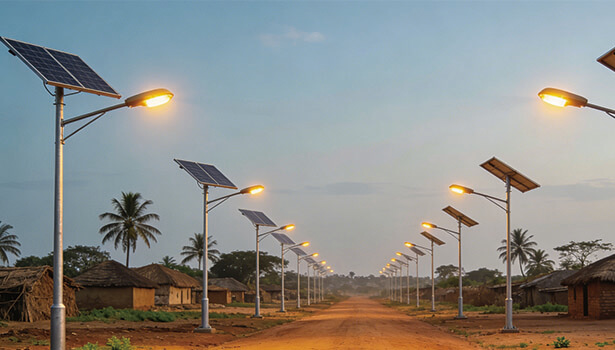
The core logic of solar street lights is straightforward, forming a closed-loop operating model of “storing energy during the day and emitting light at night.” The system operates entirely autonomously without relying on the national power grid. During the day, solar panels capture sunlight and convert it into electrical energy, simultaneously charging the rechargeable battery. After dark, the controller automatically activates the lighting mode, with the battery powering the LED lights to ensure stable illumination at night.For Nigeria, with its abundant sunshine, this operating model is highly suitable—the year-round abundance of sunlight provides a stable energy source for solar street lights, eliminating concerns about insufficient energy supply.
Core Components
The stable operation of solar street lights relies on the synergy of four core components, each of which is highly practical and tailored to Nigeria’s usage scenarios. The solar panel is the core power-generating component; it efficiently captures sunlight during the day, adapting to Nigeria’s intense sunlight, and providing a continuous supply of electricity to the entire system; the rechargeable battery stores excess daytime energy, ensuring uninterrupted nighttime lighting and fundamentally resolving the issue of lighting failures caused by power outages in Nigeria’s grid.
LED lights, as the core of the lighting system, are characterized by high efficiency, durability, and sufficient brightness. They not only provide clear nighttime visibility but also reduce maintenance frequency and costs, meeting Nigeria’s long-term usage needs. The controller serves as the intelligent control hub, automatically managing charging and lighting schedules to prevent energy waste and enhance the system’s overall energy efficiency.
Challenges Faced in Implementation
Vandalism and Theft of Components
Core components such as solar panels and rechargeable batteries are relatively valuable. Without effective protection, they are prone to theft and vandalism, which directly affects the normal operation of the street light system. This is also one of the main reasons hindering the promotion of solar street lights in some areas of Nigeria.
To address this issue, a two-pronged approach can be taken: First, strengthen public awareness and education among community residents to foster a sense of community protection, encouraging residents to actively participate in safeguarding the equipment. Second, adopt tamper-resistant designs and reinforce component installations to reduce the likelihood of theft and vandalism, laying the groundwork for future expansion.
Insufficient Installation Skills: Professional Support Is Key
The core reason why some solar street lights fail to operate normally or have a shortened lifespan after installation is the lack of professional technicians, non-standard installation procedures, and inadequate commissioning. The key to solving this problem is to strengthen technical support: First, conduct training for local engineers to cultivate a group of professionals with installation, commissioning, and maintenance capabilities. Second, collaborate with experienced solar energy companies to leverage the technical expertise of professional teams, ensuring installation quality and improving system operational stability.
5 Benefits of Solar Street Lighting in Nigeria
Enhancing Safety
Safety is the most direct and important benefit of solar street lights, especially for underlit communities in Nigeria, where each solar street light serves as a line of defense. Adequate nighttime lighting effectively deters criminal activities such as theft and robbery, reduces safety hazards caused by darkness, and safeguards residents’ personal safety and property.
In unlit areas such as rural and suburban regions of Nigeria, the installation of solar street lights significantly enhances the sense of safety for nighttime travel. At the same time, well-lit streets improve nighttime visibility, reducing traffic accidents involving pedestrians, cyclists, and drivers, and making nighttime travel safer and more reassuring.
Promoting Community Development
Solar street lights not only illuminate the night but also invigorate community development and drive comprehensive progress. From an economic perspective, reliable nighttime lighting enables markets and shops to extend their operating hours, stimulating local nighttime economic growth, creating more job opportunities for residents, and boosting the local economy.
From a social perspective, well-lit streets encourage residents to step outside, engage in outdoor activities, and interact with neighbors, breaking down barriers, strengthening community cohesion, and enhancing residents’ sense of well-being and belonging. Additionally, reliable lighting ensures the safety of public facilities such as schools and hospitals, thereby improving the quality of community services.
Cost-Effective and Sustainable
Many people worry that the installation costs of solar street lights are too high, but in the long run, their cost advantages and sustainability far exceed those of traditional street lights, making them particularly suitable for Nigeria’s development needs. The following is a cost comparison between solar street lights and traditional grid-connected street lights, clearly demonstrating their long-term advantages:
|
Comparison Dimension |
Solar Street Lights |
Traditional Grid Street Lights |
|
Initial Investment |
Higher |
Lower |
|
Daily Energy Cost |
Zero (no electricity bills required) |
Higher (continuous electricity costs) |
|
Maintenance Cost |
Lower (reliable components, less frequent maintenance) |
Higher (regular line inspection and lamp replacement required) |
|
Long-term Benefits |
Significant (5–10 year lifespan with lower total cost) |
Moderate (accumulated electricity and maintenance costs are higher) |
In addition, solar street lights utilize renewable solar energy and do not require the burning of fossil fuels, effectively reducing carbon emissions. This aligns with global environmental trends and meets Nigeria’s needs for green development, thereby achieving dual benefits for both the economy and the environment.
Adaptability to Nigeria’s Climate
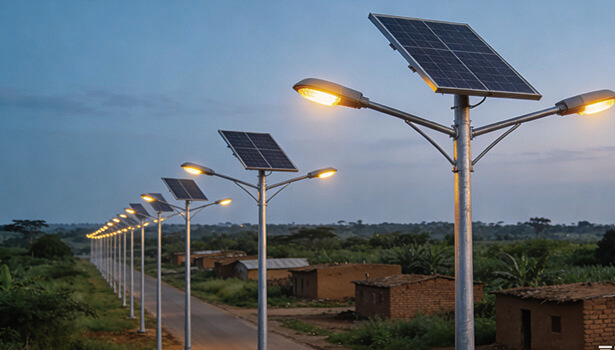
Nigeria has a tropical savanna climate, characterized by year-round heat and humidity, with some regions experiencing severe weather conditions such as heavy rains and high temperatures, which place high demands on the weather resistance of street lights. Solar street lights are specifically designed for outdoor environments and are perfectly suited to Nigeria’s climate: on the one hand, they fully utilize Nigeria’s abundant year-round sunlight to ensure a stable energy supply, eliminating concerns about energy shortages. On the other hand, their components possess strong weather resistance, capable of withstanding harsh conditions such as heat, humidity, and heavy rain; their durable structure enables long-term, stable operation without the need for frequent maintenance.
Filling the Energy Gap
In Nigeria, many rural and remote areas have insufficient grid coverage or no electricity supply at all, severely impacting residents’ daily lives and production, and lighting issues are particularly difficult to resolve. Solar street lights utilize a decentralized lighting model that does not rely on the national grid; as long as there is sunlight, they can provide illumination, perfectly filling the energy gap in these areas. They provide stable nighttime lighting for residents in remote areas, improving living conditions, while also supporting local infrastructure development and promoting equitable urban-rural development.
Frequently Asked Questions (FAQs)
Q1: What is the lifespan of a solar street light?
A1: The lifespan of a solar street light is typically 5–10 years, depending on battery quality and routine maintenance. With regular inspections and simple maintenance, extending the lifespan to over 10 years is entirely feasible.
Q2: Do solar street lights work normally on cloudy days?
A2: Yes, they can. Modern solar street light systems have strong energy storage capabilities. They store excess energy on sunny days, so even on cloudy days without sunlight, they can rely on stored energy to provide normal lighting for 2–3 days, fully capable of handling the cloudy conditions typical of Nigeria’s rainy season.
Q3: Is the installation cost of solar street lights high?
A3: Objectively speaking, the initial installation cost of solar street lights is indeed higher than that of traditional grid-connected street lights, but in the long run, they are more cost-effective. Since solar street lights do not require electricity bills from the grid and have extremely low maintenance costs, their total cost over the long term is far lower than that of traditional street lights, making them a more cost-effective choice.
Q4: Are solar street lights suitable for flood-prone areas?
A4: Yes, they are. As long as the light poles are installed at a sufficient height and the electronic components—such as solar panels, batteries, and controllers—are properly waterproofed, solar street lights can operate normally in flood-prone areas, effectively addressing flooding issues in certain parts of Nigeria.
Q5: Can solar street lights be installed on private property?
A5: Yes. Solar street lights are not only suitable for public streets but are also ideal for installation on private property, such as residential areas, farm roads, industrial sites, and private yards. They enhance safety and improve the nighttime environment, making them suitable for a wide range of applications.
For Nigeria, solar street lights are not merely a lighting solution; they are a vital pillar for overcoming lighting challenges, enhancing community safety, and driving community development. With multiple advantages—including off-grid operation, cost savings, climate adaptability, and the ability to bridge energy gaps—they perfectly align with Nigeria’s practical needs. Although challenges such as theft and technical limitations may arise during implementation, widespread adoption can be achieved by implementing targeted solutions.