Solar Street Light Manufacturing Process: From Product Design to Quality Control
Aug 07, 2026
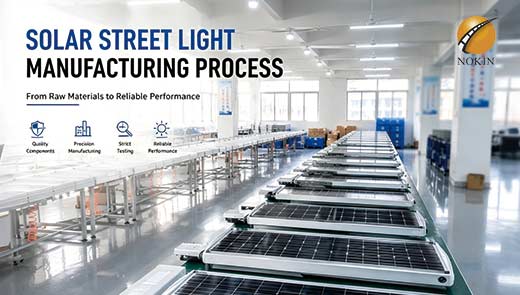
Most solar street light purchasers are familiar with the core components of the product: solar panels, LED lights, lithium batteries, and intelligent controllers. However, very few customers truly understand the complete manufacturing process of a qualified solar street light from the initial research and development to factory shipment.
A standardized and mature manufacturing process for solar street lights is the core foundation for product performance and stability, directly determining the key indicators of outdoor lighting projects:
- Overall lighting uniformity and brightness stability
- Outdoor waterproof, dustproof, and corrosion-resistant performance
- Lithium battery lifespan and night-time continuous lighting duration
- Product failure rate and after-sales maintenance cost
- Long-term success rate of municipal and commercial lighting projects
Next, solar street light manufacturer NOKIN will comprehensively disassemble the high-quality solar street light manufacturing process in the professional factory, covering six core links: product design, raw material selection, assembly production, process quality control, finished product inspection, and packaging shipment, to help purchasers accurately identify reliable solar street light manufacturers.
Why the Solar Street Light Manufacturing Process Matters
Most novice purchasers, when selecting models, only focus on the surface product parameters, and the most commonly referenced indicators include LED power, lumen value, battery capacity, etc.
But these static parameters cannot represent the actual service life and operational stability of solar street lights. What truly determines the long-term performance of solar street lights is a complete and standardized manufacturing and quality control system. The following table clearly contrasts the essential differences between "only focusing on parameters" and "relying on the entire manufacturing process":
|
Focus Only on Product Parameters |
Relying on the Entire Manufacturing Process |
|
Outstanding nominal specifications, but only a superficial appearance |
Stable real-world performance with genuine long-term reliability |
|
Lower initial procurement cost |
Longer product lifespan and lower total cost of ownership |
|
Internal components are unknown and unverified |
100% raw material verification with multiple layers of inspection |
|
No standardized quality control process |
Strict multi-stage quality inspections throughout the entire manufacturing process |
In actual project implementation, solar street lights with excellent parameters but rough manufacturing processes often experience water ingress, light degradation, battery bulging, controller failure, etc. within 1-2 years. Precise and mature manufacturing processes are the fundamental guarantee for the long-term durability of solar street light lighting projects.
Step 1: Solar Street Light Product Design
Product design and engineering optimization are the starting point and the most core环节 of solar street light manufacturing. A reasonable design scheme can avoid 80% of the subsequent product failure risks.
Optical Lighting Design for Solar Street Lights
Professional solar street light factories do not use general templates but customize precise optical lighting solutions based on actual road lighting standards and project requirements.
The core of optical design includes: LED power matching, professional light distribution design, overall road illumination uniformity adjustment, road grade adaptation calibration.
Regular solar street light manufacturers all use professional optical simulation software such as DIALux, AGi32 for pre-production simulation, which can accurately reproduce the lighting effects of street lights on different widths and slopes. Through optical simulation, engineers can optimize the beam angle, avoid local over-bright or dark areas, and ensure that solar street lights fully comply with municipal road lighting specifications and project acceptance standards.
Structural Design of Solar Street Lights
The structural design determines the outdoor adaptability and physical durability of solar street lights, covering four core modules: the light body shell, the heat dissipation system, the waterproof structure, and the installation bracket.
The integrated heat dissipation structure can quickly discharge the heat generated by the LED, effectively reducing the rate of light attenuation and significantly extending the lifespan of the LED light source.
The multi-layer waterproof structure, combined with the sealing rubber ring and the integrated molding process, can significantly enhance the IP protection level of the product, preventing rainwater and dew from seeping into the light body and the internal circuit.
At the same time, the optimized shell and bracket structure can isolate high-temperature heat sources, avoiding excessive battery temperature, and ensuring the long-term stable operation of the battery system.
Electrical System Design for Solar Street Lights
The electrical system is the core brain of the entire solar street light system. The rationality of its design directly determines the photovoltaic conversion efficiency and operational safety of the product.
The core design content includes: matching of MPPT/PWM intelligent controllers, optimization of the battery management system, setting of intelligent charging and discharging logic, and comprehensive circuit protection design.
High-quality controllers support intelligent light control and time control functions, automatically adjusting the charging and discharging strategies based on light intensity. The built-in overcharge, overdischarge, overcurrent, and short-circuit protection circuits can effectively avoid battery and circuit damage, significantly enhancing the product's safety.
Step 2: Solar Street Light Raw Material Inspection
The quality of raw materials is the foundation of the final product quality. Professional solar street light factories implement strict incoming material inspection standards for all core and auxiliary raw materials, preventing substandard materials from entering the production process at the source.
Solar Panel Quality Inspection Standards
The solar panel is the core energy input component of the solar street light. The factory's quality inspection focuses on three indicators: photovoltaic conversion efficiency, appearance integrity, and power consistency.
Grade A monocrystalline silicon solar panels are the preferred choice for high-quality products. Compared to polycrystalline silicon and inferior materials, they have advantages such as high conversion efficiency, good low-light performance, and stable power output.
The factory will sample and conduct full-power testing on each batch of panels, screening out low-efficiency, scratched, cracked, and unevenly powered defective products to ensure the stability of solar energy storage.
LED Light Source Quality Inspection
The parameters of the LED light source directly affect the lighting effect and lifespan of the street light. The factory conducts comprehensive testing of the core parameters of the LED light beads before assembly.
Key testing items: luminous flux, color temperature accuracy, color rendering index (CRI), forward voltage consistency.
Parameters of uniform LED beads can ensure uniform brightness, no color difference, and stable light output. While poorly parameterized inferior beads will develop local dark areas and severe light attenuation over time, significantly shortening the lighting lifespan.
Lithium Battery Quality Inspection
The battery determines the night lighting duration and rainy-day standby capability of the solar street light, and is a core component affecting the product's reliability.
The factory's incoming material inspection for batteries includes: actual capacity testing, internal resistance testing, cycle life verification, and safety performance testing.
Only batteries with qualified capacity, stable internal resistance, and long cycle life can be put into production. High-quality batteries can ensure the continuous 3-7 days of normal lighting in rainy days for the street light, with a lifespan of up to 5 years.
Die-Cast Aluminum Housing Inspection
Solar street lights are exposed to outdoor environments for a long time, so the shell material must have excellent corrosion resistance and weather resistance.
Professional factories use high-pressure die-casting aluminum to manufacture the light body and brackets. The quality inspection focuses on the thickness of the material, the uniformity of the surface coating, and the anti-corrosion and anti-oxidation performance.
Die-cast aluminum has high hardness, strong anti-pressure and anti-shock performance, and is combined with a professional surface spraying process to resist ultraviolet radiation and rain erosion, avoiding rusting and fading of the shell, and suitable for various harsh outdoor scenarios.
Step 3: Solar Street Light Assembly Process
After all raw materials pass quality inspection, the product enters the formal production and assembly stage. Each assembly process has standardized operation procedures and dedicated position quality inspection standards to ensure assembly accuracy and product quality.
PCB Circuit Board Assembly
The factory produces PCB circuit boards using the automated SMT soldering process, with high precision, high efficiency, and low failure rate.
The staff complete the steps of solder paste printing, component mounting, and reflow soldering according to the standardized procedures. After assembly, they conduct comprehensive circuit conduction tests using professional equipment to completely eliminate issues such as false soldering, missed soldering, and short circuits.
LED Module Assembly
In the LED module assembly process, the staff first fix the qualified LED light beads, then evenly apply high-performance thermal conductive silicone.
The thermal conductive silicone can closely adhere to the LED module and the heat sink, improving the heat conduction efficiency. Subsequently, they precisely install and fix the heat dissipation structure to ensure the overall heat dissipation effect of the light body and prevent LED burnout due to high temperatures.
Solar Panel Installation
The core requirement for solar panel installation is to be firmly fixed and waterproof. The factory uses dedicated brackets and bolts to fix the panels, eliminating the problem of shaking or falling off in windy weather.
After the positive and negative pole connections are connected, the connection gaps are sealed with waterproof glue and sealing strips to effectively prevent water from seeping into the circuit and ensuring the safe and stable operation of the power supply system.
Battery Assembly
The batteries are assembled in a dust-free workshop as complete battery groups, along with the corresponding BMS protection circuit board.
The staff complete the waterproof connection and shaping packaging, and the integrated battery group can avoid the risks of loose lines and water ingress, protecting the circuit and preventing abnormal charging and discharging.
Final Assembly
The final assembly process integrates all components and completes the light body packaging, pole bracket installation, screw and accessory tightening, and other complete procedures.
All assembly operations strictly follow the unified process standards to ensure the internal wiring is neat, the external fixation is reliable, and the overall structure is unified, laying a solid foundation for subsequent quality inspections.
Step 4: Solar Street Light Quality Control (IQC, IPQC & OQC)
High-quality solar street light manufacturers do not rely solely on final product testing to control quality. The entire process quality control system runs through all production stages to prevent substandard semi-finished products from flowing into the next process.
Incoming Quality Control (IQC)
Incoming material inspection is the first line of defense in the factory's quality control. All incoming raw materials and auxiliary materials must undergo strict sampling or full inspection.
Quality inspectors verify the parameters, appearance, and performance of solar panels, LEDs, batteries, shells, and electronic components one by one. All不合格 materials are directly returned to ensure that 100% of the production raw materials meet the standards.
In-Process Quality Control (IPQC)
Quality control personnel track and inspect each production process throughout.
The inspection scope covers core indicators such as product assembly size accuracy, welding firmness, circuit conduction performance, and sealing effect. Once process errors or non-conforming products are detected, they are immediately rectified and reworked to avoid the generation of batch defects.
Production Line Patrol Inspection
Professional QC personnel conduct irregular tour inspections of the production line every day.
They focus on checking whether the workers' operations comply with the standardized procedures, whether the production environment meets the dust-proof and constant-temperature standards, and whether there are quality hazards in the semi-finished products. Real-time monitoring ensures stable production quality.
Step 5: Solar Street Light Performance Testing
After the product assembly is completed, all solar street light products must undergo a complete set of professional performance tests, which is the core环节 to ensure the factory's qualification rate and product stability.
Waterproof Testing
Outdoor solar street lights need to be adapted to rainy and humid environments. The waterproof test is a mandatory inspection item.
The factory conducts waterproof tests according to the IP65, IP66, and IP67 classification standards. Through spray and immersion water simulation tests, it verifies the sealing performance of the light body and connection parts.
Only products with intact waterproof performance and no water ingress can pass the test and meet the requirements for all-weather outdoor use.
Aging Testing
All products must undergo a 24-48-hour continuous lighting aging test. High-standard projects can support an extended aging test of 72 hours.
Aging test can simulate the long-term continuous operation state of the product, effectively exposing hidden faults such as unstable circuit operation, uneven light emission, and abnormal battery discharge, screening out defective products and conducting rework and rectification to ensure zero faults in the final shipment.
Charge & Discharge Testing
This test simulates the real working state of solar street lights during the day charging and at night discharging.
The factory tests the charging efficiency of solar panels, the stability of battery charge and discharge, and the sensitivity of the controller response, calibrates the intelligent adjustment functions such as light control and time control, and ensures that the product's energy storage capacity and lighting duration comply with the design standards.
Lighting Performance Testing
Professional optical detection equipment is used to measure the core indicators such as illuminance (lux), beam angle, and overall lighting uniformity of the product.
The measured data is compared and verified with the previous DIALux simulation data to ensure that the actual lighting effect fully matches the project design requirements and road lighting standards.
Appearance Inspection
Quality inspectors conduct detailed inspections of the appearance of the finished products, checking whether the light body has scratches, peeling, deformation, whether the logo printing is clear, and whether the accompanying accessories are complete.
Strict appearance screening ensures that the shipped products have intact appearance and complete accessories, fully meeting the engineering delivery standards.
Step 6: Solar Street Light Packaging & Shipment
Solar street lights are precision outdoor lighting equipment. Rough packaging is prone to causing damage during long-distance transportation. Professional factories have standardized packaging and outbound quality inspection processes.
Protective Packaging
The product is wrapped with high-density foam inside to avoid damage from transportation collisions and squeezes; the outer layer is equipped with thick cardboard or wooden boxes, which have good shock and pressure resistance performance.
Export Packaging Standards
Batch export order products are uniformly stacked on standard pallets for convenient container loading and transportation. Each batch of products is labeled clearly with the product model, parameters, production batch, and quality inspection qualified information.
Export Packaging Standards
Before shipment, QC personnel conduct final sampling verification of the packaged finished products to confirm that the packaging is intact and the products are qualified, to prevent defective products from being shipped and avoid transportation losses.
How Professional Solar Street Light Manufacturers Ensure Consistent Quality
The stable quality of solar street lights relies on a closed-loop, comprehensive quality management system rather than single-stage testing. The standardized quality control process of professional manufacturers is as follows:
Product design → Engineering review → Raw material IQC inspection → Assembly production → Process IPQC inspection → Product performance testing → Long-term aging test → Standardized packaging → Delivery and delivery
Regular high-quality factories all establish an IQC, IPQC, and OQC three-level quality control system to achieve full-dimensional quality monitoring coverage from raw materials to finished products.
Meanwhile, high-quality manufacturers obtain ISO9001 quality management system certification and implement batch production traceability management. Each batch of products has complete production records, test reports, and qualification certificates, which can support third-party factory inspections and project acceptance.
How to Choose a Reliable Solar Street Light Manufacturer
Supplier Evaluation Checklist
To avoid the risk of purchasing inferior products and ensure project quality, before cooperation, suppliers can verify the factory's strength through the following checklist:
- Does the factory have an independent professional R&D and engineering design team?
- Can it provide official DIALux road lighting optical simulation reports?
- Does the production process implement a complete IQC/IPQC/OQC three-level quality control system?
- Can it provide complete aging test reports and performance testing data for finished products?
- Does the factory support third-party factory inspections and product sampling tests?
- Does it hold ISO9001 international quality management system certification?
- Can it provide product batch traceability records and qualification certificates?
- Can it provide IES/LDT optical test files for project design and acceptance?
Frequently Asked Questions
What is the complete production process of solar street lights?
The production of solar street lights mainly includes six core steps: specialized engineering product design, strict selection and quality inspection of raw materials, automated + standardized assembly production, full-process process quality control, multi-dimensional finished product performance testing, and standardized packaging and delivery inspection. Each step follows unified industry standards to ensure stable and durable products.
What core quality tests are required for solar street lights to be qualified?
Qualified solar street lights must pass a complete set of specialized tests, including IP level waterproof testing, 24-48 hours continuous aging test, charging and discharging cycle test, lighting performance parameter testing, appearance inspection, and delivery sampling test. High-standard products also need to pass special tests such as high and low temperature tolerance and salt spray corrosion.
Why is aging test so crucial?
Aging test is the most effective way to detect hidden faults in products. Through continuous power supply for a long time, it can expose problems such as unstable circuit operation, abnormal LED light decay, and battery discharge faults that cannot be detected by short-time testing, significantly reducing the failure rate of products after delivery and ensuring the long-term stable operation of the project.
How long does the production cycle of solar street lights take?
The production cycle is affected by the order quantity and customization degree. The production cycle for standard solar street lights is 7-10 working days; for special parameters and customized appearance products, including design confirmation, production inspection, and packaging throughout the process, the cycle is 12-15 working days.
How can suppliers verify the factory's production quality?
Suppliers can verify the factory's strength through various methods: checking formal qualifications such as ISO9001, requesting optical simulation reports and aging test reports, confirming the implementation of the three-level quality control system, on-site factory inspection or entrusting third-party sampling tests, and verifying the batch traceability archives and engineering supporting materials of the products.
Conclusion
High-quality solar street lights are not simply a combination of solar panels, LEDs, and batteries. The long-term stability and service life of the product are entirely dependent on a complete and mature manufacturing and quality management system.
From the professional engineering design in the early stage, the strict selection of raw materials, to standardized assembly production, full-process quality control, meticulous finished product inspection, and safe packaging for shipment, every step is indispensable.
For engineering purchasers and brand customers, instead of simply comparing prices and stacking parameters, choosing a manufacturer with a complete R&D capability and a full-process quality control system can effectively reduce the post-project costs and ensure the long-term stable implementation of outdoor lighting projects.