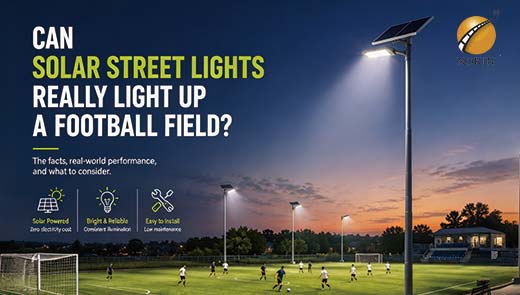
Can Solar Street Lights Really Light Up a Football Field?
Aug 05, 2026
The World Cup showcases the highest professional standards of sports lighting worldwide. Bright and uniform field lighting ensures high-speed game competitions, player safety during movement, and high-definition live broadcast quality. As the popularity of football worldwide increases, more schools, communities, and parks are building night football fields to enhance the utilization of the venues.
Unlike professional large stadiums, grassroots football fields place greater emphasis on low construction costs, low electricity bills, and low maintenance expenses. Therefore, solar street lights have become a popular alternative lighting solution. However, most project owners have a core question: Can solar street lights effectively illuminate football fields?
There is no uniform answer to this question, and the core depends on the use of the field, lighting standards, and custom design of the system. This article comprehensively analyzes the feasibility of solar lighting for football fields based on international sports lighting standards and practical engineering experience.
Can Solar Street Lights Meet Football Field Lighting Requirements?
Conclusion: Yes, but only applicable to basic non-professional scenarios and cannot meet the requirements of World Cup-level, live broadcast-level professional events.
Recommended Football Field Applications
Solar street lighting system with its advantages of energy saving, low cost, and easy installation perfectly suits basic football fields and is also the mainstream solution for the renovation of grassroots sports facilities worldwide. The specific scene adaptability is as follows:
|
Football Field Usage Scenario |
Suitability for Solar Street Lighting |
|
School Standard Football Field |
Highly Recommended |
|
Community Public Football Field |
Highly Recommended |
|
Park Five-a-Side / Seven-a-Side Football Field |
Highly Recommended |
|
Amateur Night Training Ground |
Recommended |
|
Semi-Professional & Local Amateur Match Venue |
Not Recommended for Primary Lighting |
|
World Cup-Level & Professional Broadcast Stadium |
Not Suitable |
From the perspective of actual engineering implementation, schools, communities, and small five-a-side football fields are the core mainstream markets for solar street lighting. The solutions are mature and have an extremely high cost performance, and can fully meet the needs of daily night football playing and basic training.
Understanding Professional Football Field Lighting Standards
Why Are World Cup Stadiums Always So Bright?
The high-brightness lighting effect of top-level World Cup stadiums is not achieved simply by stacking high-power lights; it follows strict professional sports lighting standards. Understanding the lighting logic of professional stadiums is necessary to accurately distinguish the differences between professional event lighting and grassroots venue lighting.
The Core Reasons Football Matches Require High-Quality Lighting
Football is a large-scale, high-speed dynamic sport where players need to constantly judge the ball's trajectory, the position of teammates, the actions of opponents, and the boundaries of the field. Ordinary basic lighting is far from sufficient; a stable, uniform, and high-definition lighting environment is the core prerequisite for ensuring safety in sports and fairness in competitions.
Five Core Assessment Indicators for Stadium Lighting
The quality of lighting is determined by professional parameters and has no direct relation to the wattage of the lights:
- Average illuminance: The core brightness standard for the field, with World Cup broadcast-level stadiums reaching 1500–2000 lux.
- Illuminance uniformity: Eliminating dark areas and visual blind spots to ensure consistent light across the field.
- Vertical illuminance: Ensuring clear and transparent images for high-definition live broadcasts from multiple angles.
- Color Rendering Index (CRI): Accurately reproducing the colors of the grass and jerseys, optimizing the viewing experience.
- Glare control: Avoiding strong light that is dazzling and preventing interference with players' rapid movement during visual judgment.
Do Ordinary Football Fields Need Professional Stadium Lighting?
Most grassroots football fields do not require professional event-level lighting; blindly pursuing high-end equipment will only result in cost waste. The lighting standards for different football fields in different scenarios vary greatly.
Lighting Standards for Different Football Field Applications
Based on international sports lighting standards and the needs of grassroots venues, the illuminance standards and professional requirements for different scenarios are as follows, clearly distinguishing between essential configurations and high-end configurations:
|
Use Scenario |
Recommended Illuminance Range |
Professional Sports Lighting Required? |
|
Community Recreation & Leisure Fields |
75–100 Lux |
No |
|
School Training Fields |
100–200 Lux |
No |
|
Amateur Competition Fields |
200–300 Lux |
Partially Required |
|
Semi-Professional Match Venues |
500 Lux |
Yes |
|
Professional Competition Stadiums |
750–2,000 Lux |
Yes |
It can be seen that only professional events and high-definition broadcasting scenarios require World Cup-level ultra-high-end lighting. The vast majority of schools, communities, and park football fields only need basic lighting configurations to meet daily usage needs, and this is the core application scenario for solar street lights.
Challenges of Football Field Lighting Design
Compared to ordinary roads and courtyard lighting, the implementation of football field lighting is more difficult, with three core pain points that are also key issues to be overcome in the design of solar lighting systems.
Large Lighting Coverage Requirements
A standard 11-a-side football field has a size of 105m×68m, with an overall area of 7140㎡. This area far exceeds the lighting coverage range of ordinary municipal roads and residential courtyards. A large area of the venue implies that the lighting fixtures need to have an extremely wide coverage range, and a proper layout of the light poles is also necessary to achieve full coverage without any blind spots throughout the venue. This requires extremely high standards for the luminaire design and installation plan.
Uniform Lighting Distribution
The most undesirable light distribution in a football field is "bright in the middle, dim on the sides, and dark along the sidelines". Ordinary lighting fixtures often have a high center light spot and severe light attenuation at the edges.
Uneven light distribution will create a large number of visual blind areas, making it impossible for players to accurately judge the boundaries of the field and the position of the football when running, passing, or shooting. This can easily lead to collisions, falls, and other safety accidents, seriously affecting the sports experience.
The Importance of Pole Height
The coverage range of lighting is proportional to the height of the light poles. The higher the light pole, the larger the spread area of the light and the more uniform the illumination.
World Cup and professional stadiums generally use light poles of 15-30 meters high, combined with professional spotlights, to meet the requirements of large venues and high illumination.
The height of the conventional solar street light poles is only 6-10 meters. Traditional low-end solar lights cannot meet the lighting requirements of large football fields and must be customized with taller light poles and professional luminaire designs.
Advantages of Solar Street Lights for Football Fields
In the construction of grassroots football fields, solar street lights have gradually replaced traditional grid power lighting and become the mainstream choice. For projects with limited budgets and a focus on long-term cost-effectiveness, their advantages are particularly prominent.
No Trenching or Underground Wiring
Traditional grid power football field lighting requires digging the ground, laying cables, and installing distribution cabinets, which is a cumbersome process and can damage the site's greenery and ground structure.
Solar street lights are a stand-alone off-grid system, requiring no wiring or distribution equipment, and are particularly suitable for remote rural schools, suburban communities, and sites without power grid coverage. They have extremely strong adaptability.
Zero Electricity Costs
The solar system stores energy through photovoltaic panels absorbing solar energy and uses it for lighting at night. There is no need to consume grid power throughout the process, achieving zero electricity cost for night lighting.
From the perspective of the entire life cycle cost, the solar stadium lighting system can save thousands to tens of thousands of dollars in long-term electricity costs. It can recover the initial investment cost within 3-5 years and has a lifespan of 8-10 years, with a cost performance far exceeding traditional grid power lighting.
Fast Installation
Traditional stadium lighting requires completing wiring, distribution, and debugging processes, which take several weeks.
Solar street lights do not require complex supporting equipment. They only need to complete light pole fixation and equipment assembly and debugging to be completed. The installation period is shortened by more than 60%, and can quickly open the football field for use at night.
Low Maintenance Costs
Solar stadium lighting uses high-quality LED light sources and a maintenance-free lithium battery system, with small light source attenuation and long battery life. The entire system has no complex circuits and no frequently worn-out components. In the future, only regular cleaning of the photovoltaic panels is required. The annual maintenance cost is less than 100 US dollars, significantly reducing the operational pressure of the site.
How to Determine Whether Your Football Field Is Suitable for Solar Street Lights
Not all football fields can directly apply the solar lighting solution. Professional assessment and customized design are necessary to ensure the lighting effect. The following is the standardized procurement assessment process.
Step 1 Determine the Intended Use
First, determine the site positioning: is it only for daily leisure and entertainment, basic training for students, or needs to host small amateur competitions. Different uses directly determine the illumination standard, light configuration, and system plan, which are the core basis for selection.
Step 2 Select the Target Illuminance
Abandon the misconception that "the higher the wattage, the better". Lock in the corresponding Lux illumination value based on the site use. For leisure and training fields, there is no need to pursue high-wattage lights. Meeting the standard illumination can meet the use requirements, avoiding cost waste.
Step 3 Assess Local Solar Conditions
Examine the average annual sunshine duration, the number of rainy days, and the shading conditions of the site (trees, buildings). In sunny areas, regular configuration is possible, while in areas with more rainy days, the capacity of photovoltaic panels and batteries needs to be increased to ensure sufficient battery life.
Step 4 Conduct Professional Lighting Simulation
Through professional optical software, simulate the light distribution of the site, precisely plan the height of the light posts, installation spacing, and number of lights, and match the corresponding energy storage system to ensure uniform illumination throughout the site and sufficient battery life at night.
Solar Street Lights vs Traditional Stadium Floodlights
To more intuitively compare the compatibility of the two lighting schemes, the following provides a comprehensive comparison from multiple dimensions such as investment, operation and maintenance, and applicable scenarios, facilitating project selection decisions:
|
Comparison Item |
Solar Street Light Lighting |
Traditional Stadium Floodlights |
|
Initial Construction Investment |
Medium (No wiring, trenching, or power distribution costs) |
High (Includes wiring, distribution cabinets, transformers, and civil works) |
|
Daily Electricity Cost |
No electricity cost (Powered by solar energy) |
Continuous electricity consumption from the power grid |
|
Wiring & Installation Complexity |
No underground wiring required; simple and fast installation |
Extensive cabling and electrical infrastructure required |
|
Installation Time |
Short (Typically completed within 3–7 days) |
Long (Typically requires 15–30 days) |
|
Lighting Performance |
Medium (Suitable for schools, communities, and recreational football fields) |
Very High (Designed for professional matches and broadcast-quality lighting) |
|
Suitability for Community & School Football Fields |
Excellent |
Moderate |
|
Suitability for Professional Stadiums |
Limited |
Excellent |
Common Misconceptions About Solar Football Field Lighting
Based on a large number of engineering consultation cases, most project parties have lighting selection misconceptions. Correcting these perceptions can avoid pitfalls and choose cost-effective solutions.
Misconception 1: The higher the light wattage, the better the lighting effect
The core factors of lighting effect are light efficiency, professional light distribution, light post height, light layout, and illumination design, rather than just wattage.
High-wattage lights with poor light distribution will have problems such as scattered light, severe glare, and many dark areas. Reasonable light distribution design and layout can achieve uniform and bright lighting with low-wattage lights.
Misconception 2: All football fields need a 1000 Lux illumination level
A 1000 Lux or higher ultra-high illumination level is only suitable for professional events and high-definition broadcasting scenarios. For 90% of community and school football fields, a 100–200 Lux illumination level can perfectly meet the needs of daily leisure and night training. Blindly pursuing high illumination levels will only increase unnecessary construction costs.
Misconception 3: Solar lights cannot be used for football field lighting
This is the most common misconception. Ordinary low-end solar street lights cannot be adapted to football fields, but customized solar sports lighting systems are already very mature.
Customized solutions for adding high light posts, professional light distribution, and increasing battery capacity can fully meet the night lighting needs of basic sites and have been widely applied in many school and community projects around the world.
Frequently Asked Questions
Can solar street lights light a football field?
Yes. Customized solar street lights can fully meet the lighting needs of community, school, park football fields and amateur training venues. They are not suitable only for professional matches and World Cup-level HD broadcast venues.
How many solar lights are needed for a football field?
The quantity depends on the field size (5-a-side, 7-a-side, 11-a-side) and target lux. A standard 11-a-side community football field usually needs 8–12 customized solar sports lights, while small 5-a-side fields only need 4–6 sets.
What lux is required for football field lighting?
Community entertainment: 75–100 Lux; School daily training: 100–200 Lux; Amateur matches: 200–300 Lux; Semi-professional matches: 500 Lux; Professional & World Cup matches: 750–2000 Lux.
Are solar football field lights suitable for schools?
Extremely suitable. Solar lighting requires no wiring, has zero electricity bills, low maintenance costs, and safe and stable performance. It is the most cost-effective lighting solution for school football fields.
Can solar street lights replace stadium floodlights?
Solar lights can replace traditional floodlights for grassroots venues (schools, communities, amateur training). They cannot replace high-power professional floodlights used for high-level professional competitions and HD live broadcasts.
How tall should football field lighting poles be?
Grassroots solar football fields adopt 10–15m high poles to ensure uniform light coverage. Professional stadiums require 15–30m ultra-high poles to support high-lux and large-area lighting.
How long can solar football field lights work at night?
With standard solar panel and battery configuration, the lights can work 6–10 hours per night, and support 3–5 days of continuous lighting on rainy and cloudy days, fully meeting daily night use needs.
Is solar football field lighting worth the investment?
Absolutely worthy. Although the initial investment is moderate, there is zero electricity cost in the whole life cycle and extremely low maintenance cost. It can recover the cost in 3–5 years and has a service life of more than 8 years, with far higher cost performance than traditional lighting.
Conclusion
The World Cup has enabled us to witness the ultimate standards of top-level sports lighting. However, top-level event configurations are not suitable for all football fields. For the majority of schools, communities, and amateur training grounds, lighting solutions that are adaptable to the scenarios, low-cost, energy-efficient, and sustainable are far more valuable than blindly over-configuring.
The customized solar football field lighting system perfectly meets the construction needs of grassroots sports venues, taking into account lighting effects, construction costs, and long-term operation advantages. Under the global trend of green and low-carbon development and national fitness, solar sports lighting will undoubtedly become the core preferred solution for the construction of grassroots football infrastructure.