How Many Solar Street Lights Does a Parking Lot Need?
Aug 11, 2026
Why Is There No Fixed Number of Solar Street Lights for a Parking Lot?
Many parking lot operation and maintenance personnel, as well as engineering procurement staff, often encounter a confusion: For a 5,000-square-meter parking lot, some projects only install 12 solar street lights and the lighting is still bright and uniform, while other projects install 40 lights and still have dark areas and non-compliant lighting.
The core reason is that the number of solar street lights installed in a parking lot is not determined solely by the area factor, but is affected by multiple factors such as site layout, security lighting grade, solar light pole specifications, solar street light parameters, and local sunlight conditions. There is no universal and unified installation quantity standard.
Blindly copying the installation plans of other projects will only lead to two problems: too many lights, resulting in waste of procurement, installation, and operation funds; too few lights, resulting in lighting dead zones and inability to meet security and passage standards.
This article will disassemble a standardized and implementable calculation and layout process for solar street lights in parking lots, which only takes 5 minutes. After reading, you can independently calculate the required number of solar street lights, accurately match the parking lot site requirements, and avoid the problems of light waste or insufficient lighting.

Step 1: Determine the Required Illuminance for Your Parking Lot
All calculations of the number of solar street lights in parking lots must start with the illuminance standard. If the illuminance is not up to the standard, no matter how many solar street lights are installed, they cannot meet the usage requirements; if the illuminance standard is too high, it will only increase the cost of solar street light procurement and the entire system setup.
IES Parking Lot Lighting Illuminance Requirements
The industry's common authoritative standard is the IES Parking Lot Lighting Specification. The illuminance requirements for different parking lot scenarios vary greatly, directly determining the selection and quantity of solar street lights.
Firstly, clarify the two core lighting units: fc (feet candle) and lux (lux). The global universal conversion formula is: 1 fc ≈ 10.76 lux.
The official illuminance standards of IES for different parking lot scenarios are as follows, which can be directly compared to determine the illuminance level of your own site:
|
Parking Lot Type |
IES Recommended Illuminance |
Scene Description |
|
Basic Parking Area |
1–2 fc (approximately 10–20 lux) |
Provides adequate lighting for daily vehicle movement and basic safety. Suitable for ordinary residential areas and non-commercial park parking lots. |
|
High-Security Area (24-Hour Operation / Night Duty) |
Minimum 0.5 fc horizontal illuminance + 0.25 fc vertical illuminance |
Vertical illuminance provides better visibility for facial recognition and security monitoring. Suitable for industrial parks, logistics parks, and enclosed parking lots. |
|
Commercial Retail / Hotel Lobby Entrance Parking Area |
2–5 fc |
Considers brand image, customer experience, and nighttime safety, with higher requirements for lighting uniformity and brightness. |
Key Point: Security level determines the illuminance standard, and the illuminance standard directly determines the light specifications and installation quantity of the solar street lights in the parking lot. First determine the illuminance, then select the solar street lights, and calculate the installation quantity. This is the only correct logic for the design of solar lighting in parking lots.
Step 2: Choose the Right Solar Street Light Wattage and Lumens
Why Solar Street Light Wattage Does Not Equal Brightness
Currently, the mainstream configuration of solar street lights in parking lots is 200W solar street lights, with a standard luminous efficacy of up to 24,000+ lumens, fully meeting the regular lighting needs of large, medium, and small parking lots, and being the most cost-effective specification in engineering implementation.
Here, it is necessary to correct the common industry misconceptions in the selection of solar street lights: the wattage of solar street lights ≠ actual lighting brightness.
Lumens and Luminous Efficacy for Parking Lot Solar Lights
The core parameter for judging the brightness of solar street lights is lumens (lm) and luminous efficiency (lm/W). For solar street lights of the same wattage, the higher the luminous efficiency, the higher the actual brightness and the better the coverage and lighting effect of the parking lot. Some low-quality solar street lights have the problem of falsely labeled wattage, with extremely low actual luminance. They may seem to meet the parameter standards, but the lighting effect in parking lots is extremely poor after installation.
Solar street lights are independent photovoltaic energy storage systems, which is the essential difference from traditional city street lights, and it is also the core key to controlling the cost of parking lot solar lighting projects:
The wattage of parking lot solar street lights not only determines the lighting brightness, but also directly matches the specifications of the photovoltaic panels and energy storage batteries of the entire set of equipment. The higher the light wattage, the higher the procurement and installation costs of the entire solar street lighting system.
Therefore, the optimal design principle for parking lot solar lighting is not to blindly choose large wattage solar street lights, but to use the minimum total wattage solar street lights to precisely meet the illumination standards of the site and minimize the total project cost.
Step 3: Determine Solar Street Light Pole Height and Spacing
Under the premise of fixed specifications of parking lot solar street lights, the height of the light pole directly determines the coverage area and installation spacing of a single solar street light, and is the core hardware factor affecting the installation quantity of solar street lights. There is a universal industry golden rule for parking lot solar street light lighting.
Recommended Solar Street Light Pole Spacing
Common scenarios: Pole spacing = Pole height × 2 - 3 times
The most commonly used 8-10 meter light poles for parking lot solar street lights, with an appropriate spacing of 16-30 meters, balance the uniformity of lighting and the absence of dark areas, suitable for most commercial, industrial parking lot solar lighting projects.
Choose the Right Solar Street Light Beam Pattern
Different light distribution angles of solar street lights are suitable for different parking lot sites. Choosing the wrong one will directly lead to uneven lighting and too many dark areas:
Type III rectangular light spot: Light spreads horizontally, suitable for parking lanes and narrow passageways, ensuring continuous lane lighting;
Type V circular light spot: Light spreads evenly, suitable for large open parking areas without obstructions, covering a wider area.
Solar Street Light Coverage Area by Pole Height
Combining the actual operation data of parking lot solar street light projects, compiling the single-light effective coverage area and applicable scenarios of common light pole specifications, can be directly applied for selection and quantity calculation:
|
Light Pole Height |
Estimated Effective Coverage Area per Light |
Recommended Applicable Scenarios |
|
6 meters |
150–250 m² |
Small community parking lots, small supermarket parking areas, narrow parking areas |
|
8 meters |
250–400 m² |
Mid-sized commercial parking lots, main residential parking lots, standard park areas |
|
10 meters |
400–600 m² |
Large parking lots, logistics parks, industrial parks, open-air parking areas |
Step 4: Calculate How Many Solar Street Lights Your Parking Lot Needs
Combining the illumination standards in the previous steps, the parameters of solar street lights, and the single-light coverage area, you can use a general engineering estimation formula to quickly calculate the number of solar street lights needed for the parking lot, suitable for 90% of common parking lot solar lighting projects.
Solar Street Light Calculation Formula for Parking Lots
Number of lights ≈ Parking lot area ÷ Single-light effective coverage area × Safety factor (1.1 - 1.3)
The safety factor function: Mitigates issues such as tree shading, solar street light light attenuation, and power generation loss in rainy weather, ensuring that the solar street lights maintain long-term lighting standards, for high-security sites, the safety factor is recommended to be 1.2 - 1.3, for ordinary sites, 1.1 is sufficient.
Solar Street Light Calculation Example for a 5,000 m² Parking Lot
Case 1: 5,000 m² Parking Lot with 8 m Poles
Average single-light effective coverage area is taken as 300 square meters, the safety factor is taken as 1.2
Calculation: 5,000 ÷ 300 × 1.2 ≈ 20 lights
Case 2: 5,000 m² Parking Lot with 10 m Poles
The average coverage area of a single light is set at 500 square meters, and the safety factor is set at 1.2.
Calculation: 5000 ÷ 500 × 1.2 ≈ 12 lights
How Many Solar Street Lights Are Needed for a 5,000 m² Parking Lot?
By comparison, it can be seen that for the same area parking lot, increasing the height of the solar street light poles and optimizing the coverage area of a single light, the number of solar street lights installed is almost halved, which can significantly reduce the total cost of the solar lighting project for the parking lot. This is the core economic advantage of the high-pole high-power solar street lights.
Important note: This formula is the precise estimation value for the solar street light project in parking lots, which can meet the landing requirements of most civilian and industrial solar parking lot lighting projects. For super-standard, large commercial complexes, and special security sites, the final number and layout of solar street lights must be determined based on the optical simulation results of the Dialux and AGi32 lighting design software.
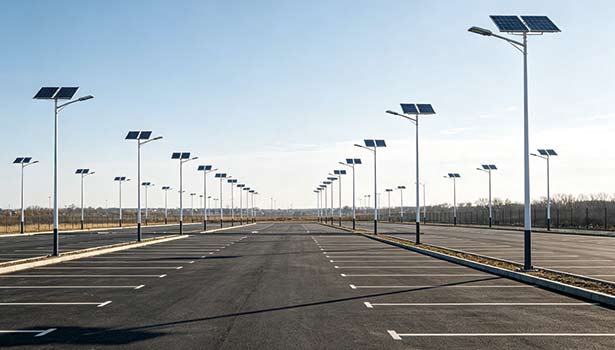
Step 5: Optimize Solar Street Light Layout for Parking Lots
The logic of installing solar street lights in parking lots is completely different from that of ordinary road lights. Road lighting focuses on linear passage lighting, while the core of solar lighting for parking lots is to use solar street lights to uniformly cover the parking area and eliminate dark areas in the parking area to ensure vehicle parking safety and security monitoring effects.
Common Solar Street Light Placement Mistakes
Most novice construction workers install solar street lights along the edge of the parking lot. This layout results in sufficient brightness at the edge of the site, but a large area of dark zone forms in the middle of the parking lot, which not only affects the parking view but is also a high-risk area for vehicle scratches and theft, making the solar street lights unable to achieve the optimal lighting effect and posing significant safety hazards.
Best Solar Street Light Layout for Parking Lots
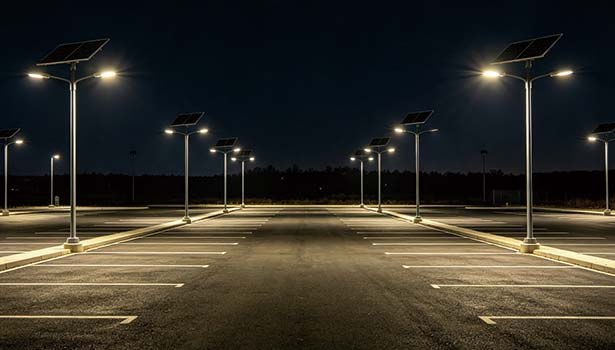
Parking lot solar street lights prefer to adopt a grid-like interlaced arrangement, breaking the limitation of unilateral lighting, allowing multiple solar street lights to cross-illuminate and achieve uniform illumination throughout the area, completely eliminating lighting dead zones.
Emphasizing lane and pedestrian passage lighting with solar street lights to ensure vehicle passage and pedestrian walking safety; for key positions such as parking lot entrances, toll booths, and corner blind areas, additional small solar supplementary lights can be added to significantly improve the security lighting level of the parking lot.
Step 6: Adjust Solar Street Light Design for Local Conditions
Solar street lights are an independent power generation and energy storage system without grid dependence, so after the number of lights is calculated, it must be re-verified based on the unique characteristics of solar lighting. Otherwise, problems such as insufficient lighting during cloudy days and insufficient battery life are prone to occur.
Check Local Sunlight Hours
In regions with a lot of rainy and foggy days throughout the year, the efficiency of photovoltaic panels for generating electricity is low. After calculating the number of lights, it is necessary to appropriately increase the battery energy redundancy or adjust the light layout to avoid insufficient lighting duration during nighttime.
Consider Site Shading
Green plants and buildings in the parking lot will directly affect the light collection and power generation of the photovoltaic panels. When installing lights, avoid shading areas. If shading cannot be avoided, appropriate increase in light configuration or upgrading of photovoltaic panel specifications is necessary.
How the Number of Solar Street Lights Affects Parking Lot Lighting Cost
The wiring and trenching for traditional city street lights are fixed engineering costs, and the number of lights has a limited impact on the total cost. However, for parking lot solar street lights, there is no need for wiring and trenching, and the entire system operates independently. The number of installed solar street lights directly determines the total project cost.
Taking a 5000-square-meter parking lot as an example, the total equipment and installation cost difference between 20 and 12 sets of solar street light systems can be up to $1000 - $2000. Precise optimization of the number and layout of solar street lights is the core means to reduce the cost of the solar lighting project for parking lots.
In summary: Optimizing the number and layout of solar street lights in parking lots is not only an optimization of lighting effects, but also directly reduces the total ownership cost of the project and improves the cost-effectiveness of the solar lighting project.
Parking Lot Solar Street Light Calculation: 6-Step Summary
Determine the grade: Refer to the IES standards to confirm the illuminance of the parking lot and the security level, and match the corresponding solar street light lighting standards;
Determine the specifications: Opt for 200W parking lot main solar street lights, with lumen and light efficiency as the core selection references;
Determine the coverage: Select the appropriate height of solar street light poles based on the size of the parking lot site, and confirm the coverage area of each light;
Calculate the quantity: Apply the formula + safety factor to accurately calculate the total number of solar street lights for the parking lot;
Optimize the layout: Interlace and stagger the placement of solar street lights in a grid pattern to cover entrances and exits, as well as dark areas in corners;
Adjust the solar power: Combine local sunlight conditions and site shading to optimize the energy storage and configuration of solar street lights, and control the total cost.
CTA
Do you want to apply the parking lot solar lighting solution directly without manual calculation? Please contact NOKIN. We offer free professional lighting design services. Fill in the inquiry form to obtain targeted lighting layout, light selection, and cost optimization plans, which are tailored to your exclusive parking lot project.