Solar Lighting Cost for Farms: Is Trenching Power Worth It?
Sep 17, 2026
Outdoor areas such as farms, open storage yards, and remote parking lots commonly face a core issue: there is a pressing need for lighting, but the sites are far from the public power grid. The lighting decisions for these remote sites are never a simple matter of choosing which type of lamp; rather, they are a real and substantial long-term financial calculation problem.
Many agricultural operators and site managers often find themselves in a dilemma when upgrading their lighting systems: should they spend a high cost to dig and lay cables to connect to the municipal power grid, or directly deploy solar lighting equipment without wiring? Both options have their pros and cons, but the vast majority have miscalculated the overall cost.
There are real community cases within the industry that can be referenced: multiple farm owners have reported that the basic quote from the power company for grid connection in remote sites is as high as $36,000, and this is only the basic connection cost, not including any supporting construction and long-term usage costs. Most purchasers have a significant misconception: they only focus on the single-time connection quote given by the power company, but ignore the hidden costs throughout the process. Excavation of trenches, cable laying, road surface restoration, construction approval, monthly electricity bills, annual line maintenance, and many other expenditures accumulate into a huge expense over the long term.
In this next blog, NOKIN will thoroughly break down the full-cycle costs of grid power connection and solar lighting, clearly defining the optimal solutions for different site distances and scenarios. Help you accurately determine: under what distance is grid power connection more cost-effective, and in what scenarios solar lighting can significantly reduce costs, completely avoiding the cost calculation trap.
What Does Grid Connection Cost for Farm Lighting?
The surface quote for grid connection access is often deceptive. The actual implementation cost is the sum of multiple fees, and the distance of the site is the core determining variable. The total construction cost for 100 meters and 1 kilometer can differ by more than 10 times.
Core Construction Costs for Grid Connection
Excavation construction is the largest cost item for long-distance connection, and the cost is greatly affected by the terrain. The industry's unified pricing standard is $15–$30 per foot. If it is a plain ground, the unit price is low; for complex terrains such as rocky ground, hardened pavement, and muddy farmland, the unit price is fully maximized.
Take an industry real calculation case as an example: for a 7,500-foot wiring distance, calculated at the highest unit price of $30 per foot, the sole excavation cost alone is as high as $225,000.
The costs of cables, protective conduits, and earth filling, increase linearly with the wiring distance. The farther the distance, the double increase in material and labor costs, with no room for compression.
Electricity Infrastructure and Approval Costs
Power company connection fees and grid expansion fees have no unified standard, and the policies and charges vary greatly from region to region. In long-distance wiring scenarios, it is likely to require additional poles, transformers and other supporting equipment, adding an additional cost of tens of thousands of dollars.
In addition, the construction permit approval and municipal reporting require a significant amount of time and manpower. If the construction involves digging hardened pavement, the subsequent pavement restoration is also a non-negligible fixed expense.
Long-Term Grid Electricity and Maintenance Costs
After the one-time construction, grid lighting is not zero in subsequent investment. Monthly fixed electricity bills, annual line inspections, aging cable replacement, and fault repairs, etc., will form long-term, continuous capital expenditures, with extremely high accumulated costs over the years.
Typical Grid Connection Cost Range
Based on industry massive project data, the total cost of grid connection can be divided into two ranges, with a significant disparity:
- Short-distance connection (within 100 meters, flat terrain): total cost $2,500–$12,500
- Long-distance connection (more than 500 meters, complex terrain): total cost can reach tens of thousands of dollars, the basic quote for a real farm case is $36,000, not including construction and subsequent costs
What Does Solar Lighting Cost for Farms?
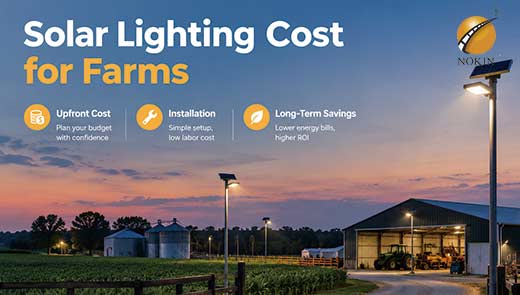
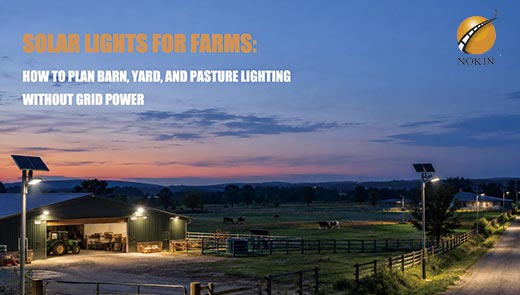
Solar street lights and solar flood lights are lighting solutions specifically designed for remote areas. Their core advantages include zero wiring, zero trenching, no ongoing energy cost, a simple and transparent cost structure, and no hidden expenses.
One-Time Solar Lighting Investment
The solar lighting system only requires a one-time investment, consisting of three core components: lighting fixtures, supporting poles, and the entire installation and construction costs. There is no need to dig the ground, lay cables, or connect to the power grid, eliminating large construction costs at the root.
What Affects Solar Lighting System Cost?
The pricing of a single solar lighting equipment is determined by four core configurations and can be flexibly customized according to the lighting needs of farms or storage areas, suitable for different scenarios:
- Lamp wattage: determines the lighting brightness and coverage area
- Lifespan: suitable for cloudy and no-light weather, remote farms can extend the lifespan as needed
- Pole height: suitable for open areas, ensuring uniform lighting
- Function configuration: light control sensing, time control adjustment, intelligent remote measurement, waterproof and lightning protection, etc., customized functions
How to Calculate the Total Cost of Solar Lighting
The total project investment = the number of lamps × the quoted price of a single solar lighting system. The calculation method is simple and intuitive, with no hidden additional costs, and the budget is highly controllable.
The most critical core advantage: the solar lighting system has no monthly electricity fees, no road aging maintenance costs, no grid expansion fees. All costs are only the initial one-time investment, with zero ongoing expenditures in the future. The cost curve stabilizes completely after implementation.
Solar Lighting vs. Grid Connection Cost by Distance
The distance between the site and the power grid is the core key factor determining the cost-effectiveness of the two schemes. We divide farm and remote site scenarios into three levels, and provide clear selection conclusions based on cost data, along with a real 10-year cycle cost calculation reference.
Core conclusion table for scenario selection
|
Scenario Level |
Grid Distance Condition |
Preferred Solution Tendency |
Core Reason |
|
A Level |
Within 100 meters; the power grid has already been laid near the site |
Grid connection is more cost-effective |
Short-distance trenching and wiring costs are extremely low, and the total long-term electricity cost is lower than the one-time investment in solar lighting. |
|
B Level |
100–500 meters; typical for crossroads and similar areas |
Case-by-case evaluation |
Costs fall within a relatively balanced range. The final decision depends on the number of lamps, terrain complexity, and local electricity prices. |
|
C Level |
500 meters or more, or no nearby power grid |
Solar lighting is strongly preferred |
Long-distance trenching, wiring, and grid-connection costs can far exceed the total cost of a solar lighting system, creating a significant cost advantage for solar lighting. |
10-Year Cost Comparison for an 8-Light Farm Project
Taking the common demand of small and medium-sized farms as an example: 8 sets of lighting equipment, a site 500 meters away from the nearest power grid. The 10-year total cost calculation:
- Grid connection scheme: grid connection fee $36,000 + trenching and wiring construction fee $80,000 + 10-year electricity and maintenance fee $45,000, total investment approximately $161,000
- Solar lighting scheme: 8 sets of custom solar street lamps with a one-time investment of $58,000, zero electricity fees, zero annual maintenance fees, total investment $58,000
Note: The above data is an industry standard estimation framework. The actual cost is based on on-site survey, official power company quotations, and customized configuration of the project.
Hidden Costs of Grid Power vs. Solar Lighting
Apart from the direct financial cost, the hidden differences in time cost, operational risk, and flexibility between the two schemes are also key considerations for farm operation decisions, and have a long-term impact on the operational efficiency of the site.
Time and Installation Delays
The process of grid connection is extremely cumbersome. From municipal approval, power company reporting, on-site construction, to road repair, the entire process usually takes several months, seriously delaying the lighting needs of the site.
Solar lighting does not require any approval or wiring process. Once the complete equipment arrives, all installations and tests can be completed within just a few days, allowing for quick deployment and use, significantly saving time costs.
Power Outages and Operational Risks
There are widespread issues of unstable power supply and frequent power outages in municipal power grids in remote farms and storage areas. Once the power grid is cut off, the lighting in the site will immediately fail, affecting night operations, material guarding, and security inspections, leading to operational losses and safety hazards.
Solar lighting operates independently and does not rely on the municipal power grid, being unaffected by power outages or unstable voltages. It provides stable lighting 24/7 and is suitable for complex operational scenarios in remote sites.
Flexibility and Future Expansion
Grid wiring is a one-time irreversible project. Once the lines are laid, they cannot be relocated. When conducting site renovations or regional adjustments, the existing lines are directly scrapped, resulting in cost waste.
The solar lighting system is completely modular and can be freely moved, freely increasing the number of lamps, and supporting later expansion and upgrade, adapting to the long-term needs of farm site expansions and functional adjustments, with extremely high flexibility.
When Is Grid Power Better for Farm Lighting?
We do not blindly recommend solar lighting. All decisions are based on a realistic cost calculation. In some specific scenarios, traditional grid power connection is indeed more cost-effective. The following are clear scenarios suitable for connecting to the grid:
Farm Sites Within 100 Meters of the Grid
The site is close to the public power grid, with a wiring distance of 100 meters or less, and no complex construction terrain.
Sites With Existing Grid Infrastructure
The site already has a mature power grid connection point, and no additional transformers, poles, or other supporting equipment are required.
Farms With High Electricity Demand
The site has a large amount of electricity demand, including agricultural product processing, refrigeration storage, and farmland irrigation, with lighting accounting for a very small proportion of the total electricity consumption.
Core principle: Do not promote products, only do precise cost calculation. Based on the actual conditions of the site, match the optimal and most cost-effective lighting solution.
How to Calculate the Payback Period of Solar Lighting
The logic of the solar solution's payback is very clear: with a one-time investment in equipment, it replaces the cumulative expenses of "connection fees + annual electricity costs + long-term maintenance fees" of the grid solution. The period when the funds are balanced is the payback period.
Solar Lighting Payback Period Example
Continuing from the 8 lamps and 500-meter remote farm scenario: The solar investment is $58,000, while the grid solution has an annual fixed electricity cost + maintenance fee of approximately $4,500. Adding the upfront high connection construction cost, the overall payback period is approximately 4–5 years.
What Affects the Solar Lighting Payback Period?
The payback period is not a fixed value. It fluctuates with three core factors: the higher the local municipal electricity price, the farther the site is from the power grid, and the higher the line maintenance cost, the faster the solar solution's payback speed, and the more obvious its cost advantage.
After the payback is completed, the remaining years of the solar system's lifespan are all pure saving income, with a significant long-term profit advantage.
5 Factors That Affect Farm Lighting Cost
Before conducting the cost calculation for site lighting, you can independently check the five core variables to quickly predict the cost-effectiveness of the solution and precisely control the project budget:
Grid Distance
Directly determines the core costs of digging trenches, wiring, and connection, and is the first criterion for solution selection.
Number of Solar Lights and Wattage
The more lamps and higher the wattage, the higher the long-term electricity cost of the grid solution. The advantages of the solar solution are more prominent.
Terrain Conditions
Rock ground, hardened pavement, and low-lying muddy terrain will significantly increase the grid construction cost. The solar solution has no additional terrain costs.
Local Electricity Prices
The higher the electricity price, the higher the long-term operating cost of traditional grid lighting. The solar payback period is shorter.
Battery Life Requirements
For remote sites without maintenance, longer rainy days for battery life are required. The configuration cost of the solar system increases slightly, but it is still much lower than the incremental cost of the grid.
Conclusion: Choosing the Right Lighting Solution for a Farm
The optimal solution for lighting in remote areas of a farm depends entirely on the hardware conditions of the site: if there is an electricity grid nearby within a short distance, it is more cost-effective to connect to the grid; for sites that are far away and lack a nearby power grid, solar lighting is an absolutely cost-effective choice; in the intermediate areas between 100-500 meters, the total cost needs to be calculated by considering the number of lights, terrain, and electricity prices to make a judgment.
Do you want to accurately calculate the cost of your site lighting? Let NOKIN know your site location, the number of lighting fixtures, and the usage scenarios. We will customize an exclusive solar street lamp/spotlight configuration plan for you for free, provide a precise on-site quotation, and help you maximize the savings on site lighting costs.