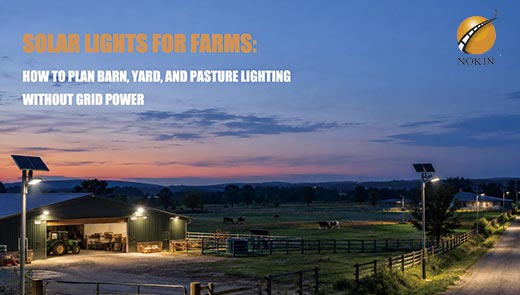
Solar Lights for Farms: How to Choose the Right Farm Lighting
Sep 14, 2026
The most common lighting misconceptions among most farm operators are not about whether to use solar lights, but rather about blindly purchasing general lighting fixtures, which eventually lead to a series of problems such as insufficient lighting, disturbing glare, power waste, and failure in winter. The lighting requirements for different functional areas of the farm vary greatly, and a single light cannot be adapted to all usage scenarios.
Traditional grid lighting is the hidden cost hotspot of the farm. Remote farms, peripheral pastures, and fence areas need to bear multiple expenses such as digging trenches, laying cables, erecting poles and wires, and power approval if they want to connect to the municipal grid. The overall extension cost of the grid is often much higher than the purchase price of the lights, resulting in extremely low cost performance.
From an industry trend perspective, off-grid solar agricultural lighting has become the core direction of modern agricultural upgrading. The World Bank's lighting Global PULSE project clearly lists agriculture as an emerging frontier field of off-grid solar, emphasizing the coordinated development of energy and agriculture, and off-grid solar lighting can effectively extend the working hours of the farm, enhance security capabilities, and help improve the quality and efficiency of livestock and crop production.
NOKIN will base itself on the real operational scenarios of the farm, break down the lighting planning schemes for the five core areas, precisely answer core questions such as the types of lights suitable for different areas, matching power specifications, and standardized installation methods, helping farm project parties avoid purchasing misconceptions and build a low-cost, stable, and highly adaptable off-grid lighting system.
5 Core Farm Lighting Scenarios for Solar Lights
The core prerequisite for farm lighting planning is to distinguish scenarios and clarify requirements. Without scene division, the purchase of lights will inevitably lead to resource waste and unmet lighting standards. Based on the lighting practices in the agricultural and livestock industry and the actual operation of the farm, we divide farm lighting into five core scenarios, with significant differences in usage periods, lighting goals, and core requirements for each scenario.
|
Lighting Scenario |
Lighting Goal |
Usage Period |
Key Requirements |
|
Warehouse / Garage |
Support cargo handling, equipment maintenance, and storage operations |
High-frequency use in the morning and evening, with partial use throughout the day |
Focused high-brightness lighting, waterproof and dustproof design, resistance to adverse weather, and flicker-free operation |
|
Equipment Field / Storage Area |
Support all-round security monitoring, material sorting, and large equipment operations |
Regular nighttime use |
Uniform large-area coverage, high brightness, theft prevention, and suitability for open areas |
|
Fence Line / Gate |
Support nighttime patrols, boundary security, and prevention of external intrusion |
Continuous nighttime use |
Directional long-distance illumination, focused line lighting, and low light pollution |
|
Pasture / Paddock |
Observe livestock status, monitor nighttime activities, and ensure livestock safety |
Full-time nighttime use |
Wide-area lighting, low glare, livestock-friendly illumination, and soft, non-stimulating light |
|
Farm Road / Lane |
Ensure safe nighttime passage for vehicles and personnel |
Dynamic nighttime use |
Uniform lighting along the road, elimination of dark corners, and continuous illumination |
The core reason for many farm lighting renovations failing is the neglect of differentiated scene requirements and the uniform purchase of the same type of lights. Either the lighting brightness in certain areas is insufficient, or the light is dazzling and affects livestock, or the lighting range does not fully meet the usage requirements, resulting in double waste of funds and resources.
Solar Flood Lights vs. Solar Street Lights for Farms
The vast majority of farm project parties cannot distinguish the suitable scenarios for solar flood lights and solar street lights. This is also the most common and costly misconception in farm lighting procurement. The light patterns and applicable scenarios of the two types of lights are completely different. Choosing the right light can directly improve lighting effects and reduce redundant costs.
|
Light Type |
Lighting Form |
Optimal Application Scenarios |
Unsuitable Scenarios |
|
Solar Flood Light |
Wide-area beam lighting with an adjustable illumination angle; can focus light on a specific point or area for targeted illumination |
Warehouses, equipment yards, fences, livestock paddocks |
Long-distance farm main roads where alternating light and dark areas or discontinuous lighting may occur |
|
Solar Street Light |
Uniform linear lighting with strong light distribution, capable of continuously extending coverage along roads and pathways |
Farm roads, lanes, and long-distance open passageways |
Block-shaped operating areas, open spaces within enclosures, or areas requiring single-point focused illumination |
Here is a common and efficient scenario decision-making method: Use solar flood lights to illuminate "a certain area, a certain site" and solar street lights to illuminate "a road, a movement path".
Based on the statistics of farm operation scenarios, more than 80% of the lighting needs of the farm are for area lighting rather than movement path lighting. Core areas such as barn operation zones, equipment storage areas, livestock enclosures, and boundary fences all require high-lit coverage in a region, which is the core reason why flood lights have become the main lighting fixtures for farms.
Precisely distinguishing the differences between the two types of lights is the key to reducing costs and increasing efficiency in farm lighting. Avoiding the blind purchase of high-brightness street lights for site lighting or using flood lights to lay roads causing lighting discontinuity, helping the farm save unnecessary procurement and renovation expenses.
Solar Light Power and Installation Guide for Farm Lighting
Based on the standards of the livestock and agriculture lighting industry and the application data of off-grid solar energy, we have compiled a standardized configuration plan for the five scenarios of the farm, covering light power, installation method, mounting height, coverage reference range, which can be directly used for project procurement.
|
Lighting Scenario |
Recommended Lights |
Adapted Power |
Installation Method and Height |
Reference Coverage Range |
|
Farm Barn / Enclosure Entrance |
Solar Flood Light |
25–40W |
Wall-mounted, 3–4 m high |
80–150 m² local operation area |
|
Equipment Field / Storeroom |
Solar Flood Light |
40–50W |
Pole-mounted, 5–6 m high |
200–350 m² full-area site |
|
Boundary Line / Fence Gate |
Solar Flood Light |
15–30W |
Wall-mounted or small pole-mounted, 3 m high |
Directional coverage of 30–50 m along the boundary line |
|
Pasture / Enclosure |
High-Power Solar Flood Light |
50–100W |
High-pole installation, 6–8 m high |
400–800 m² wide-area enclosure |
|
Farm Roads / Lanes |
Solar Street Light |
15–25W |
Pole-mounted, 5 m high; light spacing of 15–25 m |
Linear continuous coverage along the route |
How to Choose the Right Beam Angle for Farm Lighting
The beam angle directly determines the lighting projection form. It needs to be matched according to the requirements: 30°-60° narrow beam, suitable for fences, roads, etc. that require long-distance lighting; 90°-120° wide beam, suitable for storage areas, pastures, etc. that require large-area flat coverage.
Lighting Requirements for Livestock
Based on the light-sensitive characteristics of livestock, farm lighting needs to avoid strong light stress. The recommended color temperature of the lights is controlled within the 3000-4000K warm white light range, with soft and non-irritating light. At the same time, it is strictly prohibited for the lights to directly shine into the livestock shed, to avoid affecting the livestock's rest and growth state at night.
How to Plan an Off-Grid Solar Lighting System for Farms
The stability of solar farm lighting, the core does not lie in the brightness of the lights, but in the adaptability of the entire off-grid system. Blindly purchasing lights and ignoring system planning is very likely to cause problems such as insufficient power supply in winter, power failure in rainy days, and brightness decay.
Evaluate Local Sunshine Duration
The effective sunshine duration in different latitude regions varies greatly. In high-latitude areas, the effective sunshine in winter will be shortened by 30%-50%, and the power generation will drop significantly. When planning the system, it is necessary to take the lowest winter sunshine duration of the local area as the calculation standard, and not to refer to the abundant sunshine data in summer.
Plan Battery Capacity for Rainy Days
Remote farms generally have unstable power grids and frequent power outages. The off-grid solar system needs to reserve sufficient redundancy. Industry standard: For ordinary farms, it is recommended to reserve 2 days of rainy-day power supply, and for remote farms without power grids, it is recommended to achieve 3-5 days of autonomous power supply to ensure that lighting does not stop in extreme weather conditions.
Estimate Solar Lighting System Power Requirements
Basic accounting process: First, calculate the peak power of each scene's lights, the daily lighting duration, and calculate the overall daily average power consumption. Then, match the corresponding battery capacity, and finally adapt the solar panel power.
Precise parameter suggestions should be calculated by professional suppliers to avoid cost waste caused by over-provisioning or usage failures due to insufficient configuration.
Adapt the System for Winter and Summer Conditions
In winter, not only is the duration of sun light short and the light intensity weak, but the low-temperature environment also causes natural degradation of battery capacity. During system planning, redundant configurations for low-temperature conditions should be reserved to avoid significant drops in light brightness and reduced battery life in winter.
Benefits of Solar Lighting for Farms
Compared to traditional grid-based lighting, solar off-grid lighting perfectly suits the scattered, remote, and extensive layout characteristics of farms. It has comprehensive advantages in terms of cost, efficiency, and stability, and is currently the mainstream choice for farm renovations.
Reduce Farm Grid Wiring Costs
Farm outer areas need to connect to the municipal grid, which requires digging the ground, laying cables, erecting poles, and applying for power approval. Industry averages show that the comprehensive cost of extending the farm's outdoor grid can reach $25-40 per meter, and the cost of long-distance wiring is extremely high.
solar lights have zero wiring, zero trenching, no need for power approval, and can be directly installed and put into use, saving over 90% of the basic wiring costs, especially suitable for remote scenarios such as large pastures and long-distance fences.
Lower Long-Term Operating Costs
Traditional grid-based farm lighting has accumulated electricity costs, line maintenance fees, and equipment repair costs over the years. solar lights generate electricity through natural light, and after installation, there are no electricity bills. Only a small amount of annual maintenance costs are required, and the long-term investment return rate is far higher than that of grid-based lighting.
Ensure Independent Power Supply
The rural and remote farm grids have poor stability, with frequent power outages during peak summer usage and extreme weather conditions. This directly affects farm nighttime operations, security patrols, and livestock safety. Off-grid solar systems operate independently and are completely脱离 from the municipal grid, ensuring stable lighting throughout the day without power outages.
Deploy Farm Lighting Faster
Grid renovations require power department scheduling, on-site surveying, construction acceptance, and take several months. solar lights can be quickly purchased, quickly installed, and put into use the same day, significantly shortening the farm lighting upgrade cycle.
Important reminder: All advantages hold true only if the system configuration is precise. If the light power, battery capacity, and photovoltaic panel ratio are insufficient, lighting failure will occur in winter and on rainy days. Therefore, it is necessary to strictly follow the scene configuration standards mentioned earlier.
Farm Solar Light Installation and Maintenance
The farm environment is often dusty, with a lot of weeds, frequent livestock activities, and more windy and rainy weather, which is much more harsh than ordinary municipal scenarios. Exclusive installation norms and regular maintenance can significantly improve the stability and service life of solar lights.
Choose the Right Installation Location
In the Northern Hemisphere, photovoltaic panels on farms are uniformly installed facing south to ensure maximum light efficiency. The installation location should avoid being blocked by trees, buildings, and tall crops to prevent insufficient light and reduced power generation. At the same time, they should be away from low-lying water areas to prevent equipment from getting wet during rain and being damaged.
Protect Solar Lights from Damage and Lightning
Farms have risks such as livestock chewing cables, birds building nests, and lightning strikes in the wild. The preferred selection should be IP66 or higher high protection grade lights, and all cables should be installed with sleeves to prevent exposure and damage. High-pole lights on the farm should be equipped with lightning protection devices to cope with thunderstorm weather.
Clean Solar Panels Regularly
Farm dust, straw debris, livestock manure dust are abundant, and they are likely to adhere to the surface of the photovoltaic panels. Accumulated dust can directly cause a 10%-25% loss in power generation, and it is recommended to clean the photovoltaic panels once every 2-3 months to ensure power generation efficiency.
Winter Maintenance for Solar Lights
In high-latitude winter areas with heavy snowfall, it is necessary to promptly clear the snow from the surface of photovoltaic panels to prevent the snow from blocking the light and causing the lights to fail to charge normally or have insufficient battery life at night.
Farm Solar Lighting Cost and Procurement Guide
Plan the Farm Solar Lighting Budget in Phases
To control the initial procurement cost, the farm can adopt a step-by-step upgrade plan, prioritizing the implementation of necessary scenarios, and then gradually improving the overall configuration.
First stage (necessity for security): fence lines, gates, main road lighting, prioritizing the protection of farm boundaries and passage safety, avoiding risks of theft and safety accidents.
Second stage (production operations): barns, equipment storage yards lighting, extending the night operation time and improving farm production efficiency.
Third stage (livestock care): wide-area lighting of the pasture enclosure, improving the livestock night monitoring and care system.
5 Questions to Ask a Farm Solar Light Supplier
Farm project-level procurement is different from retail single items. The parameter compatibility directly determines the project effect. Before procurement, the following 5 core pieces of information must be confirmed:
What are the specific parameters of the light beam angle? Can it meet the coverage requirements of my site?
What is the continuous rainy weather endurance time marked by the equipment manufacturer? Is it suitable for the local climate?
Is the overall protection level of the light up to IP66+? Can it meet the harsh outdoor environment of the farm?
What type of battery is it? Is it a LiFePO4 battery? Is there a low-temperature protection function?
How long is the product warranty period? Does the remote farm have after-sales maintenance support?
Farm Solar Lighting Procurement Checklist
Check the eight core dimensions of scene matching, light type, power parameters, beam angle, endurance capacity, protection level, low-temperature performance, and warranty service to avoid wrong purchase and mispurchase.
Conclusion: Planning Solar Lighting for Farms
The core logic of solar lighting for farms is not about purchasing the "brightest lights", but about standardized and scenario-based system planning. The correct implementation sequence is as follows: first, divide the farm lighting scenarios by function, then match the flood light/road light types accordingly, and finally configure the battery life and power parameters based on the local climate, sun light conditions, and weather conditions.
This planning method can completely solve the core problems of insufficient lighting brightness, uneven lighting, failure in winter, cost waste, and impact on livestock growth in farms, and create a low-cost, highly stable, and long-lasting off-grid farm lighting system.
Contact NOKIN immediately: If you are unsure about the light configuration, power selection, and installation plan for your farm, please inform NOKIN of your farm scenario, site area, and local climate. As a professional solar light supplier, NOKIN will customize an exclusive farm solar lighting configuration plan for you.
FAQ
How Many Solar Lights Does a Farm Need?
There is no fixed and uniform quantity. The core factor depends on the area of the site, the type of scene, the installation height and the beam angle. Generally speaking, for small farms, the priority is to install basic lighting for the gate, fence and main road; for medium-sized farms, additional lighting for barns and equipment fields is needed; for large ranches, high-pole, high-power flood lights are required to achieve wide coverage.
Can Solar Flood Lights Illuminate the Inside of the Barn?
Yes, but it depends on the usage scenario. 25-40W flood lights are suitable for lighting the entrance of the barn and the external loading and unloading areas; if regular lighting for storage and maintenance inside the barn is needed, a special model with low glare and high color rendering index can be selected, and the color temperature can be controlled to avoid dazzling light in a confined space, ensuring safe and comfortable operations.
Do Solar Lights Work on Farms in Winter?
Yes, but a system redundancy configuration must be made. In winter, shorter sun light and low temperatures will lead to a decrease in power generation and battery capacity. As long as the power and endurance are calculated based on winter sun light parameters, a LiFePO4 battery with low-temperature protection is selected, and the snow on the photovoltaic panels is cleared in time, the stable lighting in winter can be guaranteed.
Are Solar Lights Cheaper Than Grid Power for Farms?
For remote farms, large ranches and long-distance fences, solar lights have a much higher cost-effectiveness than grid power supply. Grid power supply requires a cost of $25-40 per meter for wiring construction, plus continuous electricity costs, maintenance fees; solar lights are purchased and installed once, with no wiring, no electricity costs and low maintenance, and the entire cost can be recovered in 3-5 years, with higher long-term benefits. Only for the core and close buildings of the farm, the cost-effectiveness of grid renovation is relatively the same.