Farm Security Lighting: Where to Place Solar Lights?
Sep 23, 2026
Autumn is the peak season for farm harvesting, storage, and stockpiling of goods. Agricultural machinery equipment, fuel, crops, and livestock are all concentratedly stored at night. The vulnerability of night-time security is easily exploited by criminals. The farm area is vast, the boundaries are long, and there is no on-site security during the night. Traditional grid power lighting is prone to being cut off by power lines and has high wiring costs, which no longer meets the security needs of rural farms.
More and more farmers are choosing solar farm security lighting to establish a night-time defense system. However, most users have fallen into the same pit: they prioritize installing surveillance cameras but neglect the basic lighting. In the dark rural wilderness, without sufficient lighting, the night vision of the surveillance cameras is blurry and ineffective. Even with many cameras, they cannot provide any security protection.
Solar farm security lights are the first and most stable line of defense for rural farm security. They do not require wiring, are not prone to power outages, and can be flexibly placed at key locations such as the gate, oil tanks, machinery sheds, and fence boundaries. Light is the foundation of security, while surveillance cameras are only the upper layer assistance. First, a proper layout of rural security lighting must be done to truly implement farm theft prevention.
This article will explain the core logic of solar security light placement, six golden points, selection techniques, the difference between constant and sensor lights, and help farmers build a stable and all-day security system at the lowest cost.
Why Farms Are High-Risk Targets for Rural Theft
Farms are different from urban enclosed scenarios and naturally have multiple security shortcomings, which are also frequent venues for illegal entry and material theft.
The farm has a large area and a long boundary line. Most fences are transparent and lack closed protection. The entire area is unattended at night, providing a natural hiding space for intruders.
The rural police response distance is far and the arrival speed is slow. Once a theft occurs, the criminals have plenty of time to commit the crime and evacuate, making it more difficult to solve the case and minimize losses.
The farm has concentrated high-value assets: diesel fuel, agricultural machinery, tool accessories, livestock, copper cables, etc., which are highly marketable and are the key targets of rural crime.
Most farm thefts are premeditated and occur in familiar terrain. Ordinary cameras have very little deterrent effect. Only a stable all-day security lighting system for the farm can reduce the space for crime at its source.
Why Solar Lighting Is the First Line of Defense for Farm Security
Many farmers have put the cart before the horse, investing a large budget in surveillance systems but neglecting lighting. For farm security, lighting always comes before cameras, and solar security lights are the optimal solution for farm scenarios.
Light Removes Hiding Spots and Raises the Cost of Crime
Most nighttime thefts rely on darkness for cover. Solar security lights can provide stable lighting all night, eliminating dark areas in the site, making it impossible for intruders to hide, and significantly reducing the probability of opportunistic crimes.
Rural Crime Prevention Lighting: The Security Logic
In rural security design, targeted nighttime lighting is the core means of crime prevention and also the lowest-cost and fastest-to-implement rural crime prevention lighting solution.
Lighting Determines Whether Cameras Are Useful
The infrared night vision capability of cameras is limited, and the clarity of the picture depends heavily on the environmental illumination. Combining solar security lighting with surveillance cameras allows the cameras to capture clear details of people, equipment, and vehicles, otherwise the surveillance cameras are just a decoration.
How Solar Lights Fix Grid Lighting's Biggest Weakness
Traditional grid power lights are prone to being cut off by power lines, have cumbersome wiring, and cannot cover remote areas of the farm. Solar lights are independently powered, do not require wiring, and are not prone to power outages, with far higher security stability than ordinary lights.
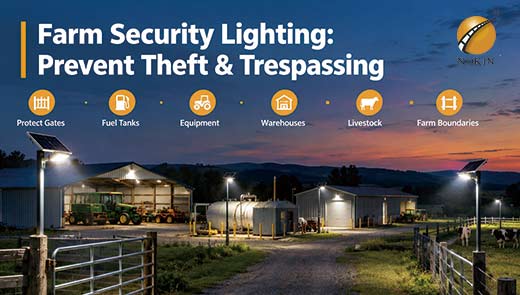
6 Key Placement Points for Farm Security Lights
Farm security does not aim for full illumination of the entire site; it only aims to "highlight key areas and illuminate assets". Blindly installing lights throughout the site will waste the budget. Precise placement of farm gate lights, barn security lights, and equipment area lighting is the most efficient solution.
|
Lighting Point |
Risk Level |
Solar Light Configuration Key Points |
|
Farm Gate / Entrance |
Highest priority; mandatory entry point |
Install high-intensity solar constant lights to cover both the inside and outside of the gate, as well as the vehicle parking area. Eliminate blind spots at the entrance and provide continuous 24-hour deterrence. |
|
Fuel Tank / Storage Area |
High theft risk; significant potential loss |
Position solar lights directly at fuel tanks and valve locations, focusing illumination on the assets rather than the ground. Eliminate hidden areas that could facilitate fuel theft. |
|
Equipment Shed / Agricultural Machinery Storage Area |
High-value asset concentration area |
Arrange solar security lights to cover the entrance and agricultural machinery parking areas, ensuring valuable equipment remains visible without dark blind spots at night. |
|
Warehouse / Tool Room |
Frequent theft of small items |
Install solar lights directly above doors and along walls vulnerable to forced entry. Provide continuous illumination to deter break-ins through windows or doors. |
|
Livestock Pen / Pasture Passage |
High risk of livestock theft |
Arrange solar lights along fences and livestock passageways to illuminate boundary movement paths and help deter livestock theft and nighttime intrusion. |
|
Fence Boundary / Perimeter |
Medium–High |
Prioritize the most exposed sections (near public roads, areas screened from the farmhouse, damaged or low fencing). A few well-placed lights along these stretches are more effective than lighting the entire fence line. |
Core Layout Principle: Illuminate the Asset, Not the Ground
The golden rule of solar farm security lighting: illuminate the assets, not just the ground. Thieves need to come into contact with equipment, oil tanks, and doors/windows to commit crimes. Illuminating the asset itself provides a far greater deterrent effect than ordinary ground lighting.
Best Low-Budget Option: Start with These 3 Points
With limited budget, prioritize the implementation of three points: solar lights at the gate + solar lights in the storage area + solar lights at the equipment shed. Use the minimum amount of dollars to cover 80% of the core security risks.
What to Look For in Farm Solar Security Lights
Agricultural operation lights only require uniform illumination, while security-specific solar lights focus on deterrence, preventing damage, and maintaining continuous stability. The technical logic of the two is completely different.
Illumination Strategy: High at Key Points, Light in Between
Security does not pursue uniform illumination throughout the area. Use "key points with high illumination + weak supplementary lighting around" to ensure security effectiveness while saving solar power consumption.
Lighting Angle Control
Direct the lights at the assets, doors, fences, and invasion paths for the fence, avoiding ineffective illumination of open areas, maximizing the security value of solar lights.
Anti-Glare Design
High-quality solar security lights can control glare, not affecting the vision of residents and patrol personnel, and completely exposing intruders.
Vandal-Resistant Design (Anti-Tamper, Anti-Impact)
Criminals often prioritize damaging lights to create darkness. Farm-specific solar security lights need to have anti-pulling, anti-pounding, and high-position installation designs to avoid single-point damage leading to security failure.
Constant vs. Motion Sensor Lights: Which to Choose
Many users are confused about how to choose between human body sensor lights and constant security lights. For high-risk areas, solar constant lights are recommended, forming continuous deterrence; for secondary peripheral areas, solar sensor lights can be used for energy-saving supplementary lighting.
Independent Solar Power: No Grid, No Outages
Solar lights have an energy storage system, not relying on the power grid, not afraid of power cuts or power outages, still working stably in extreme weather and during nighttime without personnel.
Why Solar Security Lights Outperform Grid Power on Farms
Compared to traditional power grid lighting, solar security lighting perfectly adapts to the remote, scattered, and large-scale scenarios of farms, being the optimal solution for rural security.
First, no fear of power outages or line cuts.
Power lines are easily damaged by humans, while solar lights are independently powered, fundamentally solving the problem of security paralysis.
Second, zero wiring and trenching costs.
No need to lay cables at the farm boundary or deep in the pasture, significantly reducing engineering and dollar budgets.
Third, flexible expansion.
New machinery areas or fence points can be directly installed with solar lights, without the need to modify the circuit.
Fourth, compatible with farm security needs.
Combined with anti-pulling, anti-pounding, and rain-resistant outdoor structures, specifically designed for harsh rural environments.
How to Combine Solar Security Lighting with Surveillance Cameras
Many customers are confused about which should be prioritized, security lighting or surveillance cameras. Correct sequence: lighting as the base, surveillance as the enhancement.
First, install solar security lights at key points to ensure basic illumination; In addition, add surveillance to make the images clear and usable. Adjust the lighting angle to match the monitoring field of view, eliminate the dark corners of the surveillance, and achieve true integrated security protection.
Farm Security Lighting Checklist
You can directly take screenshots for self-inspection and quickly identify potential issues:
- Have you prioritized the layout of solar lights at the six high-risk points?
- Are the lights focused on illuminating the assets rather than just the ground?
- Are the selected solar lights equipped with anti-tampering, anti-pickup, and anti-damage designs?
- Can the solar lighting continue to work in the event of power failure or wire cutting?
- Are the lights designed to control glare and not affect the daily patrol view?
- Are the core high-risk points deployed with solar lights that are always on?
- Is the lighting illuminance sufficient to support clear video recording by the surveillance cameras?
Conclusion
The correct investment logic for farm security: Start with solar lighting as the foundation, and then use cameras for evidence collection. Skipping the lighting and directly installing cameras is the most common budget waste in farm security.
Stable solar lighting for farm security can prevent rural theft and illegal intrusions from the source, build an all-weather farm night defense system at a low cost, and meet the high security needs during the autumn harvest season. Send your farm layout diagram, and NOKIN will mark the best installation points and configuration schemes for solar lights for you.