Can Solar Street Lights Power a CCTV Camera 24/7?
Aug 24, 2026
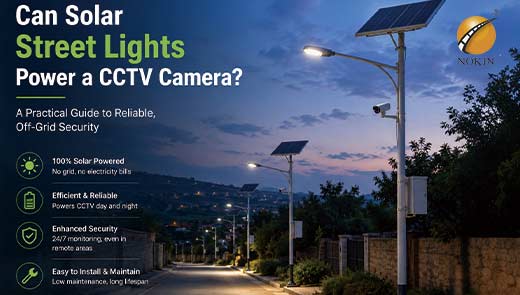
In the security procurement scenarios of municipal roads, enterprise parks, property communities, and outdoor construction sites, the integrated solution of solar street lights with CCTV cameras has become the mainstream choice. It does not require wiring, integrates lighting and all-weather security, significantly reduces construction and electricity costs, and is suitable for various outdoor scenarios without power grids and long distances. However, almost all purchasing decision-makers will raise the same core question: Will the camera go black and stop recording when there is insufficient light on rainy days? Can the solar system support 24-hour uninterrupted monitoring?
Many low-price integrated light products in the industry often have problems with false configuration of specifications and unreasonable power consumption calculation. These products directly adopt the battery and photovoltaic panel configurations of pure lighting street lights, ignoring the core demand of 24-hour continuous power consumption of the camera. Eventually, this leads to the failure of monitoring during rainy days and power failure of lighting at night.
We provide the most accurate answer: Solar street lights can stably drive CCTV cameras to work 24/7 without interruption. The core premise is to accurately calculate the power supply budget for the dual load and match the corresponding battery and photovoltaic panel configurations.
After reading this article, you will master the complete power consumption calculation method and be able to independently calculate the required battery capacity and photovoltaic panel power for the project, completely avoiding the risk of monitoring failure during rainy days and night lighting tripping, and accurately matching the security lighting needs of various scenarios.
How Much Power Does a CCTV Camera Use in a Solar Street Light System?
Many purchasing misunderstandings lie in: assuming that the camera has extremely low power consumption and does not need to calculate the electricity separately. In fact, the power consumption of the camera varies greatly day and night, and the main power-consuming points during the night are infrared night vision and 4G cellular transmission, which are also the key reasons for insufficient battery life.
CCTV Camera Power Consumption During the Day and at Night
Combining the measured data of solar street light manufacturers and industry power consumption guidelines, the power consumption standards for different types of surveillance cameras during the day and night are as follows, covering the vast majority of outdoor security scenarios:
|
Camera Type |
Daytime Normal Power Consumption |
Nighttime Infrared On Power Consumption |
|
Basic IP Camera |
2–5 W |
5–8 W |
|
High-Definition (4MP+) Camera |
4–8 W |
8–12 W |
|
High-Definition + 4G/Cellular Transmission Camera |
5–10 W |
10–15 W |
Why CCTV Camera Power Consumption Increases at Night
When the camera turns on infrared night vision, its power consumption will be 2-4W higher than during the day. And without solar power generation at night, all equipment power consumption relies entirely on the battery reserve, which is the core period that tests the system's battery life capacity.
How 4G Transmission Affects CCTV Camera Power Consumption
The 4G cellular transmission function required for outdoor scenarios without power lines will make the overall power consumption of the camera 30%-50% higher than the WiFi version. Remote construction sites, rural roads, and outdoor parks, etc., must include this additional power consumption in the power supply budget, otherwise, there will inevitably be a problem of insufficient battery life.
How to Calculate the Power Consumption of Solar Street Lights with CCTV Cameras
To achieve 24/7 uninterrupted monitoring, one cannot only look at the power consumption of a single device, but must calculate the total daily power consumption of the entire system.
Solar Street Light and CCTV Camera Daily Power Consumption Formula
Daily power consumption (Wh) = light power consumption × Lighting duration + Camera power consumption × 24 hours
Example: 60W Solar Street Light + 8W CCTV Camera
Let's take the most commonly used 60W solar street light + 8W high-definition infrared camera combination as an example for a complete real-world calculation:
light lighting power consumption: 60W × 11 hours (normal lighting duration from 19:00 to 6:00 the next day) ≈ 660 Wh
Camera 24-hour power consumption: 8W × 24 hours = 192 Wh (including 5 hours of high-power infrared operation during the night)
System daily total power consumption: 660 Wh + 192 Wh = 852 Wh/day
From the calculation data, it can be clearly seen: seemingly low-power cameras, due to 24-hour continuous operation, consume nearly a quarter of the entire system's power.
This also confirms the core conclusion: the camera is the second-largest power-consuming load after the street light. Directly applying the power supply configuration of pure lighting street lights will inevitably fail to support the stable operation of the dual devices.
How Many Days Can a Solar Street Light with CCTV Camera Run During Rainy Weather?
When the sunlight is sufficient on a sunny day, the majority of solar street light camera systems can work normally. What truly sets apart the products and determines the stability of the project is the autonomous battery endurance during continuous rainy days.
What Is Battery Autonomy for Solar Street Light CCTV Systems?
Industry standard battery endurance calculation formula:
Autonomous battery endurance time = Battery capacity (Wh) ÷ System daily power consumption (Wh)
2-Day, 3-Day and 5–7-Day Battery Autonomy Options
Based on different regional climate conditions, the industry divides into three standardized battery endurance levels to adapt to various commercial and municipal projects:
- Basic version (2 nights of autonomous endurance): Suitable for arid areas with little rainfall and sufficient sunlight throughout the year, meeting basic security lighting needs
- Standard version (3 nights of autonomous endurance): Industry standard commercial projects, suitable for most temperate and mid-latitude regions, capable of coping with regular rainy weather
- Enhanced version (5-7 nights of autonomous endurance): Suitable for tropical rainy seasons, monsoon climates, and low-sunlight high-latitude regions during winter, capable of coping with long-term rainy and low-light environments
How to Calculate Battery Capacity for 3 Days of Autonomy
Adopting the above 852 Wh/day dual-load configuration, using the industry standard 3-day autonomous endurance as an example for calculation:
Total required battery capacity = 852 Wh × 3 days = 2556 Wh
Considering battery lifespan and safe discharge norms, a 20% discharge reserve (80% safe discharge depth) needs to be reserved, and the final required battery capacity is approximately 3200 Wh (corresponding to 32V/100Ah or 12V/260Ah battery specifications).
Core comparison differences: Under the same lighting brightness, pure lighting solar street lights only need 2200 Wh battery capacity to meet 3-day endurance. After adding a 24-hour monitoring load, the battery capacity needs to be increased by 45%.
This is the fundamental reason why low-priced integrated solar street lights frequently black out and stop recording during rainy days: The battery configuration has not been upgraded to support the dual loads, and the battery capacity cannot cover the continuous power consumption during rainy days.
How to Size Solar Panels for Solar Street Lights with CCTV Cameras
Sufficient battery capacity is the foundation of endurance, while the matching photovoltaic panel power is the core guarantee for continuous power supply. If the charging power is insufficient, the battery cannot fully recharge on sunny days, and it will operate with a long-term power deficit, not only reducing endurance but also significantly shortening the battery lifespan.
Solar Panel Power Calculation Formula
Industry precise panel configuration estimation method (including system losses):
Photovoltaic panel power ≈ Daily power consumption ÷ Local effective sunshine hours × 1.3 (system comprehensive loss coefficient)
Example: Calculating Solar Panel Size for an 852 Wh/Day System
Still using the 852 Wh/day dual-load system as an example, using the annual average of 4.5 hours of effective sunshine in the mid-latitude region for calculation:
Required photovoltaic panel power = 852 Wh ÷ 4.5h × 1.3 ≈ 246W
How Local Sunshine Hours Affect Solar Panel Sizing
Regional sunshine differences have a significant impact on the configuration of photovoltaic panels for solar street lights. The same power consumption configuration has completely different requirements for photovoltaic panels in different regions:
- High sunshine areas (such as Dubai, with an annual average of 5.5 hours of effective sunshine): The power demand for photovoltaic panels is lower, and the charging efficiency is higher
- Low sunshine areas (such as London, with an annual average of 3.5 hours of effective sunshine): The power of photovoltaic panels needs to be significantly increased to meet the daily recharge requirements
Here is an extended key selection logic: The size of the photovoltaic panel for conventional integrated solar street lights is limited by the light body structure, with a lower power limit.
When to Choose a Split-Type Solar Street Light System
For scenarios with 4G high-definition cameras and high endurance requirements, a split design (independent photovoltaic panel + independent battery compartment) is a more reliable solution, which can flexibly upgrade the photovoltaic panel and battery capacity, without being restricted by the light body structure.
How to Reduce the Power Consumption of Solar Street Lights with CCTV Cameras
In addition to hardware configuration upgrades, the intelligent energy consumption management system can significantly reduce the daily power consumption of the equipment, doubling the endurance under the same battery and photovoltaic panel configuration, and significantly reducing the hardware cost of the project (each project can save hundreds to thousands of dollars in configuration costs).
PIR Motion Detection and Triggered Recording
This is the most cost-effective power-saving solution. When no one is present, the camera enters an ultra-low power standby mode (0.5 - 1W); upon detecting movement of people or vehicles, it automatically switches to full-power high-definition recording. This feature can reduce the daily power consumption of the camera by 50% - 70%.
Time-Based Brightness and Frame Rate Adjustment
During the period from 0:00 to 5:00 in the night, when there is very little traffic and people, the system automatically reduces the brightness of the solar street light to 30%, and simultaneously lowers the frame rate of the camera recording. This does not affect the security effect, but further reduces unnecessary power consumption.
Dual Battery Chambers for Independent Lighting and CCTV Power Supply
The solar street light lighting and CCTV monitoring are divided into two independent power supply systems. This avoids the situation where the high-power consumption of the solar street light during the night occupies the power supply of the camera, eliminating the imbalance problem of normal lighting and black screen during monitoring, and ensuring the stability of 24-hour monitoring.
Solar Street Light CCTV Energy Consumption and Battery Capacity Comparison
|
Working Mode |
Daytime Average Power Consumption of Camera |
Total System Daily Power Consumption |
Required Battery Capacity for 3 Days of Battery Life |
Improvement in Battery Life |
|
Continuous Full-Power Recording for 24 Hours |
192 Wh |
852 Wh |
3,200 Wh |
Baseline Battery Life |
|
PIR Detection + Time-Based Power-Saving Mode |
60–90 Wh |
720–750 Wh |
2,500–2,700 Wh |
30%+ Improvement |
How to Choose Solar Street Lights with CCTV Cameras
Most of the after-sale problems in the market are caused by false product parameters and unqualified configurations. When purchasing, do not only look at the promotional copy. You must check the product specifications (Specifications) and adhere to the three core parameter verification standards and five key questions to ask suppliers.
3 Key Specifications to Check Before Buying a Solar Street Light with CCTV
- Battery Capacity: Look at Wh (Watt-hours), not Ah: Ah (Amper-hours) has no reference value. Ah parameters without voltage indication cannot calculate the actual storage capacity. Wh is the core standard for measuring battery life.
- Photovoltaic Panel: Look at the actual peak power Pmax: Reject vague expressions like "equivalent power" and "theoretical power", only recognize the measured maximum output power (Pmax).
- Camera: Look at the actual power consumption and hardware: Verify the specifications of the CMOS sensor and the actual power consumption of infrared night vision, do not blindly pursue high-resolution sub-pack parameters, and focus on the actual operating energy consumption stability.
5 Questions to Ask Solar Street Light CCTV Suppliers
- Does the equipment marked autonomous battery life under rainy weather conditions calculate based on "lighting + camera dual load" full-load working conditions?
- What is the actual measured power consumption when the camera activates infrared night vision and 4G transmission?
- Is there a clear written commitment for the capacity retention rate of the battery after 3 years? What is the specific value?
- When the camera is powered off or in low-power standby mode, can the lighting system of the street lightwork independently and normally?
- Does the system have a dual-load power consumption test report of the entire set of equipment issued by a third-party independent laboratory?
Conclusion + Call to Action (CTA)
Solar street lights can stably power the CCTV cameras for 24/7 uninterrupted monitoring, even in continuous rainy weather, there will be no black screen or recording interruption.
The key to achieving stable operation does not lie in the equipment brand, but in precise system configuration: It must be calculated based on "lighting + monitoring dual load", equipped with 3-day standard autonomous battery life, matched with the power of the photovoltaic panel suitable for the region's sunlight, and combined with intelligent power-saving strategies to optimize energy consumption.
The basic configuration of pure lighting street lights cannot be directly applied to the integrated system with monitoring. This is the core key to avoiding project failures.
Want to quickly and accurately calculate your project configuration? No need to calculate manually? Please contact NOKIN directly for one-stop matching of high-stability, all-day battery life solar street light monitoring integrated solutions.