How to Choose Solar Street Lights with Cameras: 7 Key Specifications
Aug 26, 2026
Many project procurement parties tend to follow the selection logic of ordinary solar street lights, merely basing their choices on LED brightness, solar panels, and battery parameters for solar street lights with cameras. However, the functional positioning of these two types of products is completely different, and the selection criteria cannot be applied universally.
Ordinary solar street lights only perform nighttime lighting functions, while solar street lights with cameras are integrated intelligent devices that simultaneously achieve three core functions: lighting, video surveillance, and data communication. Simply applying traditional parameters for selection is likely to result in engineering problems such as camera night vision failure, complete system power outage in rainy days, overload of 4G module power consumption, insufficient storage, and misaligned monitoring range.
Therefore, the core selection principle of this article: Solar street lights with cameras must be system-matched based on overall energy consumption and monitoring requirements, rather than merely selecting based on lighting parameters.
What Are Solar Street Lights with Cameras?
Core Components of Solar Street Lights with Cameras
Solar street lights with cameras are integrated intelligent outdoor devices that integrate five systems: lighting, energy storage, monitoring, communication, and control. They have complete core components and are suitable for complex outdoor conditions. The specific composition is as follows:
|
Component |
Primary Function |
|
LED Lighting Module |
Provides basic nighttime lighting for areas such as roads, parks, and parking lots. |
|
Solar Photovoltaic Panel |
Absorbs solar energy during the day and converts it into electricity to power the system and charge the battery. |
|
Lithium Iron Phosphate (LiFePO4) Battery |
Stores electricity to continuously power the lighting and surveillance equipment at night and during rainy or cloudy conditions. |
|
High-Definition Surveillance Camera |
Enables 24/7 video recording, real-time video monitoring, and security surveillance. |
|
4G/5G/Wi-Fi Communication Module |
Transmits video data and supports remote equipment monitoring and control. |
|
Smart Controller |
Coordinates power distribution, LED lighting operation, and camera operating modes for intelligent system management. |
|
Storage System |
Stores surveillance footage locally via an SD card and/or in the cloud for subsequent viewing and retrieval. |
|
PIR Human Motion Sensor (Optional) |
Detects human activity and triggers video recording or intelligent dimming, helping reduce energy consumption while maintaining surveillance capabilities. |
How Solar Street Lights with Cameras Manage Energy Consumption
Most procurement parties have a misconception that cameras are a free additional feature that does not affect system energy consumption. In fact, cameras, infrared night vision, and network transmission are core power consumption increments that directly determine the energy configuration specifications of the entire system.
Daytime operation logic: Solar panels generate electricity, which is all stored in the battery for energy storage.
Nighttime operation logic: The battery releases electricity, and at the same time supplies power to the LED lights, cameras, infrared modules, communication modules, and storage devices uniformly.
Core focus: Cameras are not passive components with no power consumption. Their continuous operation significantly increases system energy consumption, completely changing the overall energy budget of the street light.
7 Key Specifications for Solar Street Lights with Cameras
Camera Resolution, Field of View, and Night Vision Performance
Camera resolution is not necessarily the higher the better. Blindly stacking high parameters will cause energy waste and storage overload. The core of project selection is to match parameters based on the monitoring scenario, and the core assessment indicators include resolution, field of view (FOV), detection distance, infrared night vision, and low-light imaging capability.
|
Monitoring Scenario Requirements |
Camera Selection Recommendations |
|
Conventional large-scale area monitoring |
1080P / 2MP camera, balancing image clarity and low power consumption |
|
Ultra-wide area monitoring |
4MP high-resolution camera + wide-FOV lens |
|
Vehicle trajectory monitoring |
4MP or higher resolution + long-focal-length compatible lens |
|
Precise license plate recognition |
High-resolution camera + enhanced infrared night vision + low-light imaging optimization |
|
Remote surveillance in remote areas |
4G network camera, suitable for outdoor applications where wired network connections are unavailable |
Core principle: Camera parameters should be prioritized to match the monitoring target rather than simply stacking high-resolution parameters, avoiding ineffective energy consumption and resource waste.
Camera Power Consumption and Total System Energy Load
For ordinary solar street lights, only the power consumption of the LED lights is calculated. However, for smart street lights with cameras, the total energy consumption is composed of multiple modules, and omitting any module will lead to insufficient system power supply.
Detailed Power Consumption of the Camera
The power consumption of the camera is not a fixed value and changes dynamically with the working mode. The core power consumption scenarios include four types:
- Standby power consumption: basic energy consumption when the equipment is powered on and ready to wait
- Normal video recording power consumption: energy consumption for normal picture recording and data encoding during the day
- Infrared night vision power consumption: power consumption significantly increases after the infrared supplementary lighting is turned on at night
- 4G communication power consumption: continuous energy consumption for real-time data upload and remote access
- Sensing trigger power consumption: instantaneous energy consumption for video recording and snapshot capture triggered by the PIR sensor
How to Calculate Average Daily Energy Consumption
Average daily total energy consumption = Lighting load energy consumption + Camera load energy consumption + Communication module energy consumption + Sensor and storage auxiliary energy consumption
When selecting models, the total power consumption must be calculated based on the actual working duration and operation mode of the project, and fixed power consumption values must not be applied. This ensures the stability of system power supply.
Battery Capacity and Backup Days for Rainy Weather
The battery is the core energy storage carrier of the entire system. The continuous power consumption of the camera and 4G module will significantly increase the battery load. The battery selection standards for traditional street lights are completely inapplicable.
How Camera and Communication Loads Affect Battery Capacity
For ordinary solar street lights: The battery only supplies power to the LED lights, with a single load and stable power consumption.
For solar street lights with cameras: The battery needs to support multiple loads such as LED lighting, camera recording, infrared night vision, 4G transmission, and data storage. The overall discharge frequency is higher and the discharge capacity is larger. If the original battery specifications are used, continuous rainy days will inevitably cause power failure and shutdown.
Advantages of LiFePO4 Batteries for Solar Street Lights
The industry's mainstream uses phosphate iron batteries, which are suitable for the complex working conditions of smart street lights. The core advantages are as follows:
- Long cycle life, slow decay of long-term charging and discharging
- High effective capacity utilization, strong power supply stability
- Resistance to high temperatures and aging, good adaptability to outdoor environments
- No daily maintenance, reducing project operation and maintenance costs
- Suitable for high-frequency charging and discharging mode, matching the fluctuation of energy consumption during day and night
How Many Backup Days Does a Solar Street Light with Camera Need?
There is no unified standard for standby days. It needs to be determined based on the climate of the project location and the reliability requirements of security protection:
- In areas with constant sunshine and sufficient light: 2 days of standby days can meet the requirements
- In areas with more rainy and cloudy weather: It is recommended to have 3 days of standby days
- In projects with monsoon climate, long rainy periods, and high security requirements: It is recommended to have 5 days of standby days
Core principle: The standby days are determined by local sunlight conditions and project security level. Do not blindly pursue high redundancy configuration, and control project costs.
Solar Panel Power and Charging Performance
Most purchasers have doubts: Do we need to increase the power of the solar panels after adding the camera? The answer is: No need for blind expansion, but the entire system energy balance calculation must be redone.
How to Choose Solar Panel Power
The selection of solar panels cannot only consider the power consumption of the LED lights, but also needs to comprehensively calculate six core indicators:
- Daily average power consumption of the camera and communication module
- Battery rated capacity and charging efficiency
- Peak sunlight duration in the project location
- Seasonal light radiation difference (difference in light between winter and summer)
- Comprehensive loss efficiency of the entire system
Solar Panel Sizing Formula for Solar Street Lights with Cameras
The daily average power generation of the required solar panels ≥ System average daily total energy consumption ÷ System efficiency
This formula can precisely avoid two problems: insufficient energy storage when there is sufficient sunlight and power failure and collapse during rainy days, ensuring the stable operation of the system throughout the year.
4G vs. 5G vs. Wi-Fi for Solar Street Lights with Cameras
No matter how good the imaging quality of the camera is or how comprehensive its functions are, if the network is unstable, all security functions will fail. The network selection must strictly match the project scenario and prioritize ensuring transmission stability.
|
Transmission Method |
Optimal Application Scenario |
Key Considerations |
|
4G |
Remote roads, rural areas, and locations without fixed network infrastructure |
Verify SIM card network coverage at the project site in advance |
|
5G |
Projects requiring high-definition real-time transmission, multi-channel video, or low-latency communication |
Check 5G base station coverage and consider deployment and operating costs |
|
Wi-Fi |
Parks, factories, parking lots, and other areas with existing fixed network infrastructure |
Ensure stable local network connectivity and minimize signal interruptions |
Offline Video Storage During Network Disconnection
Outdoor networks are prone to temporary disconnections. Equipment must have the ability to work offline. High-quality solar-powered street lights with cameras support: local SD card offline recording, automatic caching when disconnected from the network, cloud synchronization after connection, remote playback and retrieval, maximizing the prevention of monitoring data loss.
IP Rating, Temperature Range, and Environmental Protection
IP protection level is a basic parameter. It cannot only meet the basic standard of IP65, but also needs to be selected comprehensively based on the project's geographical climate and environmental conditions, adapting to extreme outdoor scenarios.
IP65 vs. IP66 vs. IP67 for Solar Street Lights
- IP65: Completely dust-proof, can withstand low-pressure water spraying, suitable for conventional urban and factory scenarios
- IP66: Completely dust-proof, withstands high-pressure water gun flushing, suitable for dusty road and construction site scenarios
- IP67: Completely dust-proof, supports short-term immersion in water, suitable for rainy, low-lying, and coastal humid scenarios
Environmental Requirements for Different Climates
For special projects in the Middle East, Africa, Southeast Asia, and coastal areas, it is necessary to focus on verifying the following parameters: working temperature range, humidity resistance, anti-salt fog corrosion, anti-ultraviolet aging, wind load resistance, dust and corrosion prevention performance, to avoid equipment aging and failure within a short period.
Video Storage, Remote Monitoring, and Data Management
Storage and data management directly determine the practicality of security protection and are also the key to differentiated selection. The core includes three modules: storage method, recording mode, and remote management.
Local SD Card, Cloud Storage, and NVR Solutions
Support for local storage with Micro SD cards, cloud online storage, and centralized storage by NVR. Can be used in a single mode or combined and matched to adapt to different project storage duration requirements.
Continuous Recording vs. Triggered Recording
Continuous 24-hour recording can ensure the completeness of the picture, but has high energy consumption and large storage occupation.
Human body sensing triggered recording, starts recording only when personnel or vehicles move are detected, can significantly reduce equipment power consumption and reduce storage resource occupation, perfectly adapting to the energy-saving requirements of solar power supply, and forming a closed loop with the previous power consumption selection logic.
How to Calculate and Select Solar Street Lights with Cameras
Standardize the five-step selection method, which can precisely match various project parameters, avoiding errors in experience-based selection, and be suitable for all outdoor scenarios.
Step 1: Calculate the Average Daily Energy Consumption of LED Lighting
LED average daily energy consumption = LED rated power × Nighttime working duration
Step 2: Calculate the Average Daily Energy Consumption of the Monitoring and Communication System
Sum up the comprehensive average daily energy consumption of cameras, infrared night vision, 4G transmission, storage devices, and sensors, calculate based on the actual working mode, and do not ignore any auxiliary loads.
Step 3: Calculate the Average Daily Total Load of the System
Average daily total energy consumption = Lighting load energy consumption + Monitoring load energy consumption + Communication load energy consumption + Auxiliary equipment energy consumption
Step 4: Determine the Battery Capacity Specification
Combine the average daily total energy consumption, battery discharge depth (DoD), preset standby days for rainy days, and system comprehensive efficiency, calculate the suitable battery capacity to ensure stable power supply during no-light periods.
Step 5: Match the Solar Panel Power
Based on the peak sunshine duration of the project location, average daily total energy consumption, charging efficiency, and seasonal sunlight loss, calculate the optimal solar panel power to ensure that the daytime power generation can cover the total daily energy consumption and reserve redundancy.
Practical Example: Solar Street Light with Camera Sizing for a Parking Lot
Take a standard outdoor parking lot project as an example, implement complete parameter calculation, visually display the selection logic, and the parameters are in line with mainstream engineering scenarios.
Project Parameters
- LED lightpower: 60W, working 12 hours at night
- Average power consumption of cameras: 5W, 24-hour uninterrupted operation
- Average power consumption of 4G communication module: 2W, online all day
- Preset standby days for rainy days: 3 days
- Peak sunshine duration of the project location: 4 hours
- System comprehensive efficiency: 0.85, battery discharge depth: 0.5
- System voltage: 12V
Daily Energy Consumption Calculation
LED average daily energy consumption: 60W × 12h = 720Wh
Camera average daily energy consumption: 5W × 24h = 120Wh
4G module average daily energy consumption: 2W × 24h = 48Wh
Average daily total energy consumption: 720 + 120 + 48 = 888Wh
Battery Capacity Calculation
Required total energy storage of batteries = Average daily total energy consumption × Standby days ÷ Discharge depth ÷ System efficiency
Calculation value: 888Wh × 3 ÷ 0.5 ÷ 0.85 ≈ 6261Wh
Match 12V system, battery capacity ≈ 522Ah, the engineering selection uses 12V 520Ah lithium iron phosphate battery, the single battery purchase cost is approximately $320.
Solar Panel Power Calculation
Required solar panel power = Average daily total energy consumption ÷ Peak sunshine duration ÷ System efficiency
Calculation value: 888Wh ÷ 4h ÷ 0.85 ≈ 261W
Reserve redundancy for seasonal sunlight loss, select 300W high-efficiency monocrystalline silicon solar panels, the single purchase cost is approximately $180.
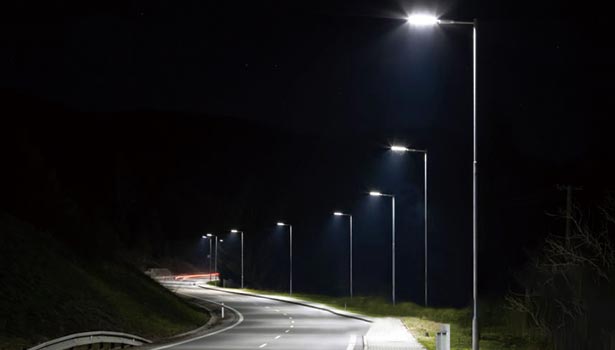
Solar Street Light with Camera Solutions for Different Applications
Different projects have greatly different monitoring priority and power supply requirements. Precise adaptation can balance practicality and cost. The specific schemes are as follows:
|
Application Scenario |
Camera Configuration Priority |
Photovoltaic System Configuration Priority |
|
Rural Roads |
Remote monitoring, human recognition |
High battery backup capacity, reliable power generation under low-light conditions |
|
Parking Lots |
Wide-angle coverage, license plate recognition, clear night vision |
Stable daytime power generation, continuous operating capability |
|
Construction Sites |
4G remote transmission, high-definition video recording |
Strong resistance to harsh environmental conditions, sufficient backup capacity for rainy days |
|
Residential Communities |
Accurate facial recognition, low-noise imaging |
Stable energy consumption management, low-failure operation |
|
Industrial Parks |
Comprehensive wide-angle coverage, multi-device integration |
Reliable network compatibility, continuous power supply |
|
Remote Infrastructure |
Offline recording, offline video caching |
High self-sufficiency, extended battery life and sufficient backup capacity |
7 Common Mistakes When Buying Solar Street Lights with Cameras
Choose the Camera First, Then Calculate the System Energy Consumption
Blindly select high-power consumption high-definition cameras, and later the solar panels and batteries cannot be matched, resulting in frequent power outages and night vision failure, which is the most common problem in engineering.
Select the Battery Based Only on the LED Lighting Load
Ignore the continuous power consumption of the camera and 4G module, and the battery capacity is insufficient, causing the project to collapse in rainy days.
Ignore the Power Consumption of the 4G/5G Communication Module
The network module is always online, and the cumulative power consumption is extremely high. Omitting it will cause a serious deviation in the overall energy budget.
Focus Only on Resolution and Ignore Monitoring Distance and Viewing Angle
High-resolution lenses combined with short monitoring distances cause image distortion, blind areas, and cannot meet the actual security needs.
Ignore Solar Radiation Loss in Rainy and Cloudy Weather
Only select based on the parameters of sunny days, without redundancy backup, and the equipment cannot operate stably in seasonal rainy weather.
Focus Only on IP Rating and Ignore Overall Environmental Adaptation
Meet the IP level standard but not resistant to high temperatures or salt fog, and equipment in coastal and high-temperature areas ages and breaks down rapidly.
Ignore Network Coverage at the Project Location
Blindly select 4G/5G cameras, and the project location has no network coverage, resulting in the complete failure of the monitoring transmission function.
Integrated Solar Street Light with Camera vs. Split-Type Solar Street Light + CCTV
The two schemes have their own advantages and disadvantages, there is no absolute good or bad, it is necessary to choose based on the project scenario, budget, and operation and maintenance requirements, the details are as follows:
|
Comparison Dimension |
Integrated Solar Street Light with Camera |
Split-Type Solar Street Light + Independent CCTV System |
|
Installation Difficulty |
Simple integrated installation with a smaller construction workload |
More complex, as two separate systems need to be installed independently |
|
Cabling Requirements |
Minimal cabling, with virtually no additional wiring and low cabling costs |
Extensive cabling requirements, resulting in higher labor and material costs |
|
Grid Dependence |
Zero grid dependence, powered entirely by solar energy |
Usually requires grid power for operation |
|
Adaptability to Remote Areas |
Excellent, with no dependence on grid infrastructure and fewer site restrictions |
Relatively poor, as installation, power supply, and O&M are more difficult in remote areas |
|
Initial Configuration Flexibility |
Fixed integrated configuration with moderate flexibility |
Highly flexible, allowing different equipment to be combined according to project requirements |
|
Operation & Maintenance |
Centralized operation and maintenance, making troubleshooting and repairs more convenient |
Two independent systems require separate operation and maintenance, making O&M more cumbersome |
|
Expansion Capability |
Moderate, suitable for standard and relatively fixed project expansion |
High, allowing additional surveillance equipment to be added as monitoring requirements grow |
Solar Street Light with Camera Procurement Checklist
|
Check the Project |
Core Verification Contents |
|
Camera Parameters |
Resolution, wide-angle FOV, night vision performance, recognition distance |
|
Equipment Load |
Total daily power consumption of the camera and communication module |
|
Battery Configuration |
Battery capacity, battery type, and required backup days during rainy weather |
|
Solar Panel |
Rated power, conversion efficiency, and low-light power generation performance |
|
Lighting System |
LED power, lighting duration, and dimming mode |
|
Network Transmission |
4G/5G/Wi-Fi compatibility and regional network coverage |
|
Storage Solution |
SD card, cloud storage, or NVR; recording mode and storage duration |
|
Protection Performance |
IP rating, operating temperature range, corrosion resistance, and UV resistance |
|
Installation Accessories |
Light pole height, camera installation angle, and mounting bracket |
|
Monitoring, Operation & Maintenance |
Mobile app, cloud-based remote monitoring, and video playback management functions |
Solar Street Light with Camera FAQs
What Is the Overall Power Consumption of a Solar Street Light with a Camera?
There is no fixed value. It is determined by LED lighting, the camera, infrared night vision, communication module, and storage device. The average daily total power consumption of conventional parking lots and park equipment is in the range of 800-1200 Wh. The power consumption of 24-hour video equipment is higher than that of trigger-type video equipment.
Can a Solar Street Light Power a Camera All Night?
Yes, but it must achieve full system energy consumption matching. Street lights with only basic lighting configuration cannot support it. The battery and solar panel specifications need to be upgraded according to the camera's power consumption, and energy redundancy needs to be reserved.
What Battery Capacity Is Needed for a Solar Street Light with a Camera?
It is determined by the average daily total energy consumption, the number of standby days, system voltage, and discharge depth. For conventional outdoor projects, the battery capacity of the 12V system is concentrated in the range of 400-600 Ah. Further expansion is required in rainy areas.
Does a Solar Monitoring Street Light Need 4G?
No. For parks and factories with a stable local area network, the Wi-Fi version can be selected; for outdoor projects in remote areas without network cables or power grids, the 4G/5G networking solution should be given priority.
How Many Backup Days Does a Solar Street Light with Camera Need?
In sunny areas, 2 days are needed; in areas with cloudy and rainy conditions, 3 days are required; in areas with high security requirements or long-term rainy conditions, 5 days are needed. Configuration can be done as needed, without excessive redundancy to increase costs.
Can Solar Street Lights with Cameras Work Normally in Rainy and Cloudy Weather?
As long as the battery backup days match the local climate and the system reserves sufficient energy storage, normal lighting, video recording, and data transmission can be achieved even on rainy days. Only prolonged and continuous extreme rain may slightly affect the battery life.What Is the Optimal Camera Resolution for Outdoor Projects?
For regular security monitoring, 2MP/1080P is preferred, balancing low power consumption and clarity; for license plate recognition and long-distance monitoring, 4MP is preferred, as blindly choosing a higher resolution is not necessary.
Can the Camera Record Video During a Network Outage?
High-quality integrated devices support offline video recording. Videos can be stored on the local SD card, and upon network recovery, they will automatically synchronize with the cloud, without losing the monitoring data during the network outage.
Conclusion
The selection of solar street lights with cameras differs fundamentally from that of ordinary lighting solar street lights. The LED power cannot be the primary selection criterion.
For professional project selection, it is necessary to integrate five dimensions: lighting load, monitoring load, communication load, energy storage redundancy, and local solar radiation resources. A comprehensive energy balance design must be completed to ensure the stability of equipment, the security effect, and the project cost.
The monitoring requirements, climate conditions, and network environments vary greatly in different scenarios. Standardized parameters cannot be adapted to all projects. For specific project scenarios, the professional technical team of the manufacturer can be relied on, combined with the parameters of the project location, to accurately calculate the suitable specifications for solar panels, batteries, cameras, and the entire lighting system, and customize the optimal solution.