9 Best Places to Install Solar Street Lights
Dec 02, 2025
Solar street lights, with their core advantages of no wiring deployment, zero electricity consumption and independent operation off the grid, have become the preferred solution for modern lighting, especially suitable for scenarios lacking a stable power grid or with high wiring costs. Its emergency power supply reliability and low-carbon environmental protection features are being recognized by the global industry. Solar lighting can reduce lighting costs in remote areas by more than 80%. This article will focus on 9 core application scenarios, elaborating on the adaptation logic, selection key points and installation critical aspects of each scenario, helping you precisely match your needs and achieve efficient lighting and long-term energy conservation.
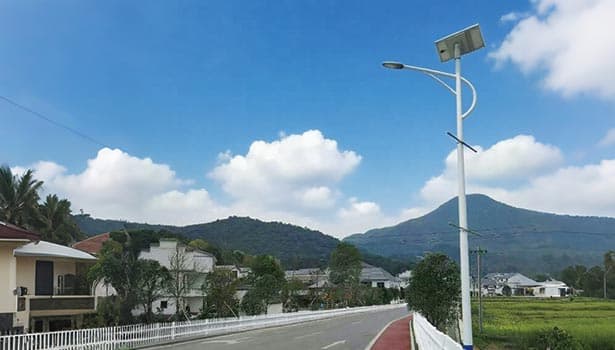
Solar Street Lights Site Selection and Evaluation Principles
Before installing solar street lights, on-site assessment needs to be completed through the following five major dimensions to ensure the stable operation of the equipment and the return on investment:
Sunlight Conditions and Orientation
Give priority to open areas without obstructions. It is recommended that the panels face south (in the Northern Hemisphere) or north (in the Southern Hemisphere) to ensure an average daily effective sunshine duration of at least 4 hours and avoid a decrease in power generation efficiency due to obstructions from buildings or mountains.
Peripheral Occlusion Influence
It is necessary to check for obstructions such as trees, power lines, and billboards. If there are fixed obstructions, the position of the light post should be adjusted or adjustable-angle photovoltaic panels should be selected to prevent the panels from being blocked by more than 20%.
Road/Pedestrian Flow Characteristics
The faster the vehicle speed and the greater the traffic volume, the higher the requirements for light intensity and coverage area: rural roads need higher illuminance to ensure visibility from a distance. The roads in the community focus on soft lighting to avoid glare.
Maintain Accessibility and Security
The position of the light post should reserve a maintenance passage to facilitate the cleaning of the panel and the replacement of the battery. Anti-theft locks and windproof fasteners should be installed in remote scenarios to reduce equipment wear and tear.
Adaptation of Environmental Factors
For areas with salt spray, extreme temperatures and high dust, targeted selection is required: anti-corrosion materials are preferred for coastal areas, wide-temperature range batteries are selected for high-temperature areas, and dust-proof designs are strengthened for desert areas.
Solar Street light Site Selection Assessment Checklist
|
Evaluation Dimension |
Key Point Description |
Priority (1–5) |
|
Sunshine Conditions |
Average daily sunshine duration ≥ 4 hours, unobstructed |
5 |
|
Sunshine Conditions |
No trees or buildings blocking, or blockage can be avoided |
4 |
|
Traffic Characteristics |
Vehicle speed and pedestrian density are clearly defined |
4 |
|
Maintenance Conditions |
Accessible maintenance channel available |
3 |
|
Environmental Adaptation |
Meets requirements for salt spray, high temperature, dust, and other harsh scenarios |
5 |
9 Places Suitable for Installing Solar Street Lights
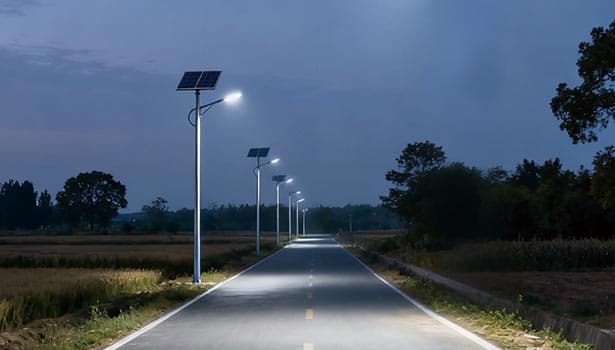
Rural Roads/Remote Highways
Why solar LED street lights suitable for rural areas?
Rural areas and remote roads are far from the urban power grid. The cost of traditional wiring can be as high as $1,500 - $3,000 per kilometer. Solar street lights do not need to be connected to the power grid. They can achieve independent lighting quickly and improve driving safety at night (Sol by Sunna Design data).
Key considerations
It needs to meet the illuminance standard of 30-50 Lux and be suitable for long-distance visibility requirements at vehicle speeds of 60-80km/h.
The battery capacity should support 3 to 5 days of autonomous operation (without charging on rainy or cloudy days).
It needs to withstand strong winds, heavy snow and other severe weather conditions.
Recommended light type
High pole (6-8 meters) + 100Ah or above LiFePO4 lithium battery + windproof and anti-theft light pole design, panel power ≥50W.
Community/Residential Area Roads
Why soalr street lights suitable for community and residential roads?
The demand for road lighting in residential areas is concentrated from 18:00 to 23:00 at night. Solar street lights do not occupy the electricity quota of residents and can improve the safety of walking at night, with an acceptance rate as high as 95%.
Key considerations
The light type should blend in with the community landscape and avoid industrial style design.
Control light pollution with illuminance ≤30lux to avoid disturbing residents' rest.
It is recommended to be equipped with a human body sensing function, which will automatically reduce power when no one is around.
Recommended light type
Stylized light head (European style/Chinese style) + warm color temperature (3000K-3500K) LED + dual control mode of sensor and timing, pole height 3-5 meters.
Q&A
Q: Will solar street lights in residential areas cause light pollution?
A: By choosing anti-glare lights and warm color temperature light sources, and combining them with the timed dimming function, the light pollution standards for residential areas can be fully met.
Parks, Squares and Walking Paths
Why solar street lights suitable for parks, squares and walking paths?
Parks and squares are mostly open Spaces with excellent sunlight conditions (averaging 4 to 6 hours of sunlight per day). Solar street lights do not require underground wiring and can be flexibly deployed on pedestrian paths and rest areas, thus extending the activity time of citizens.
Key considerations
Lighting should take into account both landscape effects and safety requirements, and avoid direct strong light.
The recommended illuminance for the pedestrian walkway is 15-20lux, and for the core area of the square, it should be ≥30lux.
The height of the light post should be adapted to the walking environment to avoid blocking the view.
Recommended light type
Low-pole (2.5-4 meters) landscape street lights or integrated lights with adjustable Angle photovoltaic panels, supporting 360° rotation to adjust the lighting Angle.
Q&A
Q: How can solar street lights in parks avoid glare from affecting walking?
A: Choose the design of diffuse reflection light heads and light shields. The installation height of the lights should be controlled within 3 meters, and the light should be projected downward without direct sunlight.
Parking Lot
Why solar street lights suitable for parking lot?
Most parking lots are large open areas with long night usage hours (from 18:00 to 6:00 the next day). The annual electricity cost for traditional lighting is as high as 800 US dollars per 100 square meters. Solar street lights can operate at zero cost, eliminate lighting blind spots, and enhance the sense of security when parking.
Key considerations
The layout of the light positions should cover all parking Spaces, with one light set every 3 to 5 meters to reduce shadow blind spots.
It is recommended to support remote monitoring to view the real-time operating status of the lights.
It must be designed with impact resistance and anti-vandalism features.
Recommended light type
Adjustable Angle light arm (120° adjustment) + 60-100W LED module + remote monitoring system, battery capacity ≥150Ah.
Q&A
Q: How many solar street lights are needed for a large parking lot?
A: Assuming each light covers an area of 15 to 20 square meters, a 1,000-square-meter parking lot requires 50 to 67 lights. It is recommended to adopt a matrix layout to enhance uniformity.
The Area Around the Factory and the Warehouse
Why solar street lights suitable for factory and warehouse?
The power consumption in the factory area is concentrated, and the wiring around the perimeter is complex, resulting in high construction costs. Solar street lights can supply power independently, which is suitable for night shift operations and security patrols, reducing the overall power load.
Key considerations
The illuminance in the night shift operation area should be ≥50lux to meet the requirements for equipment operation and safety inspection.
The protection grade must reach IP65 or above, dust-proof and moisture-proof.
The maintenance cycle should be ≥1 year to reduce the downtime for maintenance.
Recommended light type
High protection grade (IP67) + impact-resistant light housing + 200Ah large-capacity lithium battery, panel power ≥80W.
Q&A
Q: Can solar street lights in factories adapt to the surrounding environment of high-temperature workshops?
A: Select a wide-temperature-range battery with a working temperature range of -20 ℃ to 65℃, and pair it with a heat-dissipating light housing to stably adapt to the high-temperature environment in factories.
Ports/Docks and River embankments
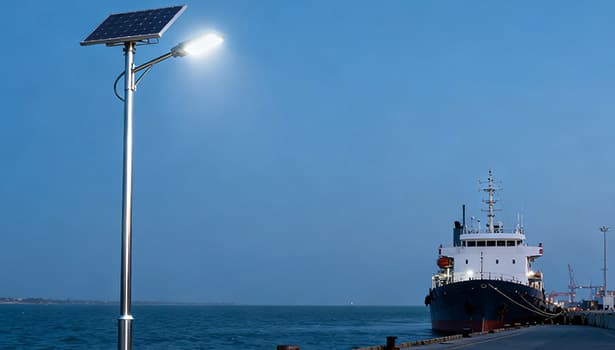
Why solar street lights suitable for ports, docks and river embankments?
Ports and river embankments are close to water bodies. Traditional wiring requires waterproof treatment, increasing construction costs by 30-50%. Solar street lights do not need wiring and can resist salt spray erosion through anti-corrosion design, with flexible deployment.
Key considerations
It must be treated to prevent salt spray and corrosion to avoid rusting of metal parts.
Lighting should be coordinated with navigation signal lights and pedestrian safety lights to avoid interference.
The wind resistance level should be ≥15 to withstand the impact of sea breeze.
Recommended light type
Stainless steel rod body (304/316 material) + anti-corrosion coated panel + IP68 high waterproof grade light, battery with waterproof packaging.
Q&A
Q: How long is the service life of solar street lights by the seaside?
A: Made of anti-corrosion materials and designed with a high IP rating, its service life can reach 8 to 10 years, and the battery replacement cycle is approximately 5 to 6 years.
Schools and Campus Roads
Why solar street lights suitable for schools and campus roads?
The demand for campus road lighting is concentrated during the time when students go to and from school (before 8:00 and after 18:00). Solar street lights can be adjusted to fit the daily routine through timed control, enhancing the safety of students' commutes and facilitating centralized maintenance by the management.
Key considerations
The illuminance should be ≥25lux to ensure the safety of students' walking at night.
Supports timed dimming, reduces power for energy conservation during class hours, and operates at full power after school.
The light type should be simple and safe, avoiding sharp designs.
Recommended light type
Medium and low poles (3-4 meters) + 40-60W LED + dual control of timing and sensing, adjustable panel Angle to adapt to the campus tree shade environment.
Q&A
Q: How can solar street lights on campus be adapted to the peak hours of going to and from school?
A: By setting the timing mode through programming, it operates at full power from 7:00 to 8:30 in the morning and from 5:30 to 9:00 in the evening, and reduces power during the rest of the time to save energy.
The Outer Field of Public Transportation Hubs
Why soalr led street lights suitable for the out field of public transportation hubs?
Most bus stops and station connection points are at the end of the power grid, making rapid wiring difficult. Solar street lights can be deployed within 24 hours to meet the lighting needs of waiting for buses and can also integrate convenient functions to enhance the service experience.
Key considerations
The illuminance should be ≥30lux to ensure that the waiting area is clearly visible.
It is suggested to integrate USB charging and LED information screen functions to enhance convenience for the public.
It should be designed to be resistant to damage and rain.
Recommended light type
Combined light posts (lighting + USB charging + information screen) or small independent lights, panel power ≥30W, battery support for 12 hours of continuous lighting.
Q&A
Q: Is the USB charging function of the solar street light at the bus stop sufficient?
A: Equipped with 5V/2A dual USB interfaces, it only takes 2 to 3 hours to fully charge a single phone, and the battery can support 10 to 15 full charges.
Intersections & Accident-prone Spots
Why solar powered street lights suitable for intersections and accident-prone spots?
Intersections and accident-prone sections have extremely high requirements for night visibility. Traditional wiring often leads to a sharp increase in costs due to the difficulty of road construction. Solar street lights can be deployed quickly and reduce the accident rate through high-brightness lighting (data from Sol by Sunna Design shows that night accidents can be reduced by 60%).
Key considerations
The illuminance should be ≥60lux to ensure that vehicles can recognize signals and pedestrians from a distance.
It has good uniformity of light, avoiding visual fatigue caused by alternating light and dark.
The battery needs to support 5 to 7 days of autonomous operation to cope with continuous rainy days.
Recommended light type
High brightness (100-150W LED) + short-pitch dense light layout (2-3 meters per light) + large-capacity battery of over 200Ah, supporting emergency backup lighting mode.
Q&A
Q: How do solar street lights at intersections work in conjunction with traffic signals?
A: Select a warm white light source (4000K) to avoid color conflicts with signal lights while ensuring light penetration, making it clearly visible even in rainy or foggy weather.
FAQ
Q: How do solar street lights work on cloudy days?
A: On cloudy days, the power can be replenished through low-light power generation. High-quality lithium batteries can support autonomous operation for 3 to 7 days, depending on the battery capacity and energy-saving Settings.
Q: How often do solar panels need to be cleaned?
A: Generally, solar panels should be cleaned every 3 to 6 months. In areas with a lot of dust and little rainfall, the cleaning time can be shortened to 1 to 2 months. Timely cleaning of solar panels can effectively ensure the power generation efficiency.
Q: How long is the battery life of solar street lights?
A: The lifespan of LiFePO4 lithium batteries is approximately 5 to 8 years, and the replacement cost is about 300 to 800 US dollars per piece, which is much lower than the long-term electricity bill of traditional lighting.
Q: Will extremely low or high temperatures affect the operation of solar street lights?
A: Choosing wide-temperature-range batteries (-20℃ to 65℃) for your solar street lights can adapt to most extreme environments. The capacity may slightly decline at low temperatures, but it does not affect the basic lighting requirements.
Q: Is it difficult to install solar street lights?
A: The installation process is simple and can be completed by 2 to 3 people. There is no need for complex construction. It is recommended that a professional team handle the site selection and commissioning to ensure the power generation efficiency.
The advantages of solar street lights, such as no wiring, zero electricity charges and low maintenance, make them irreplaceable in nine major scenarios including rural roads, residential areas and parking lots. Through precise matching of scene requirements, scientific selection and standardized installation, long-term stable lighting and cost savings can be achieved. Please contact NOKIN immediately to get an accurate quotation and start a new experience of low-carbon and energy-saving lighting!