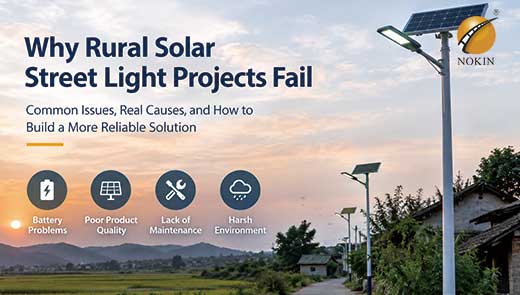
Why Rural Solar Street Light Projects Fail
Oct 13, 2026
In many developing countries and remote rural areas, solar street lights are regarded as a "one-time solution": once installed, there will be no electricity bills, no need to connect to the power grid, and the entire village road can be illuminated on the same day. However, the reality is often much harsher. A typical rural project often follows this trajectory - in the first year, the entire road is brightly lit, and villagers praise it; in the second year, the brightness of the lights begins to significantly decline, and some lights go out prematurely; by the third year, a large number of lights collectively "go on strike", and the entire road reverts to darkness. The community is disappointed, and the public funds or aid funds invested in the project are wasted, while the project manager has to face the villagers' doubts and the accountability from higher-ups.
Why do many rural solar street light projects fail? In the following content, NOKIN will dissect the six most common fatal mistakes in rural off-grid solar street light projects and provide practical avoidance methods for each mistake. If you are planning or approving a rural road lighting project, this article can help you avoid a whole sunk cost instead of realizing the problem after the solar street lights go out.
Mistake 1 — Sizing Rural Solar Street Lights Based on Average Sunshine Instead of Consecutive Rainy Days
Why Annual Average Sunshine Data Can Underestimate Rainy-Season Risks
This is the most common and fatal configuration error in rural solar street light projects. Many suppliers, when designing the system, only use a table of the average annual sunshine duration in the region to estimate the power of the solar panels and the capacity of the battery. The formula seems scientific: Annual sunshine hours ÷ 365 days × some coefficient = daily effective power generation. But the biggest problem with the annual average data is - it averages out the worst situation of the year.
You might calculate "an average of 4.5 hours of effective sunshine per day", but the real situation is often: 6 hours per day in the dry season and almost zero during the rainy season for a week. And the operation logic of off-grid solar systems is: the daily power generation must be greater than the daily power consumption at night, otherwise, it will draw from the battery. Once the number of consecutive rainy days exceeds the battery's designed endurance, the street lights will go out in rows.
Why Rural Off-Grid Solar Street Light Systems Are Vulnerable to Consecutive Rainy Days
Rural off-grid systems have no backup from the grid. Urban street lights, even if there is insufficient solar power, still have city power as a backup; but rural solar street light projects, once entering continuous rainy days, the system can only rely on the battery to hold out.
In tropical and monsoon climate regions, there are usually 5-7 consecutive days without effective sunshine, and even extreme cases of 10 days or more. Taking solar street light projects in Southeast Asia, the African equatorial belt, and the monsoon regions of South America as examples, many "failed in the first year of the rainy season" projects used the annual average data when configuring.
How to Specify Consecutive Rainy-Day Autonomy in Solar Street Light Contracts
When purchasing, do not only ask "how long it can shine", but ask "how many nights can it continue to shine without sunlight".
- Clearly state in the contract: The system's endurance is designed based on the most unfavorable continuous rainy days in the local area, rather than the average annual sunshine.
- Require the supplier to provide the source of climate data used for the endurance design (local meteorological station data, NASA irradiation database, etc.).
- In the acceptance terms, state: If the actual endurance does not meet the contract's endurance based on continuous rainy days, the supplier is responsible for rectification.
Mistake 2 — Failing to Assign Solar Street Light Maintenance Responsibilities
Why Solar Street Light Projects Fail Without Ongoing Maintenance
The delivery logic of many rural projects is: installation and commissioning → acceptance signature → supplier's departure → from then on, no contact.
Solar street lights are not one-time consumables; they require continuous cleaning and maintenance: the surface of the solar panels will accumulate dust, directly reducing the power generation efficiency, the LED light heads will age, and the controllers and batteries will also malfunction. The problem is - who is responsible for handling these?
In most failure cases, the answer is "no one is responsible". The panels accumulate dust and no one cleans them, the lights break and no one repairs them, and the controller malfunctions and no one investigates. The performance of the lights gradually deteriorates at a rate of 5% - 15% each year, and eventually the entire system collapses within 2-3 years.
Rural Solar Street Light Maintenance Challenges: Technicians, Transport, and Spare Parts
The maintenance difficulties in rural areas are completely different from those in cities:
- There is a shortage of professional technicians, and it is difficult to find electricians who can repair solar systems locally;
- The villages are scattered and the roads are remote, making the cost of transportation for maintenance personnel high and the cycle long;
- Spare parts for the equipment need to be pre-stored, and temporary purchases often cannot be made or take a long time.
These factors combined lead to the inevitable result of "blurred responsibility = maintenance paralysis" in rural areas.
How to Assign Maintenance Responsibilities Before Project Handover
Before the project delivery, it is necessary to clearly designate a maintenance responsibility entity among the village committee, local contractors, and equipment suppliers, and implement it in writing.
- Reserve spare parts inventory (lightcaps, controllers, batteries, cables) in the budget to avoid having no parts to replace after a failure;
- Provide a graphic and textual simple maintenance manual upon delivery to enable local villagers to understand "how to clean the panels, how to check if the lights are on, and who to report for repair";
- Provide basic operation training to local maintenance personnel to make the "first repair" a demonstration.
Mistake 3 — Ignoring Solar Street Light Theft Risks in Rural Areas
Why Solar Panels and Batteries Are Vulnerable to Theft
Solar panels and batteries have strong second-hand recycling value, and in remote areas, they are very realistic targets for theft.
The batteries (such as lithium iron phosphate or gel batteries) and photovoltaic panels of a rural solar street light have clear market prices on the black market. Some projects are even more serious - the batteries and panels of the entire village road are dismantled in batches, and the project is "robbed clean" before the warranty period is over.
Even more counter-intuitive is that: the more eye-catching and the higher the configuration, the higher the risk of theft - because it means more "waste value".
Rural Installation Conditions That Increase Solar Street Light Theft Risks
- Remote, unattended areas;
- The lightposts are installed at a low height, accessible with bare hands;
- Lack of anti-theft design, ordinary screws can be used to dismantle;
- There is no community watchkeeping mechanism, and no one patrols.
How to Reduce Solar Street Light Theft with Anti-Theft Design and Community Monitoring
- Prioritize the use of anti-theft structures: anti-theft bolts, detachable lightcaps, integrated lights with built-in batteries;
- Raise the installation height to make the batteries and panels less accessible by hand;
- Establish a community watchkeeping responsibility mechanism, incorporate the street lights into the village regulations, and mobilize villagers for daily inspections;
- Key components can consider integrating hidden battery compartments to reduce the temptation of "selling the parts after dismantling".
Mistake 4 — Overpromising Solar Street Light Coverage and Illumination
Why Rural Solar Street Light Projects Often Fail to Meet Coverage Expectations
This is a frequent reason for "the project being questioned and subsequent funds difficult to obtain".
During the initial communication with the solar street light suppliers, in order to win the project, they often exaggerate the lighting effect - suggesting that this set of lights can "light up the entire village", but in reality, due to cost and configuration constraints, the lighting can only cover the main road, and the alleyways and public activity areas in the village remain dim.
Once the gap between expectation and reality is formed, the community will consider the project "not meeting the expectations", the project results will be questioned, the person in charge's assessment will be affected, and the subsequent rural infrastructure funding approval will also be hindered.
Why Wattage Alone Cannot Measure Solar Street Light Performance
Many purchasers consider "the higher the wattage = the brighter" as the only criterion. But in fact:
- Wattage is only the input power of the lighthead, not representing the light output;
- Lumens (lm) reflect how much light the lightactually emits;
- Lux (lux) and uniformity determine whether the road is actually bright and whether there are dark areas.
Focusing solely on wattage often results in spending more money but not meeting the illumination standards, or over-lighting and wasting the configuration.
How to Specify Solar Street Light Illuminance and Coverage Requirements
- Clearly define the lighting goals at the project's early stage: specify which roads to illuminate and which areas to cover, rather than vague statements like "illuminate the entire village";
- Set procurement and acceptance standards based on key indicators such as pavement illuminance (lux), lighting coverage range, and uniformity;
- Have suppliers calculate the configuration based on the target illuminance rather than blindly increasing wattage based on the budget.
Mistake 5 — Applying Urban Road Lighting Standards to Rural Solar Street Light Projects
Why Urban Road Lighting Standards May Not Suit Rural Roads
Many solar street lighting projects have taken two opposite extremes in configuration standards:
Extreme 1: Copying urban road lighting standards. Directly applying the high illuminance and high power standards of urban main roads to rural areas, resulting in a tenfold increase in configuration costs and a direct collapse of the budget. Even if it were to be successfully implemented, it would be a serious waste of resources
Extreme 2: Unwilling to increase costs. Using household small-power lights to make up for the shortfall, resulting in severely insufficient pavement illuminance and inability to ensure safe nighttime passage. The project is judged as "ineffective lighting".
Rural Road Lighting Requirements: Balancing Illuminance, Uniformity, and Reliability
Rural roads and urban traffic characteristics are completely different:
- Low speed, small traffic volume;
- The main traffic participants are pedestrians and non-motorized vehicles;
- Nighttime activity time is short and usage density is low.
Therefore, the illuminance target for rural road solar street lights can be reasonably reduced, and it does not need to reach the standards of urban main roads. However, two indicators must not be lowered - uniformity (to avoid alternating light and dark on the road surface and forming safety hazards) and system reliability (it cannot go out frequently).
How to Set Solar Street Light Specifications for Rural Road Conditions
- Based on the actual traffic scenarios and road grades of rural areas, customize lighting indicators instead of directly copying urban norms;
- Refer to the corresponding logic between road grades and lighting to determine "how much illuminance this road actually needs";
- Find a balance between "reasonable reduction of illuminance" and "staying within the bottom line of uniformity and reliability".
Mistake 6 — Budgeting for Solar Street Light Purchases Without Maintenance Costs
Why Solar Street Light Projects Need a Long-Term Maintenance Budget
The funding planning for many projects is: one sum of money is used to cover the procurement and installation costs, and once the acceptance is completed, the funds are zero.
However, solar street lights have a service life. After 2-3 years, the battery capacity begins to decline (especially for inferior batteries, it declines faster), the light head light fades, and the cables age - these all require continuous capital investment for replacement and maintenance. If no reserve maintenance budget is set, once the system deteriorates, it can only watch helplessly as it becomes a "failed project".
Solar Street Light Total Cost of Ownership (TCO): A 5-Year Cost Comparison
Many decision-makers only focus on the one-time purchase price and ignore Total Cost of Ownership.
Here is a typical comparison of the TCO of rural solar street lights (estimated for a single street light over a 5-year life cycle, in US dollars, for illustration purposes only):
|
Cost Item |
Purchase Price Only (Short-Sighted Approach) |
Full Lifecycle Cost (Reasonable Approach) |
|
Initial Purchase and Installation Cost |
About $220 |
About $280 |
|
Battery Replacement (Every 3 Years) |
No budget allocated; battery failure in Year 3 |
Included in the budget; about $60 |
|
Spare Parts and Maintenance (5 Years) |
About $0 |
About $45 |
|
Solar Panel Cleaning and Inspection |
About $0 |
About $25 |
|
Total Cost Over 5 Years |
About $220 (but fails in Year 3) |
About $410 (stable operation for 5 years) |
|
Cost Per Night Over the Actual Service Life |
High due to premature failure |
Lower, spread over 5 years |
Conclusion: The initial savings from a lower purchase price may ultimately be offset by premature failure and reduced service life.
How to Plan Solar Street Light Maintenance and Replacement Costs
- When the project is initiated, the operation and maintenance budget is included in the overall financial planning (such as spare parts replacement, panel cleaning, annual inspection);
- The low-maintenance design is given priority in the selection: long-life batteries (such as lithium iron phosphate), maintenance-free structure, and easy-to-clean solar panels;
- The TCO (Total Cost of Ownership) is used instead of the purchase price to evaluate the solution.
Solar Street Light Project Checklist: 10 Things to Check Before You Buy
This 10-item self-inspection checklist covers the first 6 risk points and adds supplier capability verification. It is recommended to check each item item by item during the project initiation and procurement stages. If any item is missing, the project should be returned for re-evaluation.
|
No. |
Self-Inspection Item |
Yes/No |
|
1 |
Battery capacity is designed based on the local number of consecutive rainy days and specified in the procurement contract. |
☐ Yes / ☐ No |
|
2 |
Maintenance responsibilities are clearly assigned to the village committee, contractor, or supplier, and spare parts are reserved. |
☐ Yes / ☐ No |
|
3 |
The installation plan incorporates anti-theft measures, such as tamper-resistant structures, internally installed batteries, and high-position installation. |
☐ Yes / ☐ No |
|
4 |
Lighting acceptance criteria are based on illuminance and coverage area rather than wattage alone. |
☐ Yes / ☐ No |
|
5 |
The system configuration is tailored to rural conditions rather than directly copying urban lighting standards. |
☐ Yes / ☐ No |
|
6 |
Operation and maintenance costs are included in the budget and calculated based on total life-cycle costs. |
☐ Yes / ☐ No |
|
7 |
The supplier can provide verified implementation cases from similar rural projects. |
☐ Yes / ☐ No |
|
8 |
The warranty covers battery capacity degradation, not just the light head. |
☐ Yes / ☐ No |
|
9 |
The supplier provides a maintenance manual and basic on-site maintenance training. |
☐ Yes / ☐ No |
|
10 |
A phased implementation plan is in place, with provisions for future expansion. |
☐ Yes / ☐ No |
Supplementary explanation for item 8: The battery is the most aged component in the solar street light system and the most expensive replacement item. If the warranty only covers the light head and does not cover battery degradation, it is equivalent to leaving the biggest risk to the purchaser. Be sure to read this clause clearly when signing the contract.
Conclusion: How to Make Rural Solar Street Light Projects More Reliable
Reviewing the entire text, the truth about the success or failure of the rural solar street light project is clear: the problem almost never lies in "whether the lights themselves are good or not", but rather in three aspects - whether the configuration is correct, whether someone is responsible for the maintenance, and whether there is money for operation and maintenance.
- The configuration should be determined based on the actual local climate (continuous rain) and actual scenarios (road grade), rather than simply copying theoretical data or urban standards;
- The responsibility should be locked in advance for the maintenance entity, reserve spare parts, and provide training to avoid losing contact immediately after delivery;
- The funds should be planned based on the full life cycle cost, rather than just focusing on the one-time purchase price.
If your project can hold these three points at the same time, then solar street lights in rural areas are not only feasible, but also a long-term investment that can be realized.
If you are planning a rural solar street light project, please tell us your project scenario - the country where it is located, the total length of the roads, and the project funding scale. NOKIN will provide you with a "avoiding pitfalls" lighting configuration suggestion based on the local climate, road grade, and your budget, avoiding the above six mistakes from the source.