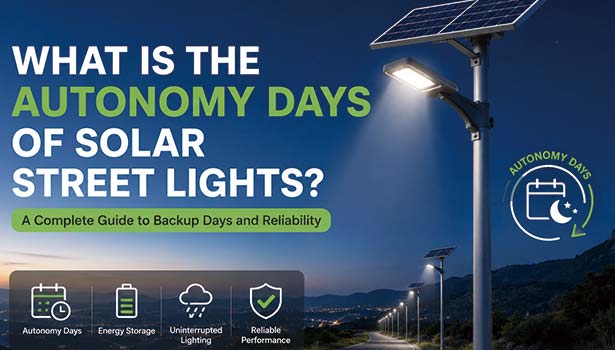
What Is the Autonomy Days of Solar Street Lights?
May 28, 2026
Many overseas buyers, engineering contractors, and municipal maintenance personnel often encounter a common problem: Even though they are all solar street lights, why do some products completely lose their lighting and experience a sharp decrease in brightness after only 2 days of continuous rain, while high-quality 3-5 rainy days solar street lights can remain stable and illuminated even in continuous rainy and no-sunlight conditions? The core answer lies in solar street light autonomy days and reliable solar street light autonomy days design.
autonomy days is not an additional parameter of the product, but a core indicator determining the long-term stability of solar street lights outdoors. Especially for municipal roads, rural remote roads, parking lots, parks and scenic areas, as well as coastal rainy areas, sufficient rainy-day autonomy days is crucial to avoid project acceptance failures, reduce maintenance and operation costs, and ensure safe night-time passage.
This article will deeply analyze the definition, calculation method, industry standards, and core influencing factors of solar street light autonomy days, and share professional design solutions for 3-5 days rainy-day autonomy days, helping everyone fully understand the selection and design logic of solar street lights in rainy seasons.
What Does Autonomy Days Mean in Solar Street Lights?
Core Definition of Solar Street Light Autonomy Days
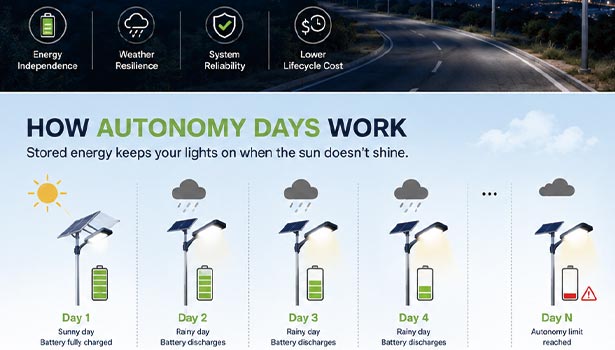
Solar street light Autonomy Days, also commonly known as backup days, backup nights, or rainy-day autonomy days, refers to the maximum number of days that a solar street light can provide normal lighting without charging from the sun, relying solely on the battery's stored electricity.
This parameter is specifically designed for off-grid solar lighting systems and perfectly suits rainy, cloudy, and foggy low-light scenarios. It is a core technical parameter for measuring the durability and reliability of solar street lights.
How Autonomy Days Is Calculated
The industry standard calculation formula is as follows:
Autonomy Days= Battery usable energy (Wh) /Daily light power consumption (Wh/day)
The core logic of the formula: The more effective electricity that the battery can release and the lower the daily power consumption of the light, the longer the rainy-day autonomy days of the solar street light.
Why Autonomy Days Matters in Outdoor Solar Lighting Projects
Solar street lights rely on solar panels for daytime charging and battery storage for nighttime lighting. Continuous rainy and cloudy weather will directly lead to a significant drop in solar irradiation intensity and a sharp decline in photovoltaic panel charging efficiency.
If the autonomy days design of the product is insufficient, a series of problems will occur: the battery's SOC (remaining power) keeps decreasing, the LED light's brightness declines, the lighting duration shortens, and eventually the lights go out completely, seriously affecting road safety and project acceptance results.
It is clear that Autonomy Days is one of the core parameters determining whether a solar street light is truly reliable and is also a key assessment indicator in overseas municipal tenders and outdoor infrastructure projects.
Why Is 3–5 Days Battery Backup the Industry Standard?
Recommended Solar Street Light Backup Days for Different Regions
The lighting conditions and rainy days frequency in different regions vary greatly, and the corresponding solar street light autonomy autonomy days design standards also differ. Based on international engineering selection guidelines, the applicable standards for each region are as follows:
|
Region Environment Type |
Recommended Autonomy Days |
Explanation of Applicable Scenarios |
|
Sunny and Dry Areas |
2–3 Days |
Arid inland regions with low rainfall, long sunshine duration, and stable solar radiation conditions. |
|
Urban and Rural Areas |
3–5 Days |
Common application scenarios in most cities and rural areas, balancing rainfall frequency, lighting reliability, and project cost. |
|
Tropical Monsoon Regions |
5–7 Days |
Areas with long rainy seasons, frequent heavy rainfall, and multiple consecutive cloudy or rainy days, such as Southeast Asia and South America. |
|
High-Latitude Winter Regions |
More Than 7 Days |
Regions with short winter daylight hours, frequent rain and snow, and relatively weak solar irradiation intensity. |
Why 3–5 Days Backup Is the Most Cost-Effective Solution
In the global commercial solar street lighting market, 3-5 days backup is the default standard configuration for integrated solar street lights, and it is the most cost-effective engineering solution. The core reasons are three:
Firstly, 3-5 consecutive rainy days are the most common extreme weather conditions worldwide, which can cover the lighting needs of most cities, rural areas, parks, and parking lots during the rainy season, effectively avoiding the risk of power failure.
Secondly, this standard perfectly balances product reliability, battery capacity, and project budget. A short autonomy days of less than 7 days cannot cope with rainy season weather, while an ultra-long autonomy days of more than 7 days will significantly increase the cost of batteries and the entire unit, resulting in resource waste.
Finally, the commercial solar street lighting products of mainstream industry brands are all based on a 3-5 days rainy-day autonomy days as the basic configuration, suitable for most overseas small and medium-sized infrastructure and municipal projects.
How to Calculate Solar Street Light Autonomy Days?
Step 1 – Calculate Daily Power Consumption
The daily power consumption of the light is the basis for autonomy days calculation, determined by the LED power and the duration of night lighting. The formula is simple and intuitive:
Daily Power Consumption (Wh)=LED Power (W)×Working Hours (h)
For example: A 50W solar street light that operates for 10 hours every night has a daily power consumption of = 50W × 10h = 500Wh.
If the light supports intelligent dimming and operates at reduced power at night, the daily power consumption can be calculated based on the average power consumption, and the autonomy days will be extended accordingly.
Step 2 – Calculate Battery Usable Capacity
The mainstream configuration for solar street lights is LiFePO4 lithium-ion batteries, which is also the optimal battery type for rainy season autonomy days. When calculating autonomy days, the nominal capacity of the battery cannot be directly used; it is necessary to focus on the available electricity and discharge depth (DOD).
Take the commonly used 12.8V 100Ah lithium iron phosphate battery as an example: The total nominal capacity of the battery = 12.8V × 100Ah = 1280Wh. According to industry safety standards, the regular DOD of LiFePO4 batteries is 80%, which can effectively protect the battery and extend its cycle life, so the actual available electricity is only 1024Wh.
This is the core reason why many low-priced street lights have false autonomy days claims: only the total battery capacity is labeled, while the discharge depth loss is ignored, resulting in actual rainy-day autonomy days far lower than the advertised value.
Step 3 – Calculate Required Battery Backup Days
Combining the daily power consumption and the target autonomy days, the minimum battery capacity required for the project can be calculated inversely. At the same time, engineering design should reserve redundancy to avoid environmental losses.
Real Engineering Calculation Example
Practical case: A city road project, with a daily power consumption of 500Wh for the lights, requires a 5-day rainy-day autonomy days. The theoretical required battery capacity = 500Wh/day × 5day = 2500Wh.
In actual engineering, three additional losses need to be added: aging loss of the battery over time, capacity reduction in low-temperature environments, and controller operation efficiency loss. Reserving 10%-20% capacity redundancy is necessary to ensure long-term stable autonomy days meeting the 3-5 days autonomy days standard.
Key Factors Affecting Solar Street Light Backup Performance
Solar Panel Conversion Efficiency
During cloudy and rainy seasons, there is no direct sunlight, only scattered light. The weak light charging capacity of the photovoltaic panel directly determines the speed of autonomy days recovery for the street light.
Monocrystalline silicon solar panels have a higher photoelectric conversion efficiency than polycrystalline silicon, and have a more sensitive response to weak light. Even in rainy weather, they can still continuously collect scattered light to recharge the battery. At the same time, large-sized photovoltaic panels can increase the total charging power, significantly shortening the rainy season battery charging cycle and avoiding continuous battery depletion.
Why LiFePO4 Batteries Are Best for Rainy Weather
The battery is the core carrier of the battery's endurance capacity. The LiFePO4 lithium iron phosphate battery is currently the preferred choice for solar street lights to adapt to rainy weather conditions, with advantages far exceeding those of ordinary lead-acid batteries:
The cycle life can reach over 5,000 times, and the long-term charging and discharging attenuation is slow, and the endurance stability is strong;
The high-temperature stability is excellent, and it is less likely to fail in outdoor exposure to strong sunlight and temperature fluctuations;
The deep-cycle discharge capacity is strong, supporting high DOD discharge, and the electricity utilization rate is higher;
The weather resistance is excellent, and it is less likely to bulge or fail under continuous rainy and low-power conditions.
MPPT Controllers and Charging Efficiency
The controller is the core of power scheduling and directly affects the charging efficiency in rainy weather. The mainstream controllers in the industry are divided into PWM and MPPT types, with a significant gap.
Compared with traditional PWM controllers, the MPPT solar controller can track the maximum power point in real time, and in low-light and rainy conditions, the charging efficiency can be improved by 10%-25%. It can maximize the use of limited scattered light for charging, alleviate the problem of insufficient electricity during the rainy season, and is the core component to ensure a 3-5-day endurance.
Smart Dimming and PIR Motion Sensors
Constant full-power lighting is an important cause of insufficient endurance. Solar street lights equipped with PIR human body sensing sensors and intelligent dimming systems can optimize the power usage logic: automatically reduce brightness and operating power during the low-traffic hours at night, and restore to normal brightness when someone passes by.
This intelligent power consumption control mode can effectively reduce the overall daily power consumption, and directly extend the rainy-day endurance time by 1-2 days, significantly improving the reliability during the rainy season.
Common Solar Street Light Battery Backup Design Mistakes
High LED Power With Insufficient Battery Capacity
This is the most common design mistake in the industry. Many manufacturers, in order to highlight the advantages of product parameters, blindly combine large-power LED bulbs, but compress the battery cost and reduce the battery capacity.
This configuration has excellent lighting effect in sunny days, but in continuous rainy and cloudy weather for 2-3 days, it will quickly consume the electricity and go out, completely unable to meet the project requirements during the rainy season.
Ignoring Worst-Month Solar Radiation Data
Some designs only refer to the average solar radiation duration throughout the year, ignoring the lowest solar radiation parameters during the rainy season and winter. The average data cannot cover extreme conditions, resulting in frequent endurance problems during the rainy season after the project is implemented. Professional solar street light sizing must be based on the peak solar radiation duration of the worst month in the local area.
Using Low-Quality Batteries
Low-quality refurbished batteries and counterfeit batteries have falsely high rated capacity and extremely low actual electricity consumption, and poor discharge stability. These batteries have no obvious problems in short-term use, but their endurance significantly decreases during the rainy season, and they are prone to aging, bulging, and leakage faults, increasing the maintenance cost in the long run.
Fake Wattage Labeling Problems
There is a widespread fraud of mislabeling wattage in the industry. Small-power bulbs are mislabeled as large-power ones to mislead buyers in selection. The actual power consumption of the mislabeled products does not match the promotion, resulting in the complete failure of the previous endurance calculation and inability to meet the preset 3-5-day endurance standard during the rainy season.
Best Solar Street Light Design for 3–5 Rainy Days Backup
Use High-Efficiency Monocrystalline Solar Panels
Prioritize the use of high-conversion-efficiency monocrystalline photovoltaic panels, combined with a reasonable power ratio, to ensure charging capacity in weak light environments. Appropriately increase the size of the photovoltaic panels to enhance peak charging power and quickly make up for the power loss during the rainy season.
Reserve Extra Battery Capacity
Based on the project target of 3-5 days of endurance, combined with local climate, temperature, and battery aging coefficient, reserve about 15% of battery capacity redundancy. The entire series is equipped with high-quality LiFePO4 batteries to ensure deep-cycle discharge stability and prevent endurance reduction.
Choose an Intelligent MPPT Controller
It is uniformly equipped with a high-precision MPPT charging controller, which maximizes the utilization rate of scattered light in rainy conditions, optimizes the charging and discharging logic, avoids damage to the battery due to over-discharge or over-charging, and ensures the long-term stable operation of the system.
Optimize Smart Lighting Modes
Customize a scientific dimming curve, combine scene settings with time-based lighting and human body sensing energy-saving mode. Without affecting the safety of night traffic, reduce the average daily power consumption and easily meet the 3-5-day battery endurance requirements for rainy days.
Perform Professional Solar Street Light Sizing
The professional design of rain season street lights is not simply a combination of batteries and photovoltaic panels. It requires comprehensive calculation of local peak PSH solar radiation, battery DOD discharge depth, temperature attenuation coefficient, and rain season weather data, combined with optical simulation modeling, to output precise system configuration that is suitable for the actual site conditions of the project.
Conclusion
Autonomy Days is the core indicator for evaluating the reliability of outdoor off-grid lighting systems, directly determining the stability of the product during the rainy season and the quality of project implementation.
For the vast majority of municipal roads, rural infrastructure, parks, and parking lots worldwide, a 3-5 day autonomy days during rainy days is the optimal industry standard that balances reliability and cost. To achieve stable autonomy days, it is necessary to rely on efficient photovoltaic panels, high-quality LiFePO4 batteries, MPPT intelligent controllers, and energy-saving dimming systems in a coordinated manner.
It is meaningless to merely pursue high power and low price. A systematic solar street light design that is scientific and suitable for the scene can fundamentally eliminate problems such as rain season power failure, frequent after-sales service, and project acceptance failure, and improve the long-term investment return rate of the project.
If you need a dedicated configuration list for 3-5 day autonomy days during rainy days in the location of the project, you can contact NOKIN solar street light at any time to customize a rain season solar street light project plan for free, providing precise quotations and a complete set of technical parameters.
FAQ About Solar Street Light Autonomy Days
How Many Backup Days Are Recommended for Solar Street Lights?
For regular urban, rural and industrial park projects, a 3-5 day autonomy days is recommended; for dry and less rainy areas, a 2-3 day configuration can be selected; for tropical areas with heavy rainfall and snowy winters, upgrading to a 5-7 day autonomy days is recommended to ensure stable operation during extreme weather conditions.
Can Solar Street Lights Work During Cloudy Weather?
Yes, they can. High-quality solar street lights are equipped with low-light efficient photovoltaic panels and sufficient autonomy days. In cloudy weather, they can rely on scattered light for charging and store electricity in the battery to provide continuous lighting. With a 3-5 day autonomy days configuration, they can fully cope with continuous cloudy days and light rain, with only severe rain and prolonged lack of sunlight causing a slight reduction in brightness.
What Is the Best Battery Type for Solar Street Lights?
The preferred battery type is LiFePO4 phosphate iron battery. It has a long cycle life, high temperature resistance, strong deep discharge performance, and low attenuation. Its outdoor weather resistance far exceeds traditional lead-acid batteries, and it can continuously and stably support autonomy days for rainy and cloudy weather conditions. It is currently the standard battery for outdoor solar street lights.
How to Calculate Solar Street Light Battery Backup Time?
First, calculate the daily average power consumption of the light (LED power × lighting duration), then calculate the effective usable power of the battery (total battery capacity × DOD discharge depth), and finally divide the usable power by the daily average power consumption to obtain the accurate duration of autonomy days. When calculating, it is recommended to reserve an environmental loss redundancy.
Is 5 Days Backup Enough for Tropical Regions?
Ordinary tropical urban projects can meet basic needs, but tropical rainforest areas and areas with extremely long rainy seasons in the core regions are recommended to upgrade to a 5-7 day autonomy days configuration. Tropical areas have frequent rainy and scarce sunlight weather, and higher autonomy days redundancy can completely avoid the risk of light failure during the rainy season, ensuring the long-term stable operation of the project.