Solar Street Light Wattage Calculation Guide: Lux, Lumens & Illuminance Explained
May 26, 2026
During the design and implementation of solar street light projects, many purchasers and contractors often encounter two typical problems. One is that after the installation of the street lights, the road surface brightness is insufficient and the lighting uniformity is poor, failing to meet the safety standards for road traffic. The second is blindly choosing high-wattage lights, resulting in redundant power consumption, waste of solar components and batteries, and significantly reducing the project's profit margin.
The core reason for these problems is that most practitioners only rely on wattage selection and ignore the core lighting indicator, illuminance (Lux). The core logic of solar street light design is that wattage is not equal to brightness. What truly determines the lighting effect is the actual illuminance on the ground.
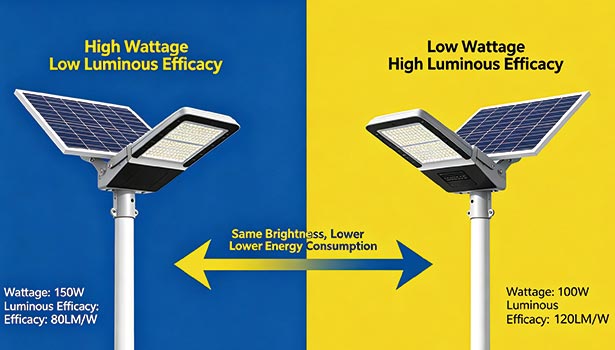
High-wattage lights do not represent high-quality lighting effects. Efficient photoelectric conversion efficiency and reasonable optical design are far more important than simply increasing power.
In this next blog, NOKIN will systematically break down the calculation logic of illuminance and wattage for solar street lights, explaining the definition of Lux, the illuminance calculation formula, different lighting standards for different scenarios, and the method of wattage matching. It will also be accompanied by practical cases and key avoidance points to help engineering personnel accurately complete the lighting design for the project, while considering compliance, practicality, and cost controllability.
What Is Illuminance (Lux) in Solar Street Lights?
What Does Lux Mean?
Lux (Lumens) is an internationally recognized unit for measuring road illuminance, specifically used to measure the visible light brightness received by a unit area of the ground. It is also the core indicator for road lighting acceptance.
In simple terms, Lumens is the total light output of the light, while Lux is the actual effective brightness that falls on the road surface and is perceived by the human eye. Its basic physical formula is: 1 Lux = 1 Lumens/m2.
All acceptance standards for road lighting projects are based on Lux values as the core basis, rather than light wattage or total lumens.
Lux vs Lumens vs Wattage
Many project design misunderstandings arise from confusing the roles of Lux, Lumens, and Wattage. Each of these parameters has its own specific function and cannot be substituted for each other. The following table clearly distinguishes the core differences:
|
Parameter |
Definition |
Engineering Importance |
|
Lux (Illuminance) |
Actual illuminance on the ground area |
Highest importance; determines whether the project meets lighting standards and passes project acceptance |
|
Lumens |
Total light output of the light source |
Medium importance; determines the brightness potential of the lighting fixture |
|
Wattage |
Power consumption of the light during operation |
Secondary importance; mainly affects energy consumption and solar system configuration costs |
After entering the LED lighting era, the core design logic of the industry has completely changed. Traditional high-pressure sodium lights rely on high wattage to achieve high brightness, while LEDs have the characteristics of high lumens and low power consumption.
Therefore, the optimal design principle for solar street lights is: Use the minimum power that meets the standard illuminance to complete the project configuration, and avoid excessive design and cost waste.
Solar Street Light Illuminance Standards for Different Applications
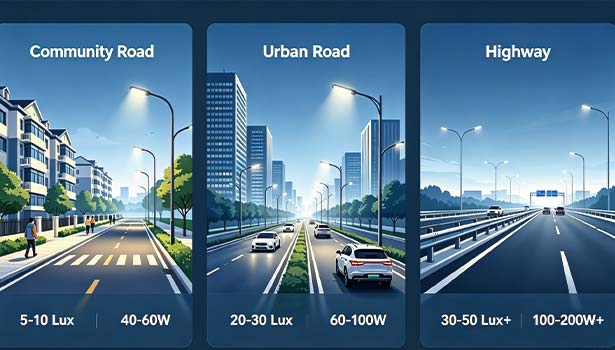
Different roads and sites have different traffic demands and usage scenarios, resulting in significant differences in standard illuminance. Refer to CIE international lighting standards and civil lighting industry norms, and the recommended Lux values for various scenarios are as follows:
Residential Roads and Walkways
Recommended standard illuminance: 5–10 Lux
Applicable scenarios: Internal roads in residential areas, pedestrian walkways, park paths, rural roads. These scenarios have few traffic and pedestrian flows, only requiring basic traffic and security lighting, and low illuminance design can significantly reduce the overall project cost.
Urban Roads and Commercial Areas
Recommended standard illuminance: 20–30 Lux
Applicable scenarios: Secondary roads in cities, commercial streets, parking lots in residential areas, main roads in parks. This scene has frequent traffic and vehicle flows, and there are clear requirements for contrast brightness and uniformity. It is necessary to ensure safe night-time passage and commercial visual experience.
Highways and Industrial Areas
Recommended standard illuminance: 30–50 Lux and above
Applicable scenarios: urban main roads, highways, large industrial parks, port terminals. These scenarios have fast vehicle speeds, dense traffic, and long operation times. In addition to high illuminance, higher lighting uniformity and a wider illumination range are required. High poles and high luminous flux lights need to be matched.
Solar Street Light Illuminance Calculation Formula
Standard Lux Calculation Formula
In solar street light engineering design, the industry's commonly used average illuminance calculation formula is the recognized standard in the industry and is applicable to all outdoor road lighting projects:
E=Φ×UC×LLF/W×S
Parameter Explanation
- E: Average road illuminance, unit Lux
- Φ: Total luminous flux of the light, unit Lumen (Lumen)
- UC: lightutilization coefficient, typically taken as 0.7–0.85, representing the effective utilization of light
- LLF: Light loss maintenance coefficient, typically taken as 0.7–0.8, compensating for lightaging, dust obstruction, and weather loss
- W: Road width, unit m
- S: lightpole spacing, unit m
Lumen Calculation Formula
In actual project design, we usually know the target illuminance and need to reverse calculate the total lumens required for the light, then convert to match wattage. The core calculation formula is as follows:
Required Lumens=Target Lux×Area/UF×MF
Here, UF represents the utilization coefficient, and MF represents the maintenance loss coefficient. Through this formula, the required luminous flux for the project can be accurately calculated, avoiding insufficient brightness or redundancy.
Real Solar Street Light Wattage Calculation Example
To facilitate project implementation, we take a real general road project as an example to complete the full set of calculations from illuminance, lumens to watts:
Project Parameters
Road width 6m, light pole spacing 25m, target standard illuminance 15 Lux, suitable for community main road scenarios
Step 1 – Calculate Lighting Area
Area = road width × light pole spacing = 6m × 25m = 150㎡
Step 2 – Calculate Required Lumens
Take UF = 0.75 and MF = 0.75
Required lumens = (15 × 150) ÷ (0.75 × 0.75) = 4000 Lumens
Step 3 – Convert Lumens to Wattage
Select a conventional industrial-grade LED source with a luminous efficiency of 150lm/W
Required wattage = 4000 ÷ 150 ≈ 27W. The engineering selection can be standardized to use 30W lights
Step 4 – Match Solar Panel and Battery Capacity
Based on the 30W light head power, it can precisely match the corresponding specifications of solar panels and energy storage batteries, avoiding excessive system power or insufficient battery life, effectively controlling the overall project cost. This standardized calculation process can be directly used for Google's selected fragment display, adapting to precise search traffic.
Solar Street Light Wattage Recommendation Chart
Based on industry standard illuminance and regular engineering parameters, a table for direct application of wattage selection is compiled, covering the vast majority of commercial and residential solar street light projects:
|
Application |
Recommended Wattage |
Typical Lux |
|
Pavements and Park Paths |
20–40W |
5–10 Lux |
|
Community Internal Roads |
40–60W |
10–15 Lux |
|
Parking Lots and Commercial Area Roads |
60–100W |
20–30 Lux |
|
Main Roads, Highways, and Industrial Areas |
100–200W |
30–50 Lux |
Key Factors Affecting Solar Street Light Wattage Calculation
Pole Height and Pole Spacing
Light pole height directly affects the illumination coverage range and road illuminance. The higher the light pole, the larger the single light coverage area, but the light disperses, and the illuminance at a single point on the road will significantly decrease.
Light pole spacing determines the uniformity of lighting. If the spacing is too large, there will be bright and dark patches and lighting dead zones on the road; if the spacing is too small, there will be power redundancy and cost waste. In engineering design, it is necessary to calculate jointly based on the pole height and spacing to ensure uniform illuminance compliance.
LED Luminous Efficiency
Luminous efficiency is the core parameter for energy saving and effect optimization of solar street lights. Industry standard: for regular commercial projects, luminous efficiency ≥ 120lm/W, for high-end municipal and highway projects, it is recommended to use high-quality LED sources with luminous efficiency ≥ 180lm/W. High-efficiency lighting fixtures can output high lumens at low wattages, meeting illumination standards while reducing the configuration costs of solar panels and batteries, significantly enhancing the project's overall cost-effectiveness.
Battery Capacity and Backup Days
Illumination and wattage calculations not only affect the lighting effect but also determine the configuration of the entire solar system. The greater the power of the lights, the higher the capacity of the batteries and the power of the solar panels required.
At the same time, the climate of the project location should be considered, and the rainy-day operation duration (typically 3-7 days) should be reserved. The higher the endurance requirements, the overall power configuration of the system needs to be moderately increased to avoid the lights not being able to light up properly during rainy days.
Common Mistakes in Solar Street Light Design
Choosing Lights Only by Wattage
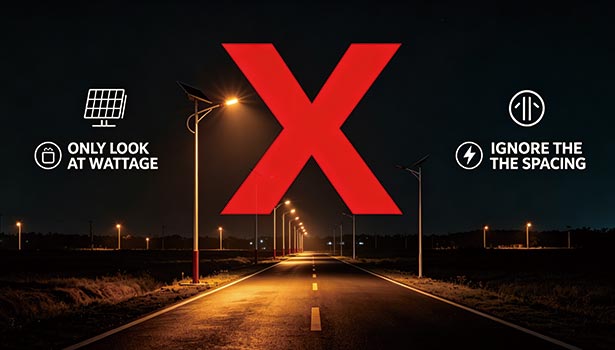
This is the most common design mistake. Ignoring luminous efficiency, light distribution design, and loss coefficients, only pricing and selecting based on wattage is prone to problems such as "high wattage, low brightness" or "excessive brightness, exceeding cost standards".
Ignoring Pole Spacing
The same wattage and lights, with different spacings, can result in a difference of up to twice in the pavement illumination. Not calculating the spacing and directly configuring parameters is the main reason for the project's lighting not meeting standards and failing the acceptance.
Ignoring Lighting Uniformity
Some projects have average illumination standards met, but the road surface has severe light spots and uneven brightness, still failing the acceptance. When designing, it is necessary to take into account both average illumination and uniformity to avoid local over-brightness and local dimness.
Ignoring Light Loss Over Time
lights will experience light decay, dust blocking, and component aging over time. If the maintenance loss coefficient is not included in the calculation, the project will experience severe brightness deficiency after 1-2 years of use.
Best Practices for Solar Street Light Engineering Design
Use Professional Lighting Simulation Software
For large-scale municipal and commercial projects, it is recommended to use professional lighting simulation software for modeling and simulation. It can accurately calculate illumination, uniformity, and light spot distribution, replacing the rough manual calculation to ensure the scheme is precise and compliant.
Follow CIE and IES Lighting Standards
All designs should be benchmarked against CIE and IES international road lighting standards, matching corresponding illumination parameters based on the project scenario to ensure compliance and successful acceptance, and adapting to various engineering procurement standards in overseas projects.
Optimize Efficiency Instead of Excessive Brightness
A high-quality solar street light design does not aim for extreme brightness but to meet the standard illumination with the lowest power consumption. Through high luminous efficiency lights, reasonable spacing, and precise parameter calculation, achieve the optimal balance between effect and cost, increasing the project's profit margin.
FAQ About Solar Street Light Wattage and Illuminance
How Many Lux Are Needed for Road Lighting?
For rural paths, residential roads, it is 5-10 Lux, for ordinary urban roads, it is 10-20 Lux, for main roads, parking lots, it is 20-30 Lux, for highways and industrial areas, it is 30-50 Lux and above.
How Do You Convert Lumens to Lux?
Basic conversion formula: Average illumination = Total lumens × Utilization coefficient × Maintenance coefficient ÷ Illumination area, and adjust it precisely based on project pole height and spacing parameters.
Does Higher Wattage Mean Better Brightness?
No. The core of lighting effect depends on illumination, luminous efficiency, and light distribution design. High luminous efficiency lights with low wattage perform much better than low luminous efficiency lights with high wattage. Blindly increasing wattage will only increase the project cost.
What Is the Best Pole Spacing for Solar Street Lights?
For conventional 6-8 meter poles, the spacing is recommended to be 20-30 meters; for 10-meter or higher high-pole street lights, the spacing can be controlled at 30-40 meters. The specific spacing needs to be calculated precisely based on road width and target illumination.
How Many Lumens Does a 100W Solar Street Light Need?
The conventional commercial 100W solar street lamp has a standard required luminous flux range of 12,000–18,000 Lumens. This value is calculated based on the mainstream LED efficacy standards in the industry. The efficacy of conventional lamps is 120–180 lm/W, which is the optimal luminous range suitable for parking lots, secondary urban roads, etc., with a scene illuminance of 20–30 Lux. Lamps with a luminous flux lower than 12,000 Lumens will result in insufficient road illumination, while lamps with an excessive luminous flux will cause brightness redundancy and energy waste, increasing the procurement and operation costs of the project.
What Is the Ideal Wattage for Residential Roads?
The ideal wattage for solar street lights in residential areas and rural roads is 40-60W, which is suitable for a standard road illumination of 10-15 Lux. This wattage range can perfectly meet the traffic needs of residential roads, taking into account both night-time security and the safety of drivers and pedestrians. Compared to high-wattage lamps, 40-60W lamps have lower power consumption, which can effectively reduce the configuration costs of solar panels and energy storage batteries, and avoid light pollution caused by excessive brightness, fully adapting to the daily lighting scenarios in residential areas.
Conclusion
The core logic of the solar street light project design is that illuminance determines the lighting effect, while wattage determines energy consumption and cost. Both are indispensable and cannot be confused.
Accurate project design requires comprehensive consideration of multiple parameters such as standard Lux illuminance, LED efficiency, light pole height and spacing, light loss coefficient, and rainy-day endurance. Through standardized formulas, the optimal wattage is calculated to completely avoid problems like insufficient brightness, power waste, and non-compliance with acceptance standards.
If you have a customized solar street light project, you can contact me NOKIN to design a free solar street light project lighting plan for you, as well as precise parameter matching and cost budgeting, to help the project be implemented efficiently and achieve compliant profitability.