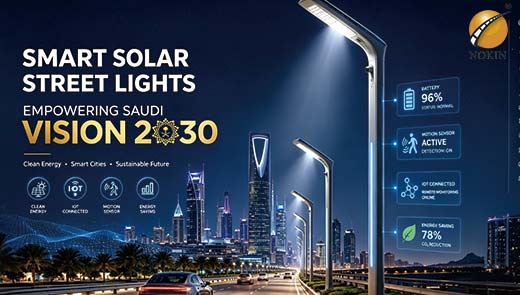
Smart Solar Street Lights and Saudi Vision 2030: Powering Saudi Smart Cities
Jun 24, 2026
What are Smart Solar Street Lights?
Smart Solar Street Lights are a new generation of photovoltaic lighting equipment that integrates Internet of Things (IoT), sensing, and AI algorithms. They are powered by solar energy independently and have a cloud control link, not limited to basic lighting, but also serving as distributed IoT terminal nodes in smart cities.
Core Components of Traditional Solar Street Lights
Traditional solar street lights only have basic photovoltaic energy storage lighting functions, with a fixed hardware architecture, and the operation mode cannot adapt to the dynamic needs of cities.
- Solar panel
- Battery
- LED light
- Controller
New Smart Modules in Intelligent Solar Street Lights
- IoT sensors
- Wireless communication module
- Remote monitoring cloud remote control system
- AI dimming algorithm
Smart vs Traditional Solar Street Lights Comparison
The following is a comparison table of the two product core parameters, which is convenient for the Saudi infrastructure procurement party to quickly select:
|
Feature |
Traditional Solar Street Light |
Smart Solar Street Light |
|
Lighting Control |
Fixed duration and fixed brightness |
Environment-adaptive dimming |
|
Operation and Maintenance Mode |
Full staff on-site inspection |
Cloud-based remote operation and control |
|
Fault Troubleshooting |
Delayed fault detection and passive maintenance |
Real-time alerts with precise fault location |
|
Energy Utilization Rate |
Medium energy consumption with high resource waste |
High energy efficiency, compatible with energy-saving control indicators |
Why Saudi Arabia Needs Smart Solar Street Lights
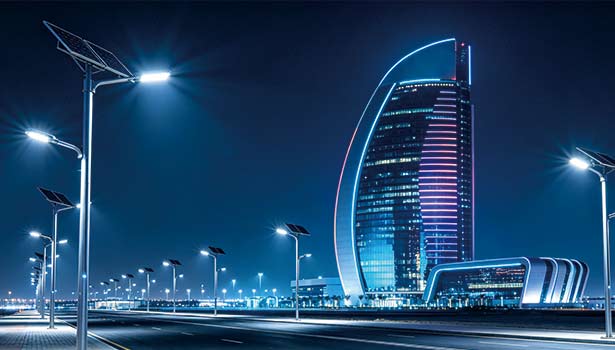
Saudi Vision 2030 is a national long-term transformation strategy of Saudi Arabia. This strategy was officially implemented in 2016. Its core is to break away from the sole reliance on the oil industry and promote urban digitalization, the popularization of clean energy, and the upgrading of living environment quality throughout the country.
The official website of Saudi Vision 2030 clearly states the key infrastructure priorities: building smart infrastructure, scaling up the implementation of renewable energy, and enhancing the livability of cities throughout the region.
Saudi Vision 2030 and Energy Transformation
In combination with the 2025 annual vision report of the Saudi government, the three pillar core goals are highly bound to the intelligent photovoltaic lighting infrastructure:
Economic diversification
Reduce the proportion of the oil industry in GDP, support the development of new energy, intelligent infrastructure, and green operation and maintenance industries. Intelligent solar street lights can drive local photovoltaic industry employment, reduce the expenditure on power procurement by the national power grid, and optimize the structure of fiscal expenditure.
Sustainable green development
Implement phased indicators for carbon neutrality, reduce the consumption of fossil energy in municipal lighting. Relying on the abundant solar radiation resources throughout Saudi Arabia, replace municipal street lights and inefficient traditional solar street lights to reduce the total carbon emissions of the city.
All-round digital transformation
Build a unified IoT control platform for cities, with solar street lights as the low-cost IoT entry point, fill in the digital infrastructure gaps in suburban areas, deserts, and parks, and break through the barriers of data interoperability in municipal facilities.
Saudi Vision 2030 and Energy Transformation
The MDPI 2025 Smart City Special Study points out: In the past five years, the expansion speed of new cities in Saudi Arabia has increased by an average of 11% annually. The continuous expansion of cities has continuously increased the operational pressure on the local energy system, and the pain points of municipal lighting have become increasingly prominent.
Challenges of Traditional Municipal Lighting
- Rapid urban expansion: The construction of new cities such as NEOM and Red Sea City is carried out in clusters, and the demand for lighting infrastructure has doubled.
- High-energy-consuming municipal lighting: The annual electricity cost of traditional street lights remains high, and the annual lighting electricity cost of a single city exceeds one million US dollars.
- Difficulties in power supply in remote areas: There is no main power grid coverage in desert roads and suburban living areas, and the cost of wiring with mains electricity is extremely high.
- High overall operation and maintenance costs: Saudi Arabia has a vast land area, and the costs of commuting for manual inspections and labor salaries are increasing year by year.
How IoT Improves Smart Solar Street Light Performance
IoT (Internet of Things) is the core core component that distinguishes intelligent solar street lights from traditional ones. Through wireless data transmission and cloud computing power, it connects the entire chain of photovoltaic energy storage, lighting operation, and municipal management, providing comprehensive adaptation to the municipal operation standards of Saudi Arabia.
Real-Time Remote Monitoring
The IoT cloud platform collects all dimensions of the street light operation data 24/7 without the need for personnel to go to the site for verification.
Core monitoring data of the platform
- Battery voltage: real-time voltage and remaining power
- Solar charging efficiency: average daily charging conversion rate of the solar panel
- LED lightoperating power and lightfailure status
- Fault alerts: real-time push notifications for short circuits, power shortages, and lightdamage
Local operation advantages in Saudi Arabia
Reduce 80% of the frequency of on-site manual inspections in the wild, avoiding risks of high-temperature outdoor operations in the desert; locate faults within 10 minutes in the background, improving maintenance efficiency by 65%; reduce the annual operation cost per area by $22,000 - $38,000.
Adaptive AI Lighting Control
Equipped with microwave, infrared and meteorological composite sensors, it can autonomously adjust the lighting strategy through AI algorithms, adapting to the day-night temperature differences, sandstorms and traffic flow characteristics in Saudi Arabia.
Sensor real-time identification dimensions
- pedestrians: the number of pedestrians in the street
- vehicles: the density of vehicles on the road
- weather: outdoor weather conditions such as sandstorms, strong sunlight, and rainy nights
- traffic density: changes in traffic flow during peak hours in the morning and evening
The system can autonomously adjust the brightness of the lights, the duration of their start and stop, and the output power. Compared with ordinary solar street lights, the overall energy-saving efficiency is increased by an additional 20-40%, meeting the energy-saving assessment indicators of Saudi Arabia.
Predictive Maintenance
Relying on AI, machine learning, and cloud-based big data analysis, it breaks away from the post-event maintenance model and achieves pre-event predictive control.
3 Predictive Maintenance Functions:
- Battery life prediction: Based on high-temperature charging and discharging data, predict the replacement cycle of lithium iron phosphate batteries and prepare spare parts in advance.
- LED fault warning: Monitor light attenuation parameters and predict the aging time of lights in batches, and centrally coordinate the replacement operation.
- Panel performance analysis: Aggregate data on dust shading and aging wear, and formulate a unified cleaning plan for photovoltaic panels.
Predictive Maintenance Value:
Significantly reduce unexpected downtime and maintenance costs, extend the overall lifespan of streetlights, and reduce the total life cycle cost by 18%.
Top 5 Applications of Smart Solar Street Lights in Saudi Arabia
Smart Mega Cities (NEOM)
NEOM is the benchmark zero-carbon new city under Saudi Arabia's 2030 vision. High-carbon grid electricity lighting facilities are prohibited throughout the area. Intelligent solar street lights are standard infrastructure.
Implementation applications: Integrated AI urban management across the board, construction of linear urban smart road networks, zero-carbon outdoor lighting network setup across the board. All street lights are uniformly connected to the NEOM city smart platform and linked to the operation of the entire security and transportation systems.
Highways and Desert Roads
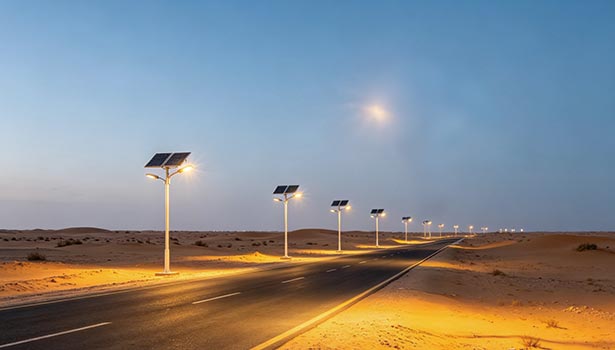
Adapted to the unique desert road network conditions of Saudi Arabia, covering unpowered desert trunk roads and intercity connecting highways.
Project adaptation advantages: Independent power supply without municipal grid, capable of withstanding extreme temperatures of 55℃; Automatically increases brightness in sandstorm weather to ensure driving safety; Unified IoT background control for the large road network, reducing the difficulty of long-distance road maintenance.
Residential Communities
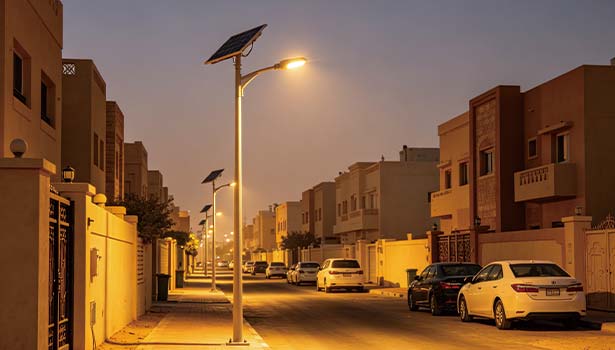
Adapted to all outdoor lighting in special墅 areas, contiguous residential communities, and closed health care communities.
Implementation scenarios: Full-area lighting for internal vehicle roads, pedestrian walkways, and private parking lots in the community; Standardized human body sensor lighting modules, low-power standby mode during无人 periods, and instant full brightness when vehicles pass by, balancing living comfort and energy efficiency.
Industrial Parks and Ports
Adapted to Saudi coastal ports, cross-border logistics parks, and oil and gas supporting industrial parks.
Core requirements: Equipment operates stably 24/7, resistant to oil and gas corrosion, and resistant to seaside salt fog; IoT background system links with the park's security system, reporting abnormal power outages and external damage immediately, ensuring the safety of industrial park operations around the clock.
Tourism and Religious Areas
Covering two core areas: the Mecca pilgrimage area and the Red Sea coastal cultural tourism resort area.
Scene characteristics: During holidays, the number of people surges, while on ordinary days, the number of visitors is scarce, with extremely strong fluctuations in passenger flow. The IoT system can be linked with the tourist data of the scenic area to automatically adjust the lighting brightness, balancing the religious atmosphere, night viewing landscape effect, and energy control.
Technical Requirements for Smart Solar Street Lights in Saudi Arabia
High Temperature and Sandstorm Resistance
Saudi's outdoor normal conditions: summer extreme temperatures ranging from 50 to 55°C, strong ultraviolet radiation all over the place, and severe sandstorms invading throughout the year. Official hardwired solar street light selection standards:
- Battery standard: LiFePO4 lithium iron phosphate special high-temperature-resistant battery, eliminating the risk of high-temperature bulging and spontaneous combustion
- Protection level: whole machine IP66 or above dustproof and waterproof specifications
- Shell technology: thickened anti-corrosion and anti-oxidation aluminum alloy shell, resistant to sandstorm impact and salt spray corrosion
Communication Protocol Compatibility
The municipal smart platform in Saudi Arabia uniformly adapts to four communication protocols, and the bidding products must be fully compatible; otherwise, they cannot be connected to the city's central platform: LoRaWAN, NB-IoT, commercial 5G, and Zigbee. In desert areas, LoRaWAN long-distance communication is preferred, while in urban and new areas, 5G high-speed transmission is preferred.
Cloud-Based Smart Control Platform
The cloud control platform must be compatible with Arabic + English bilingual back-end, and come with four standard functional modules:
- Data visualization dashboard for all-round control large screen
- Precise street lightpositioning on GIS geographic points
- Automatic generation of energy consumption analysis reports
- Full-process fault closed-loop management work order system
Challenges of Deploying Smart Solar Street Lights
Higher Initial Investment
The initial CAPEX (capital expenditure) for this project is higher than that of ordinary solar street lights. Adding the costs of custom high-temperature-resistant components and IoT communication modules, the purchase cost of each light is 18%-25% higher. However, the energy-saving and maintenance cost savings over 3-4 years can cover the initial difference, making the long-term economic benefits better.
IoT Data Security
As a city IoT terminal, solar street lights have two major network risks: external network attacks and leakage of road traffic point data and area人流 data. The Saudi municipal project requires the equipment to be equipped with local compliant encryption chips, and the backend data to be stored locally in the cloud, prohibiting cross-border transmission.
Cross-Platform Compatibility
The communication protocols and backend ports of different brands of IoT street lights on the market are not unified. In old areas for renovation, system fragmentation and inability to uniformly control are prone to occur. The large-scale segment in Saudi Arabia has now required bidders to follow the unified communication interface standard of Saudi Smart City to achieve intercommunication of all devices.
Future Trends in Smart Solar Street Lighting
In line with Saudi Arabia's long-term digitalization plan for 2030, the integration of these three technologies will reshape the outdoor lighting infrastructure sector in Saudi Arabia and extend the additional urban service value of solar street lights.
AI Autonomous Lighting
The AI model of solar street lights can autonomously learn the weekly and annual traffic patterns of the area, eliminating the need for manual back-end debugging. It can autonomously adapt to pilgrim holidays, weekend traffic, and seasonal changes in day and night, fully optimizing the lighting plan and further reducing municipal energy consumption.
Digital Twin Integration
The operation data of intelligent solar street lights is fully integrated into the city's digital twin system, synchronously mapping road network energy consumption, traffic conditions, and environmental data, assisting in integrated decision-making for urban planning, emergency dispatch, and traffic analysis.
Street Lights as Urban IoT Hubs
In the future, Saudi Arabia's smart solar street lights will no longer have a single lighting attribute. They will upgrade to an integrated urban IoT Hub, integrating multiple functions: security CCTV cameras, new energy EV charging stations, all-area WiFi signal base stations, and air and dust environment monitoring sensors. The single pole can be reused to reduce the cost of secondary infrastructure excavation in the city.
Conclusion
Smart solar street lights are no longer merely basic outdoor lighting equipment; they are now becoming the core distributed IoT nodes in Saudi Arabia's smart city construction.
With the in-depth implementation of Saudi Vision 2030, the IoT intelligent photovoltaic lighting system that takes into account high-temperature resistance, cloud remote monitoring, AI predictive maintenance, and all-round data analysis capabilities will replace traditional lighting products and become the core essential category for upgrading modern infrastructure in Saudi road networks, new cities, parks, and cultural and tourism areas.
Solar street light suppliers that are adapted to the Saudi climate, compatible with the local smart platform, and possess full-chain operation and maintenance service capabilities will deeply seize the incremental market of photovoltaic street lights in the Middle East.
FAQ About Smart Solar Street Lights
Are smart solar street lights suitable for Saudi deserts?
Yes. Customized smart solar street lights with IP66+ housing, anti-sandstorm structure and LiFePO4 high-temperature batteries can work stably under 50-55℃ desert temperature and strong UV radiation. It is the official approved lighting product for Saudi desert road projects.
How does IoT improve solar street light efficiency?
IoT sensors realize pedestrian and vehicle induction dimming, real-time solar charging data optimization, and remote switch control. Compared with ordinary solar lights, IoT models increase energy efficiency by 20%-40%, and cut manual maintenance costs greatly.
What is the lifespan of smart solar street lights?
Qualified Saudi-standard smart solar street lights have an overall service life of 8-10 years. The LiFePO4 battery lasts 6-7 years, and the LED light source lasts more than 50000 hours. Predictive IoT maintenance can extend the overall service life by 15%.
Can smart street lights integrate with smart city platforms?
Absolutely. Certified models support LoRaWAN, 5G and NB-IoT protocols, which can be seamlessly connected to NEOM and Saudi municipal official smart city platforms, realizing GIS positioning, unified data statistics and centralized order management.