The Ultimate Guide to Purchasing Solar Street Lights for Southeast Asia (2026)
Jun 26, 2026
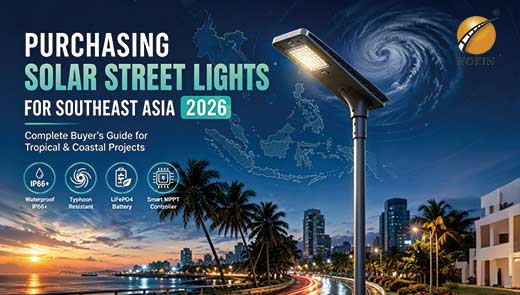
Southeast Asia is one of the regions with the fastest-growing demand for solar street lights globally. The unique tropical climate, scattered island terrain, continuously rising electricity prices, and green infrastructure policies of various countries have led to the gradual elimination of traditional municipal street lights.
For engineering contractors, municipal purchasers, park developers, and foreign trade buyers, general-purpose solar street lights often do not fit the local scenarios. To balance stability, cost-effectiveness, and long-term return on investment, a set of targeted local purchasing standards is needed.
NOKIN's latest 2026 ultimate guide for purchasing solar street lights for Southeast Asia, based on on-site project experiences in Thailand, the Philippines, and Indonesia, breaks down market advantages, regional differentiation requirements, core purchasing parameters, pitfalls to avoid, and price systems, helping buyers make precise selections.
Why Solar Street Lights Are Growing Rapidly in Southeast Asia
Rising Electricity Prices Increase Demand for Solar Lighting
Many Southeast Asian countries have gradually increased industrial and municipal electricity prices year by year, increasing the operational pressure on traditional municipal electricity lighting. Monthly electricity expenses for municipal roads, public parks, and main roads in towns keep rising, burdening local finances.
At the same time, the electricity costs for commercial parks, industrial parks, and resorts keep increasing. Companies, in order to control long-term operating expenses, start to actively replace zero-cost solar lighting equipment.
Solar street lights do not need to be connected to the municipal power grid, and a one-time investment can significantly reduce monthly electricity expenses. The long-term operation and maintenance costs are extremely low, making it a core choice for Southeast Asian governments and enterprises to reduce costs.
Growing Demand for Off-Grid Lighting in Rural and Island Areas
Southeast Asia has a complex terrain, including many remote mountainous areas, coastal islands, and rural roads. Many areas have not yet laid out a complete municipal power grid.
The construction cost of traditional municipal street lights for laying cables and installing transformers is extremely high, and the later fault repair is difficult and costly. Off-grid solar street lights do not require wiring and operate independently, perfectly adapting to such scenarios.
Currently, the core demand scenarios for off-grid lighting in Southeast Asia include: remote rural main roads, island community public lighting, coastal scenic paths, and mountain forest sightseeing roads, and the market demand is continuously surging.
Government Green Infrastructure Policies Accelerate Adoption
Southeast Asian countries have recently actively promoted carbon neutrality, smart cities, and green infrastructure upgrade plans, and vigorously supported new energy lighting projects.
Countries such as Thailand, Vietnam, Indonesia, and the Philippines have included solar street lights in the municipal infrastructure upgrade list and introduced subsidy and bidding preferential policies for town lighting, road renovation, and coastal infrastructure projects.
At the same time, the requirements for smart city construction require intelligent and energy-efficient public lighting equipment, and traditional lights cannot meet the new standards, further promoting the popularization and implementation of solar intelligent street lights.
Key Challenges When Buying Solar Street Lights for Southeast Asia
Southeast Asia has a tropical monsoon and maritime climate, with high temperatures, high humidity, frequent heavy rain, salt fog, and typhoons. Ordinary general-purpose solar street lights are prone to problems such as corrosion of the light body, battery water ingress, insufficient battery life, and light damage. To ensure stable operation for 3-5 years, targeted adaptation to the local climate is necessary, which is also the core key point that distinguishes Southeast Asian purchasing from other regions.
High Humidity and Heavy Rainfall
Southeast Asia has abundant rainfall throughout the year and extremely high air humidity. Long-term rainy weather is the biggest test for lighting equipment. Ordinary street lights have insufficient sealing, and water vapor easily seeps in, causing circuit boards to get damp and short-circuit, and battery leakage.
Therefore, the selection in Southeast Asia must focus on three core indicators: overall waterproof grade, light body sealing process, and PCB circuit board moisture-proof and anti-corrosion treatment.
Optimization of the rain season project in Thailand
A municipal road in a certain Thai city initially installed conventional solar street lights. During consecutive rainy days, there was insufficient lighting duration at night and the lights would turn off early, failing to meet the municipal lighting standards. The subsequent projects have been fully upgraded, adopting large-capacity lithium batteries, customizing a 4-day rainstorm endurance design, and combining with fully sealed moisture-proof technology, completely solving the problem of unstable lighting during the rainy season, and being suitable for the year-round rainy climate in Thailand.
Coastal Salt Fog Corrosion
Countries along the coast such as the Philippines, Vietnam, and Indonesia have high salt fog concentrations and extremely strong corrosiveness, making them the number one killer for lighting equipment.
Ordinary iron light bodies and ordinary painting processes for street lights are prone to rust, cracking, and component detachment in the short term, significantly reducing the equipment's service life.
Coastal projects must adopt exclusive configurations: cast aluminum alloy light bodies, thickened anti-corrosion coatings, and stainless steel fastening components, providing comprehensive protection against salt fog erosion.
Reconstruction of coastal projects in the Philippines
The initial purchase of ordinary steel light bodies for solar street lights in a certain coastal road in the Philippines resulted in severe corrosion, light body rusting, screw detachment, and a decline in light light transmission rate within just 18 months, leading to a significant increase in operation and maintenance costs.
Later, all were replaced with aluminum alloy anti-corrosion shells + salt fog-specific testing processes, significantly improving the equipment's stability and extending the service life to over 8 years.
Typhoon and Strong Wind Load Challenges
Typhoons and strong wind weather occur frequently in Southeast Asia, especially in the coastal areas of the Philippines, Vietnam, and eastern Malaysia. Strong winds are highly likely to cause light poles to tilt, lights to fall off, and the equipment to collapse.
When purchasing, one must not only focus on the light parameters but also carefully verify the structural wind resistance performance. The core assessment includes three points: the wall thickness and overall structure design of the light pole, official wind load parameters, and the configuration of reinforced anchor bolts.
For municipal, road, and coastal main road projects, it is recommended to choose light styles with thickened light poles, integrated structures, and standard reinforced anchor bolts to avoid equipment damage risks during typhoon weather.
7 Key Factors to Consider When Purchasing Solar Street Lights
The core reason for purchasing failures in Southeast Asia is that only conventional parameters are considered, while the exclusive needs of tropical climates are ignored. The following seven core factors are the core standards for project selection in Southeast Asia in 2026.
Focus on Lumens Instead of Watts
There is a widespread cognitive misunderstanding in the industry: believing that the higher the wattage, the brighter the light. In fact, wattage only represents power consumption and does not represent lighting effect.
Many low-quality products falsely label high wattages, with high power consumption and low brightness, not only consuming electricity quickly but also failing to meet the lighting standards for municipal roads.
Buy Lumens, Not Watts, the actual lumens value is the core standard for measuring lighting brightness.
Check Real Lumens and Light Distribution
When purchasing solar street lights, it is necessary to verify the four core lighting parameters: actual lumens value, road illumination (Lux), light emission angle, and lighting uniformity.
Some inferior lights have obvious "zebra effect", with alternating road brightness and uneven light spots, unable to meet the lighting standards for municipal roads. Formal projects must require solar street light suppliers to provide IES light distribution reports to ensure uniform road lighting, no dark areas, and no zebra patterns.
Choose the Right Battery Type
The high-temperature and high-humidity environment in Southeast Asia has extremely high requirements for battery compatibility. The lifespan, stability, and endurance performance of different battery materials vary greatly. The following is a comparison of three mainstream battery types for Southeast Asia:
|
Battery Type |
Recommendation Index |
Southeast Asia Compatibility |
Key Advantages |
|
Lead-acid Battery |
★★ |
Low |
Low cost, but short lifespan and poor humidity resistance |
|
Lithium-ion Battery (NMC) |
★★★★ |
Medium |
High energy density, but limited heat resistance |
|
Lithium Iron Phosphate Battery (LiFePO4) |
★★★★★ |
High |
Heat-resistant, moisture-proof, long lifespan, and highly safe |
Final recommendation: All municipal, road, and long-term lighting projects in Southeast Asia should uniformly use lithium iron phosphate batteries (LiFePO4).
Evaluate Solar Panel Efficiency
The weather in Southeast Asia is mostly cloudy and rainy, and the conversion efficiency of solar panels directly determines the charging efficiency and energy storage effect.
Currently, the mainstream in the market are polycrystalline and monocrystalline panels. Monocrystalline panels have a higher conversion efficiency and stronger weak-light charging ability, making them more suitable for the climate in Southeast Asia.
2026 Purchase Hard Standards: The conversion efficiency of solar panels should be ≥ 22%, to ensure rapid recharging during rainy days and avoid the problem of insufficient battery life.
Check IP and IK Protection Ratings
In tropical high-temperature, heavy rain, and salt fog environments, the protection level is the foundation for the long-term stable operation of solar street lights. The purchase must be strictly verified.
IP65 vs IP66
The minimum requirement is IP65. For coastal and rainy core areas, IP66 should be preferred. It can fully resist the infiltration of rainwater and the accumulation of dust.
IK08 Standard
It must reach IK08 or above, which can withstand typhoons, foreign object impacts, and outdoor harsh wear and tear, and is suitable for long-term outdoor use.
Ensure 3–5 Days of Battery Backup
Many low-cost projects have a core problem: sufficient brightness during sunny days, but direct power-off during continuous rainy days, unable to meet the basic needs of public lighting.
Based on the characteristics of the rainy season in Southeast Asia, the unified purchase standard for solar street lights: reserve 3-5 days of autonomous battery life redundancy. For rural, island, and remote areas without power grids, it is recommended to directly set the battery life to 5 days.
Upgrade of rural solar street lighting in Indonesia
In many remote rural areas of Indonesia, the solar street lights installed earlier only reserved 2 days of battery life. During the rainy season, frequent night power-off and interruption of lighting occurred, seriously affecting the safety of villagers' travel.
Later, all rural projects were upgraded to a 5-day battery life and energy storage design, combined with efficient charging panels, completely solving the problem of power outage during the rainy season and achieving stable lighting throughout the year.
Consider Smart Lighting Features
In 2026, municipal and commercial projects in Southeast Asia have fully favored intelligent lighting. Traditional time-controlled street lights are gradually being phased out. The core essential intelligent functions are as follows:
Human body sensing:
low brightness for no one and high brightness for someone, significantly saving energy and reducing consumption, extending equipment battery life.
Smart dimming:
automatic adjustment of brightness according to different time periods, adapting to the lighting needs at different times of the night.
IoT remote control:
remote switching of lights, adjustment of brightness, and viewing of equipment operation data.
Remote monitoring:
real-time monitoring of battery voltage, charging status, and fault warnings, reducing operation and maintenance costs.
Integrated vs Split Solar Street Lights: Which Is Better?
The project scenarios in Southeast Asia vary greatly. Integrated and split-type street lights have their suitable application scenarios. Selecting based on needs can balance cost-effectiveness and practicality.
Integrated Solar Street Lights
Integrates solar panels, batteries, light sources, and controllers into one unit, with an integrated design.
Applicable scenarios: residential area roads, park walkways, rural paths, small community lighting projects.
Core advantages: simple installation, short construction period, low labor installation cost, and neat and beautiful appearance.
Main disadvantages: The core components are concentrated in one unit, and later maintenance requires overall inspection. The adaptability to high-power consumption scenarios is limited.
Split Solar Street Lights
Solar panels, batteries, and lights are installed separately, and can be independently matched with high-power components.
Applicable scenarios: urban main roads, expressways, industrial parks, large-scale municipal lighting projects.
Core advantages: can be equipped with high-capacity batteries and high-power panels, with stronger lighting performance, more stable battery life, and better resistance to adverse weather conditions.
Main disadvantages: The installation process is more complex, and the labor and construction costs are slightly higher.
Common Mistakes When Buying Solar Street Lights
Many Southeast Asian projects have problems such as premature aging, frequent failures, and high rework rates. The core lies in the four major misunderstandings in the solar street light procurement stage, which are also the core pitfalls that buyers must avoid.
Choosing the Lowest Price Only
Some buyers blindly pursue low prices, ignoring product quality and configuration. Low-cost solar street lights often have problems such as false marking of parameters, poor-quality components, and simple craftsmanship. Low-cost solar street lights, although having a low initial procurement cost, will frequently experience corrosion, power outages, and brightness reduction within 1-2 years. The subsequent operation and maintenance, as well as replacement costs will far exceed the initial price difference, resulting in an extremely low overall cost performance.
Ignoring Climate Adaptability
Directly purchasing common solar street lights from inland regions without making custom upgrades for the hot, humid, salt fog, and typhoon environments of Southeast Asia.
Ultimately, various climate adaptability faults such as battery overheating degradation, light body corrosion, equipment tilting, and insufficient power supply during rainy seasons will occur, significantly shortening the equipment's service life.
Trusting Fake Wattage Claims
The solar street light lighting industry is plagued by the phenomenon of falsely claiming wattage. Many manufacturers overstate the power output while the actual lumens output is extremely low.
Simply comparing wattage without verifying the measured lumens and the light distribution report can easily lead to the selection of inferior products with "high power but low brightness", resulting in unqualified project acceptance.
Skipping Technical Reports
Oral parameter commitments have no reference value. For regular Southeast Asian solar street light projects, one must request a complete set of authoritative test reports.
Core essential reports: LM79 light efficiency test report, IES light distribution curve report, salt fog test report, battery performance test report. Products without reports will not be purchased.
Solar Street Light Price in Southeast Asia
In 2026, the price of solar street lights in Southeast Asia varies based on application scenarios, configuration parameters, and protection levels:
|
Product Type |
Price Range (USD) |
Compatible Scenarios |
|
Civilian Residential Model |
$80–$180 |
Small rural roads, community walkways, courtyard lighting |
|
Commercial Engineering Model |
$200–$500 |
Expressway service roads, scenic areas, main roads in towns |
|
Municipal Engineering Model |
$500–$1,500+ |
Urban main roads, highways, coastal municipal projects |
(The solar street light price is for reference only. For specific details, please consult the solar street light supplier)
Solar Street Light ROI and Long-Term Cost Analysis
Many buyers only focus on the initial procurement cost, ignoring the total cost of ownership (TCO) and return on investment (ROI).
Low-cost, low-specification solar street lights have a low initial investment, but the annual operation, maintenance, and replacement costs are high, and they are likely to be scrapped overall within 3 years.
Highly standardized Southeast Asian customized model experience street lights have a slightly higher initial investment, but they can operate stably for 5-8 years, with zero electricity costs and low maintenance, and can recover the cost through energy savings within 2-3 years, with higher long-term benefits.
How to Choose a Reliable Solar Street Light Supplier
The strength of the solar street light supplier directly determines the project implementation effect and the post-sale guarantee in the future. For Southeast Asian purchases, the top three core standards should be referred to.
Verify Certifications
Products for formal export to Southeast Asia must have complete international certifications to ensure project compliance, smooth customs clearance, and meeting the bidding requirements.
Core essential certifications: CE certification, RoHS environmental protection certification, IEC international electrical certification. Products without these certifications cannot participate in formal municipal projects.
Check Technical Reports
Refuse oral parameter commitments. Before purchasing, the solar street light supplier must provide a complete set of measured technical reports to verify the authenticity of the parameters.
Core reports include: IES light distribution report, LM79 light efficiency test report, battery cycle life report, salt fog protection test report.
Evaluate Warranty and After-Sales Service
The difficulty and cost of post-sale services in overseas Southeast Asian projects are high. The warranty period is the core guarantee.
2026 preferred standards: Complete machine warranty ≥ 3 years, complete core battery, light source, and controller warranties, and the supplier has experience in local project implementation and remote maintenance capabilities.
FAQ About Solar Street Lights in Southeast Asia
Can Solar Street Lights Work During Monsoon Season?
Yes, they can. The solar street lights customized for Southeast Asia are equipped with 3-5 days of power supply in rainy days, IP66 high protection level, and moisture-proof and corrosion-resistant techniques. They can perfectly handle continuous rainfall and cloudy weather during the monsoon season without frequent power outages.
What Is the Best Battery for Tropical Climates?
The preferred choice is lithium iron phosphate battery (LiFePO4). It is resistant to high temperatures, moisture, has a long cycle life, and high safety. It can be adapted to the extreme environment of high temperature and high humidity, frequent rain and salt spray in Southeast Asia, and is far superior to lead-acid and ternary lithium batteries.
How Long Do Solar Street Light Batteries Last?
High-quality lithium iron phosphate batteries can last up to 6-8 years in compliant usage scenarios in Southeast Asia. They can undergo more than 2,000 cycles of charging and discharging and have extremely strong long-term stability. In the 2-3 years, they can recover the investment cost and have a much higher investment return rate than traditional grid-connected street lights throughout their entire life cycle.
Conclusion
In the 2026 solar street light procurement for Southeast Asia, do not apply general standards; instead, select models that precisely match the local tropical climate and project scenarios. The core procurement focus can be summarized into 5 points:
Give priority to the actual lumen output, abandon the sole reliance on wattage;
Select special lithium iron phosphate batteries that are suitable for tropical environments;
Reserve 3-5 days of power supply during rainy days to adapt to rainy season weather;
Strengthen anti-corrosion, waterproof, and wind-resistant designs to withstand extreme climates;
Choose reliable suppliers with complete qualifications and successful implementation cases in Southeast Asia.
By following these standards for procurement, you can completely avoid common faults in Southeast Asian projects, ensure the long-term stable operation of solar street lights, and achieve the best cost-performance ratio and the highest investment return.