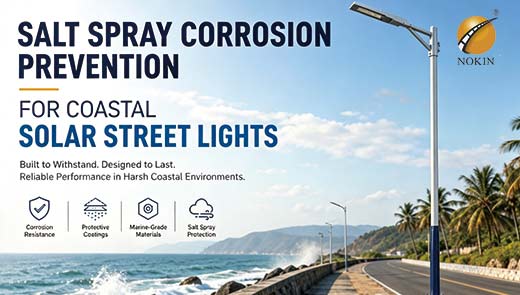
Salt Spray Corrosion Prevention for Coastal Solar Street Lights
Jul 03, 2026
Why Salt Spray Corrosion Threatens Coastal Solar Street Lights
The lifespan of solar street lights along the coast of Southeast Asia is much shorter than that of inland street lights. The core reason is salt spray corrosion. Without targeted anti-corrosion design, the equipment of solar street lights usually experiences rusting, malfunction, and even scrapped within 1-3 years, resulting in frequent equipment replacement costs and high operation and maintenance expenses.
What is Salt Spray Corrosion?
Salt spray corrosion is an electrochemical destructive phenomenon targeting the surfaces of metals and coatings. It is widely present in all coastal areas and is mainly caused by sea wind and high humidity in the ocean environment.
Its corrosion mechanism consists of three steps: Firstly, sea wind carries high-activity chlorine ions everywhere; Secondly, these tiny chlorine ions firmly adhere to the metal components of the solar street lights.
Finally, the high humidity in the coastal environment forms a thin water film on the metal surface, forming a complete electrolytic cell, continuously triggering electrochemical corrosion reactions, and gradually eroding the metal structure and destroying the protective coating.
Why Southeast Asia Has Higher Corrosion Risk
The unique tropical marine climate of Southeast Asia makes it a high-risk area for salt spray corrosion globally, with a corrosion degree far higher than that of ordinary inland and temperate coastal areas. The combination of multiple adverse environmental conditions will significantly accelerate the corrosion rate.
The core characteristics of the harsh environment in this region include: year-round high temperatures, continuous high humidity, long rainy seasons, and frequent typhoons. These conditions keep the surface of the street light equipment in a humid state, accelerating the attachment and penetration of salt.
The four countries with the most severe corrosion problems in Southeast Asia are the Philippines, Indonesia, Malaysia, and Vietnam. These countries have long coastlines and numerous islands, with a large number of road and scenic area solar street light projects.
According to the ISO corrosion grade standard, the area within 1 kilometer of the coastline belongs to the C5-M high-corrosion ocean zone. Outdoor equipment in this area will suffer from intense salt spray erosion and must be equipped with professional anti-corrosion protection plans.
Components Most Vulnerable to Salt Spray Corrosion
Salt spray corrosion does not occur uniformly on solar street lights. Some core vulnerable components will fail first, leading to the paralysis of the entire lighting system.
Light Pole Corrosion
The light pole is the main load-bearing structure of the solar street light and the largest metal component. It is most susceptible to salt spray erosion. Long-term salt attachment will cause rust on the surface of the light pole and the detachment and peeling of the protective coating.
As the corrosion deepens, the wall of the light pole tube will gradually thin, and the overall load-bearing capacity will significantly decrease. Severe cases may cause the light pole to be unable to withstand typhoon impacts, resulting in tilting, collapse, and safety hazards and project economic losses.
Solar Panel Frame Corrosion
Most solar panels use aluminum alloy frames. In the high-salt environment of the coast, the edges of the frames are prone to oxidation and corrosion, causing white rust, cracking, and other problems.
Corrosion of the frame will damage the edge sealing structure of the solar panel, allowing moisture and salt spray to penetrate the internal components, causing battery chips to age, power generation efficiency to decline, and even triggering internal short circuits and component failure.
Battery Box Damage
The battery box is the core protective carrier of the storage battery of the solar street light. When the coastal environment protection is inadequate, water vapor and salt spray will continuously invade the box.
The contact terminals of the battery are extremely sensitive to salt spray corrosion, and after corrosion, they will experience poor contact and unstable current. Long-term erosion will significantly shorten the battery lifespan and is the main reason for the premature failure of the energy storage system of solar street lights in the coastal area.
Fasteners and Bolts Corrosion
Fasteners and bolts, such as small-sized fasteners, are often overlooked but are highly prone to failure in coastal street lights. Ordinary iron and low-grade stainless steel fasteners are prone to rust and jamming.
Rust on bolts will cause the support to loosen, the solar panel to shift, and the light pole to be subjected to uneven force. Minor cases will cause unstable lighting, while severe cases will result in equipment falling and project shutdown, causing significant losses.
7 Effective Ways to Prevent Salt Spray Corrosion in Solar Street Lights
Targeted salt fog corrosion protection is the key to extending the service life of solar street lights in Southeast Asia. The following 7 methods, which have been verified through engineering, can effectively resist marine corrosion and reduce the long-term operation and maintenance costs of the project.
Use Marine-Grade Anti-Corrosion Materials
Material selection is the foundation of anti-corrosion. The ability of different materials to resist chloride ion erosion varies greatly. The recommended materials for coastal solar street light projects are as follows:
|
Material |
Anti-Corrosion Grade |
Applicable Scenarios |
|
316 Stainless Steel |
Optimal |
Core components in C5-M highly corrosive coastal areas. Contains molybdenum, providing extremely strong resistance to chloride ion corrosion. |
|
304 Stainless Steel |
Moderate |
Suitable for coastal areas within 1–5 km of the shoreline. Offers high cost-effectiveness and is ideal for standard anti-corrosion accessories. |
|
Aluminum Alloy |
Good |
Suitable for solar panel frames with protective coatings and lightweight structural accessories. |
|
Glass Fiber Reinforced Plastic (FRP) |
Excellent |
Ideal for lighting poles and non-load-bearing components. Completely rust-free and offers significantly better corrosion resistance than ordinary metals. |
Apply Multi-Layer Anti-Corrosion Coatings
A single-layer anti-corrosion treatment cannot adapt to the highly corrosive environment of Southeast Asia's coast. A multi-layer composite coating process must be adopted to form a dense three-dimensional protective barrier. The optimal anti-corrosion process combination is: hot-dip galvanizing + epoxy primer + powder coating + fluorocarbon coating.
Each layer of coating has an independent protective function. The bottom layer isolates the metal from contact with air and salt, and the surface layer resists ultraviolet aging and salt fog penetration. The multi-layer protection works together to significantly enhance the overall anti-corrosion performance.
Choose High IP Protection Ratings
Many project parties confuse waterproofing and anti-corrosion concepts. It is necessary to clarify: high waterproof grade is a necessary condition for anti-corrosion, but it cannot replace the anti-corrosion process. Both must be used together.
The protection grade standard for coastal solar street lights is as follows: the minimum standard is IP66, the conventional coastal project is preferred IP67, and extreme marine environments such as docks and intertidal zones require IP68 protection. High IP protection grade can effectively prevent external salt fog and water vapor from invading the equipment interior, avoiding internal components from getting damp and corroded.
Avoid Galvanic Corrosion Between Different Metals
Electrochemical corrosion caused by hetero-metal is a hidden cause of rapid damage to coastal street light accessories, which is easily overlooked in conventional designs. The electrode potential of different metal materials varies.
In a humid salt fog environment, direct contact of two different metals will generate a potential difference, accelerating metal electrochemical corrosion, causing rapid damage to the accessories. It is necessary to avoid incorrect combinations such as stainless steel bolts paired with carbon steel brackets. The correct solution is to add insulating pads to isolate the potential difference, eliminating the cause of electrochemical corrosion at its source.
Optimize Structural Drainage Design
Residual water and salt accumulation in equipment gaps is the source of long-term corrosion. Scientific structural design can fundamentally reduce salt accumulation and water accumulation risks.
Core optimization solution: adopt a bottom-outlet wiring design to prevent water accumulation at the connection points; adopt an integrated smooth shell to reduce dust and salt accumulation gaps. At the same time, reserve optimized drainage holes to quickly discharge rainwater and condensate, avoiding long-term dampness inside the equipment and completely cutting off the corrosion environment.
Verify Salt Spray Test Reports
Before purchasing coastal-specific solar street lights, suppliers must provide authoritative salt fog test reports to verify the anti-corrosion performance of the products and prevent unqualified products from being implemented in the project.
The industry's common authoritative testing standards are ASTM B117 and ISO 9227, which are general specifications for marine anti-corrosion of lighting equipment. Based on the testing standards and regional corrosion intensity, the recommended test duration is: 500 hours for ordinary coastal areas, 1000 hours for highly corrosive coastal areas, and more than 1500 hours for extreme marine environments.
Products that pass long-term salt fog testing can stably adapt to the continuous salt fog erosion environment of Southeast Asia's coast.
Establish a Regular Maintenance Plan
Even with a high standard anti-corrosion design, regular maintenance is the key to extending the equipment's lifespan. The maintenance frequency should be adjusted differently based on the distance from the coast.
|
Distance from the Coastline |
Maintenance Frequency |
Core Maintenance Contents |
|
Within 1 km (High Corrosion Zone) |
Every 3 Months |
Remove surface salt, check bolt tightness, inspect sealing ring aging, and test cable insulation performance |
|
1–5 km (Medium Corrosion Zone) |
Every 6 Months |
Remove residual salt, tighten loose bolts, and inspect battery box sealing performance |
|
More than 5 km (Low Corrosion Zone) |
Every 12 Months |
Conduct comprehensive equipment inspection and perform rust prevention and reinforcement for vulnerable components |
How to Choose a Reliable Coastal Solar Street Light Supplier
The technical strength of the solar street light supplier directly determines the anti-corrosion quality and service life of coastal solar street lights. When procuring for Southeast Asian coastal projects, it is necessary to focus on checking the following three core indicators.
Verify International Certifications
Regular and high-quality suppliers must have complete international authoritative certifications, which is the basic guarantee of product quality. Core verification certifications include: ISO 9001 quality management system certification, CE safety certification, RoHS environmental protection certification, IEC international electrical standard certification.
Complete certifications can prove that the product complies with international marine engineering application standards and can be adapted to complex and variable coastal harsh environments.
Request Salt Spray Test Reports
Only certifications are not enough to ensure the implementation effect. It is necessary to require the supplier to provide special test reports for coastal projects, the core three items are: salt spray corrosion test report, waterproof performance test report, wind resistance performance test report.
The test report can directly reflect the product's adaptability to the high salt, high humidity, and frequent typhoon environment in Southeast Asia, and prevent false anti-corrosion publicity.
Confirm Warranty Period
The operating environment of coastal equipment is much more severe than that of inland areas, and the conventional inland warranty standards cannot be used. The warranty period for Southeast Asian coastal solar street light projects should reach 5–8 years. Long-term warranty reflects the supplier's confidence in the product's anti-corrosion quality, which can effectively ensure project investment returns and reduce subsequent US dollar-based operation and maintenance costs.
Case Studies of Coastal Solar Street Light Projects in Southeast Asia
NOKIN's anti-corrosion solar street lights have been widely used in multiple coastal engineering projects in Southeast Asia, achieving excellent anti-corrosion effects and stable lighting performance.
Philippine Coastal Road Project
Project pain points: This coastal road is 0.8 km from the coastline, belonging to the C5-M high corrosion area. Ordinary solar street lights have severe rusting within 2 years and frequent battery failures, with extremely high annual replacement costs.
Product configuration: 316 stainless steel fasteners, fiberglass pole, four-layer composite anti-corrosion coating, IP67 protection level, 1000-hour salt spray test certification.
Application effect: The equipment has run continuously for 5 years, with no obvious corrosion or coating detachment problems, stable power generation efficiency, and annual operation and maintenance costs reduced by 65% compared to the original equipment.
Indonesian Dock Project
Project pain points: The dock is constantly exposed to sea wind erosion and high humidity. Traditional street lights have rusted bolts that get stuck and the supports frequently loosen, seriously affecting nighttime lighting safety.
Product configuration: Complete 316 stainless steel vulnerable components, insulated anti-electric corrosion design, optimized drainage structure, IP68 ultimate anti-corrosion and waterproof level.
Application effect: Can resist strong salt spray erosion for a long time, with zero drop and zero failure, stable operation during typhoon season, and significantly improving the project safety coefficient.
Malaysian Coastal Park Project
Project pain points: The park is close to the coastline, and salt spray continuously adheres. Ordinary solar panels have aluminum frames oxidizing and seeping water, significantly shortening the equipment's service life.
Product configuration: fluorocarbon sprayed aluminum frame, sealed anti-corrosion battery box, quarterly special operation and maintenance plan.
Application effect: The equipment has run for 4 years without frame oxidation and corrosion problems, battery service life extended from 3 years to 7 years, and the overall operation and maintenance costs of the project have been significantly reduced.
FAQ About Coastal Solar Street Lights
Can Solar Street Lights Be Used Near the Sea?
They can be used normally, but ordinary inland model solar street lights cannot be adapted to the coastal environment. Only specialized equipment that has undergone professional shipbuilding anti-corrosion design, selected with high-standard materials, and processed with multiple layers of protection can withstand long-term salt spray erosion from the seaside and operate stably.
How Often Should Coastal Solar Street Lights Be Cleaned?
The cleaning maintenance frequency is adjusted according to the distance from the sea: in high-salt areas within 1 kilometer of the coastline, clean once every 3-6 months; in areas within 1-5 kilometers, clean once every 6 months to promptly remove surface salt and avoid corrosion accumulation.
Which Is Better for Coastal Areas: Aluminum or Steel?
The superiority or inferiority depends on the alloy grade and surface coating process. High-quality coated aluminum alloy is lightweight and suitable for making solar panel frames; 316 stainless steel has stronger overall anti-corrosion performance and is suitable for load-bearing structures and fasteners. Ordinary carbon steel and uncoated aluminum alloy are not suitable for the highly corrosive environment in the coastal area.
Conclusion
Salt fog corrosion is the biggest obstacle restricting the stable operation of solar street lights along the coast of Southeast Asia. The service life and operational stability of coastal solar street lights are mainly determined by five key factors: selection of professional anti-corrosion materials, multi-layer anti-corrosion coating technology, high-standard IP protection level, scientific structural optimization design, and standardized regular maintenance.
Blindly choosing low-cost ordinary equipment will lead to frequent equipment failures and a higher overall investment cost in US dollars over the long term. Adopting customized ship-class anti-corrosion solutions can maximize the service life of the equipment and reduce the project operation and maintenance costs.
Call to action: Do you need a customized solution for anti-salt fog solar street lights that is suitable for Southeast Asian projects? Please contact NOKIN to obtain an exclusive project solution.