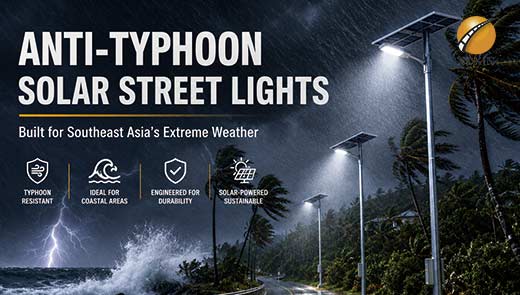
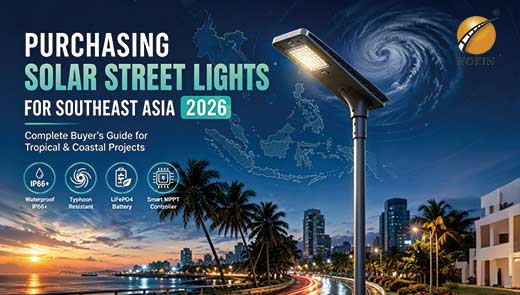
Anti-Typhoon Solar Street Lights for Southeast Asia
Jun 30, 2026
Southeast Asia has over 170,000 kilometers of coastline. Coastal countries such as the Philippines, Indonesia, Vietnam, Thailand, and Malaysia are constantly facing the impact of extreme tropical climates. Typhoons, prolonged rainy seasons with heavy downpours, high concentration of salt fog, high temperatures, and high humidity are the greatest challenges for outdoor lighting facilities in these areas.
Traditional street lights in such scenarios have significant drawbacks. They are prone to rusting and aging of the light posts, cable failures due to moisture underground, and large-scale power outages after typhoons and heavy rains. This not only affects road safety but also significantly increases municipal operation and maintenance costs.
Solar street lights, with their advantages of no wiring, low energy consumption, and independent power supply, have become the mainstream choice for municipal, port, and scenic area lighting projects in Southeast Asia. However, ordinary solar street lights cannot adapt to the extreme coastal environment of typhoons, salt fog, and heavy rain combined. They are prone to problems such as bending, corrosion, and battery failure.
In this blog, NOKIN will combine local climate data in Southeast Asia, project cases, and industry authoritative standards to systematically explain how to select anti-typhoon solar street lights that are suitable for Southeast Asian coastal areas, helping engineering contractors and purchasers avoid selection risks and adapt to the harsh conditions of tropical coastal areas.
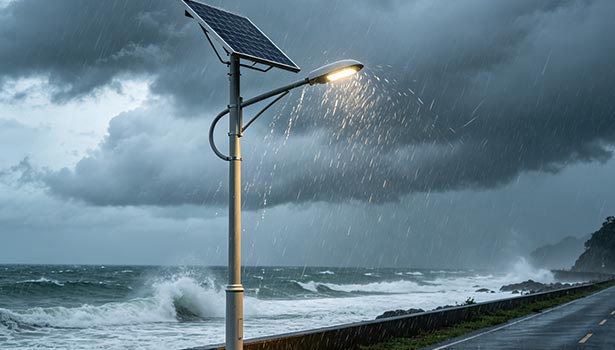
Why Southeast Asian Coastal Areas Need Anti-Typhoon Solar Street Lights
Typhoon Damage Risks in the Philippines and Vietnam
Southeast Asia is a high-tropical cyclone occurrence area globally. Different coastal countries have significant differences in the annual frequency of typhoons, and the high-speed airflow brought by super typhoons can directly damage conventional outdoor lighting equipment. The following are authoritative data on the frequency of typhoons in core coastal countries of Southeast Asia:
|
Coastal Country |
Annual Typhoon Frequency |
Extreme Wind Speed Range |
|
Philippines |
18–20 times |
150–250 km/h |
|
Vietnam |
6–8 times |
150–220 km/h |
|
Thailand Coastal Areas |
3–5 times |
140–200 km/h |
Conventional solar street lights have thin light posts and shallow foundation fixation, which cannot withstand the strong gusts of over 150 km/h. During the typhoon season, they are prone to bending, falling, and light head detachment, causing large-scale lighting paralysis.
Rainy Season Challenges for Solar Charging
The tropical monsoon climate in Southeast Asia is remarkable. There is a concentrated rainy season lasting several months each year, which is the core problem affecting the operation of solar street lights during rainy seasons. Rainy days are generally 7–15 days of continuous rainy weather, with thick clouds, scarce sunlight, and significant reduction in light intensity. This directly leads to a sharp drop in the charging efficiency of solar panels and insufficient battery storage for solar street lights.
Conventional solar street lights have limited battery capacity and no redundant battery life design. During rainy nights, the lighting duration is significantly shortened, and even turns off early, unable to meet the all-day lighting needs of coastal roads and ports.
Salt Fog Corrosion in Coastal Areas
Southeast Asian coastal areas are constantly in a high-humidity environment, with a stable relative humidity of 80%–95%. Combined with the diffusion and penetration of sea surface salt fog, it forms a strong corrosive environment.
Conventional solar street lights lack professional anti-corrosion design and will experience multiple failures when exposed to this environment for a long time: the surface of the light post rusts and falls off, the shell of the light is oxidized and cracked, the internal PCB circuit board oxidizes and short-circuits, and the battery compartment gets waterlogged and damp.
This is why anti-corrosion solar street lights are a must-have configuration for Southeast Asian coastal projects, rather than an optional one.
Main Challenges for Solar Street Lights in Southeast Asian Coastal Areas
Unlike the common inland scenarios, the tropical coastal areas in Southeast Asia have extremely strict operational requirements for solar street lights suitable for tropical climates. The core challenges lie in five key dimensions, directly determining the lifespan and operational stability of the equipment.
Strong Typhoon Wind Loads
The instantaneous wind speed in coastal typhoons is extremely high, and the airflow impact force is strong. The ordinary light posts, supports, and photovoltaic panels have large wind resistance, and there is no anti-wind mechanical design. They are highly likely to be torn apart and blown down by strong winds, causing overall equipment damage.
Salt Spray Corrosion
Seawater salt fog has extremely strong permeability and corrosiveness, which can penetrate ordinary spraying and thin galvanization layers. Under long-term action, the metal structure rusts, and the circuit components age and fail, resulting in an increasing equipment failure rate.
Flooding and Heavy Rain
During the rainy season in Southeast Asia, there are concentrated rainstorms, and low-lying sections, fishing ports, and coastal areas are prone to short-term water accumulation and flood backflow. If the waterproof grade of lights, battery compartments, and controllers is insufficient, they will directly get water and short-circuit, leading to the报废 of the street lights.
High Temperature Aging
The tropical coastal areas have a year-round high temperature, and the surface temperature remains high for a long time. High temperatures accelerate the degradation of lithium batteries and reduce the heat dissipation efficiency of controllers, causing the equipment to overheat and crash, and significantly shortening the battery cycle life.
Insufficient Solar Charging During Rainy Seasons
During the extremely long rainy season, there is a lack of sufficient sunlight for photovoltaic charging, and the charging efficiency is less than 50% of the normal state. Ordinary street lights without redundant power supply design cannot meet the night lighting needs during continuous rainy weather, significantly reducing their practicality.
What Makes Solar Street Lights Wind Resistant
Most ordinary solar street lights on the market are only suitable for inland areas without wind and without corrosion. They cannot be adapted to the coastal typhoon environment. True wind-resistant solar lighting must meet three core hard-core design standards.
Wind Resistance Rating Standards
The wind resistance grade is the core indicator for wind-resistant street lights. It needs to be precisely selected based on the typhoon intensity of different coastal areas in Southeast Asia.
|
Wind Resistance Speed Rating |
Applicable Scenarios |
|
140 km/h |
Ordinary coastal areas in Southeast Asia with low typhoon frequency |
|
≥180 km/h |
Entire Philippines and high-frequency typhoon core areas in Vietnam (recommended minimum standard) |
|
200+ km/h |
Islands prone to severe typhoons, open coastlines, and high-wind port areas |
Aerodynamic Structural Design
Through structural optimization to reduce wind resistance, it reduces the impact force of strong winds on the street lights from the root cause, which is the key to the anti-wind design.
Conical Pole Design
Using an integrated structure with a conical shape that is thinner at the top and thicker at the bottom, the force is distributed evenly and the wind resistance coefficient is extremely low. Compared to a straight pole, the anti-wind performance is improved by more than 30%, and it is less likely to bend or deform.
Low Wind Resistance Lamp Head
Streamlined closed-type light head design without exposed scattered structures, which can effectively avoid strong wind tearing, water accumulation, and salt accumulation problems, and balance anti-wind and anti-corrosion.
Integrated All-in-One Structure
The photovoltaic panel, light, battery, and controller are integrated as a whole, without external suspended supports, and the overall structure is stable, reducing the risk of loosening and falling off during typhoon weather.
Foundation Depth Requirements
Even with a high-quality light body structure, if there is no stable foundation, the light will still collapse in the typhoon. The soft soil in Southeast Asia is mostly loose, and it must strictly follow the standard of deep foundation burial.
General light post foundation deep burial engineering standards:
- 6-meter lightpost: Foundation deep burial 1.2–1.5 meters
- 8-meter lightpost: Foundation deep burial 1.5–2 meters
For areas such as islands, wind mouths, and soft soil regions, the foundation needs to be deepened and reinforced with steel bars to enhance the overall anti-overturning ability.
How to Calculate Wind Load for Solar Street Lights
Wind load calculation is a core part of the design for coastal street lights, which can accurately determine whether the equipment can withstand the extreme typhoon weather in the local area. The industry's common authoritative calculation formula is as follows.
Wind Load Formula
F = P × A × Cd
Wind pressure calculation formula: P = 0.613 × V2 Parameter explanation: F = Wind load force, P = Wind pressure, V = Wind speed, A = Wind exposure area, Cd = Wind resistance coefficient
180 km/h Typhoon Calculation Example
Taking the 180 km/h wind speed of the main typhoon in the Philippines as an example, substitute it into the formula for calculation:
Conversion of wind speed: 180 km/h = 50 m/s
Calculate wind pressure: P = 0.613 × 50² = 1532.5 Pa
Combining the wind exposure area and wind resistance coefficient of the conventional integrated street light, the limit wind load that the equipment needs to withstand can be obtained.
When selecting the engineering type, the load-bearing capacity of the light structure and the anti-pressure capacity of the foundation must be greater than the calculated wind load value to ensure stable operation during the typhoon season.
7 Key Parameters When Buying Anti-Typhoon Solar Street Lights
Based on the typhoon, salt fog, heavy rain, and long rainy season conditions in Southeast Asia, 7 core essential parameters are selected, which are the key to distinguishing ordinary street lights from professional coastal anti-wind and anti-corrosion street lights.
IP66 / IP67 Waterproof Rating
In coastal areas with frequent heavy rain and floods, the minimum standard is IP66, which can resist strong rain erosion and dust and moisture prevention. For low-lying areas prone to water accumulation and coastal wind-affected areas, IP67 is preferred, which supports short-term immersion protection and eliminates water ingress short-circuit faults.
Marine-Grade Aluminum Housing
Abandoning ordinary iron and inferior aluminum materials, using 6063-T5/A380 marine-grade aluminum materials, combined with electrostatic anti-corrosion coating, it can withstand long-term erosion by high-concentration salt fog and prevent oxidation and rusting of the housing.
Hot-Dip Galvanized Light Pole
The light pole adopts the overall hot-dip galvanizing process, with a qualified zinc layer thickness, and is treated with outdoor-specific spray treatment, suitable for coastal high-corrosion environments, and the light pole service life can be extended to over 10 years.
3–7 Days Battery Backup
For the 7-15 day extremely long rainy season in Southeast Asia, the standard configuration is 3 days of basic backup, and for island and remote port areas, 5-7 days redundant backup is preferred, completely solving the problem of power failure during rainy days.
LiFePO4 Battery with BMS
Opt for LiFePO4 lithium iron phosphate battery, which is resistant to high temperatures, has a long cycle life, and is highly safe. Combined with the intelligent BMS battery management system, it can prevent overcharging, overdischarging, and high-temperature overload, suitable for tropical extreme high-temperature environments.
IK08–IK10 Impact Protection
The light body and light head have IK08-IK10 mechanical impact resistance capabilities, which can withstand the impact of typhoon debris and debris, avoiding equipment damage faults.
Smart Dimming Controller
Equipped with intelligent light and shadow sensing + time-based dimming system, it automatically adapts to low-light mode during the rainy season, optimizes energy storage and consumption, extends the service life, and balances energy saving and stable lighting.
Integrated vs Split Solar Street Lights: Which Is Better for Coastal Areas?
Integrated and split-type street lights are the two main categories of mainstream products in Southeast Asian projects. Considering the coastal typhoon environment, there are significant differences in performance between the two. The selection reference is as follows:
|
Comparison Dimension |
Integrated Solar Street Light |
Split-Type Solar Street Light |
|
Wind Resistance Performance |
High (integrated structure with no suspended components) |
Medium (external photovoltaic panels are more vulnerable to wind damage) |
|
Installation Difficulty |
Simple, can be installed quickly by one person |
Complex, requires step-by-step assembly and wiring |
|
Maintenance Cost |
Low, fully sealed design with a low failure rate |
Medium, wiring components are more prone to corrosion and aging |
|
Typhoon Adaptability |
Excellent, ideal for high-frequency typhoon-prone areas |
Depends on structural design; overall stability is moderate |
Selection Conclusion: For typhoon-prone coastal and island projects in the Philippines, Vietnam, Indonesia, etc., integrated anti-typhoon solar street lights should be prioritized; for inland near-sea and non-typhoon areas, split-type can be selected as needed.
Best Applications of Anti-Typhoon Solar Street Lights
Thanks to its anti-wind, anti-corrosion, waterproof, and long service life advantages, this type of street light can fully adapt to various harsh coastal scenarios in Southeast Asia. The core applications are as follows:
- Coastal Roads: Ensure all-weather lighting during typhoons and rainy seasons, improving road safety
- Fishing Ports: Resistant to salt fog corrosion and flood immersion, suitable for high-frequency operation scenarios in ports
- Island Communities: Without reliance on mains electricity, solving the problems of island power supply difficulty and maintenance difficulty
- Beach Resorts: Balancing against weather conditions and appearance aesthetics, suitable for tourism scenarios
- Beach Parking Lots: Stable lighting throughout the day, reducing the cost of outdoor equipment wear and tear
- Port Logistics Parks: Suitable for 24-hour operation needs, not crashing in extreme weather
Common Mistakes When Buying Coastal Solar Street Lights
Most project failures occur later due to mistakes in the initial selection. For coastal projects in Southeast Asia, the following issues need to be particularly avoided:
Only Focusing on Wattage
Many purchasers solely rely on wattage to judge brightness and quality, ignoring core parameters such as wind resistance, corrosion resistance, and battery endurance. High-wattage ordinary street lights are prone to rapid damage in coastal environments and have a much lower cost performance than low-wattage professional weather-resistant street lights.
Ignoring Wind Certification
Some merchants falsely label wind resistance levels, without authoritative test reports to support. Street lights without 180km/h+ wind resistance certification cannot withstand the extremely strong typhoons in the Philippines and Vietnam, and have a significant risk of toppling.
Choosing Cheap Carbon Steel Poles
Ordinary thin-walled carbon steel light poles have no anti-corrosion treatment and will rust and deform in a short period of use. They are prone to bending and breaking in a typhoon and have extremely high costs for replacement and maintenance.
Ignoring Rainy-Day Battery Backup
Only focusing on the regular sunny-day lighting effect, while ignoring the battery endurance during rainy seasons. Street lights without redundant battery endurance cannot frequently turn off during rainy seasons and cannot meet the basic usage requirements of municipal projects.
Pre-Purchase Checklist for Anti-Typhoon Solar Street Lights
Before purchasing, it is necessary to verify the following materials to comprehensively avoid selection and supply risks and adapt to the standards of coastal projects in Southeast Asia:
Wind Resistance Certification
Require suppliers to provide certificates from authoritative institutions, prioritize choosing products with 180km/h and 200km/h wind resistance certifications, which are suitable for high-frequency typhoon areas.
Salt Spray Test Report
Verify the ASTM/ISO standard salt spray test report. It is recommended to have a minimum of 1000 hours of salt spray test compliance to ensure the ability to withstand long-term coastal salt spray erosion.
Waterproof Certification
The entire machine, battery compartment, controller must have a minimum IP66 protection level. In low-lying water areas, it must be IP67 to prevent water penetration and immersion faults.
Battery Verification
Prioritize LiFePO4 lithium iron phosphate batteries. Verify the battery capacity, cycle life, and BMS intelligent protection system. Reject inferior ordinary batteries and adapt to tropical high-temperature environments.
Local Project References
Verify the supplier's implementation cases in the Philippines, Indonesia, Vietnam, Thailand, and Malaysia. Local practical cases are the best evidence of product adaptability and can significantly reduce procurement risks.
How to Choose Reliable Solar Street Light Suppliers
High-quality products cannot be separated from reliable suppliers. When selecting partners for projects in Southeast Asian coastal areas, it is necessary to focus on five dimensions:
Southeast Asia Project Experience
Familiarity with local typhoon patterns, climate conditions, and engineering standards, with a large number of implementation cases, which can precisely match the selection requirements of different countries.
OEM / ODM Capability
Based on project scenarios, wind speed, salt spray levels, battery endurance requirements, customize light pole height, wind resistance levels, protection parameters, and battery endurance configurations to adapt to individualized engineering needs.
Engineering Support
Can provide wind load calculation, foundation construction plans, structural mechanics design, etc., to ensure project construction compliance and stable equipment operation.
Warranty Policy
Provide multi-year whole machine + battery quality guarantee services, clearly define after-sales guarantees for extreme conditions such as typhoons and corrosion, and avoid later maintenance risks.
Local After-Sales Service
Have local after-sales service outlets and spare parts reserves, which can quickly respond to fault repairs and replacement needs, reducing project downtime losses.
Case Study: Philippines Coastal Road Project
The Philippines is the country with the most frequent typhoons in the world, with an average of 18-20 typhoons per year, with extreme wind speeds reaching 250km/h. Outdoor lighting equipment in this area is extremely demanding. A municipal project for a coastal road in the Philippines purchased 180km/h wind resistance level integrated solar street lights, suitable for local extreme conditions.
Project Configuration:
IP67 waterproof rating, 1000-hour salt spray corrosion resistance test, 5-day rainy endurance, maritime-grade aluminum alloy casing, deep concrete foundation construction.
Performance Results:
After multiple severe typhoon seasons and extremely long rainy seasons, the streetlights did not collapse, did not rust, and did not have any lighting failure. They operated stably throughout the process, and the operation and maintenance costs were reduced by 60% compared to traditional city street lights, making it a benchmark lighting project along the coast of the Philippines.
Conclusion
When selecting solar street lights in the coastal areas of Southeast Asia, the core factor is not the brightness or price, but the comprehensive resistance capability that can adapt to extreme tropical conditions. A qualified coastal anti-wind lighting system must possess five core capabilities: anti-tropical cyclone, anti-salt fog corrosion, anti-heavy rain and flood, long-lasting power supply during rainy periods, and intelligent stable control.
When making the selection, one should abandon the misconception of only considering wattage and only focusing on low prices. Instead, the focus should be on verifying the wind load grade, anti-corrosion materials, IP protection standard, rainy period power supply, authoritative test reports, and local project cases.
Only by precisely matching the local industrial conditions such as typhoons in the Philippines, rainy seasons in Vietnam, and islands in Indonesia, can solar street lights ensure long-term stable operation, reduce the total life cycle operation costs, and create a high-value-per-dollar coastal lighting project.
FAQ
Can solar street lights withstand typhoons in the Philippines?
Ordinary solar street lights cannot withstand Philippine super typhoons. Only professional typhoon-proof solar street lights with ≥180km/h wind resistance rating, aerodynamic pole design and deep foundation can operate stably in Philippine coastal typhoon seasons.
What solar street lights are best for Southeast Asia?
The best solar street lights for Southeast Asia are wind-resistant, anti-corrosion, high-waterproof models. They must support 3–7 days rainy day backup, adopt marine-grade materials and LiFePO4 batteries, adapting to typhoons, salt spray, high humidity and long monsoon seasons.
How much wind can a solar street light withstand?
General coastal models withstand 140km/h wind. Professional typhoon-proof models for Philippines and Vietnam can resist 180–200km/h wind. Enhanced models for extreme island areas can withstand over 200km/h super typhoon wind speed.