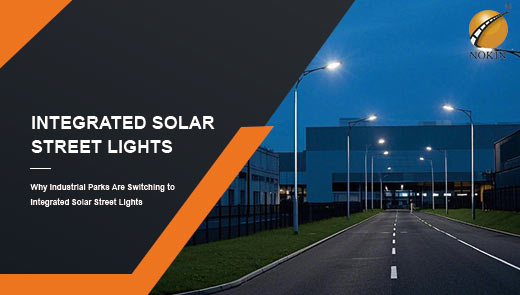
Why Industrial Parks Are Switching to Integrated Solar Street Lights
Mar 26, 2026
Industrial Park Lighting Is Undergoing a Major Transformation
For various industrial parks, manufacturing factories, and logistics storage bases around the world, the lighting system is no longer just a simple supporting facility; it directly affects operational costs, production safety, and green ratings, and has become a core infrastructure. In recent years, more and more parks have abandoned traditional city street lights and fully switched to integrated solar street lights. This is not a niche choice but a structural transformation of industrial lighting globally.
This article will deeply analyze the industry pain points of industrial park lighting, the shortcomings of the traditional model, and the core reasons why integrated solar street lights become the optimal solution. At the same time, it will mark SEO keywords suitable for Google search to help park managers and procurement decision-makers quickly find the appropriate solution and also help the industry content accurately obtain overseas traffic.
The traditional industrial lighting system has been in operation for decades. With fluctuations in global energy prices, tightened environmental policies, and upgraded operational requirements of the parks, this outdated model is rapidly losing its effectiveness. The replacement with new energy lighting has become inevitable.
Why Traditional Street Lighting Is Failing in Industrial Parks
Rising electricity costs
Industrial parks generally require 10-12 hours of night lighting, and some logistics parks and 24-hour factories even need continuous lighting throughout the day. Global industrial electricity prices have risen year after year, and the electricity expenses for traditional city street lights have become a fixed large expense for the parks, which is a rigid cost with almost no room for reduction.
According to data from multiple solar lighting industry analysis sites, the operating cost (OPEX) of industrial lighting has increased by more than 30% in the past five years, with electricity expenses accounting for over 70% of the total lighting expenditure, continuously eroding the park's profits.
High reliance on the power grid, and the risk of power outages directly affects production and operation.
Dependence on unstable power grids
In case of power grid failures, power restrictions, line maintenance, etc., the lighting in the park will be severely paralyzed.
Power outages at night will cause all logistics handling, employee inspections, and vehicle passage to come to a standstill. Even if it causes only minor delays in production progress, it can lead to serious safety accidents, especially in remote park areas where the power grid stability is even worse. Such risks occur frequently.
High installation and infrastructure costs
Traditional street lights require a complete set of power supply facilities: digging the ground to lay cables, building transformers, and installing distribution boxes. The initial construction process is cumbersome.
New parks need to reserve a large amount of power infrastructure budget, and remote parks even have to bear the cost of long-distance wiring. When expanding the park or adding new lighting areas, the wiring construction needs to be repeated, which not only delays production but also significantly increases additional costs.
Key Lighting Challenges in Industrial Parks
Regardless of industry trends, when it comes to daily operations, the lighting problems in industrial parks directly hit the core of management. Each issue is directly related to costs and safety, and is also the main motivation for park decision-makers to urgently replace the lighting system.
High Upfront Investment
The upfront infrastructure costs of traditional lighting far exceed the cost of the lights themselves. Cables, transformers, auxiliary materials, and labor costs for construction, the overall investment is extremely high.
Especially for newly built parks and remote areas without power grids, the proportion of power support costs is even higher. Some remote factory areas even have to bear costs far exceeding the lighting itself for power grid construction, resulting in an extremely low return on investment.
Complex Maintenance
The traditional street light lines are complex, and lights, lines, and transformers are prone to failure. After damage, they require manual inspection one by one, resulting in extremely low maintenance efficiency.
Problems such as aging power grid lines, short circuits, and leakage occur frequently, not only resulting in high maintenance costs but also posing safety hazards. The inspection and maintenance of large-scale parks require a large amount of manpower, and the long-term maintenance expenditure has no upper limit.
Safety Risks At Night
Industrial parks have multiple functional zones, such as logistics loading and unloading areas, warehouse blind zones, perimeter walls, employee passageways, etc. These areas are prone to insufficient lighting and dim lighting.
The lighting shortcomings will directly increase the probability of accidents such as vehicle scratches, personnel bumps, goods damage, and unauthorized intrusions. The costs for handling and managing these accidents also increase simultaneously, seriously affecting the operation order of the park.
Difficult Expansion
When the park expands roads, adds new storage areas, or plans new factories in the future, traditional lighting needs to be re-excavated and wired, damaging the existing ground and infrastructure.
The old lighting system has poor compatibility with new equipment and cannot adapt to intelligent control requirements. To upgrade, it can only be replaced as a whole, further increasing the renovation cost and completely failing to keep up with the expansion pace of the park.
What Are Integrated Solar Street Lights
The integrated solar street light, also known as the all-in-one solar street light (All-in-One Solar Streetlight), has the core feature of integrating the four key components - solar photovoltaic panels, LED lighting fixtures, lithium iron phosphate batteries, and intelligent controllers - into a single integrated structure.
This kind of street light is an independent off-grid power supply system, which does not need to be connected to external mains cables, dig cable trenches and lay lines. It relies on its own photovoltaic panels to absorb solar energy and convert it into electric energy, which is stored in batteries. At night, it automatically supplies power to the LED lights, and realizes autonomous operation throughout the day, completely independent from the grid.
Why Integrated Solar Street Lights Are the Best Industrial Lighting Solution
The all-in-one solar street light integrates photovoltaic panels, batteries, LED lights, and controllers into one unit, completely revolutionizing the traditional lighting model and precisely addressing all the lighting problems in industrial parks. Its five core advantages form overwhelming competitiveness and naturally become the preferred solution for global industrial parks.
Zero Electricity Cost and Long-term Savings
Core advantages: Completely get off of municipal power grid, relying on solar energy for independent power supply, zero electricity cost for daily lighting, eliminating the largest operating cost from the root.
Business solar lighting ROI analysis data shows that the investment return period (ROI) of industrial-grade all-in-one solar street lights is only 5-8 years, and the total lighting cost can be saved by over 60% throughout the life cycle. The subsequent years have pure profits, and the cost performance far exceeds traditional street lights.
Fast Installation and Scalability
Core advantages: No need for excavation and wiring throughout the process, no need to build transformers, only need to fix the light poles and simple debugging to complete the installation.
A single conventional street light can be installed within one day, and the overall construction period is shortened by more than 70% compared to traditional street lights. Installation and lighting can be completed on the same day, without delaying the production, logistics, and expansion progress of the park.
Especially suitable for scenarios: newly built industrial parks, temporary construction areas, expanded roads of industrial parks, and scattered supplementary lighting areas.
Off-grid Reliability
Core advantages: It belongs to an independent off-grid power supply system. Grid power outages do not affect lighting at all. It can light up stably for 24 hours.
Combined with a large-capacity industrial-grade lithium iron phosphate battery, the standard configuration can support normal lighting for 3-5 consecutive rainy days. In areas with heavy rain and insufficient lighting, the battery can be upgraded, ensuring uninterrupted lighting all year round, and completely breaking free from the constraints of the power grid.
Low Maintenance
Core advantages: No external cables, significantly reducing fault points, basically eliminating line failure problems.
Using long-life lithium iron phosphate batteries, the cycle life is 5-8 years, and the high-brightness LED light source has a lifespan of up to 50,000 hours. No frequent replacement of accessories is needed; high-end models support remote intelligent monitoring, automatic fault alarms, eliminating the need for manual inspection one by one, and reducing maintenance personnel costs by 80%.
Supports ESG and Green Certification
Core advantages: Pure clean energy lighting, zero carbon emissions during operation, no noise, and no light pollution, fully meeting the requirements of carbon neutrality and sustainable development.
It can directly serve as core supporting materials for LEED certification, green industrial park rating, and international environmental compliance, quickly enhancing the green image of the enterprise, strengthening foreign trade cooperation and market competitiveness.
Which Industrial Parks Should Prioritize Integrated Solar Street Lights
The all-in-one solar street light is suitable for the vast majority of industrial scenarios. The following four types of parks should be replaced first, with the most significant benefits and the lowest renovation difficulty:
Newly Built Industrial Parks
Without historical power grid burden, the early planning can directly layout the solar lighting system, eliminating power infrastructure costs, achieving low-carbon lighting in one step, and meeting the initial operation and green rating requirements of the park.
Industrial Parks in Remote/Unstable Power Areas
Mainly covering Africa, Southeast Asia, South America, etc., these parks have weak power supply support. The traditional lighting costs are extremely high. The all-in-one solar street light does not rely on the power grid and can quickly achieve full coverage lighting.
Logistics Parks & Warehousing Bases
Nighttime loading and unloading operations and cargo transfer are frequent, with extremely high requirements for lighting duration and brightness. The zero electricity cost advantage can significantly reduce operating costs, and stable lighting can also improve operational efficiency and reduce safety accidents.
Large-Scale Manufacturing Parks
The park covers a large area and has numerous lighting points. The traditional lighting costs and maintenance expenses are astonishing. After replacing with integrated solar street lights, the overall cost savings effect is multiplied. The long-term benefits are extremely considerable.
Integrated Solar Street light vs. Traditional Street light
Core Comparison
By comparing the data intuitively, the gap between the two lighting schemes can be clearly seen, helping park decision-makers quickly make a selection:
|
Comparison Item |
Traditional Street Lights |
Integrated Solar Street light |
|
Initial Installation Cost |
High (including cables, transformers, and wiring labor) |
Low (no wiring required, only light post and fixture costs) |
|
Daily Electricity Expenditure |
Continuous large-scale expenditure (ongoing electricity costs) |
$0 electricity cost (completely energy self-sufficient) |
|
Maintenance |
Complex, multiple failure points, high labor costs |
Simple, fewer failure points, supports intelligent monitoring |
|
Expandability |
Poor, expansion requires re-wiring and infrastructure upgrades |
Strong, easy to add new lighting points without wiring |
|
Impact of Power Outages |
Large areas affected, lighting failure may disrupt operations |
No impact, operates independently with normal functionality |
How Much Do Industrial Solar Street Lights Cost
For the procurement decision-makers of industrial parks, cost is the core consideration factor. The price of industrial-grade integrated solar street lights is not a fixed value. It is mainly influenced by power configuration, battery life, material grade, and purchase quantity. The entire calculation is in US dollars and does not include additional infrastructure costs such as additional wiring and transformers. The overall cost performance is much higher than that of traditional street lights.
2026 Industrial Solar Street Light Price Range (Per Set)
Specialized industrial street lights need to meet IP65 or above waterproof, wind-resistant, corrosion-resistant, long battery life, and high-brightness lighting requirements. They are divided into basic practical models, mid-range standard models, and high-end heavy-duty models, suitable for different park needs. The specific quotations are as follows (each set includes the light, excluding the batch purchase price of the light pole):
|
Product Grade |
Core Configuration |
Applicable Scenarios |
Price per Set (USD) |
|
Basic Practical Model |
30–50W LED light source; 3-day battery life in rainy conditions; basic lithium battery; IP65 waterproof |
Small parks, internal passages, non-core operation areas |
80–140 |
|
Mid-range Standard Model |
60–100W LED light source; 5–7-day battery life in rainy conditions; long-life lithium iron phosphate battery; intelligent light control |
Medium-sized manufacturing parks, logistics channels, regular storage areas |
150–280 |
|
High-end Heavy-duty Model |
120–200W LED light source; 7–10-day battery life in rainy conditions; industrial-grade battery; remote monitoring; strong wind resistance |
Large manufacturing parks, heavy logistics areas, remote parks, main roads |
290–450 |
Core Factors Affecting Industrial Solar Street Light Pricing
Power & Lighting Demand
Main roads and heavy loading areas in the park require higher power light sources. The higher the brightness requirement and the wider the coverage area, the higher the single set price will be; internal pedestrian passages and secondary roads can choose low-power models to control the purchase cost.
Battery Configuration & Backup Life
Industrial-grade lithium iron phosphate batteries have longer lifespan and longer battery life, and the cost is higher than that of ordinary batteries; in rainy and low-light areas, large-capacity batteries need to be upgraded, and the price will increase by 15%-25%, but it can ensure stable lighting throughout the year.
Order Quantity & Customization Requirements
Industrial parks that make bulk purchases (50 sets or more) can enjoy wholesale discounts, with the unit price reduced by 10%-20%; if customizing intelligent monitoring, dimming functions, or special anti-corrosion materials, the price will increase slightly based on the customized content.
Installation & Accessory Costs
Industrial solar street lights do not require wiring; only the light post and foundation installation costs are needed. The installation labor cost per set is only 15-30 US dollars, much lower than the hundreds of US dollars wiring construction cost of traditional street lights; remote parks can arrange personnel for installation themselves, further reducing costs.
Cost Optimization Tips for Industrial Park Procurement
For new parks, prioritize bulk purchasing of mid-range standard models to avoid subsequent renovation costs and enjoy bulk discounts;
For remote and power-poor parks, directly choose high-end heavy-duty models to avoid replacing batteries due to insufficient battery life later;
Do not blindly pursue high power. Select based on the functional zoning of different areas in the park, combine the purchase of main and secondary roads, and control the overall budget.
How Decision-Makers Choose Industrial Solar Lighting Solutions
At present, the selection of lighting in industrial parks has already moved beyond the misconception of "only considering low prices", and the core reasoning of decision-makers has undergone three major changes:
Shift From Upfront Price to Total Life Cycle Cost (TCO)
No longer only focusing on the initial procurement cost, but calculating the total investment during the light's lifespan, including procurement, installation, electricity bill, maintenance, and replacement costs. The full life cycle cost of integrated solar street lights is much lower than that of traditional street lights, becoming the core selection criterion.
Shift From Basic Lighting to Smart + Green Systems
Abandoning simply meeting the lighting demand, instead choosing an integrated solution with intelligent control, low-carbon environmental protection, and remote monitoring, making lighting a part of a smart and green park, enhancing the overall value of the park.
Shift From Central Grid Power to Distributed Clean Energy
Adhering to the global energy transition trend, giving up the limitations of centralized power supply, adopting distributed solar off-grid power supply, achieving energy self-sufficiency, reducing costs and conforming to the global low-carbon development direction.
Are Solar Street Lights Worth It for Industrial Parks
The integrated solar street light is not merely a simple replacement for traditional city street lights. Instead, it is a new generation of lighting solution specifically designed to address the pain points of industrial parks. It has achieved four core upgrades:
- Cost upgrade: From high-cost debt to zero electricity bill profit, achieving significant long-term cost savings
- Efficiency upgrade: From cumbersome construction to rapid deployment, without disrupting the production and operation of the park
- Stability upgrade: From reliance on the power grid to off-grid independence, unaffected by power outages and adverse weather conditions
- Value upgrade: From simple lighting to green empowerment, helping with ESG ratings and green certifications
Industrial park lighting is moving from "passive electricity consumption" to "self-generated electricity". Instead of bearing the high electricity costs and maintenance costs of traditional street lights, it is better to plan for the integrated solar street light in advance, seize the low-carbon benefits, and achieve the dual goals of cost reduction and efficiency improvement.