A Complete Guide of 60W Integrated Solar Street lights
Dec 12, 2025
In projects such as municipal road upgrades, rural lighting projects, and lighting renovations in industrial parks and parking lots, 60W integrated solar street lights (including built-in batteries) have become the preferred choice for an increasing number of engineering purchasers and contractors due to their advantages of no wiring, zero electricity charges, and flexible deployment. Next, NOKIN will systematically sort out for you the core definition, technical specification interpretation, key points for selection, installation suggestions, etc. of 60W integrated solar street lights. At the same time, it will answer key questions about battery capacity, endurance, etc., to help you efficiently complete project selection and implementation.
The 60W integrated solar street light is an ideal choice for medium and small power lighting scenarios. It is typically applied to municipal branch roads and rural main roads with a pole height of 5 to 6 meters. The luminous flux is usually between 6,000 and 10,000 lumens. When paired with high-quality lithium iron phosphate batteries, it can provide continuous lighting for 3 to 5 rainy days, effectively balancing lighting effect and cost input.
What is A 60W Integrated Solar Street Light?
The core of the 60W integrated solar street light lies in its All-in-One design, which integrates core components such as solar photovoltaic panels, 60W LED lights, lithium batteries, intelligent controllers, and photosensitive/microwave sensing modules into a single integrated housing to form an independent lighting system. The greatest advantage of this design is that it eliminates the need for wiring and the installation of individual components, significantly simplifying the construction process. At the same time, it enhances the overall integrity and aesthetic appeal of the product, making it suitable for a variety of complex installation environments.
The Difference from Traditional Street Lights
Compared with traditional municipal street lights, the most significant advantage of 60W integrated solar street lights is that their operating costs are almost zero, there is no need to pay electricity bills, and they are easy to deploy and not restricted by the coverage of the power grid. They are particularly suitable for remote villages, newly-built industrial parks and other areas where the power grid is difficult to reach. Meanwhile, it has a low dependence on the power grid and can still operate normally during power outages or grid failures. However, it should be noted that its lighting effect and battery life are greatly affected by sunlight conditions, and the battery life directly determines the long-term usage cost. This is also the main difference compared with traditional municipal street lights.
Core Technical Specifications of 60W Integrated Solar Street Lights
The 60W integrated solar street lights from different manufacturers have differences in parameters, which directly affect the lighting effect, battery life and service life. The following interprets the meanings of key parameters and selection points from four core dimensions: light source, solar module, battery, and endurance.
The Light Source, Luminous Flux and Color Temperature of the 60W Integrated Solar Street Light
60W LED is the core light source of this type of street light, and its key parameters are luminous flux and color temperature. According to the product example of Fireflier Lighting Limited, the common system lumen range of 60W leds is approximately 6,000-10,200 lm, and the corresponding luminous efficacy (lm/W) is between 100-170 lm/W. The higher the luminous efficacy, the higher the energy utilization rate: Products with a luminous efficacy of ≥150 lm/W are suitable for scenarios with high brightness requirements such as vehicle lanes. Products with a luminous efficacy of 100 to 130 lm/W can meet the demands of scenarios such as walkways and courtyards. In terms of color temperature, 3000K - 4000K warm white light or natural white light is commonly used for municipal roads, which can not only ensure the clarity of lighting but also avoid the dazzling effect of strong light.
The Solar Module of the 60W Integrated Solar Street Light
It should be noted that "60W" refers to the power of the LED light head, not that of the solar panel. The product specifications of LED solar lights show that the common configuration of solar panels for 60W integrated solar street lights is 18V/60WP or 20-80W panels. The specific power needs to be matched according to the lighting duration and local sunlight conditions. When selecting the type, it is important to focus on checking the panel power, photoelectric conversion efficiency (common monocrystalline silicon ≥23%) and charging time indicators provided by the manufacturer to ensure that the solar panel can provide sufficient power to the battery.
The Battery Type and Capacity of 60W Integrated Solar Street Light
The battery is the core energy storage component of the 60W integrated solar street light, directly determining its endurance and service life. According to the product example of the sun light LED, the current mainstream battery types are LiFePO₄ (lithium iron phosphate) or 12.8V Li-ion (lithium-ion) batteries. Among them, lithium iron phosphate batteries are more favored due to their high safety and long cycle life (≥3000 cycles). Typical capacity examples include 12.8V 24Ah (approximately 307 Wh), 12.8V 42Ah (approximately 537.6 Wh), etc. When selecting a model, particular attention should be paid to "storage capacity (Wh)" and "available depth of discharge (DoD)". The DoD of lithium iron phosphate batteries usually reaches 80% to 90%, meaning the actual available energy is over 80% of the nominal capacity. The higher the DoD, the higher the battery utilization rate.
The Battery Life and Weather Redundancy of the 60W Integrated Solar Street Light
Battery life (i.e., the number of continuous lighting days in the absence of sunlight) is one of the parameters that purchasers pay the most attention to. Manufacturers often take "supporting 3 to 5 days of battery life in rainy days" as the core selling point. Project data from Anner Energy Technology shows that the actual battery life is affected by multiple factors: the higher the LED luminous efficiency, the lower the energy consumption; By adopting control strategies such as timed downshifting and induction lighting, the battery life can be significantly extended. The larger the battery capacity, the more energy it can store and the longer the battery life will be.
Example of battery life calculation: Assuming the street light operates for 10 hours a day and adopts a control strategy of "100% power (60W) for the first 4 hours + 50% power (30W) for the last 6 hours", with a system efficiency of 85%, then the daily energy requirement Wh = (60W×4h + 30W×6h) ÷85% ≈ 447 Wh. If a 12.8V 42Ah (537.6Wh) lithium iron phosphate battery is selected, with a DoD of 80%, the actual available energy would be 537.6Wh ×80% = 430.08Wh, which can meet the lighting needs for approximately one day. If a 12.8V 60Ah (768Wh) battery is selected, the actual available energy is 614.4Wh, which can meet the demand for about 1.4 days. If a larger power solar panel is paired, the redundancy capacity in rainy days can be enhanced.
Installation Parameters and Engineering Suggestions for 60W Integrated Solar Street Lights
Scientific installation parameters and engineering design can maximize the lighting effect of the 60W integrated solar street light and extend its service life. The following provides specific suggestions from three dimensions: pole height spacing, lighting strategy, and anti-theft protection.
Recommended Pole Height and Spacing for 60W Integrated Solar Street Lights
According to the project case and product suggestions of CmoonLight Solar Street Light, the common recommended pole height for 60W integrated solar street lights is 5-7 meters. The specific selection should be based on the scenario: For rural side roads and pedestrian paths, a pole height of 5 to 6 meters should be chosen to ensure uniform ground illuminance. For municipal branch roads and main roads in industrial parks, poles with a height of 6 to 7 meters are selected to meet the lighting requirements for vehicle passage. In terms of pole spacing, it is recommended to be 20 to 30 meters. If the road width exceeds 6 meters, symmetrical installation on both sides can be adopted to ensure there are no blind spots for lighting on the road surface. When actually installing, adjustments should be made according to the local illuminance standards to avoid insufficient brightness due to excessive spacing.
Light Distribution and Illuminance Strategy for 60W Integrated Solar Street Lights
To balance the lighting effect and battery life, it is recommended to adopt a combined control strategy of "timed downshifting + sensor lighting". Referring to the mainstream practices of street light projects in the industry, the following Settings can be made: 100% power lighting from 18:00 to 22:00 (peak hours for pedestrian and vehicle traffic) at night, 50% power from 22:00 to 02:00, and 30% power from 02:00 to 06:00. It is also equipped with a microwave sensing module. When it detects the approach of vehicles or pedestrians, it automatically increases to 100% power and resumes downshifting when no one is around. This strategy can reduce energy consumption and extend the battery life in rainy days while ensuring the lighting requirements during critical periods.
Anti-theft and Protection of 60W Integrated Solar Street Lights
In terms of anti-theft, choose products with an integrated shell design. The battery is built inside the light body to reduce the risk of theft. When installing, use anti-theft bolts to fix the light head and the light pole. The bottom of the light pole is built with a concrete foundation and an anti-theft manhole cover is added. In terms of protection, products with a protection level of ≥IP65 should be selected to ensure dust-proof and water-proof performance, and to adapt to harsh environments such as rainy days and sandstorms. In areas prone to thunderstorms, lightning protection grounding devices should be installed with a grounding resistance of no more than 4Ω to prevent damage to the controller and battery caused by lightning strikes. In addition, the surface of the solar panels should be kept clean to avoid obstructions that may affect the charging efficiency.
How to Choose 60W Integrated Solar Street Lights for Your Project?
When selecting a model, it is necessary to comprehensively verify the product parameters based on the project requirements and conduct thorough inspection tests to avoid affecting the project outcome due to non-compliant parameters. The following is a detailed purchase list and inspection suggestions.
Must-check Parameter List (in Table Form)
|
Parameter Category |
Core Selection Standards |
Reference Values |
Remarks |
|
Light Source Parameters |
LED power, luminous flux, luminous efficacy, color temperature |
60 W; 6000–10200 lm; ≥120 lm/W; 3000K–4000K |
For vehicle lanes, prioritize high-efficiency, natural white LED products. |
|
Solar Module / Solar Panel Parameters |
Power, type, conversion efficiency |
20–80 WP; Monocrystalline silicon ≥23% |
Match power configuration according to local sunshine duration. |
|
Battery Parameters |
Battery type, capacity (Wh), DoD, cycle life |
Lithium iron phosphate; ≥307 Wh; ≥80% DoD; ≥3000 cycles |
LiFePO4 is preferred due to high safety and long service life. |
|
Controller Parameters |
Control type, sensing functions, protection mechanisms |
MPPT controller; supports light control/microwave sensing |
MPPT has higher charging efficiency than PWM; ensure overcharge/overdischarge/short-circuit protection. |
|
Protection Grade & Operating Temperature |
IP rating, temperature range |
≥IP65; –20°C to 60°C |
For cold regions, ensure strong low-temperature discharge performance. |
|
Warranty & Maintenance |
Overall product warranty, battery warranty, maintenance policy |
Overall warranty ≥2 years; battery warranty ≥5 years |
Warranty duration directly impacts long-term ownership and maintenance cost. |
Note: The above reference values are derived from the typical specification pages of manufacturers such as solar light leds. Specific adjustments need to be made in accordance with project requirements.
Suggestions for 60W Integrated Solar Street Light Inspection and Acceptance Testing
Arrival inspection is a crucial step to ensure product quality. It is recommended to conduct tests in accordance with the following steps:
Visual inspection: Check whether the light body shell has any damage or scratches, whether the components are installed firmly, and whether the interfaces are well sealed.
Electrical insulation test: Use a multimeter to detect the insulation of the circuit to avoid the risk of short circuit.
Luminous flux test: When conditions permit, use an Integrating sphere (Integrating sphere) to detect the actual luminous flux, or measure the ground illuminance in a dark environment with an illuminance meter to ensure compliance with parameter requirements;
Charge and discharge test: Connect the solar panel to simulate charging, check the charging status displayed by the controller, then turn on the lighting mode and test the switching effect of different power levels.
Controller function test: Verify whether the light control switch (automatically turns on in dark environments and automatically turns off in bright environments), sensing function, and timed downshift function are normal. During the testing process, it is necessary to keep good records. If any problems are found, communicate with the supplier in a timely manner for returns or exchanges.
Maintenance Points and Common Fault Troubleshooting for 60W Integrated Solar Street Lights
Reasonable maintenance can extend the service life of 60W integrated solar street lights and reduce the failure rate. The following is a summary of the core maintenance points and the troubleshooting methods for common faults.
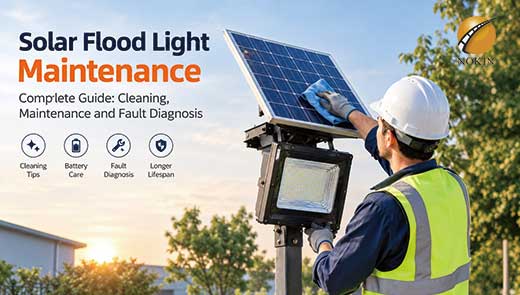
Key Points of Core Maintenance
Regular cleaning:
Clean the dust, leaves and other obstructions on the surface of the solar panels once every quarter to ensure charging efficiency. When cleaning, use a soft cloth to avoid scratching the glass.
Battery maintenance:
Avoid over-discharging the battery (set a reasonable protection voltage through the controller). When there is no sunlight for a long time, manually turn off the street light to reduce battery wear and tear.
Line inspection:
Check the connection bolts and anti-theft devices between the light cap and the light post once a year to ensure they are securely fastened. After the thunderstorm season, check whether the lightning protection grounding device is functioning properly.
Controller calibration:
Calibrate the light control threshold and timing parameters of the controller once a year to ensure the accurate implementation of the lighting strategy.
Common Problems and Troubleshooting Steps of 60W Integrated Solar Street lights
Question 1: Insufficient Brightness
Possible causes: Insufficient charging due to solar panel obstruction, LED light attenuation, reduced battery capacity, and unreasonable setting of the controller's downshift parameters.
Troubleshooting steps: ① Check if there is any obstruction on the surface of the solar panel. After cleaning, observe whether the brightness has returned. ② Use a multimeter to measure the battery voltage. If it is lower than 11V (for a 12.8V battery), it indicates insufficient charging or battery aging. ③ Check the downshift setting of the controller. If the downshift is too early, adjust the parameters. If all the above are normal, it might be due to LED light attenuation. You need to contact the supplier to replace the light beads.
Question 2: Unable to Charge or Insufficient Battery Life
Possible causes: Solar panel failure, controller failure, battery aging, poor contact of the charging line.
Troubleshooting steps: ① Use a multimeter to measure the output voltage of the solar panel (under direct sunlight on a sunny day). If it is lower than 80% of the rated voltage, it indicates a fault with the solar panel. ② Check if the charging indicator light of the controller is functioning properly. If it doesn't light up, it indicates a controller fault. ③ Check the voltage change of the battery after charging and discharging cycles. If the capacity drops by more than 30%, the battery needs to be replaced. ④ Check the connection line between the solar panel and the controller to ensure that the plug is firm and not loose.
Question 3: The Light Cannot be Turned on/off Automatically
Possible causes: Malfunction of the light control sensor, incorrect controller parameters, or sensor obstruction.
Troubleshooting steps: ① Check if there is any obstruction on the surface of the light control sensor, clean it and then test it; ② Enter the controller Settings interface and calibrate the light control threshold (for example, set the dark threshold to 5lux); If the sensor remains abnormal after cleaning, replace the light control sensor or controller.
FAQ
Q: What height of pole is suitable for a 60W integrated solar street light?
A: A pole height of 5 to 7 meters is suitable. For rural branch roads and pedestrian paths, 5 to 6 meters can be selected. For municipal branch roads and main roads in industrial parks, 6 to 7 meters can be chosen. The specific height should be adjusted according to the road width and illuminance requirements.
Q: How many years can the battery of a 60W integrated solar street light last?
A: The mainstream lifespan of lithium iron phosphate batteries is 5 to 8 years, which depends on the number of charge and discharge cycles, the ambient temperature during use, and the control strategy. Lithium iron phosphate battery has a cycle life of ≥ 3,000 times and can be stably used for more than 6 years under normal usage conditions.
Q: How can we ensure normal lighting even on rainy days?
A: It can be guaranteed through three points:
Choose large-capacity lithium iron phosphate batteries (such as 12.8V 60Ah and above);
Configure solar panels with sufficient power (such as 80WP) to enhance charging efficiency;
Adopt intelligent control strategies (timed downshifting + sensor lighting) to reduce energy consumption during off-peak hours.
Q: Is it difficult to install a 60W integrated solar street light? Do you need a professional team?
A: The installation difficulty is relatively low and no professional electrician team is required. The integrated design requires no wiring. It only needs to complete three steps: pouring the light post foundation, fixing the light head to the light post, and debugging the controller parameters. A regular construction team can complete it after simple training. The installation period is about 1 to 2 hours per set.
Q: Do the sunlight conditions in different regions have an impact on the selection?
A: It has a significant impact. In areas with abundant sunlight (such as those with an annual sunshine duration of ≥2000 hours), smaller power solar panels (20-60WP) can be selected. In areas with less sunlight (such as those with an annual sunshine duration of less than 1500 hours), it is necessary to choose solar panels with a higher power capacity (60-80Wp), and at the same time, pair them with large-capacity batteries to ensure sufficient charging.
The 60W integrated solar street light (including battery) is an excellent choice for small and medium power lighting scenarios such as municipal branch roads, rural roads, parks, and parking lots, thanks to its advantages of no wiring, zero electricity charges, and flexible deployment. If you are also looking for 60W integrated solar street lights, please contact NOKIN's professional consultants to provide you with a customized selection plan and quotation reference for your project.