How to Select the Optimal Wattage for Solar Street Lights?
Dec 11, 2025
In solar street light procurement, power selection is the most critical yet frequently misjudged step. Many users either blindly pursue high wattage, leading to soaring costs and energy waste, or opt for insufficient power, resulting in inadequate brightness that fails to meet safety lighting requirements. Whether for municipal roads, residential alleys, parks, plazas, or commercial parking lots, different scenarios demand vastly distinct brightness levels and coverage ranges for solar street lights. This variability means there is no one-size-fits-all optimal wattage.

This article scientifically analyzes the core factors influencing solar street light power selection and provides scenario-based power recommendations to help you quickly match the most suitable wattage. This approach ensures effective illumination while maximizing cost-effectiveness.
5 Core Factors Influencing Solar Street Light Power Selection
Lighting Requirements
The core function of solar street lights is to provide lighting that meets the needs of the specific scenario. Different scenarios have significantly different brightness requirements, which is the primary basis for power selection. Scenarios like sidewalks and residential alleys only need to meet basic safety lighting requirements, while main roads and commercial areas require high-intensity lighting to ensure traffic efficiency and safety.
Regarding brightness standards:
Residential areas: 5-10 lux
Main roads: 20-30 lux
Commercial districts: 30-50 lux
Different brightness requirements directly correspond to different solar street light wattage levels.
Illuminated Area
Illuminated area is the core metric determining solar street light power. The calculation formula is: Area (㎡) = Width (m) × Length (m) Smaller areas require lower wattage; larger areas demand higher power for comprehensive coverage. For instance, a 50㎡ residential alley versus a 500㎡ parking lot requires 5-8 times more power—a fundamental principle in lamp selection.
Installation Height
Installation height directly impacts illumination range and brightness decay. Height must be synchronized with lamp power—an often-overlooked selection factor. Greater height expands illumination coverage but reduces ground brightness, necessitating increased power to compensate.
Standard height-power correspondences are:
6-8m: Residential areas and alleys (low power)
10-12m: Main roads and plazas (medium-high power)
Above 12m: Highways and large venues (high power)
Precise height-power matching prevents lighting failures.
Photovoltaic Panel and Battery Capacity
Solar street light power selection must align with photovoltaic panel and battery capacity to prevent insufficient runtime—this is the core principle of power matching. The photovoltaic panel matching principle requires the panel power to be ≥1.2–1.5 times the street light power to ensure adequate charging efficiency. For example, a 60W street light requires a ≥72W photovoltaic panel.
Regarding battery capacity, high-power solar street lights require larger lithium batteries to prevent short-term operational gaps. For instance, a 100W light should be paired with a ≥100Ah lithium battery. Only through proper power matching can solar street lights operate stably.
Climate Conditions
Regional climate variations impact solar street light charging efficiency and endurance, necessitating tailored power adjustments. For areas with frequent cloud cover, rain, or limited daylight hours, add 10-20W to the recommended power rating to prevent insufficient endurance.
Temperature impact: Low temperatures reduce battery capacity by approximately 30%. Increase photovoltaic panel power to ensure high-power solar street lights function normally. Climate adaptation is a crucial supplement to solar street light power selection.
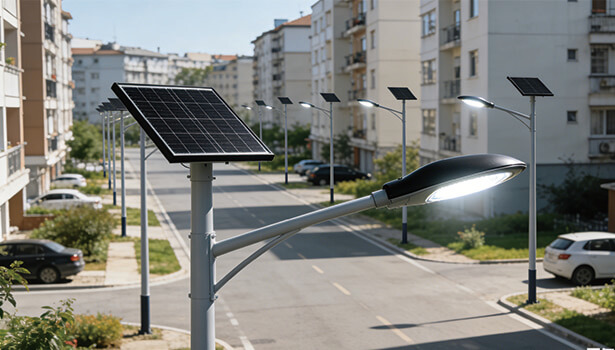
Optimal Power Range for Different Scenarios
15-30 Watts
Suitable for: Residential alleys, garden paths, courtyards, small parking lots ≤100㎡, rural country roads. This represents the mainstream power range for rural solar street lights, offering core advantages of energy efficiency, flexible installation, lower costs, and simple maintenance. Performance benchmarks include an illumination radius of 8-12m, brightness of 5-10 lux, and a full-charge runtime of 7-10 days. Suitable for short-duration nighttime lighting (6-8 hours daily), this constitutes a typical application scenario for low-power solar street lights.
40-60 Watts
Suitable for secondary roads, commercial parking lots (100-300㎡), community centers, parks, and industrial park access roads. This power range is the optimal choice for residential solar street lights and the top recommendation for commercial parking lot solar lights.
The core advantage lies in balancing brightness and coverage, making it suitable for most municipal and commercial scenarios with the highest cost-performance ratio. Performance reference: illumination radius 12-18m, brightness 10-20 lux, full-charge runtime 5-7 days, supporting 10-12 hours of continuous nighttime illumination. This is the most versatile power range among solar street light recommendations.
70-100 Watts
Ideal for main roads, highways, large commercial complexes, sports venues ≥300㎡, and high-traffic transportation hubs. This core range excels in intense illumination coverage, strong penetration, and compliance with municipal lighting standards for complex environments.
Illumination radius: 18-25m illuminance of 20-30 lux, and 3-5 days of full-charge runtime. Supports 24-hour intermittent lighting, such as reduced-power mode on main roads during late night hours. This represents the core application scenario for high-power solar street light selection.
Core Parameter Comparison Table for Solar Street Lights of Different Power Ratings
|
Power Range |
Applicable Area |
Mounting Height |
Lighting Radius |
Brightness Range (lux) |
Core Application Scenarios |
|
15–30W |
≤100 m² |
6–8 m |
8–12 m |
5–10 |
Residential alleys, walkways, rural roads |
|
40–60W |
100–300 m² |
8–10 m |
12–18 m |
10–20 |
Secondary roads, commercial parking lots, residential main roads |
|
70–100+W |
≥300 m² |
10–12 m+ |
18–25 m |
20–30+ |
Main roads, large venues, transportation hubs |
Key Considerations for Power and Core Technology Matching
Light Source Type and Power
LED light source characteristics exhibit varying luminous efficacy across different power levels. Low-power LEDs (15-30W) achieve approximately 120-150 lm/W, while high-power LEDs (70-100W) yield about 100-130 lm/W, with efficacy slightly decreasing at higher power ratings.
Recommended Matching: For low-power scenarios (15-30W), select high-efficiency SMD LEDs to balance energy efficiency and soft illumination (e.g., residential walkways). For medium-to-high-power scenarios (40-100W), choose high-power integrated LEDs to enhance brightness and penetration (e.g., main roads, foggy/rainy regions). Power matching directly impacts solar street light performance.
Dimming Functionality and Power
Common dimming modes include time-controlled dimming (e.g., 100% power for first 6 hours, 50% for last 6 hours) and light-controlled dimming (automatic adjustment based on ambient brightness). Power adaptation logic: For dimmable street lights, base power can be appropriately reduced. For instance, to achieve 20 lux brightness, a standard 60W lamp would suffice.
while a dimmable lamp would use 50W. This achieves the requirement by operating at full power during the first half of the night and reduced power during the latter half. For non-dimmable lamps, selection must be based on full-power requirements for the longest illumination period. For example, for 12 hours of continuous lighting, directly match the upper limit of the corresponding power range. The dimming function and power matching of solar street lamps are key to energy savings.
Protection Rating and Power Matching
Regarding protection ratings (IP ratings), outdoor street lights should meet ≥IP65. Harsh environments like coastal or dusty areas require ≥IP67. The relationship between power and protection: High-power lamps (70-100W) generate significant heat and require higher protection ratings with robust heat dissipation structures, such as one-piece aluminum alloy housings, to prevent high temperatures from shortening lifespan. Low-power lamps (15-30W) produce minimal heat and can utilize lightweight protective designs to reduce installation costs, such as plastic + metal composite housings. Proper protection rating matching with power output ensures stable operation for solar street lights.
Smart Control Functions and Power
Smart function types include human presence detection, remote control, and fault alerts. Impact on power consumption: street lights with motion sensors can utilize low base power + sensor-triggered high power. For example, 10W constant illumination normally, switching to 30W high brightness upon detection, achieving over 40% energy savings compared to purely high-power fixtures. Remote-controlled street lights suit large-scale municipal projects, allowing real-time power adjustments based on demand—e.g., boosting main road power to 100W during holidays and reducing to 80W on weekdays. Smart solar street lights offer greater flexibility in power selection.
Installation Methods and Power Rating
Common installation methods include clamp mounting on utility poles, flange mounting on concrete bases, and wall-mounted installation. Power adaptation requirements: High-power street lights (70-100W) are heavier (approx. 20-30kg), necessitating flange mounting or reinforced clamps to prevent loosening. Low-power lights (15-30W) weigh approximately 5-10kg and can be flexibly mounted via wall-mounting or standard clamps, adapting to diverse scenarios. Proper matching of installation methods and power ratings is essential for safe operation.
4 Common Misconceptions in Solar Street Light Power Selection
Blind Pursuit of High Power
Assuming higher power is always better increases costs—high-power products cost 30%-50% more than low-power ones—while wasting energy and overburdening panels and batteries. The correct approach is needs-based selection, adhering to the principle of “just meeting lighting requirements.”
Neglecting Panel-Power Matching
Pairing high-power lights with underpowered panels causes insufficient charging and poor endurance. For example, an 80W panel with a 100W light fails to fully charge even on sunny days. The correct approach strictly follows the matching principle: “Panel power ≥ 1.2–1.5 times the light power.”
Focusing Only on Area, Not Height
For the same 200㎡ area, a 40W lamp is sufficient at an 8m installation height. However, selecting a 40W lamp at 12m height will result in insufficient ground illumination, with brightness reduced by over 30%. The correct approach is to increase the solar street light power by 10-20W for every 2m increase in height. This is the key logic for matching solar street light power to installation height.
Ignoring Technical Specifications and Power Compatibility
Selecting high-power lights paired with standard heat-dissipating housings causes overheating damage. Alternatively, choosing full-power models for dimmable lights wastes resources. The correct approach involves matching solar street light power and technical features based on light source type, dimming functionality, and installation environment.
Selecting the power rating for solar street lights is not about choosing the highest possible wattage, but achieving a triple alignment of scene requirements, objective conditions, and technical characteristics. First, clearly define the area, height, and brightness requirements of the lighting scene to preliminarily determine the power range for the solar street lights.
Next, factor in local climate conditions to allow for operational redundancy, ensuring proper matching between the photovoltaic panels, battery capacity, and power output. Finally, optimize the wattage selection based on technical characteristics such as light source type, dimming functionality, and installation method. This approach guarantees effective illumination while controlling costs and extending the product's lifespan.