Best Solar Street Lights for Rural Areas in Indonesia
Jul 07, 2026
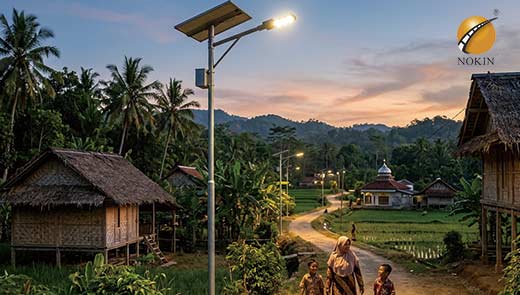
Indonesia has 17,000 islands, and there is a significant gap in grid coverage and infrastructure development in rural and remote areas. Traditional municipal electricity lighting requires large-scale cable laying and power station construction, which has high upfront costs, long construction periods, and high maintenance difficulties, and cannot be adapted to the decentralized rural settlement layout in Indonesia.
Off-grid solar street lights have perfectly solved the pain points of rural lighting. These devices rely on solar power supply and do not need to be connected to the grid. The operating cost is nearly zero, and they have become the core solution for rural road and community lighting in Indonesia.
However, the quality of solar lighting products in Indonesia varies, with a wide range of power configurations and product structures. Many project purchasers lack targeted selection criteria, resulting in unstable lighting effects, short equipment lifespan, and frequent problems such as these. NOKIN, combining the actual environment and project requirements in rural areas of Indonesia, systematically explains the categories of solar street lights, tropical climate adaptation configurations, selection criteria, cost analysis, and supplier selection techniques, providing a one-stop professional reference for rural lighting project procurement.
Why Solar Street Lights Are Ideal for Rural Areas in Indonesia
Challenges of Rural Lighting in Indonesia
Firstly, the scattered terrain of islands limits the layout of the grid. Rural residential areas are scattered on countless small islands, and centralized power supply is extremely difficult to implement.
Secondly, the mountainous and rugged roads in rural areas increase the construction difficulty and engineering cost of traditional grid wiring.
Thirdly, the cost of rural grid construction is high. The unit investment for extending municipal power grids to remote rural areas is extremely high, with low economic benefits and a long investment return period.
Fourthly, frequent power outages affect daily use. The Indonesian rural power grid has poor stability and frequently experiences power outages, which cannot support continuous lighting at night.
Fifthly, the traffic safety in rural areas is prominent. Rural roads, farmland roads, and bridges lack lighting, and night traffic accidents are high, restricting rural travel and economic development.
Benefits of Solar Street Lights for Rural Projects
- No grid connection: Pure off-grid design, suitable for all remote rural, mountainous, and island areas, completely independent of municipal power grids.
- Zero electricity cost: Solar energy is a free renewable energy source, with no subsequent electricity costs, significantly reducing long-term operational expenses for rural projects.
- Simple installation: Compact structure, few components, no complex wiring and power engineering required, suitable for various rural road environments.
- Quick deployment: Short overall construction period, batch installation for immediate use, quickly meeting the emergency lighting needs of rural areas.
- Low maintenance cost: Stable equipment performance, no vulnerable line components, low maintenance frequency and cost, suitable for the weak maintenance conditions in rural areas of Indonesia.
- Green and environmentally friendly: Zero carbon emission operation, in line with the energy transition in Southeast Asia and the green development policies of rural areas in Indonesia.
- Enhance road safety: Stable and continuous nighttime lighting eliminates blind spots on the road, effectively reducing the occurrence rate of night traffic accidents, ensuring travel safety.
Types of Solar Street Lights for Rural Areas
Indonesia's rural areas have diverse scenarios, including narrow village roads, main roads, mountain roads, and coastal roads. Different scenarios are suitable for different categories of rural solar street lights. Currently, mainstream products are divided into three categories.
All in One Solar Street Light
All in One Solar Street Light is a single unit device that integrates solar panels, lithium batteries, LED lights, and intelligent controllers. This product is the most mainstream selection for small and medium-sized rural lighting projects in Indonesia.
Advantages: Simple and elegant appearance, installation without complex assembly required; standard light control + human body sensing intelligent system, low failure rate, convenient later maintenance.
Disadvantages: Overall size is limited, power and battery capacity are low, and the battery's endurance is slightly insufficient in continuous rainy weather in the tropics. Applicable scenarios: Ordinary village roads, internal roads of communities, small rural squares, village committee courtyards and other regular lighting scenarios.
All in Two Solar Street Light
All in Two Solar Street Light separates the solar panel from the light body. The light body integrates the battery, light source, and controller, while the solar panel is installed independently and the wiring is connected. This product takes into account both ease of installation and environmental adaptability.
Key features: The angle of the solar panel can be adjusted independently to match the tropical sunlight angle in Indonesia; the light body is lightweight, easy to replace, and has moderate power and battery life, with extremely high cost-effectiveness.
Applicable scenarios: Main roads in rural areas, rural market roads, roads around schools, and community parking lots.
Split Solar Street Lights
Split solar street lights have a structure where the solar panel, battery, and light body are completely separated. They belong to high-power professional lighting equipment.
Core advantages: Support ultra-high power configuration, equipped with a large-capacity independent battery, and have the strongest rainy-day battery life; each component operates independently, allowing for targeted maintenance and replacement without the need for overall scrapping.
Applicable scenarios: Main roads in rural areas, long-distance roads in mountainous areas, rural roads, main roads on islands, and bridge lighting.
Comparison of Three Solar Street Light Types
|
Product Type |
Installation Difficulty |
Power Range |
Maintenance Difficulty |
Recommended Applications |
|
All-in-One Solar Street Light |
Very easy; integrated one-piece design enables fast and efficient installation |
30W–80W (Low to Medium Power) |
Very low; integrated design requires minimal maintenance with no separate component disassembly |
Small village roads, community streets, residential areas, and small public squares |
|
All-in-Two Solar Street Light |
Easy; solar panel is installed separately, allowing flexible angle adjustment |
50W–120W (Medium Power) |
Low; solar panel and lighting unit can be serviced independently |
Rural main roads, village markets, school surroundings, and community centers |
|
Split Solar Street Light |
Moderate to high; solar panel, battery, and light fixture are installed separately |
100W–150W (High Power) |
Easy; individual components can be replaced or repaired separately |
Mountain roads, major rural roads, bridges, remote islands, and other large-scale outdoor lighting projects |
How to Choose Solar Street Lights for Rural Areas in Indonesia
Choose According to Road Width
Different road widths correspond to different light power and pole heights, directly determining the uniformity of road lighting.
Rural paths (2-3 meters): Only for pedestrians, no vehicle traffic, small power integrated solar street lights can meet the requirements.
Community roads (3-5 meters): Daily pedestrians and small electric vehicles pass through, need to be paired with medium-power lights to ensure full coverage of road lighting.
Main roads in rural areas (5-8 meters): Support for vehicle and agricultural machinery traffic, need to be paired with high-power lights and high poles to enhance the lighting range and brightness.
Select the Right Solar Street Light Wattage
According to industry configuration standards, the power adaptation scheme for Indonesian solar street lights in rural scenarios is as follows:
- 30W: Suitable for narrow rural paths, garden paths, community corners, meeting basic pedestrian lighting needs.
- 50W: Suitable for ordinary village roads, internal community roads, with uniform brightness and high cost-effectiveness.
- 80W: Suitable for main roads in rural areas, rural market roads, can support small vehicle traffic lighting.
- 100W: Suitable for wide rural main roads, school surrounding roads, long-distance parking lots, etc., with long illumination distance and wide coverage.
- 150W: Suitable for rural roads, bridge roads, large parking lots, etc., with high brightness and strong penetration.
Choose the Right Battery Capacity
Indonesia has a tropical monsoon climate, with long rainy seasons and frequent continuous rainy days, and battery capacity directly determines the stability of lighting in adverse weather conditions.
Rainy-day battery life: For rural projects, the battery is recommended to support 3-5 days of rainy battery life to avoid long-term no-light charging leading to lighting interruption.
Prioritize lithium batteries: High-quality off-grid solar street lights all use lithium batteries, which have a longer service life, better heat resistance, and slower degradation rate compared to traditional lead-acid batteries.
Choose High-Efficiency Solar Panels
The power generation efficiency of the solar panel determines the charging speed and power generation capacity in weak light environments in tropical areas.
Monocrystalline panel: High conversion efficiency, stable power generation on cloudy days, suitable for Indonesian tropical environment, and the best cost-effectiveness. Double-sided solar panels: Double-sided power generation, capable of utilizing ground-reflected light to increase power output, suitable for open rural roads and island areas.
Panel size matching: High-power lights must be paired with large-sized panels to ensure sufficient daytime power storage and eliminate the problem of insufficient power supply during rainy seasons.
Choose Smart Lighting Control Features
Smart control can reduce energy consumption and extend equipment lifespan, being the mainstream configuration for modern rural lighting projects.
- Human detection: Automatically brightens when people or vehicles pass by, automatically dims when no one is present to save power and extend battery life.
- Timed control: Customizes lighting duration based on rural schedules, starts and stops at set times without manual operation.
- Remote control: Can remotely adjust parameters, detect faults, and facilitate unified management of rural batch equipment.
- Adaptive dimming: Automatically adjusts brightness based on light intensity and battery power to ensure stable lighting throughout the night.
Key Specifications for Solar Street Lights in Indonesia's Tropical Climate
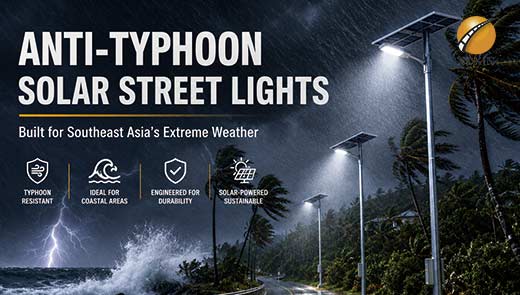
Indonesia's high temperatures, heavy rainfalls, high humidity, and salt fog environment cause significant damage to solar street lights. Targeted tropical adaptation configurations are crucial for the long-term stable operation of solar street lights.
Waterproof Rating (IP66 vs IP67 vs IP68)
Indonesia experiences concentrated rainfall and frequent sudden heavy rainfalls throughout the year. The waterproof level is the core indicator to prevent solar street lights from getting waterlogged and short-circuiting.
IP66: Basic dust and water resistance, suitable for inland rural roads with mild rainfall.
IP67: High-level waterproof, can withstand heavy rain erosion, suitable for most rural areas in Indonesia, with the best cost-performance ratio.
IP68: Fully waterproof and can be immersed, suitable for low-lying waterlogged sections and rainy mountainous roads.
Humidity and Corrosion Resistance
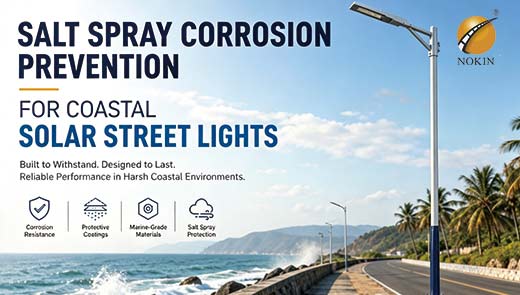
The tropical high humidity environment extremely easily causes equipment wiring corrosion and metal parts rusting. Qualified tropical climate-specific solar street lights adopt an all-sealed integrated process, with the internal cavity filled with moisture-proof insulating gel to isolate humid air. The light body shell uses anti-corrosion materials to avoid rust and damage caused by long-term high humidity environment.
Salt Spray Protection for Coastal Areas
Most rural areas in Indonesia are close to the sea, and sea wind salt fog will severely corrode light poles and equipment shells. Professional coastal-adapted solar street lights use 316 stainless steel components and light poles, with extremely strong salt fog resistance. The equipment surface uses high-standard electrostatic spraying technology to form a protective layer, isolating salt corrosion.
High Temperature Resistance
Indonesia has a perennially hot climate, which accelerates battery aging and LED light source degradation. High-quality solar street lights are equipped with high-temperature-resistant lithium batteries, capable of stable operation at 60°C, eliminating the problem of thermal runaway. The light body design has multiple sets of heat dissipation slots to quickly conduct heat and reduce light attenuation, extending equipment lifespan.
Battery Backup for Long Rainy Seasons
Indonesia's continuous rainy season can last for more than one month, with severely insufficient light. The solar street light system needs to reserve sufficient battery capacity to ensure 3-5 days of autonomous lighting without charging. Combined with efficient low-light charging panels, it can continuously store power during rainy days, ensuring stable nighttime lighting.
Recommended Solar Street Light Configurations for Different Rural Applications
Based on overseas rural project implementation cases, the following targeted configuration table has been compiled to provide direct reference for procurement:
|
Application Scenario |
Recommended Power |
Pole Height |
Recommended Solar Street Light Type |
|
Ordinary Village Roads |
30W–50W |
4–6 m |
All-in-One (Integrated) Solar Street Light |
|
Rural Main Roads |
80W–100W |
6–8 m |
All-in-Two or Split Solar Street Light |
|
Roads Around Schools |
80W–100W |
6–8 m |
Split Solar Street Light |
|
Rural Marketplaces |
100W–120W |
7–8 m |
Split Solar Street Light |
|
Mosques & Community Centers |
50W–80W |
5–7 m |
All-in-One (Integrated) Solar Street Light |
|
Parking Lots |
80W–100W |
6 m |
Split Solar Street Light |
|
Farmland Access Roads |
30W–50W |
4–5 m |
All-in-One (Integrated) Solar Street Light |
|
Bridges & Mountain Roads |
100W–150W |
8–10 m |
Split Solar Street Light |
Common Mistakes When Buying Solar Street Lights
Choosing Only High Wattage
Many purchasers simply believe that the higher the power, the better the lighting effect.
In fact, the actual brightness is determined by the luminous efficiency, the quality of the light bulbs, and the light distribution design. Blindly pursuing high power will only result in budget waste and energy redundancy.
Ignoring Rainy-Day Battery Backup
Most low-priced solar street lights are only suitable for daytime lighting and have not been optimized for battery endurance during rainy seasons. During the long rainy season in Indonesia, these devices have insufficient battery storage, frequently turn off at night, and cannot meet the project operation standards.
Not Checking Actual Battery Capacity
Batteries are the core component of solar street lights, and many merchants in the market have the practice of falsely marking the battery capacity.
If the actual capacity of the battery is insufficient, it will lead to rapid degradation of the device's endurance and a significant decline in lighting effect within one year of use.
Ignoring After-Sales Support
The rural areas in Indonesia are remote and scattered. If there is no local after-sales support after equipment failure, the repair is extremely difficult. Purchasing solar street lights without a complete after-sales service will result in the equipment being left idle for a long time and significantly increasing the later replacement cost.
Ignoring Installation Environment
Environments such as coastal salt fog, mountainous high humidity, and low-lying water accumulation will cause serious damage to solar street lights. Not choosing the appropriate configuration based on the installation scenario will significantly shorten the lifespan of the street lights.
Successful Solar Street Light Projects in Rural Indonesia
Village Roads Lighting Project
In numerous rural areas of Sumatra and Java Islands in Indonesia, the integrated solar street light road renovation project has been implemented on a large scale. This project has completely solved the problem of lack of lighting in rural areas, reduced the incidence of night traffic accidents, and received wide recognition from local villagers and the government.
Community Lighting Project in Rural Areas
In rural communities on Bali and Sulawesi Islands, split-into-one-and-all solar street lights are used to cover community roads and activity squares. The intelligent sensing mode realizes energy-saving lighting, meeting daily lighting needs while reducing community operation costs.
School Lighting Project
In many rural primary and secondary schools in Indonesia, medium-power solar street lights are installed around cightus roads. Stable night lighting ensures the safety of students' travel and after-school activities, improving the infrastructure for rural education.
Remote Island Lighting Project
In rural areas of remote islands without power grids in eastern Indonesia, large-power split-into-one-and-all solar street lights are used. The pure off-grid design completely eliminates reliance on the grid, achieving full coverage of lighting on remote islands and filling the infrastructure gap.
Solar Street Light Cost Analysis and ROI
Most solar street light purchasers only focus on the initial purchase cost, ignoring the total cost of ownership (TCO). The following is a systematic cost comparison and investment return analysis in US dollars.
Initial Investment
Purchase Cost: The unit price of rural solar street lights ranges from 80 to 350 US dollars, depending on power and configuration level.
Installation Cost: The off-grid design eliminates cables and power engineering, and the installation cost per light is only 15 to 30 US dollars, with a short construction period.
Maintenance Cost: The annual maintenance cost of a single light is less than 10 US dollars, and only requires simple cleaning and equipment inspection.
Electricity Cost: Zero electricity expenses, no subsequent energy consumption costs.
5-Year Total Cost Comparison
|
Cost Item |
Solar Street Lights |
Traditional Grid-Powered Street Lights |
|
Initial Purchase & Installation Cost |
US$95–380 |
US$200–450 |
|
5-Year Electricity Cost |
US$0 |
US$180–300 |
|
5-Year Maintenance Cost |
US$40–50 |
US$100–150 |
|
5-Year Total Cost of Ownership (TCO) |
US$135–430 |
US$480–900 |
ROI and Payback Period
Solar street lights can save a significant amount of electricity and maintenance costs annually. The average payback period for rural projects is 1.5 to 2.5 years, and after the return on investment, the equipment can be used stably for more than 5 years, with an extremely high long-term investment return rate.
How to Choose a Reliable Solar Street Light Manufacturer
Complete Qualification Certifications
Prioritize suppliers with CE, RoHS, IP67/IP68 waterproof and tropical climate testing certifications to ensure products meet Indonesian market standards.
High-Quality Core Components
Use well-known lithium batteries and high-efficiency LED light bulbs to ensure equipment stability and lifespan.
Clear Warranty Policies
Regular solar street light manufacturers provide 3-5 years of long-term warranty, covering batteries, light bodies, controllers and all components.
Rich Project Experience
Prioritize manufacturers with rural implementation cases in Indonesia, familiar with local climate and installation environment.
Customized Contract Manufacturing Support
Can adjust configurations according to rural project needs and provide exclusive tropical climate adaptation solutions.
FAQ
Which Solar Street Light Is Best for Rural Indonesia?
Integrated street lights are used on ordinary village roads; split-and-integrated street lights are used on main roads and market roads; large-power split-and-integrated street lights are used on mountainous and bridge roads. The optimal solution needs to be determined based on the actual situation.
What Wattage Is Best for Rural Solar Street Lights?
Narrow rural roads are suitable for 30W-50W, ordinary village roads for 50W-80W, wide main roads for 80W-100W, which can fully meet the daily lighting nee
Can Solar Street Lights Work During Indonesia's Rainy Season?
Professional tropical-adapted solar street lights can support 3-5 days of power supply during rainy days. Combined with an efficient low-light charging panel, they can provide stable lighting during the long rainy season.Which Battery Is Best for Tropical Solar Street Lights?
High-temperature-resistant lithium batteries are the best choice. They have excellent high-temperature resistance and low attenuation characteristics, longer service life, and are perfectly adapted to the tropical climate of Indonesia with its high temperatures and heavy rainfall.
How Long Do Solar Street Lights Last?
High-quality solar street lights have an overall lifespan of 8-10 years, while lithium batteries have a lifespan of 5-7 years. The daily maintenance is simple and they can operate stably for a long time.
Are All-in-One Solar Street Lights Good for Rural Areas?
Definitely. Integrated street lights are easy to install, have low maintenance costs, and have high cost performance. They are the most widely used product in ordinary rural lighting projects in Indonesia.
Do Solar Street Lights Require Regular Maintenance?
The maintenance workload is extremely small. It only requires regular cleaning of the solar panels of dust and checking the fixation status of the light post. The annual maintenance cost of a single light is less than 10 US dollars.
How Do I Choose a Reliable Solar Street Light Supplier?
Pay special attention to verifying the supplier's qualification certification, core component brands, warranty period, local project experience and customization service capabilities, and avoid low-quality small manufacturers with low prices.
Conclusion
Choose the Right Solar Street Light for Your Rural Project
There is no universal solar street light that can be adapted to all rural projects in Indonesia. The procurement process should take into account the road grade, lighting scenario, local climate and project budget, and comprehensively select product types, power configurations and protection levels.
Consider Total Cost Instead of Initial Price
Many purchasers overly pursue low prices, resulting in frequent failures of solar street lights and soaring replacement costs in the later stage. Compared to the initial purchase price, the total life cycle cost, battery lifespan, tropical adaptability and long-term stability of the equipment are more important. Long-term value is far higher than short-term cost savings.
Work with an Experienced Solar Street Light Manufacturer
Solar street lights are not only lighting tools for rural areas in Indonesia, but also an important infrastructure for improving rural traffic safety, improving public facilities, and promoting green energy development.
A scientific and reasonable solar lighting solution can create a safe, bright and sustainable rural living environment, helping Indonesia's rural areas to transform their energy sources and upgrade their infrastructure.
If you need customized project configuration solutions and precise quotations, you can contact the professional team of NOKIN to obtain one-on-one exclusive solutions for rural lighting.