Will Rain Ruin Solar Street Lights?
Jan 12, 2026
When planning outdoor solar lighting systems or using solar street lights in daily life, many people have a core question: Will rain damage solar street lights? This question directly relates to the lifespan, long-term stability of solar street lights, and the overall cost-effectiveness of the initial purchase and later maintenance, especially for users in rainy areas, where it is a key consideration before making a decision.
Will Rain Damage Solar Street Lights?
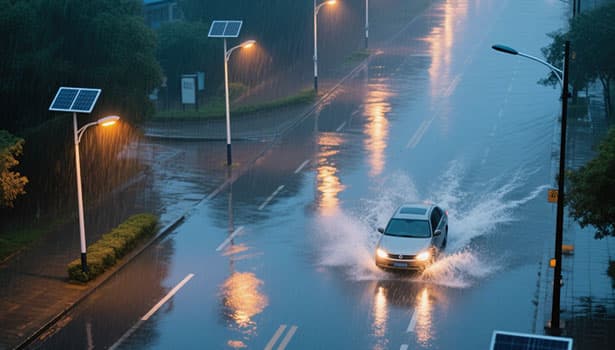
From the perspective of actual outdoor usage scenarios, the impact of rain on solar street lights mainly lies in two core dimensions:
First, in rainy days, the lighting conditions deteriorate, and whether the photovoltaic components can generate electricity normally to meet the lighting needs at night, which directly affects the realization of the basic functions of the street lights;
Second, whether rainwater will penetrate into the interior of the lamps and cause physical damage to the core electrical components such as batteries, main boards, and circuits, thereby leading to equipment failure.
Based on the comprehensive analysis of multiple industry data and actual cases, the core conclusion can be drawn: Rain will not necessarily damage high-quality sealed solar street lights, but long-term continuous rainy days will affect the energy storage efficiency and the lifespan of components.
How Does Rain Affect Solar Street Lights?
How Rainy Weather Reduces Solar Panel Power Generation?
The core energy source of solar street lights is the photovoltaic panel, which converts light energy into electrical energy through the photovoltaic cell's photovoltaic effect. In rainy and cloudy weather, clouds will significantly weaken the solar radiation intensity, and the water film formed by rain on the photovoltaic panel will further refract and scatter light, resulting in a significant decrease in the effective light received by the photovoltaic panel, directly causing a reduction in power generation efficiency.
Why Long-Term Undercharging Shortens Battery Lifespan?
According to industry measured data, in light cloud and rain weather, the photovoltaic panel's power generation efficiency is approximately 20-30% of that on a sunny day, while in heavy rain or thick cloud weather, the efficiency may drop to less than 10%. This efficiency decline may not have a significant impact in short-term single rain events because the battery usually has reserve power, but continuous long-term rainy days will prevent the battery from obtaining sufficient charging, leading to an imbalance in energy storage where the charging is less than the consumption, and ultimately affecting the duration of night lighting.
What needs more attention is that if the battery is in an "undercharged" state for a long time, it will accelerate the deterioration of the internal cells, shorten the battery lifespan, and ultimately affect the overall lifespan of the solar street light.
Can Rainwater Infiltration Cause Physical Damage to Solar Street Lights?
Common Waterproof Failure Points in Solar Street Lights
From a theoretical perspective, the external components of solar street lights such as photovoltaic panels and lamp shells have basic waterproof capabilities, and rainwater itself will not directly damage these components or the core electrical components inside. The real risk lies in the sealing design flaws or aging of the sealing materials - if there are leaks in the seal, rainwater will seep into the interior of the lamps, first contacting the circuit interface, then gradually penetrating to the main board and batteries, thereby causing short circuits, internal metal component corrosion, and other serious problems.
Specifically, poor sealing will cause rainwater to enter key electrical areas such as the main board and battery interfaces, thereby triggering short circuit faults or component corrosion, ultimately leading to the inability of the street light to work properly.
What IP Rating Is Needed for Solar Street Lights in Rainy Areas?
To effectively avoid the risk of rainwater infiltration, choosing solar street lights with an appropriate waterproof grade is crucial. The industry commonly adopts the IP (Ingress Protection) protection grade standard, where the first digit represents the dust protection level, and the second digit represents the waterproof level. The higher the number, the stronger the protection performance. Solar equipment with an IP65 or higher waterproof grade can effectively prevent rainwater from seeping in, among which the IP65 grade can withstand any direction of jet water and is suitable for most ordinary rainy weather environments; the IP66 grade can withstand strong jet water, and the IP68 grade can withstand long-term immersion in water under certain pressure, and the latter two are more suitable for severe environments with frequent heavy rain and flood risks.
Will Rain Ruin Solar Street Lights Over Time?
Does Short-Term Rain Damage Solar Street Lights?
For solar street lights with good waterproofing, intact sealing strips, and proper interface handling, short-term rainy days (typically referring to intermittent rainfall lasting from a few hours to 3 days) will not cause immediate damage. Such equipment with high IP ratings (IP65 and above) and excellent sealing performance have their lamp housing interfaces, line outlet ports, and other key parts treated for waterproofing, effectively preventing rainwater from entering. In occasional rainy weather conditions, they can normally achieve power generation, energy storage, and lighting functions without worrying about the direct hazards brought by rain.
Can Long-Term Rainy Seasons Shorten Solar Street Light Lifespan?
Long-term continuous rainy season environments (typically referring to rainy weather lasting for 7 days or more, such as the plum rain season in southern China, the monsoon season in Southeast Asia, and the rainy season in the Pacific Northwest of North America, etc.) will bring a series of potential impacts to solar street lights, including:
Long-term rainy season will cause the relative humidity of the air to remain above 80%, and the high-humidity environment will damage the surface oxide layer of metal components, accelerate the corrosion of internal circuit connections, battery tabs, etc., with minor cases increasing contact resistance and affecting power supply efficiency, and severe cases leading to component failure.
However, by strictly implementing appropriate design specifications and correct selection, such risks can be significantly reduced. Specific measures that can be taken include: configuring large-capacity batteries (suggested based on the longest rainy season duration in the local area, choosing a battery capacity that can meet normal lighting for 7-10 days without sufficient sunlight), using MPPT (maximum power point tracking) controllers to optimize charging management in weak light environments, improving power generation utilization, and selecting high-level waterproof (IP66 and above) and corrosion-resistant designs (such as using stainless steel for metal components and surface electroplating treatment).
How to Tell If Rain Has Affected Your Solar Street Light?
If your solar street light shows abnormal behavior after rain, you can quickly locate the core part affected by rainwater based on the specific fault manifestations. The following table summarizes common faults and corresponding possible causes, along with additional preliminary troubleshooting directions to provide clear references for subsequent maintenance or repair:
|
Fault Manifestation |
Possible Cause |
Initial Troubleshooting Method |
|
Engineering lights do not light up or show unstable brightness |
Insufficient battery charge; insufficient photovoltaic panel power generation |
Check the controller’s battery level indicator; clean dirt, dust, and water film from the photovoltaic panel surface and observe whether power generation improves |
|
Internal moisture, water stains, or corrosion inside the lamp |
Poor waterproof sealing |
Inspect sealing strips at the lamp housing joints and cable outlet ports for aging, deformation, or cracks; observe the water entry path to identify the leakage point |
|
Controller damage or circuit short circuit |
Water infiltration causing electrical failure |
Disconnect the power supply and open the lamp housing; check the controller for signs of water ingress and inspect circuit connections for oxidation or burn marks |
How to Protect Solar Street Lights in Rainy Weather?
Choose the Right IP Rating for Rainy and Humid Environments
When purchasing solar street lights, it is recommended to prioritize products with IP65 or higher waterproof grades for photovoltaic lamps. Specific selection should be based on local rainfall intensity and usage environment: for ordinary outdoor scenarios, IP65 is sufficient to meet the requirements, while for areas with frequent heavy rain or near water sources (such as lakes, rivers), it is recommended to choose IP66 or higher grades. Additionally, when purchasing, check the product's waterproof testing report to avoid purchasing inferior products with falsely labeled waterproof grades. High waterproof grades can prevent rainwater from infiltrating at the source, ensuring the stable operation of the street light in rainy weather.
Optimize Battery Capacity for Long Rainy Seasons
The performance of the battery directly affects the battery life of solar street lights during the rainy season and is the core component for coping with long-term rainy weather. It is recommended to choose lithium batteries with large capacity and good resistance to moisture and temperature. Compared with traditional lead-acid batteries, lithium batteries have better charging and discharging cycle performance, lower self-discharge rate, and are less likely to leak or corrode in high humidity environments. Avoid using low-quality batteries - low-quality batteries are more prone to internal short circuits and rapid capacity decline in humid environments. The specific capacity selection can be based on the formula: Battery capacity (Ah) = Lamp power (W) × Daily lighting duration (h) × Safety coefficient (1.2 - 1.5) ÷ Battery voltage (V).
Regular Inspection and Maintenance After Rain
Daily and after rain, solar street lights should be inspected and maintained regularly. It is recommended to establish a quarterly maintenance ledger: Conduct a comprehensive inspection of the sealing ring for aging or cracking every 3 months, and check if the sealing tape has fallen off. Replace damaged sealing components in time; within 24 hours after rain, clean water stains, dust, fallen leaves and other impurities on the photovoltaic panels to avoid long-term adhesion of stains affecting light collection efficiency; at the same time, check if there is any loosening or oxidation at the wiring joints, and tighten or apply anti-rust treatment in time.
Best Installation Locations to Prevent Rainwater Damage
When installing solar street lights, strictly select the installation location: Avoid installing them in low-lying water-accumulating areas, flat and prone-to-water-accumulation areas. It is recommended to choose a location with slightly higher terrain and smooth drainage; at the same time, ensure that the bottom of the lamp is no less than 5 meters from the ground to reduce the risk of water splashing onto the lamp body from the ground. In addition, build a simple drainage ditch around the lamp post foundation or lay a gravel layer to enhance drainage capacity to ensure good drainage around the lamp and avoid long-term water retention. A good installation environment can reduce the soaking and erosion of the lamps by rainwater from the spatial perspective.
For areas with frequent rainy seasons, it is recommended to prioritize optimizing component quality and increasing waterproof levels when selecting solar street lights. At the same time, adjust the installation plan according to local climate characteristics (such as increasing the number of lamp body sealing layers in windward areas and using large-capacity lithium batteries in the rainy season), to ensure the stable operation of the lamps. In addition, do a good job in "Rainy Season Maintenance of Solar Street Lights" and "Rainy Season Protection of Solar Street Lights" on a daily basis, understand the "role of IP level in solar lamps" well, which can not only avoid failure risks caused by rainwater, but also extend the service life of solar street lights from the conventional 5-8 years to 8-12 years, further improving the investment cost performance.
.jpg)
FAQ About Solar Street Lights in Rainy Weather
Q1: Can Solar Street Lights Generate Electricity on Rainy Days?
A: Yes, they can, but the efficiency will significantly decrease. The photovoltaic panels generate electricity based on light energy. Even on rainy days, scattered light penetrating through cloud gaps and ground-reflected light can still be absorbed by the photovoltaic panels and converted into electricity, although the energy density is much lower than on sunny days. According to industry data, the power generation efficiency on rainy days is only 10-30% of that on sunny days, and it is even lower during heavy rain. Therefore, for consecutive rainy days, it is necessary to combine the longest duration of rainy periods in the local area and configure large-capacity batteries that can meet the full lighting requirements. Generally, it is recommended to choose a capacity that is 30-50% larger than the conventional configuration to ensure lighting needs.
Q2: What is Solar Street Light IP Rating and Why is it Important?
A: IP rating is an internationally recognized standard for the dust and water resistance performance of equipment, consisting of "IP" + "two-digit numbers". Higher IP ratings prevent rainwater infiltration, reducing the risk of short circuits, corrosion, and performance failure during rainy weather.
|
IP Rating Item |
Level / Recommendation |
Key Explanation |
|
First digit (Dust protection) |
0–6 |
Level 6 means completely dust-proof, preventing dust from entering the lamp housing |
|
Second digit (Water protection) |
0–8 |
Higher numbers indicate stronger resistance to rain, water spray, and immersion |
Q3: What Should I Do If My Solar Street Light Fails After Heavy Rain?
A: First, conduct a preliminary inspection. The steps are as follows:
Check if the sealing components of the lamp housing are intact, with no cracks, rubber strips falling off, etc., for leakage points;
Observe if there is moisture, water stains, or metal corrosion marks inside;
Check the battery status. You can view the battery voltage through the controller display or measure the battery voltage with a multimeter (below the rated voltage by more than 10% is considered under-voltage);
Ensure that the surface of the solar panel is free of debris coverage and clean the surface stains. If the preliminary inspection reveals damaged sealing, abnormal battery voltage, or obvious water infiltration traces, and the problem still cannot be resolved after self-treatment, it is recommended to contact professional maintenance personnel for repair.