7 Ways to Extend Solar Street Light Time on Cloudy Days
Jan 13, 2026
Solar street lights are widely used in urban roads, rural lanes, and other settings due to their zero electricity costs and eco-friendly, pollution-free advantages. However, as their core energy source relies on sunlight, prolonged cloudy or rainy periods with insufficient illumination can lead to issues like shortened lighting duration and unexpected shutdowns, compromising traffic safety and user experience. This article outlines 7 scientifically proven methods to extend lighting duration during overcast conditions from multiple angles, ensuring stable operation of solar street lights.
Enhance Photovoltaic Conversion Efficiency and Optimize Battery Storage Capacity
Boost Solar Panel Conversion Efficiency
Solar panels serve as the core energy-harvesting components, with their conversion efficiency directly determining power generation during overcast conditions. Efficiency can be enhanced through two approaches: First, select high-performance solar panels, prioritizing models with higher conversion rates. Second, reasonably expand panel surface area—within the load-bearing limits of the lamp post—to increase light-capturing surface and harvest more weak light energy. This is crucial for improving the overcast adaptability of solar street lights after installation.
Increasing Battery Energy Storage Capacity
Given the inherent instability of solar supply, the battery's energy storage capability is paramount. Expanding battery capacity allows for the full storage of excess electricity generated during sunny periods. This ensures stable power output during cloudy, rainy, or low-light conditions, preventing lighting interruptions caused by insufficient energy reserves.
Upgrade to Monocrystalline Panels and MPPT Controllers
Monocrystalline Solar Panels' Low-Light Advantage
Monocrystalline solar panels are the optimal choice for low-light environments, serving as the benchmark for “extracting every ounce of sunlight.” Their core advantages—high conversion efficiency and compact size—make them ideal for pole-mounted installations. They reduce load on light poles while ensuring efficient power generation. Under cloudy or low-light conditions, they capture more solar energy than conventional panels, significantly extending the operational duration of solar street lights on rural roads and in community parks during overcast days.
Energy Efficiency Enhancement with MPPT Controllers
Pairing monocrystalline panels with advanced MPPT (Maximum Power Point Tracking) controllers further maximizes power generation. Compared to traditional PWM (Pulse Width Modulation) controllers, MPPT controllers continuously track the solar panel's maximum power point in real time. This maximizes light energy harvesting even during overcast conditions with insufficient sunlight, boosting overall power generation.
Below is a comparison of power generation performance between MPPT and PWM controllers in overcast environments:
|
Application Scenario |
Recommended Brightness (Lumens) |
Core Requirements |
|
Municipal Main Roads |
2,000–4,000 lm |
Stable brightness with long continuous lighting duration (typically 8–12 hours) |
|
Rural Streets & Lanes |
800–1,500 lm |
Cost-effective performance with adaptability to complex weather conditions |
|
Parking Lots / Courtyards |
1,500–2,500 lm |
Uniform illumination with adjustable brightness based on actual demand |
Actual test data shows that under identical overcast conditions, MPPT controllers generate nearly twice the power output of PWM controllers. To achieve efficient operation of solar street lights during cloudy weather, prioritizing the combination of monocrystalline silicon panels with MPPT controllers is the most direct and effective solution for enhancing energy efficiency and ensuring stable performance.
High Luminous Efficacy LED Solutions
The energy efficiency of the light source directly determines the power consumption level of solar street lights. Selecting high luminous efficacy LED chips not only reduces overall energy consumption but also extends illumination duration under identical energy storage conditions, while simultaneously lowering the system's comprehensive cost.
Core Advantages of High Luminous Efficacy LEDs
The core advantage of high luminous efficacy LED chips lies in “achieving higher brightness with lower power consumption.” While delivering equivalent illumination (lumens), high luminous efficacy LED chips require significantly less power than standard LED chips. This characteristic directly reduces the energy consumption requirements of solar street lights, thereby lowering the power matching demands on solar panels and batteries.
Dual Optimization for Cost and Endurance
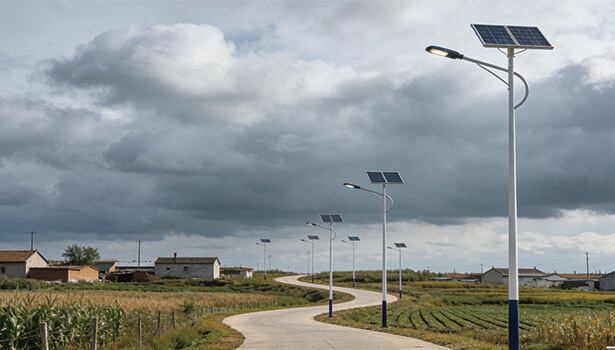
Among the core components of solar street lights, solar panels and batteries account for a much higher proportion of costs than LED light sources. Selecting high-efficiency LED chips enables the use of smaller solar panels and lower-capacity batteries while meeting lighting requirements. This significantly reduces overall project costs for solar street lights while enhancing energy savings.
If solar panel and battery configurations remain unchanged, high-efficiency LED chips achieve the same brightness with lower power consumption. This effectively reduces energy usage and directly extends illumination duration during overcast conditions.
Implement Smart Dimming Controls
Core Logic of Intelligent Dimming
The core principle of smart dimming control systems is “adjusting brightness based on actual usage scenarios” to prevent unnecessary energy consumption. Common dimming modes include three types: motion-sensing dimming, time-segmented dimming, and dawn/dusk sensing dimming, allowing flexible selection according to different application requirements.
Common Dimming Modes and Application Effects
Motion-sensing dimming is the most widely adopted mode: When no pedestrians or vehicles are detected, street lights automatically switch to low-power standby mode. Upon sensing movement, brightness instantly increases to normal illumination levels. This mode maximizes energy savings and extends operational duration while meeting actual traffic demands.
Time-based dimming adjusts brightness according to traffic volume during different periods. For instance, it reduces brightness during low-traffic periods like 1-4 AM while maintaining normal levels during peak times such as evenings and nights. Daylight-sensing dimming automatically adjusts illumination power based on natural light changes, achieving precise lighting supply.
Additionally, premium smart dimming systems support remote adjustment capabilities, allowing flexible parameter tweaks based on seasonal changes. This further enhances energy efficiency while reducing light pollution, extending battery lifespan, lowering solar street light maintenance costs, and adapting to diverse application scenarios.
Adopting Grid-Connected Hybrid Power Supply Mode
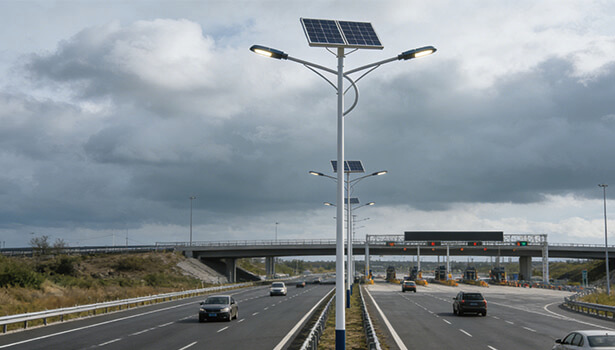
For applications demanding extremely high operational reliability, a grid-connected hybrid power supply mode can be employed. This dual-source approach (“solar + grid”) eliminates lighting interruptions during overcast or rainy conditions.
Working Principle of Grid-Connected Hybrid Power Supply
The operational logic of this system is straightforward: When solar panels generate sufficient power and batteries are fully charged, battery power is prioritized for LED street lights. When consecutive cloudy days deplete the battery, the system automatically switches to grid power mode, supplying electricity from the utility grid to the street lights.
Advantages and Cost Considerations
The core advantage of this mode is its exceptional reliability. Regardless of the number of consecutive cloudy or rainy days, it guarantees 100% normal operation of solar street lights, completely avoiding lighting interruptions caused by insufficient energy.
However, it should be noted that grid-connected hybrid power supply requires laying cables and connecting to the municipal power grid. The initial construction costs and subsequent operational and maintenance costs are significantly higher than those of pure solar power supply. This mode is more suitable for scenarios with extremely high reliability requirements for urban main road lighting (such as city thoroughfares and roads surrounding hospitals).
Selecting the Appropriate Installation Location and Angle
Principles for Choosing Installation Locations
When installing solar panels, prioritize areas with ample sunlight and no obstructions, such as the tops of open lampposts, rooftop platforms, or open spaces. Strictly avoid installing panels in shaded areas beneath trees, buildings, or other obstructions to prevent reduced light absorption and decreased photovoltaic conversion efficiency.
Adjusting Installation Angle
The installation angle must be adjusted reasonably based on local latitude and seasonal changes, with the core objective being to maximize sunlight reception by the solar panels. Generally, the installation angle should be close to the local latitude angle. After entering winter, the installation angle can be appropriately increased to address the issue of reduced solar altitude angle, thereby improving light energy capture efficiency in low-light environments.
Implementing Regular Maintenance and Remote Monitoring
Many operations managers view maintenance as an “extra burden,” yet regular upkeep is crucial for ensuring long-term stable operation of solar street lights and enhancing their endurance during overcast conditions. Integrating a remote monitoring system further boosts operational efficiency, enables proactive fault prevention, and reduces long-term usage costs.
Core Components of Regular Maintenance
Regular maintenance primarily involves three key steps: First, periodically clean solar panels to remove dust, leaves, bird droppings, and other debris that may obstruct light absorption. Second, promptly inspect and repair components like wiring and connectors to prevent energy loss from aging circuits or poor connections. Third, regularly assess battery health and replace aged batteries to maintain reliable energy storage capacity.
Value-Added Benefits of Remote Monitoring
Remote monitoring systems enhance operational efficiency. These systems enable real-time tracking of solar street light performance metrics, including battery charge levels, power generation, and illumination output. Upon detecting anomalies—such as sudden drops in power generation or battery leakage—the system issues immediate alerts. This allows maintenance personnel to intervene proactively, preventing minor issues from escalating into major outages. Consequently, system stability and operational efficiency are significantly improved.
Extending lighting duration during overcast conditions requires a multi-faceted approach encompassing hardware upgrades, intelligent control systems, installation optimization, and robust maintenance support. Businesses and communities can flexibly combine the seven methods outlined above based on their specific scenarios and budgets to effectively address insufficient lighting during cloudy days. Consulting professional service providers for customized solutions enables solar street lights to fully realize their value in energy conservation, emission reduction, and stable lighting, maximizing application benefits.