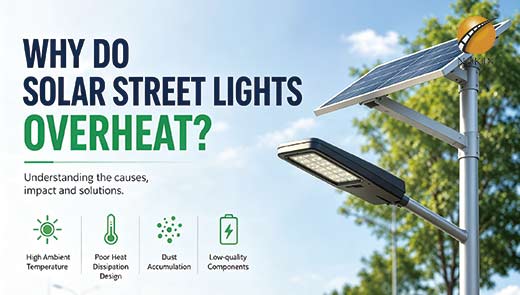
Why Do Solar Street Lights Overheat?
Jul 30, 2026
After entering summer, many outdoor maintenance and purchasing personnel have noticed a contradictory phenomenon: the duration of sunlight for solar street lights has significantly increased, and the charging efficiency has improved, but problems such as light failures, brightness decline, and premature light aging have all erupted simultaneously.
The main cause is not insufficient power supply, but high temperature and poor heat dissipation. The intense sunlight in summer combined with the continuous heat generation inside the lights leads to a double heat load that continuously damages LED chips, lithium batteries, and driving power supplies. Among them, aluminum heat dissipation fins are currently the most cost-effective and stable passive heat dissipation solution. This article will comprehensively analyze the reasons for the overheating of solar street lights, their hazards, as well as the core advantages and selection criteria of aluminum heat dissipation fins.
Why Do Solar Street Lights Overheat?
Most purchasers have a misconception: LED lights are energy-saving and environmentally friendly, with low power consumption, and hardly generate heat. But the actual situation is completely opposite.
Even though the LED light efficiency is excellent, still 20% to 40% of the electrical energy cannot be converted into light energy and is ultimately all converted into heat energy. Solar street lights are integrated outdoor equipment, and the heat sources are not from a single module. The accumulation of heat from multiple parts is very likely to cause heat accumulation.
Heat conduction path of solar street lights:
Solar photovoltaic panel → Energy storage battery → Controller → LED chip → Heat continuously accumulates
How Much Heat Do LED Chips Generate?
The photoelectric conversion of LEDs has inherent losses, and it is impossible to achieve 100% light emission. During operation, most of the lost electrical energy is converted into heat energy, and these three major heat generation areas are formed.
They are the junction temperature of the LED chip, the temperature of the PCB circuit board, and the temperature of the light housing. The continuous accumulation of multiple layers of heat is difficult to be quickly dissipated, which directly leads to a sudden increase in the internal temperature of the light. This heat conduction mechanism has been confirmed by the research on LED thermal management in "Nature" and professional data from Haopai Energy.
Why Does the LED Driver Produce Heat?
The driving power supply for LEDs is the core voltage-stabilizing component of the light and also has energy losses. The industry's mainstream driving power supply has a conversion efficiency of only 90% to 95%.
The remaining 5% to 10% of the electrical energy is all converted into heat. In the three working conditions of high-power street lights, continuous lighting throughout the night, and high-temperature summer environment, the temperature of the driving power supply will continue to rise, becoming a secondary core heat source.
How Summer Temperature Increases Heat Accumulation
Solar street lights in summer face a double heat load impact. The heat dissipation pressure is far greater than in other seasons.
During the day, strong light continuously exposes the light body shell, and the external environmental temperature remains high, continuously heating the light; at night, LED lights operate at full load for a long time, continuously generating heat inside. The combined heat from inside and outside forms a heat accumulation that cannot be quickly dissipated.
This phenomenon is particularly prominent in hot and bright regions such as the Middle East, Africa, and Australia, and is also the core reason for the high failure rate of local solar street lights.
What Happens When Solar Street Lights Overheat?
High temperature is the "number one killer" of solar street lights. Long-term heat accumulation will not immediately cause the light to fail, but it will continuously wear out the core components, significantly shorten the lifespan of the entire light, and increase maintenance costs.
Overheating of solar street lights causes the following processes of heat loss:
Heat accumulation → Increase in junction temperature of the chip → Decrease in photoelectric conversion efficiency → Accelerated LED light decay → Significant reduction in the overall lifespan of the light
Faster LED Light Decay
The junction temperature of the LED chip is positively correlated with the speed of light decay. The higher the junction temperature, the faster the brightness decay of the light, and the worse the light emission stability.
Under long-term high-temperature conditions, the LM80 standard lifespan of LEDs will significantly decrease. lights that were originally expected to last 5-8 years may show obvious brightness loss within 3 years.
Shorter Lithium Battery Lifespan
The lithium iron phosphate batteries and lithium batteries that come with solar street lights are extremely sensitive to working temperatures. The optimal operating temperature for these devices is 20–30℃.
In hot summer conditions, the temperature inside the battery compartment exceeds the standard temperature, which accelerates the aging of the battery's internal chemical materials and significantly reduces the number of times the battery can be charged and discharged. Long-term overheating can lead to a sudden drop in battery storage capacity, bulging, and even premature failure.
LED Driver Failure
The LED driver power supply contains precision electronic components such as capacitors and MOSFETs. These components have extremely low tolerance to high temperatures.
Continuous high temperatures accelerate the aging and performance decline of electronic components, directly causing flickering of the lights, intermittent outages, and ultimately leading to a complete failure of the driver power supply and the inability of the entire light to work.
Reduced Lighting Efficiency
High temperatures directly damage the photoelectric conversion efficiency of LED chips. For solar street lights with the same power, the higher the temperature, the lower the actual luminous efficiency.
For example, a 100W solar street light, in a high-temperature overheating condition, the actual effective brightness will continuously decrease, unable to meet the standards for road lighting, and resulting in "power compliance but insufficient illumination" problems.
How Do Aluminum Heat Sink Cooling Fins Improve Heat Dissipation?
The mainstream heat dissipation methods for outdoor solar street lights are active cooling (fans, liquid cooling) and passive cooling. After long-term industry testing and verification, aluminum cooling fins for passive heat dissipation are the optimal solution for solar street lights, balancing stability, low cost, and zero maintenance advantages.
Aluminum fin heat dissipation conduction path:
LED chip → Aluminum-based MCPCB board → Aluminum alloy base → Cooling fin → Natural air convection heat dissipation
High Thermal Conductivity of Aluminum
Aluminum is the preferred heat dissipation material for outdoor lighting equipment, with prominent core advantages. It has a high thermal conductivity coefficient, which can quickly conduct the heat generated by the chip and power supply.
At the same time, aluminum is lightweight, does not increase the load of the light body, and is corrosion-resistant, anti-aging, suitable for outdoor harsh environments such as rain, snow, and sun exposure. Moreover, the material cost is reasonable, and large-scale production can effectively control the equipment cost, with overall investment costs far lower than other heat dissipation solutions.
Larger Heat Dissipation Surface Area
The heat dissipation area of ordinary flat light shells is limited, and the heat can only be slightly dispersed through the surface of the shell, easily accumulating. While the fin structure through three-dimensional design expands the contact area for heat dissipation by multiple times.
The dense and uniform three-dimensional fins can increase the contact area between the light and the flowing air by 3-5 times, significantly improving the efficiency of natural convection heat dissipation, quickly removing the accumulated heat inside, and fundamentally reducing the junction temperature.
Passive Cooling Through Natural Convection
Solar street lights are outdoor and open-air equipment, unable to rely on active heat dissipation methods such as fans and liquid cooling. Active heat dissipation devices have inherent defects, with mechanical structures prone to damage, a high probability of water and dust intrusion, and the need for regular maintenance, resulting in extremely high long-term operation costs.
Aluminum cooling fins rely on passive natural convection heat dissipation, without mechanical moving parts, no energy consumption, no failure risks, and no need for complex maintenance throughout the year. It is a highly stable heat dissipation solution suitable for long-term outdoor use.
Maintaining IP66/IP67 Protection
The core premise of the heat dissipation design is not to damage the outdoor protection performance of the light. Some heat dissipation solutions require opening holes for ventilation, which will directly destroy the waterproof and dustproof structure.
The aluminum cooling fins are an integrated closed structure, without the need to open holes to achieve efficient heat dissipation, able to completely retain the IP66/IP67 waterproof and dustproof level, perfectly adapting to complex working conditions such as rain, snow, and sun exposure.
How to Choose a Solar Street Light with Excellent Heat Dissipation
A high-quality solar street light heat dissipation system is not simply increasing the number of fins, but a complete scientific engineering design. A qualified heat dissipation structure must meet the following core standards:
✅ ADC12 die-cast aluminum integrated molding housing
✅ Integrated non-segmented heat sink structure
✅ Moderate depth and evenly distributed deep fin design
✅ Massive three-dimensional heat dissipation area
✅ High thermal conductivity aluminum-based MCPCB board
✅ High-quality thermal conductive silicone filling heat transfer gaps
✅ Scientific air convection flow path design to ensure smooth airflow
Why is More Fin Density Not Necessarily Better?
Many purchasers have misunderstandings: The more fins, the better the heat dissipation effect. However, in actual engineering tests, overly dense fins can actually reduce the heat dissipation efficiency.
If the fin spacing is too narrow, it will block the natural air circulation, forming an air stagnation layer, and the heat cannot be diffused outward, resulting in a "seemingly perfect heat dissipation structure, but actually serious heat accumulation" problem.
The core of a high-quality heat dissipation design is to balance the number, height and spacing of fins, ensuring smooth air convection, so as to maximize the heat dissipation performance.
Solar Street Light Heat Dissipation Checklist
To facilitate the rapid screening of high-quality equipment by purchasers, combined with LED thermal management standards and outdoor heat dissipation engineering practices, a solar street light heat dissipation performance purchase checklist has been compiled, which can directly be used as a selection basis:
|
Check Item |
Professional Recommended Standard |
|
Housing Material |
ADC12 die-cast aluminum housing |
|
Heat Dissipation Fins |
Standard three-dimensional cooling fins with no simplification or material reduction |
|
Fin Height & Arrangement |
Sufficient fin depth, evenly distributed layout, and optimized spacing for efficient natural convection |
|
LED Chip Configuration |
Tier-1 high-efficiency LED chips with stable thermal performance and controlled heat generation |
|
PCB Board |
High thermal conductivity aluminum-core MCPCB for rapid heat transfer and efficient heat dissipation |
|
LED Driver |
High-efficiency, low-heat dedicated driver design to minimize thermal losses |
|
Operating Temperature |
Official high-temperature test data available, with compliant LED junction temperature control |
|
Protection Rating |
IP66/IP67 protection, with the heat dissipation structure designed to maintain waterproof and dustproof performance |
FAQs
Is the more energy-efficient the LED, the less heat it will generate?
No. LED's energy saving merely indicates high energy utilization rate, but still there is 20% to 40% energy loss, all of which is converted into heat energy.
Even if high-power LED street lights have controllable power consumption, the heat generated per unit time is still considerable. Energy saving does not mean no heat generation; heat management remains a core necessity.
Can fans be installed to assist in heat dissipation?
The industry does not recommend using fans for heat dissipation in outdoor solar street lights.
Fans are active mechanical components. Long-term outdoor use is prone to water ingress, dust accumulation, malfunctions, and damage, significantly increasing the equipment failure rate. At the same time, the fan holes will damage the IP protection level of the light, and long-term operation will increase maintenance costs and energy consumption. Passive aluminum fin cooling is the optimal solution for outdoor lights.
Do the heat dissipation fins need regular maintenance?
Aluminum heat dissipation fins belong to passive passive structure and almost require no special maintenance.
Only simple cleaning of the accumulated dust and debris on the surface once or twice a year, and maintaining the air circulation in the fin gaps, can maintain stable heat dissipation performance for a long time.
Do solar street lights require a heat dissipation structure?
Solar street lights must be equipped with a professional heat dissipation structure. When LEDs are operating, 20% to 40% of the electrical energy is converted into heat energy. Coupled with intense sunlight exposure and high ambient temperatures, the interior of the lamps is prone to accumulate a large amount of heat. Without aluminum heat dissipation fins and other efficient passive heat dissipation structures, the LEDs, the driving power supply, and the lithium batteries will rapidly age, experience accelerated light attenuation, and have frequent failures, significantly shortening the lifespan of the entire lamp.
What is the maximum temperature limit that LED street lights can withstand?
The optimal operating temperature for LED street lights is 20°C to 30°C. If the internal temperature of the lamps exceeds 85°C continuously, there will be a significant decrease in brightness; working in a high-temperature environment above 100°C for a long time will cause permanent damage to the LED chips, aging of the driving electronic components, and accelerated degradation of the lithium batteries, resulting in frequent flickering and failure of the lamps.
Will high temperatures damage the lithium batteries of solar street lights?
High temperatures will severely damage the lithium batteries and lithium iron phosphate batteries of solar street lights. The battery is extremely sensitive to temperature. If the internal temperature exceeds 85°C continuously, there will be a significant decrease in brightness; working in a high-temperature environment above 100°C for a long time will cause permanent damage to the LED chips, aging of the driving electronic components, and accelerated degradation of the lithium batteries, leading to premature failure of the lamps.
Is the heat dissipation effect of aluminum better than that of steel?
The heat dissipation performance of aluminum is far superior to that of steel. The thermal conductivity of aluminum alloy is about 3 times that of ordinary steel, which can quickly absorb and conduct the heat inside the lamps and achieve efficient air convection heat dissipation through fin structures. Steel has a lower cost, but has poor heat conductivity, is heavy, and is prone to rust, which is completely unsuitable for the heat dissipation conditions of outdoor solar street lamps.
Are the heat dissipation fins maintenance-free?
Aluminum heat dissipation fins basically achieve maintenance-free. They belong to a purely passive heat dissipation structure, without electronic or mechanical moving parts, without failure risks, and no energy consumption. Only simple cleaning of surface dust and debris once or twice a year is required to ensure the air circulation in the gaps of the fins, allowing for long-term stable heat dissipation with almost no operation costs.
Why do LED street lights become noticeably dimmer in summer?
The core reason for the dimming of LED street lights in summer is heat accumulation. Outdoor high temperatures combined with intense sunlight exposure heat the lamp body, and the internal heat generated by the operation of LEDs leads to a rapid increase in the chip's junction temperature. High temperatures will reduce the efficiency of LED photoelectric conversion, decrease the luminous flux, and weaken the battery's discharge performance, resulting in a significant decrease in the actual illumination of the lamps.
Will poor heat dissipation shorten the lifespan of solar street lights?
Poor heat dissipation is the primary core factor that shortens the lifespan of solar street lights. If the heat cannot be dissipated for a long time, it will continuously cause LED light attenuation, aging of the driving components, and degradation of the battery performance. In hot regions, street lamps with insufficient heat dissipation will have a design lifespan reduced by more than 40%, significantly increasing the later replacement and operation costs.
Conclusion
The overheating of solar led street lights in summer is the result of multiple factors working together, not a single equipment failure. The inherent heat generation of LED chips, energy loss of the driving power supply, combined with strong sunlight exposure in summer and high environmental temperatures, form a double heat load, ultimately leading to heat accumulation.
Long-term high temperatures will directly cause accelerated LED light decay, reduction in lighting brightness, significantly shorten the service life of lithium batteries and driving power supplies, increase overall operation and maintenance costs, and reduce the overall stability of the street lights.
Among all the cooling solutions, aluminum heat dissipation fins, with their excellent thermal conductivity, large heat dissipation area, zero-energy passive convection, no damage to the protection level, low maintenance costs and other core advantages, have become the most mature, economical and reliable standardized cooling solution for solar street lights at present.
When purchasing solar street lights, one should not only focus on brightness parameters, battery capacity and photovoltaic panel power. The design of the cooling structure and heat management capability directly determine the long-term service life, lighting stability and overall lifecycle operation and maintenance costs of the street lights, and are core indicators that cannot be ignored in the selection process.