What is the Meaning and Importance of Solar Street Lights?
Jan 19, 2026
As a key application of new energy, solar street lights leverage their unique advantages to become the core solution for replacing traditional grid-powered lighting, injecting new momentum into urban green transformation. Solar street lights represent an advanced standalone lighting system capable of stable operation without reliance on conventional power grids. By harnessing limitless solar energy, they deliver reliable outdoor illumination for roads, walkways, and public spaces, achieving precise alignment between energy utilization and outdoor lighting requirements. This article analyzes the profound significance of solar street lights from both technical essence and practical value perspectives, explores their vital role in urban development, and shares key selection criteria to provide guidance for relevant applications.
What Do You Understand About Solar Street Lights?
Basic Understanding of Solar Street Lights
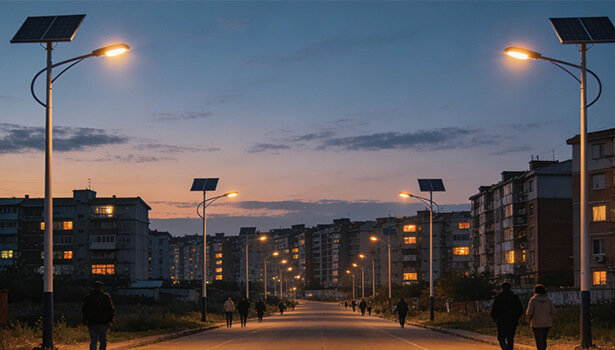
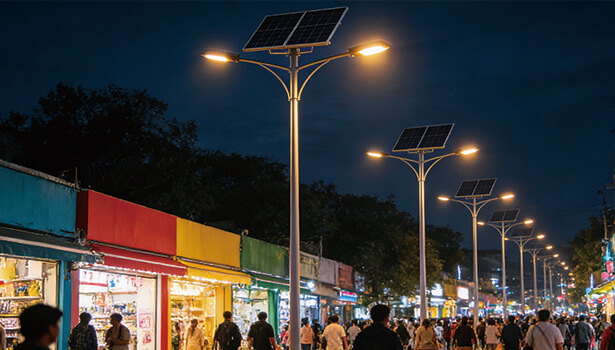
The most distinctive feature of solar street lights is their “standalone operation,” freeing them from dependence on traditional power grids. They can be flexibly deployed across various outdoor settings—whether urban thoroughfares, community walkways, or public spaces in remote areas—delivering consistent illumination.
Their operational logic is simple and efficient: photovoltaic panels capture solar energy during daylight hours, converting it into electricity for storage. At night, they automatically activate lighting mode, forming a closed-loop operation of “daytime energy storage and nighttime illumination.” This enables round-the-clock lighting assurance without manual intervention.
Core Components of Solar Street Lights
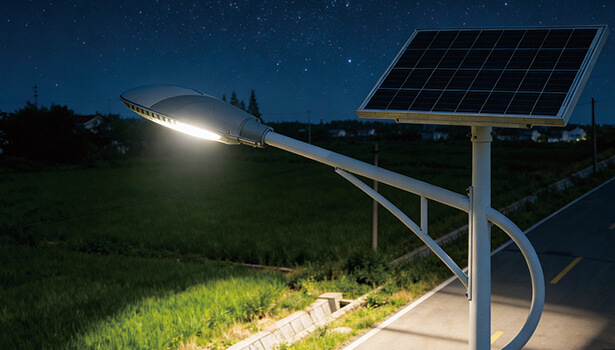
The coordinated operation of four core components is essential for the stable performance of solar street lights, each fulfilling indispensable functions. High-efficiency solar panels serve as the energy collection core, converting sunlight into electricity and acting as the primary power source for the street lights.
Durable LED luminaires serve as the lighting terminals. Leveraging their low-power consumption and high-brightness advantages, they have become the standard lighting source for solar street lights. High-performance rechargeable batteries undertake the energy storage task, retaining the electricity converted during the day to provide power support for nighttime illumination. The smart controller acts as the system's “brain,” regulating electrical energy distribution to ensure stable operation of all components and prevent malfunctions.
The Technical Meaning of Solar Street Lights
Photovoltaic Technology
Photovoltaic technology is the core enabler of energy self-sufficiency in solar street lights. Its central component is the solar panel, typically mounted atop the lamp post to maximize sunlight capture. Composed of silicon-based photovoltaic cells, the panel directly converts sunlight into direct current (DC) via the photovoltaic effect. The properties of silicon determine energy conversion efficiency. Currently, two mainstream panel types each offer distinct advantages, catering to different application scenarios:
|
Solar Panel Type |
Key Advantages |
Suitable Applications |
|
Monocrystalline Silicon |
High conversion efficiency; excellent performance in low-light conditions |
Areas with limited sunlight and applications requiring longer operating time |
|
Polycrystalline Silicon |
Moderate cost with stable performance |
Urban roads and regions with sufficient sunlight |
Energy Storage
Since solar energy is only generated during daylight hours, energy storage systems serve as the critical safeguard for solar streetlights' nighttime operation, functioning as the system's “energy reservoir.” Currently, mainstream energy storage batteries on the market fall into two categories, with their performance differences directly impacting the street lights' lifespan and stability. A high-quality energy storage system ensures streetlights maintain stable illumination throughout the night even under extreme conditions such as consecutive rainy days or insufficient sunlight, preventing lighting interruptions caused by energy depletion.
|
Battery Type |
Energy Density |
Weight |
Service Life |
Key Disadvantages |
|
LiFePO4 Battery (Lithium Iron Phosphate) |
High |
Lightweight |
8–10 years |
Slightly higher initial cost |
|
Traditional Lead-Acid Battery |
Low |
Heavy |
3–5 years |
Short lifespan and frequent maintenance required |
Intelligent Controls
The intelligent controller serves as the core regulatory component of solar street lights, balancing energy collection, storage, and consumption to ensure safe and stable system operation. By precisely regulating voltage and current, it prevents battery overcharging or deep discharge, thereby extending battery lifespan.
Integrated smart features further enhance system efficiency. These include automatic dusk-to-dawn operation—enabling lights to turn on at sunset and off at sunrise without manual intervention, precisely matching natural light cycles—along with motion-sensing dimming. Lights automatically dim when no people or vehicles are detected and return to full brightness upon detecting movement, significantly conserving energy.
LED Technology
The high compatibility between LED fixtures and solar systems is crucial for achieving high efficiency and energy savings in solar streetlights. Compared to traditional lighting sources, LED fixtures offer numerous advantages. In terms of energy consumption, their power usage is only 1/10th that of incandescent bulbs and 1/3rd that of sodium lamps, maximizing reduction in energy consumption for the solar system.
Performance-wise, LED fixtures deliver higher brightness and more uniform illumination. They lack fragile filaments, offering superior impact resistance and aging resistance with a lifespan exceeding 50,000 hours. This significantly reduces replacement and maintenance frequency. Their low power consumption and long lifespan perfectly align with the core requirements of solar street lights—low maintenance and high reliability—making them the optimal choice for solar lighting systems.
The Importance of Solar Street Lights
Cost-Effective and Energy-Efficient Lighting
A core advantage of solar street lights lies in long-term cost savings and high energy efficiency, delivering value throughout their entire lifecycle. Operationally, solar street lights rely entirely on solar power, eliminating grid dependency and substantially reducing municipal lighting electricity expenses. Simultaneously, the extended lifespan of LED fixtures and lithium iron phosphate batteries reduces component replacement and maintenance frequency, further lowering operational expenses. Although initial procurement costs are slightly higher than traditional streetlights, the gap continues to narrow as photovoltaic and LED technologies advance.
Long-term analysis reveals that solar street lights deliver significantly lower total lifecycle costs than conventional alternatives, offering municipalities a more cost-effective solution. Moreover, by eliminating fossil fuel consumption, solar streetlights substantially reduce greenhouse gas emissions like carbon dioxide, providing tangible support for achieving carbon neutrality and peak carbon emission goals.
Enhanced Safety and Security
Reliable nighttime illumination is fundamental to ensuring road safety and elevating security in public areas. Solar streetlights excel in this domain through their autonomous operation capability. Even during power outages caused by grid failures or extreme weather, they maintain illumination, preventing accidents and security risks stemming from lighting disruptions.
Simultaneously, their intelligent sensing capabilities ensure comprehensive coverage without blind spots. Automatic activation at dusk and deactivation at dawn prevent periods of darkness caused by human operational oversights, providing continuous assurance for residents' nighttime travel and public area security.
Embracing Green and Sustainable Solutions
As a tangible embodiment of renewable energy applications, solar street lights represent a crucial manifestation of cities practicing green development principles. Their adoption holds multifaceted significance for advancing sustainable urban construction. Environmentally, they reduce reliance on fossil fuels, alleviate pressure on grid power supply, and assist cities in lowering their carbon footprint—aligning with global climate governance and green urban development trends.
Socially, their widespread adoption promotes eco-consciousness among citizens, fostering sustainable living awareness and strengthening community pride in green development. This cultivates a positive atmosphere for public participation in environmental protection.
Things to Consider When Selecting Outdoor Solar Street Lights
Define Usage Purpose
Before selecting a model, clearly define the usage scenario and core requirements. Different applications necessitate distinct designs and functional configurations. For road security and traffic guidance, prioritize models with high brightness, extended runtime, and human motion detection to ensure adequate illumination in complex road conditions. For community courtyards and landscape lighting, balance aesthetics with appropriate brightness by choosing decorative solar street lights in diverse designs. This approach enhances the ambiance of the setting while ensuring fundamental lighting needs are met.
Focus on Brightness Parameters
Brightness selection should be based on actual scene requirements, with lumens (lm) as the core reference metric rather than traditional power (watts). Lumens directly reflect a luminaire's total light output. Brightness demands vary significantly across different scenarios: main roads and thoroughfares require 2000-5000 lumens to ensure vehicles and pedestrians can clearly identify road conditions.
Community walkways and courtyards require 500-2000 lumens, balancing illumination with comfort. Landscape lighting and auxiliary lighting need only 100-500 lumens to create ambiance. Note that LED fixtures can achieve high lumen output at low power. When selecting fixtures, evaluate both power and lumen specifications comprehensively to avoid energy waste from pursuing high power alone.
Selecting the Appropriate Solar Panel Type
Different solar panel types suit varying scenarios. Selection should balance local sunlight conditions and budget constraints. Amorphous silicon panels are lightweight and flexible, accommodating irregular installations, but offer lower conversion efficiency. They are suitable for well-lit areas with less stringent efficiency requirements.
Monocrystalline silicon panels deliver the highest conversion efficiency and perform exceptionally well in low-light conditions. They are ideal for areas with insufficient sunlight and high endurance demands, though they come at a relatively higher cost. Polycrystalline silicon panels offer high cost-effectiveness and stable performance, with conversion efficiency between monocrystalline and amorphous silicon. They are the mainstream choice for typical urban settings, balancing efficiency, cost, and stability requirements.
Selecting Appropriate Battery Types
Battery type directly impacts the lifespan and endurance of streetlights. Selection should be based on usage scenarios and budget. Lead-acid batteries are low-cost but have short lifespans, are heavy, and require frequent maintenance. They are suitable for scenarios with limited budgets and convenient maintenance access. Nickel-cadmium (NiCd) batteries excel in low-temperature performance and offer extended cycle life, though they exhibit memory effect and faster capacity degradation. They suit cold environments where capacity loss tolerance is high. Nickel-metal hydride (NiMH) batteries provide higher capacity than NiCd with minimal memory effect, though at a slightly higher cost. They are ideal for scenarios demanding capacity and stable performance.
Consider Charge/Discharge Duration
Charge/discharge duration is a key metric for assessing solar street light endurance. It requires comprehensive evaluation based on local sunlight conditions and lighting needs. When selecting models, confirm the time required for the battery to fully charge under standard sunlight conditions and the continuous illumination duration the street light can maintain after a full charge. Opt for solar street lights with short charging times and strong endurance. Avoid deep discharging during use to extend battery lifespan and ensure stable operation under complex lighting conditions.
Solar street lights are not merely a simple combination of “solar energy + street light.” They represent the deep integration of photovoltaic technology, energy storage technology, intelligent control, and LED technology. Their core significance lies in achieving “zero energy consumption, high reliability, and low maintenance” for outdoor lighting. In practical terms, they not only save cities long-term operational costs and enhance public safety but also promote green sustainable development, contributing to the construction of a new smart and eco-friendly urban ecosystem.