What Affects the Brightness of Solar Street Lights?
Jan 15, 2026
The brightness of solar street lights directly impacts the safety and practicality of outdoor lighting. Insufficient brightness poses risks in residential areas and municipal roadways, while also undermining the core energy-saving advantages of these lights. Many users encounter confusion regarding brightness variations among identical models and maintaining consistent illumination during procurement and operation. This article dissects the factors influencing solar street light brightness and provides professional solutions.
Solar Panel Performance
Solar street lights derive their energy from sunlight, with solar panels serving as the core component for energy conversion. Their performance directly determines the initial energy captured by the lights, thereby influencing brightness output.
Panel Power Rating
Panel power rating is the key indicator of energy absorption capacity. Under identical sunlight conditions, higher-rated panels absorb more solar energy per unit time, providing greater electrical energy for subsequent illumination. For example, a 150W panel can convert 30-50Wh more electricity daily than a 100W panel under clear skies. This surplus is sufficient to extend the operating time of a 50W LED light source by 1-2 hours or maintain a higher brightness level.
Conversion Efficiency
Conversion efficiency refers to the proportion of solar energy a panel converts into electricity, directly influenced by materials and manufacturing techniques. Significant differences exist in conversion efficiency between panels made of different materials, as detailed in the table below:
|
Solar Panel Material |
Conversion Efficiency Range |
Impact on Brightness |
|
Monocrystalline Silicon |
18% – 24% |
Sufficient energy supply, stable brightness, and minimal degradation |
|
Polycrystalline Silicon |
15% – 19% |
Brightness may decrease in rainy or cloudy conditions due to insufficient energy |
Battery Quality and Capacity
The electricity generated by solar panels relies on batteries for storage to power nighttime illumination. The quality and capacity of lithium batteries directly determine energy storage capability and discharge stability, making them a core factor affecting solar street light brightness.
Battery Capacity
Battery capacity is measured in ampere-hours (Ah), indicating the amount of electrical energy the battery can store. A larger capacity means more stored energy, enabling the street light to maintain higher brightness for longer periods. If battery capacity is insufficient, even if the panels absorb ample energy during the day, it cannot be fully stored. This leads to energy shortages during nighttime discharge, forcing the street light to reduce brightness to extend illumination time or even shut off prematurely.
Battery Type
Currently, lithium batteries and lead-acid batteries are commonly used in solar street lights. The performance differences between these two types directly impact brightness stability. A detailed comparison is provided in the table below:
|
Battery Type |
Energy Density |
Low-Temperature Performance |
Discharge Stability |
|
Lithium Battery |
High (120–180 Wh/kg) |
Good (can discharge normally at -20°C) |
Stable, with minimal voltage fluctuation |
|
Lead-Acid Battery |
Low (30–50 Wh/kg) |
Poor (capacity drops by over 30% at -10°C) |
Moderate, with increasing fluctuation over long-term use |
Discharge Performance and Aging
The discharge rate of a battery directly impacts the brightness stability of solar street lights. High-quality batteries discharge at a steady current, ensuring uniform brightness. Unstable discharge can cause flickering lights and gradual dimming. Additionally, batteries have a finite lifespan; they gradually degrade over time, leading to reduced capacity and discharge performance. Typically, lithium batteries last 5-8 years, while lead-acid batteries last 2-3 years. Aged batteries must be replaced promptly, otherwise they will severely affect the brightness of the street light.
Light Source Type and Parameters
The light source is the core component that emits light in solar street lights. The type, power, and parameters of the LED light source directly determine the actual brightness performance of the street light, making it the most intuitive factor affecting brightness.
Light Source Types
Current solar street light sources primarily consist of LED lights and traditional sodium lamps, which exhibit significant differences in brightness and energy efficiency. LED lights, with their high luminous efficiency, have become the mainstream choice for solar street lights. Specific comparisons are detailed in the table below:
|
Light Source Type |
Luminous Efficacy (lm/W) |
Energy Consumption |
Brightness at the Same Power |
|
LED Lamp |
100–150 |
Low |
High — a 50W LED is equivalent to a 150W sodium lamp |
|
Sodium Lamp |
40–60 |
High |
Low — high power consumption with insufficient brightness |
Color Temperature and Color Rendering Index
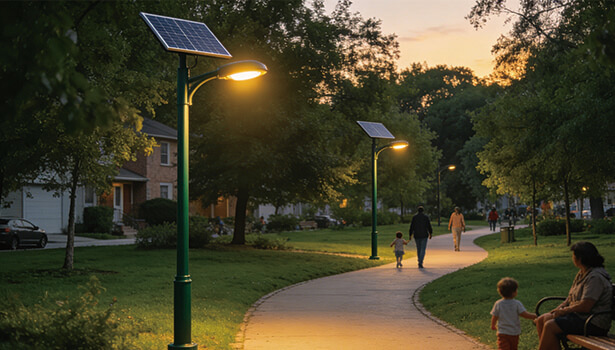
Color temperature affects the human eye's subjective perception of solar street light brightness. Different color temperatures suit varying applications and impact visual brightness differently. 6000K cool white light has a bluish hue and is perceived as brighter by the human eye, making it suitable for high-brightness requirements such as municipal thoroughfares and highways. 3000K warm white light has a yellowish hue and is perceived as less bright visually, but its soft glow makes it ideal for residential areas, parks, scenic spots, and other leisure environments.
The Color Rendering Index (CRI) affects how accurately an object's color is reproduced. Light sources with a high CRI (CRI ≥ 80) enhance environmental clarity, indirectly improving visual comfort, though they have no direct impact on actual luminous brightness.
Controller Performance
Charge and Discharge Regulation
A high-quality controller precisely manages the charging and discharging processes, ensuring efficient charging of the solar panels while preventing overcharging or over-discharging of the battery. Overcharging damages batteries and reduces their capacity; over-discharging causes voltage drops that prevent stable power supply to LED sources, leading to reduced solar street light brightness. Conversely, low-quality controllers lack precision in charge/discharge regulation, often resulting in undercharging or excessive discharge. This not only diminishes brightness but also shortens the lifespan of both batteries and light sources.
Smart Dimming Function
Modern solar street light controllers often feature smart dimming capabilities, adjusting brightness according to usage needs. Common modes include time-based dimming and motion-sensor dimming. By rationally allocating electrical energy, smart dimming enhances energy efficiency without compromising usage requirements, indirectly ensuring stable brightness during peak periods.
Environmental and Installation Factors
Indirect Impacts of Natural Elements
Weather Conditions
Prolonged overcast or rainy periods reduce both the duration and intensity of sunlight reaching the panels, leading to insufficient battery charging. If the battery capacity is small, energy shortages during nighttime discharge can cause a noticeable drop in brightness, potentially failing to meet basic lighting requirements.
Geographic Location
Annual average sunlight duration and intensity are lower in high-latitude regions compared to low-latitude areas. Solar street lights with identical configurations may exhibit slightly reduced brightness in high-latitude zones. Therefore, higher-power solar panels and larger-capacity lithium batteries are recommended for such locations.
Ambient Lighting
Surrounding light levels affect human perception of solar street light brightness. In bustling areas, high brightness from nearby shop lights or other street lights may make these lights appear dimmer. Conversely, in remote locations without light pollution, solar street lights of the same brightness will appear brighter.
Installation Height and Spacing
Installation Height
The installation height of solar street lights must match the power of the LED light source. If installed too high, light will scatter excessively, reducing ground illuminance and making the light appear insufficient. If installed too low, the light coverage area will be small, and glare may occur, affecting the vision of pedestrians and vehicles. Typically, the appropriate installation height for a 50W LED light is 6-8 meters, and for an 80W LED street light, it is 8-10 meters.
Installation Spacing
Excessively wide spacing creates noticeable dark zones between lights, compromising overall illumination. Conversely, overly tight spacing wastes energy. Optimal spacing should be determined based on LED power, installation height, and road width, typically ranging from 3 to 5 times the installation height.
How to Ensure Stable Brightness in Solar Street Lights?
Match Scenario Requirements
Selecting appropriate configurations based on usage scenarios and local light conditions is the first step to enhancing brightness stability. Specifically:
Municipal main roads: Opt for 100-150W solar panels, 80-100W LED light sources, and high-capacity lithium batteries to ensure sufficient brightness and stable runtime.
For rural roads, 50-80W solar panels paired with 30-50W LED light sources and motion-sensor dimming provide a balance of brightness and energy efficiency. In high-latitude or rainy regions, high-efficiency monocrystalline silicon panels and larger batteries are recommended to maintain brightness stability under harsh conditions.
Standard Installation
Installation requires attention to multiple details, serving as a critical maintenance aspect for solar street lights. Key considerations include adjusting the solar panel angle according to local latitude and avoiding obstructions, strictly matching LED light source power with installation height and spacing, ensuring secure wiring connections, and applying waterproofing to interfaces to prevent brightness issues caused by poor contact.
Regular Maintenance
Daily maintenance requires attention to key points and is the core measure for ensuring stable brightness of solar street lights. It is recommended to clean dust and debris from the solar panel surface every 1-3 months and inspect lithium battery performance annually. If capacity drops by more than 30%, replace the battery promptly. Additionally, regularly inspect the LED light source and controller. Address issues such as flickering or abnormal brightness immediately to maintain consistent illumination.
The brightness of solar street lights is determined by the coordinated performance of core components such as solar panels, lithium batteries, LED light sources, and controllers. It is also influenced by environmental factors, installation height, maintenance practices, and product quality—all critical elements affecting brightness. To maintain stable operation of high-brightness solar street lights, focus on three key areas: scientifically informed procurement, standardized installation, and regular maintenance. Select high-quality products suited to the specific application scenario. By implementing these measures, solar street lights can effectively balance energy efficiency with lighting requirements, delivering a safe and comfortable illumination environment for outdoor settings.