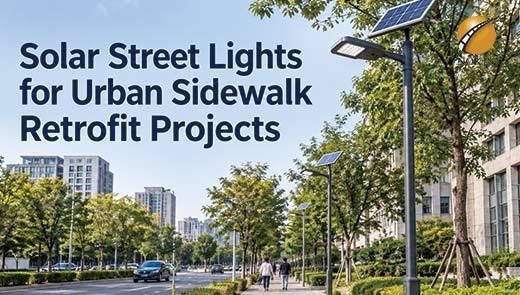
Solar Street Lights for Urban Sidewalk Retrofit Projects
Nov 23, 2026
Solar street lights provide a non-digging wiring and zero operating electricity cost lighting solution for sidewalk retrofit. However, the success of the project depends on three preconditions: shading assessment, energy storage configuration, and reuse of old poles.
This article, from an engineering project initiation perspective, outlines scenario constraints, solution comparisons, system selection, cost models, and acceptance criteria, providing municipal and engineering teams with a practical decision-making basis. For specific road section configuration suggestions, please contact the engineering team at the end of the article to obtain lighting simulations and quotations.
Why Sidewalk Lighting Requires a Different Approach from Road Lighting
Sidewalk retrofit does not involve reducing road lighting fixtures by one level. The service targets, evaluation indicators, and available space of solar street lights have changed. Directly applying road lighting experience will result in over-brightness, glare, or occupation of the clear width of the path.
Lighting Requirements for Pedestrian Safety and Visibility
Road lighting and pedestrian lighting have different design priorities. While road lighting primarily considers the visual needs of drivers and roadway conditions, sidewalk lighting places greater emphasis on pedestrian visibility, horizontal illuminance, uniformity, and vertical illuminance in areas where facial recognition and pedestrian interaction are important.
Facial recognition relies on vertical illuminance. In conflict areas such as pedestrian crossings, intersections, and school entrances, ANSI/IES RP-8 proposes higher vertical illuminance requirements based on conflict levels. The selection of solar street lights must obtain IES/LM-63 luminance files and simulate the vertical illuminance at a height of 1.5 meters using DIALux, rather than only referring to the nominal lumens.
Common configurations for pedestrian areas include 3000–4000K and CRI 70+ lighting. At areas requiring line-of-sight guidance such as pedestrian crossings and curb edges, solar sidewalk road studs can be used in combination with solar street lights to complement rather than replace each other.
Space and Accessibility Constraints on Urban Sidewalks
Sidewalk widths vary depending on the urban layout and local accessibility requirements. In retrofit projects, solar street light poles, foundations, and maintenance access must be positioned without obstructing the required accessible clear width. The minimum clearance should follow applicable local regulations.
The underground pipelines in old urban areas are complex, and excavation involves road approval. This is precisely where solar street lights' no-wiring advantage lies: no need for trenches and manhole wells, and poles can be erected after pre-burial of the foundation.
Why Shading Limits Solar Street Light Performance
Photovoltaic panels in urban environments are shaded by street trees and buildings along the street. The municipal housing department of a certain city publicly replied that the pilot solar street lights in the urban area were affected by tall buildings and tree branches, resulting in insufficient daily lighting and problems such as low illuminance and short lighting time. Eventually, they reverted to using grid power supply.
This case reveals the boundary conditions of the sidewalk scenario: photovoltaic power generation depends on sunlight, and sidewalks are precisely the most shaded locations. Solar street light projects must include shading assessment as the first step, rather than addressing it after installation.
On-Site Assessment Before Selecting Solar Street Lights
Three evaluations determine the feasibility of solar street light projects: solar accessibility, condition of existing poles, and cost of grid connection. The order cannot be reversed - first confirm sunlight, then discuss equipment.
Solar Access and Shading Assessment
The goal of the survey is to determine the annual solar distribution at the installation site and the peak solar hours in the worst month. The engineering criterion is that the daily peak solar radiation should be no less than 4 hours. When this value is lower, the capacity of photovoltaic and energy storage should be increased, or alternative grid power supply should be used.
The shading assessment should be conducted around the winter solstice, when the solar altitude angle is the lowest and the shadow is the longest. Record the ratio of building height to pole position, seasonal changes in tree canopy, and mark the periods when the photovoltaic panel is shaded. The difference in shading between the leafing and non-leafing periods of street trees and building shading is more easily overlooked.
The inclination angle of the photovoltaic panel is set according to the local latitude, facing south (in the Northern Hemisphere). In high-latitude regions, the inclination angle can be increased to improve weak light collection in winter.
Assessing Existing Poles and Foundations
The cost advantage of reusing old poles is obvious, but before installing solar street lights, a structural safety assessment must be conducted: checking the wall thickness of the pole body and rust, the condition of the flange and the anchor bolt, the verticality deviation, and whether the original design leaves a reserve for wind load.
The reusability of common pole types varies greatly. If split-type solar street lights are used for double-arm and bullleg poles, the solar panel support needs to be welded and a crane is required; for integrated solar street lights, the old light head can be removed and inserted into the bracket end for fixation. The diameter of the cement pole is usually no less than 160 millimeters and needs to be fixed with a clight or adapter.
The grounding resistance is generally no more than 10Ω. The grounding body of an old foundation may have corroded and failed, and it should be measured on-site instead of relying on the completion data.
Evaluating Grid Connection Costs
Whether to use pure off-grid solar street lights depends on the marginal cost of connecting to the power grid. If there are available cables and distribution boxes on the road section, replacing the light head only results in a lower initial investment for the power grid scheme; if new cables need to be laid, trenches need to be excavated or transformers need to be expanded, the overall cost of the cables will significantly increase the cost of the power grid.
The industry experience range is: the payback period for solar street lights in newly built sections without a power grid is approximately 3–4.5 years, and for sections with an existing power grid that can be reused, it is approximately 5–7 years. These are example data and should be replaced with actual project measurements before release.
Three Solar Street Light Retrofit Options for Urban Sidewalks
After a clear assessment conclusion is reached, the retrofit plan for solar street lights converges into three paths. These are not mutually exclusive, and different sections of the same project can be adopted separately.
Retrofitting Existing Poles with Integrated Solar Light Heads
This path is applicable to double-arm poles and large-bend arm poles with intact structures and matching diameters. The construction only requires removing the old light head, inserting the integrated solar street light into the original bracket end for fixation, without welding or using a crane, and without changing the original shape.
The advantage is that the workload is small, the construction period is short, and the impact on traffic is low, suitable for retrofit with limited funds or the need to retain the street style. The limitation is that the area of the solar panel is constrained by the size of the light head, and in areas with frequent rainy weather, it is necessary to check if the energy storage is sufficient.
Installing New Integrated Solar Street Light Poles
This method is used in sections without available old poles or where new lighting needs to be installed. The pouring depth of the foundation is generally one-eighth of the pole height plus 0.2 meters, with a concrete grade of no less than C25, and the verticality deviation of the pole is controlled within 3 millimeters per meter.
The advantage of installing new poles is that the area of the solar panel and the battery compartment are not limited by the original pole, and the solar street light can be fully configured based on the worst month's sunlight. The cost is the construction period, maintenance, and hoisting of the new pole, as well as the cross-operation with pavement restoration.
Combining Solar Power with Grid Backup
For sections with high continuity requirements - around hospitals and schools, at intersections of main roads - a solar street light scheme with priority to solar power and backup by power grid can be adopted. The system charges with solar power during the day and prioritizes power from the energy storage at night, automatically switching to power grid when the energy level drops below the threshold.
This path retains the off-grid energy-saving attribute and eliminates the risk of power failure due to continuous rainy weather. The cost is the need to retain the power grid line. Whether to add an intelligent platform should be determined based on the operation and maintenance scale: remote control of individual lights, fault alarm, and remote dimming can only be achieved in projects with hundreds of lights or more.
How to Size a Solar Street Light System for Sidewalk Projects
The core of selection is to translate the luminous target into solar power, battery capacity, and control strategy, ensuring that the solar street light still meets the illumination requirements in the worst conditions.
Calculating Solar Panel Capacity Based on Worst-Month Sunlight
The solar power capacity should be based on the peak sunlight hours of the worst month of the year, rather than the annual average. The simplified estimation formula is: solar power (W) ≈ light power × nightly lighting hours × redundancy coefficient ÷ (peak sunlight hours × system efficiency), with the redundancy coefficient set at 1.2–1.3 and the system efficiency at 0.7–0.8.
Taking a 40W light, 8 hours per night, peak sunlight duration of 4 hours, and efficiency of 0.75 as an example, the photovoltaic power is approximately 137W. In engineering, a margin of 150W or more is taken to account for potential variations; if the peak sunlight duration in winter is only 3 hours, with the same configuration, it is necessary to increase it to 180W or more. The above is an example calculation. The actual values should be based on on-site measurements and manufacturer's luminous data.
The efficiency of single-crystal silicon modules is commonly 19%–23%, while that of polycrystalline silicon is approximately 15%–17%. In the space of pedestrian street light heads with limited area, high-efficiency modules are more valuable for solar street lights.
Selecting Battery Capacity and Backup Days
Lithium iron phosphate batteries are more suitable for municipal solar street light projects in terms of cycle life and safety, with a typical cycle number of more than 2000 times. The discharge depth (DOD) is recommended to be designed at 80%, and the available energy is the product of the rated capacity and DOD multiplied by the system efficiency.
Continuous operation time is determined based on local continuous rainy records. The conventional configuration is 3–5 days. Taking 40W lights, 8 hours per night, a 3-day battery life, and DOD of 80% as an example, the required rated energy is approximately 1200Wh, which is equivalent to 94Ah for a 12.8V system. If the battery compartment is placed inside the light pole, the accelerated degradation of lifespan due to summer sealed high temperature must be considered.
Avoid using batteries of unknown origin that have been used in a series. Battery quality directly determines the replacement cost and is the largest single variable in the payback period of solar street lights.
Using MPPT Controllers and Time-Based Dimming
The charging efficiency of MPPT controllers in low light conditions is better than PWM. Pedestrian streets with many obstructions and uneven lighting conditions usually benefit more from MPPT for solar street lights.
Time-based dimming reduces output in the late night, compressing the capacity of battery and photovoltaic configurations. A typical strategy is 100% brightness for the first 4 hours, 70% at midnight, and 50% until dawn. When setting the power reduction nodes, it is necessary to verify that the illumination still meets the minimum standard after the reduction.
Using MPPT Controllers and Time-Based Dimming
Solar street lights in pedestrian areas are recommended to use cut-off type light distribution to control upward light and background spillage. The IES' BUG rating describes back light, upward light, and glare, and in dark sky sensitive areas, lights with an upward light rating of U0 should be preferred.
Solar Street Light Retrofit Costs and Payback Period
Comparing only the unit price of lights will lead to incorrect conclusions. The cost comparison of solar street light retrofit should cover equipment, construction, electricity charges, maintenance, and replacement, and be calculated within the same time span.
Comparing Initial Installation Costs
The initial investment in solar street lights is concentrated on lights, photovoltaic panels, batteries, controllers, and basic construction; the power supply scheme includes lights, cable laying, trench excavation, distribution boxes, and grid connection. In hardened pavement pedestrian streets, the unit cost of trench excavation and pavement restoration is often higher than the lights themselves.
Accounting for Long-Term Operating and Maintenance Costs
Solar street lights do not generate operating electricity charges and eliminate the inspection expenses caused by aging underground cables, short circuits, and theft. Maintenance focuses on cleaning the photovoltaic panels and testing the batteries: cleaning the panel surface quarterly, conducting capacity tests every two years, and replacing when the attenuation reaches 70%.
Example Cost Calculation and Assumptions
The illustrative calculation only explains the calculation method: a project with 100 6-meter poles, 40W lights, 8 hours per night, a power supply scheme requires new cable laying. The initial investment of the solar street light scheme is approximately 25% higher, but it saves electricity charges and line maintenance costs annually, and recovers the incremental investment in normal lighting areas in about 4 years.
This calculation does not include mid-term battery replacement, capital costs, and changes in electricity prices. When preparing the budget, the battery replacement costs within 8–10 years should be included on the solar street light side, otherwise, its economic advantage will be overestimated.
How Key Project Variables Affect Payback
The payback period is most sensitive to peak sunshine duration, electricity price, and battery replacement cycle. For every 0.5-hour decrease in sunshine, the required photovoltaic and battery capacity increases; the higher the electricity price, the greater the cost advantage of solar street lights over the grid power; and earlier battery replacement extends the payback period.
It is recommended to provide three scenarios of calculation in the project proposal document, namely optimistic, benchmark, and conservative, to facilitate explanation of the sources of uncertainty during the review stage. Calculation tables should be prepared based on the local electricity price and sunshine data, and the calculation templates can be obtained by contacting the engineering team.
Installation, Commissioning, and Acceptance of Solar Street Lights
Pedestrian path retrofit is sensitive to the impact on traffic. The construction organization and acceptance standards of solar street lights need to be pre-agreed in the contract.
Testing a Pilot Section Before Full Installation
Before large-scale construction, 3-5 sample sections should be made, covering shaded areas, building shadow areas, and open areas. The observation period should span 15 consecutive sunny and rainy days, and record the lighting duration, battery endurance in rainy conditions, and measured illuminance values.
The sample section is used to verify the configuration assumptions. If the shaded area turns off the lights earlier, the photovoltaic and battery capacity should be adjusted before large-scale installation, rather than being rectified during the acceptance stage.
Solar Street Light Installation on Paved Sidewalks
The process is as follows: underground pipeline detection, foundation excavation and pouring, maintenance, pole grounding, light assembly, electrical connection, parameter debugging. Before excavation, obtain the underground pipeline map and mark it on-site to avoid cutting existing pipelines.
The construction period should avoid traffic peaks and residents' rest periods. The maintenance door should face the pedestrian path side for easier maintenance, but it should not occupy the clear width of the passage; when the wind speed exceeds the threshold, the hoisting should be stopped, and the limit value should follow the local safety regulations.
Lighting Performance and Project Acceptance Criteria
Illuminance and uniformity are measured on-site according to EN 13201-4 or applicable standards, and vertical illuminance is measured at separate points in conflict areas. The verticality deviation of the light pole, grounding resistance, and simulation of continuous rainy endurance are all listed as acceptance items.
The contract should clearly define the warranty scope and response time: the main component warranty period, battery degradation replacement threshold, and fault response time should all be written into the clauses. The acceptance form should include measured data and light luminosity files as the baseline for subsequent operation and maintenance.
Frequently Asked Questions About Solar Street Lights for Sidewalks
Can Solar Street Lights Meet Pedestrian Lighting Standards?
Yes, provided that the luminance design is constrained by the target level. The IES/LM-63 luminance file needs to be obtained, and the horizontal illuminance, vertical illuminance and uniformity should be simulated using DIALux, and it should be confirmed that the minimum illuminance during the power reduction period still meets the standards. The nominal power alone cannot determine compliance.
How Many Rainy Days Can Solar Street Lights Support Without Sunlight?
It depends on the battery capacity and discharge depth. The conventional configuration is 3–5 days. In rainy areas, the duration of continuous operation should be increased or a complementary power supply from the mains should be adopted, and the configuration should be based on the local historical rainfall records. The battery life should be verified in a sample section.
Can Solar Street Lights Work on Shaded Pedestrian Paths?
Yes, but the obstruction survey must be conducted first and the configuration adjusted accordingly. If the trees on the pedestrian path are severely obstructive and cannot be pruned, the photovoltaic panels can be moved to the building roof, installed in a split-type, or replaced with solar street lights with complementary mains power supply. Ignoring the assessment of obstructions is the main reason for the failure of urban solar photovoltaic projects.
What Determines the Payback Period and Maintenance Costs?
The industry experience range for payback is approximately 3–7 years. The differences come from whether new cables need to be laid, electricity prices and sunlight conditions. The specific values should be calculated based on the project's actual measurement. Maintenance mainly focuses on cleaning the panel surface, battery testing and inspection of fasteners, but the replacement of the battery must be included in the expenditure.
Plan Your Urban Sidewalk Solar Lighting Project
If you are planning to carry out the sidewalk lighting retrofit project, you can contact the NOKIN solar street light engineering team to obtain on-site survey, DIALux lighting simulation and configuration quotations; you can also refer to the completed municipal lighting project cases to understand the layout and acceptance practices of solar street lights on similar road sections.