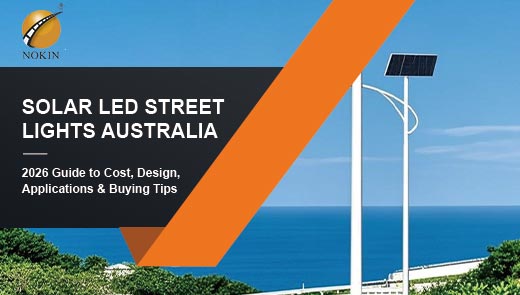
Solar LED Street Lights Australia | 2026 Ultimate Guide
Apr 09, 2026
Australia, with its abundant solar resources, rising energy costs and strict environmental policies, has made solar LED street lights the mainstream choice for municipal, commercial and remote area lighting. As an authoritative guide for 2026, this article deeply analyzes the Australian solar street light market, technology, applications, advantages and procurement points, providing professional references for various projects.
Why Solar LED Street Lights Are Growing Rapidly in Australia
Rising Energy Costs in Australia
In recent years, electricity prices in Australia have continued to increase significantly, and municipal and commercial lighting expenses have become a heavy burden. At the same time, federal and local governments have introduced strict carbon reduction policies, pushing public facilities to accelerate the transition to renewable energy.
Solar LED street lights can completely eliminate lighting electricity costs, controlling long-term operating costs at the root. Each system can reduce hundreds of kilograms of carbon emissions annually, helping governments and enterprises achieve carbon neutrality goals. This economically and environmentally friendly solution is rapidly replacing traditional grid street lights.
Australia’s High Solar Resource Advantage
Australia is one of the regions with the most abundant solar energy resources in the world. The average annual sunshine duration exceeds 220 days, and the annual irradiation in most areas is 4-6 kWh/m².
Compared to other countries, Australian solar street lights have more stable power generation efficiency in winter. Even in the southern temperate regions with short winter sunlight, they can ensure basic lighting. The northern tropical regions have a strong light environment throughout the year, making solar street lights achieve ultra-efficient power generation and ultra-long battery life.
How Solar LED Street Lights Work (System Design Explained)
The Core Three Components of Solar Street Lights
|
Component Type |
Functional Description |
Technical Characteristics |
|
Solar Panel (Power Generation) |
Absorbs solar energy and converts it into direct current, providing continuous energy for the entire system |
Mainly uses monocrystalline silicon photovoltaic panels, with a conversion efficiency of 19%–24%, suitable for Australia’s high solar irradiance conditions |
|
Battery (Energy Storage) |
Stores electricity generated during the day for use at night |
Primarily uses LiFePO4 (lithium iron phosphate) batteries, offering high safety, stability, and long cycle life |
|
LED Lighting (Lighting) |
Provides nighttime illumination as the terminal output of the system |
Utilizes high-efficiency LED modules with a luminous efficacy of 160–180 lumens per watt, ensuring energy savings and stable brightness |
Intelligent Control System
• Light Control Automatic Switch (Dusk-to-Dawn)
Built-in light sensor, automatically turns on at dusk and turns off at dawn, no need for manual operation.
• Multi-day Battery Life
Standard configuration supports 2–3 days of normal lighting in rainy days, high-end customized models can reach 5–7 days, suitable for local rainy areas in Australia.
• Intelligent Dimming
Can be combined with human body sensing, reduces power at night when no one is present, fully lights up when someone is present, further improving battery life.
Applications of Solar Street Lights in Australia
Municipal Road Lighting in Australia
Covering main and secondary roads in cities, suburban roads, highway service areas, traffic roundabouts, etc.
State governments in Queensland and other areas have already introduced certification standards to promote the large-scale use of solar street lights for municipal roads, replacing traditional grid-based lighting. Government projects in New South Wales, Western Australia, and other places widely adopt solar street lights to solve lighting problems in remote sections.
Commercial and Public Area Lighting
- Commercial: parking lots, industrial parks, logistics centers, peripheries of commercial complexes
- Public: schools, parks, community walkways, hospitals, docks, bus stops
- Sports: sports fields, golf courses, outdoor fitness areas
These scenarios do not require grid renovations. They can be quickly deployed and put into use immediately, significantly reducing upfront investment.
Remote and Off-Grid Areas in Australia
Farms, ranches, mining areas, campsites, remote villages, border checkpoints, etc.
In large areas of the Australian inland and islands, there is no grid coverage. The cost of traditional wiring is extremely high. Solar street lights are completely independent of the grid and operate on their own power supply, making them the only economically feasible lighting solution for these areas.
Key Benefits of Solar LED Street Lights Australia
Zero Electricity Cost + No Wiring Required
- Zero electricity cost: Lifetime free lighting cost, the initial investment can be recovered within 5-8 years, and the subsequent pure income
- No wiring required: Eliminates the costs of cables, transformers, excavation construction, etc. Each kilometer saves infrastructure costs of over $10,000
- No construction damage: Avoids road excavation, greenery damage and underground pipeline disruption, reducing environmental impact
Fast Installation and Deployment
Using Plug & Play modular design, installation is simple.
- The foundation only requires a concrete base, and 2-3 people can complete one installation in half a day
- No need for professional electricians with licenses to operate, ordinary construction teams can complete it
- Large projects (such as 10-kilometer walking paths) can be completed throughout the line within 1-3 months
Long Lifespan and Low Maintenance
- LED light source: Lifespan of 50,000-100,000 hours, approximately 10-15 years without replacement
- Lithium iron phosphate battery: Cycle life exceeds 6,000 times, service life up to 15-20 years
- Solar panels: Lifespan of over 25 years, with low attenuation rate
- Minimal maintenance: Cleaning of the solar panels once or twice a year is sufficient, annual maintenance cost is less than $50 per unit
Adaptability to Extreme Environments
Designed specifically for the Australian climate, with **IP66/IP67 waterproof and dustproof, IK10 impact resistance, UV resistance, strong wind resistance (above level 12)** capabilities.
- Northern region: Tolerant to temperatures above 45°C, strong ultraviolet rays, tropical rainstorms
- Southern region: Adapted to temperatures below 0°C, frost, short-term hail
- Coastal area: Resistant to salt corrosion, suitable for docks, seaside roads, etc.
Why Customized Solar Street Lights Are Essential in Australia
Climate Differences Across Australia
Australia has a vast territory with significant climate variations. A "one-size-fits-all" product cannot be adapted to the entire country:
- Northern tropics (Queensland, Northern Territory): high temperatures, heavy rain, high humidity, requiring enhanced heat dissipation, waterproofing, and moisture resistance
- Southern temperate zone (Victoria, Tasmania): short winter days, low temperatures, frost, requiring enhanced energy storage and low-light power generation capabilities
- Arid inland areas: high dust, requiring self-cleaning coatings and dust-proof designs
- Coastal areas: strong salt fog corrosion, requiring anti-corrosion materials and processes
Custom Design Elements
|
Design Element |
Customization Points |
Adaptation Scenarios |
|
Solar Panel Angle |
10°–15° in northern regions, 25°–35° in southern regions, precisely matched to local latitude |
All regions across Australia |
|
Photovoltaic Panel Capacity |
Increase power by 20%–40% in areas with frequent rainfall |
Tasmania, southwestern regions |
|
Battery Storage |
Standard 2-day autonomy; extended to 3–5 days in rainy areas |
Eastern coast, southern regions |
|
Lighting Duration |
8–12 hours for municipal applications; 10–14 hours for remote areas |
Project-specific requirements |
|
Protection Level |
IP66 for inland areas; IP67 for coastal and tropical areas to enhance waterproofing |
Different climate zones |
Solar Street Light Technology Trends in Australia (2026)
LiFePO4 Battery Dominance
Lithium iron phosphate batteries completely replace traditional lead-acid batteries and become the standard in the Australian market:
- Longer lifespan: 6,000+ cycles, 3–4 times longer than lead-acid batteries
- Higher safety: Resistant to high temperatures, non-flammable and non-explosive, suitable for the Australian high-temperature environment
- Environmentally friendly and non-toxic: No heavy metal pollution, in line with Australian environmental standards
- More stable performance: Stable operation within a wide temperature range of -20°C to 60°C
Smart Solar Street Lighting (IoT & Remote Monitoring)
In 2026, Australian solar street lights will accelerate their intelligence and IoT integration:
- Integrated 4G/NB-IoT modules to achieve remote monitoring, fault warning, and energy consumption analysis
- Support mobile/PC background management, real-time viewing of each lamp status, and maintenance efficiency increased by 40%
- Some high-end models integrate cameras, environmental monitoring, and Wi-Fi hotspots, becoming nodes of smart cities
Market Growth and Government Policies
The Australian solar street light market is growing rapidly:
- Compound growth rate of 15.70% from 2025 to 2033, with a market size of 757 million US dollars in 2033
- Federal and state government subsidies and carbon reduction policies continue to promote the implementation of municipal projects
- Demand from commercial and remote areas has exploded, with the growth rate of the off-grid lighting market exceeding 20%
Real Case Studies of Solar Street Lights in Australia
Queensland Government Project
Project Overview:
Municipal road lighting renovation in Queensland, 120 sets of solar street lights replacing traditional grid-powered street lights.
Key Highlights:
- Certified by Australian Road Lighting Standard AS1158, meeting the requirements for municipal main roads lighting
- Annual electricity cost savings of approximately 45,000 US dollars, reducing carbon emissions by over 120 tons
- No need for grid renovation, total investment is 35% lower than the traditional solution, and the difference is recovered within 18 months
Commercial Parking Lot Project
Project Overview:
Large commercial parking lot in New South Wales, 110 sets of solar street lights
Project Effect:
- Installation period is only 25 days, no excavation, no power outage, no impact on operation
- Zero electricity cost operation, annual savings of 32,000 US dollars
- Intelligent dimming + human body sensing, night-time energy saving rate reaches 45%, battery life extended to 4 days
Remote Ranch Project
Project Overview:
Large inland ranch in South Australia, 36 sets of solar street lights covering 8 kilometers of roads and living areas
Solution:
- Completely off-grid, with a custom 5-day battery life and IP67 dustproof and waterproof configuration
- Resistant to high temperatures and dust, suitable for extreme climates in inland areas
- Solves the lighting problem in areas without electricity in pastures, enhancing safety and operational efficiency
How to Choose Solar Street Lights in Australia (Buying Guide)
Avoid One-Size-Fits-All Products
The climate in Australia is complex, and general-purpose products are prone to problems such as insufficient power generation, short battery life, and short lifespan.
It is necessary to choose a supplier that supports local customization in Australia. Based on parameters such as project location, climate, sunlight, and lighting duration, the system configuration should be designed on a one-to-one basis.
Key Parameters (Battery, Panel, System Matching)
Avoid false labeling and choose the actual capacity LiFePO4 batteries. The standard project should have a battery life of ≥ 2 days, and in rainy areas, it should be ≥ 3 days.
Photovoltaic panel efficiency
Opt for first-line brand monocrystalline silicon panels with a conversion efficiency of ≥ 19%, and ensure the power measurement is up to standard. Avoid false labeling.
System matching design
The photovoltaic panels, batteries, LEDs, and controllers need professional matching, rather than simple assembly.
Poor matching can lead to insufficient charging, short battery life, premature battery aging, and frequent system failures.
Cost of Solar LED Street Lights in Australia (2026 Price Guide)
|
Type |
Configuration |
Price Range (USD) |
Applicable Scenarios |
|
Municipal Standard Model |
6–8 meter poles, 30–60W LEDs |
650–1,200 |
Urban roads, residential communities |
|
Commercial High-End Model |
8–10 meter poles, 60–100W LEDs |
1,000–1,800 |
Parking lots, main roads |
|
Remote Customized Model |
Enhanced battery capacity and protection, 100W+ |
1,500–2,600 |
Remote areas, farms, isolated islands |
The Future of Solar Street Lighting in Australia
Solar LED Street Lights Australia has become an irreversible trend in the Australian lighting market due to its zero electricity cost economy, zero carbon sustainability, and grid-free flexibility.
From 2026 onwards and in the future, with technological upgrades, cost reduction, and policy support, solar LED street lights will fully cover municipal, commercial, and remote areas, reshaping the public lighting landscape in Australia.
When purchasing, it is essential to choose locally customized, professionally matched, and high-quality component products to achieve a long-term, stable, energy-efficient, and high-return lighting solution.