How to Optimise Street Light Placement for Maximum Efficiency
Mar 30, 2026
The rationality of street light layout is directly linked to the efficiency of urban night-time lighting, safety and operational costs. Scientific optimisation not only reduces energy consumption and eliminates light pollution, but also maximises the coverage area of illumination.It is a core element in the upgrading of urban lighting systems, with the layout of solar street lights representing a key direction in energy-efficient lighting today. This article explores the core logic, key factors, practical techniques and technological integration involved in street lighting layout, with a particular focus on analysing the key considerations for solar street light placement. It aims to provide municipal authorities and relevant enterprises with actionable solutions for optimising street lighting layouts.
Understanding the Basics of Street Lighting
The Core Function of Street Lighting
The core value of street lighting extends far beyond merely ‘illuminating the road surface’; its functions span multiple dimensions including safety, community well-being and urban development, serving as a vital safeguard for the normal functioning of cities at night. Energy-efficient street lights (such as solar-powered street lights) are particularly well-suited to balancing environmental protection with the need for low-cost operation and maintenance.
Safety is the primary mission of street lighting. By enhancing night-time visibility for pedestrians and drivers, it effectively reduces the incidence of traffic accidents, whilst a well-planned layout of solar street lights can further improve night-time safety in remote areas. Adequate and well-planned lighting facilitates the development of night-time commerce and public activities. Thanks to their energy-saving advantages, solar street lights can effectively reduce the operational and maintenance costs of community lighting; at the same time, their minimalist design allows them to blend seamlessly with various urban landscapes, enhancing the city’s overall aesthetic appeal and liveability.
Why does rational layout determine lighting efficiency?
Many cities suffer from a tendency to ‘prioritise installation over layout’, resulting in inefficient street lighting. A rational layout is the key to resolving this issue; for solar street lights, the rationality of the layout is central to determining their energy utilisation efficiency. An irrational layout is prone to two extremes: ‘over-illumination’ or ‘under-illumination’. An irrational layout of solar street lights can directly lead to insufficient charging during the day and inadequate illumination at night, thereby wasting renewable energy resources.
A scientifically planned layout ensures uniform light distribution, eliminating ‘dark zones’ and ‘blind spots’. The layout of solar street lights must take into account sunlight conditions to achieve dual optimisation of light coverage and energy absorption; simultaneously, an optimised layout reduces the number of unnecessary installations. A well-planned layout maximises energy utilisation efficiency, further reducing operational and maintenance costs and highlighting the energy-saving benefits.
Five Key Factors to Consider Before Planning
Traffic Density and Road Type
Roads with different traffic densities have vastly different requirements for street light layout. Solar street light planning must take road type into account to match the appropriate power and energy storage configurations: Motorways and main roads experience heavy traffic and pedestrian flow; a layout density of 30–50 metres per lamp is recommended, with a symmetrical arrangement on both sides and high illumination intensity requirements.
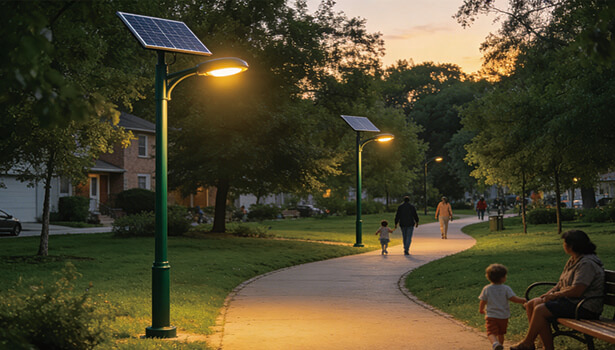
Secondary roads have moderate traffic flow; a layout density of 50–80 metres per lamp is recommended, with single-sided or alternating double-sided arrangements. Roads in residential areas are primarily used by pedestrians and non-motorised vehicles; a layout density of 80–120 metres per lamp is recommended, with single-sided arrangements sufficient. The lighting intensity should be soft, complementing the energy-saving characteristics of solar street lights.
Prioritise pedestrian pathways
Pedestrian safety at night is a key consideration in street light layout. Priority should be given to covering areas such as pavements and zebra crossings. In areas with high pedestrian traffic, solar street lights should be prioritised to balance energy efficiency with safety. Areas such as school entrances, shopping centres and community access points require a higher density of street lights. On narrow pavements, low-profile solar street lights can be used to avoid wasted light, whilst enhancing pedestrian safety and reducing operational and maintenance costs.
Prioritised Coverage of Public Gathering Areas
Public gathering areas such as squares, bus stops and parks experience high footfall at night and are prone to safety hazards, necessitating optimised layout planning. In such areas, solar street lights can be paired with energy storage equipment to ensure stable night-time lighting. It is recommended to adopt a ‘main light + auxiliary light’ combination model, where auxiliary lights can be small solar street lights. This flexible layout is energy-efficient, ensuring overall brightness whilst preventing localised lighting deficiencies.
Adaptation to Existing Infrastructure
Prior to planning the layout, full use must be made of existing infrastructure; solar street lights can be installed by retrofitting existing lampposts, thereby further reducing construction costs. When installing solar street lights, particular attention must be paid to the sunlight conditions at the installation site to avoid obstruction by trees or buildings, ensuring that the solar panels can absorb sufficient sunlight and guaranteeing a stable power supply—this is a key consideration in the layout of solar street lights. At the same time, urban planning must be taken into account, with space reserved in advance for vegetation growth to prevent future obstruction of sunlight.
Compliance with Local Regulations and Standards
Different regions have specific regulations governing street lighting. The layout of solar street lights must comply with local installation standards for renewable energy lighting equipment, with particular attention paid to requirements regarding lamp height, illuminance levels and light pollution control. For example, in residential areas, street lights must not exceed 8 metres in height, and the illuminance levels of solar street lights must strictly adhere to these standards to avoid non-compliance and the need for rework.
Planning for Optimal Light Distribution
Scientific Calculation of Illumination Coverage and Spacing
The illumination coverage of street lights is directly related to the luminaire’s beam angle, power rating and installation height. The spacing between solar street lights must be determined based on their power rating and sunlight conditions to prevent insufficient illumination caused by excessive spacing. Wide beam angles (120° or above) are suitable for open areas, whilst narrow beam angles (60° or below) are suitable for narrow areas; solar street lights can be selected with appropriate beam angles according to local requirements.
Specific spacing guidelines are as follows: for luminaires 6–8 metres high, a spacing of 50–80 metres per unit is recommended (residential areas, pavements); for luminaires 8–12 metres high, a spacing of 30–60 metres per unit is recommended (secondary roads); for luminaires 12–15 metres in height, a spacing of 40–70 metres per luminaire is recommended (for main roads). The spacing of solar street lights can be adjusted appropriately according to sunlight conditions to ensure both charging and lighting requirements are met.
Balancing Illuminance Levels According to Need
The ‘zonal lighting control’ mode meets the requirements of different areas whilst reducing energy wastage. Solar street lights can adjust illuminance levels via an intelligent control system, further enhancing energy-saving performance. High-risk areas (junctions, bus stops) utilise high illuminance levels; general traffic areas use medium illuminance levels; residential areas and parks employ low illuminance levels with soft light sources.
Practical street light Layout Techniques
Grid Layout Method
Suitable for areas with flat terrain and regular layouts (residential areas, industrial parks), this method involves arranging street lights uniformly in a square or rectangular grid to ensure coverage without dark spots or overlap. It is simple to install and easy to maintain. If solar street lights are used in such areas, they can be laid out uniformly according to the grid to ensure consistent sunlight conditions for each lamp, maximising energy efficiency.
Alternating Layout Method
This method is suitable for narrow roads (less than 10 metres wide) or where there are obstacles on either side. Small solar street lights are recommended as they offer flexible installation without taking up excessive space. Lights are installed alternately on both sides of the road to complement each other, avoiding light overlap and reducing the number of fixtures required. When using this layout for solar street lights, care must be taken to avoid obstruction by obstacles to ensure adequate sunlight exposure.
Focused Layout Method
Suitable for core areas with high pedestrian and vehicular traffic (such as intersections and commercial districts), this method can be combined with solar street lights and intelligent control systems to enhance lighting efficiency and safety. In key areas, the layout is densified to increase light intensity, whilst in peripheral areas, density is reduced and low-power luminaires are used. Energy-efficient solar street lights may be selected for peripheral areas to lower overall energy consumption, creating a ‘bright core, soft periphery’ model.
Solar street light-Specific Layout Method
The layout of solar street lights must take into account their energy supply characteristics, with particular emphasis on sunlight conditions. The core principle is to ensure maximum energy utilisation efficiency and avoid situations where ‘charging is insufficient during the day and lighting is inadequate at night’.
Key Points: Solar panels must be installed in unobstructed locations, preferably facing south (in the Northern Hemisphere), to ensure at least 6 hours of effective sunlight per day. Battery packs should be installed in a cool, dry location where water is unlikely to accumulate, thereby extending service life and reducing maintenance costs. In remote areas without grid access, a ‘solar street light + energy storage’ combination should be adopted to ensure normal lighting during cloudy or rainy weather, thereby resolving lighting challenges in remote areas.
Height Adjustment Method
Street light heights must be adjusted appropriately according to local requirements; for solar street lights, height should be determined by a comprehensive assessment of sunlight conditions and lighting needs. For wide roads (main thoroughfares), 12–15-metre high-mast street lights are used; if these are solar-powered, high-power panels must be selected. For narrow roads and pavements, 6–8-metre low-mast solar street lights are used, offering easy installation and concentrated illumination. Public squares utilise 10–12-metre medium-to-high-mast street lights, paired with energy storage equipment, to meet the demand for extended night-time illumination.
Environmental Considerations
Reducing Light Pollution
Light pollution can disrupt residents’ rest and disturb the natural rhythms of wildlife. Solar street lights can further reduce light pollution through intelligent dimming. The use of upward-facing luminaires should be avoided in favour of luminaires fitted with light shields to minimise light scattering. Illuminance levels should be carefully controlled; soft light sources are recommended for residential areas, as the gentle glow of solar street lights is better suited to such environments and causes less disturbance to residents.
Putting Energy Efficiency into Practice
Prioritise energy-efficient street lighting solutions such as solar-powered and LED options. Optimise the layout to reduce the number of luminaires, thereby achieving the dual objectives of ‘energy saving and high efficiency’. Optimising the layout of solar street lights maximises their energy-saving benefits and promotes the efficient use of energy. For example, by replacing traditional high-pressure sodium lamps with LED street lights and optimising their layout, a city can reduce energy consumption by over 40%. If these are replaced with solar street lights, energy consumption can be reduced even further, offering greater advantages in terms of long-term operational and maintenance costs.
Adapting to Weather and Climatic Conditions
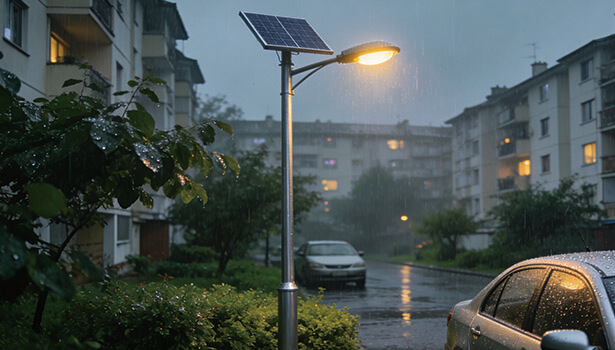
As climates vary across different regions, the layout of solar street lights must be tailored to local conditions to ensure stable charging and lighting. In areas prone to heavy rainfall and flooding, avoid installing battery packs in low-lying areas. In windy regions, select luminaires and poles with high wind resistance. In snowy regions, raise the height of the street lights appropriately to prevent snow accumulation from blocking sunlight, and ensure that the battery packs of solar street lights are properly protected against water and freezing.
Consideration of Vegetation and Obstacles
When planning the layout, it is essential to take into account obstacles such as trees and buildings, as this is particularly crucial for solar street lights and directly affects their energy absorption efficiency. Avoid installing street lights directly beneath trees; where this cannot be avoided, select slow-growing tree species or ensure regular pruning of branches. Avoid areas in the shadow of buildings to ensure that solar street lights can receive adequate sunlight, thereby preventing insufficient charging and unstable lighting caused by a lack of sunlight.
Optimising street light layout is a systematic process that balances lighting efficiency, safety and cost control. The key lies in integrating road types, pedestrian flow patterns and environmental conditions to achieve scientific planning and precise placement. Particularly for solar street lights, it is essential to align with sunlight characteristics and energy-saving requirements, implementing specific layout principles to maximise their environmental and cost-effective benefits. A well-designed street light layout not only enhances the quality of urban night-time lighting but also supports the city’s energy-saving and low-carbon development, providing a viable pathway for the upgrading of municipal lighting.