Highway Solar Street Lights: Design Standards, Cost, and Installation Guide
Mar 31, 2026
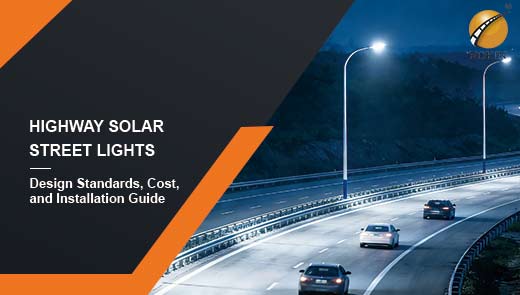
With the deepening implementation of global "carbon neutrality" policies and the extension of highway construction to remote areas, the drawbacks of traditional municipal street lights, such as reliance on the power grid, complex construction, and high long-term costs, have become increasingly prominent. Solar powered street lights, as a clean, efficient, and independent lighting solution, have gradually become the preferred choice for highway lighting due to their advantages of no electricity charges, flexible deployment, and stable performance.
Solar Street Light Design Standards for Highways
Illuminance Standards for Highway Solar Street Lights
Unlike ordinary municipal roads, highways have higher speeds and larger traffic volumes, which require more stringent requirements for the stability and uniformity of lighting. Each indicator setting must be precisely controlled based on the actual driving scenarios.
As the core indicator of highway lighting, illuminance needs to be accurately set according to the road grade and lane number. Generally, the average illuminance of the main lanes of highways should reach more than 30 lx, while the emergency lanes and ramps should not be lower than 20 lx, ensuring that drivers can clearly identify road signs, obstacles, and the vehicles ahead.
Taking into account the differences in traffic flow in different sections, the illuminance standard for busy main roads can be appropriately increased, while suburban and remote sections can be reasonably optimized within the compliance range, ensuring safety while avoiding resource waste.
Lighting Uniformity Requirements
Uniformity is the key to measuring lighting quality. The calculation formula is the ratio of the minimum illuminance on the road surface to the average illuminance. The closer the value is to 1, the more uniform the lighting is, which can effectively reduce visual fatigue. For high-speed driving, alternating bright and dark light spots are prone to causing drivers to be dazzled, increasing the risk of accidents.
The illuminance uniformity of highway solar street lights should be no less than 0.4, and the brightness uniformity should be no less than 0.3. Through scientific light placement design and light selection, no lighting blind areas should be formed, ensuring continuous and gentle road lighting.
Solar LED Street Light Pole Height and Spacing
The reasonable matching of light pole height and light placement spacing is the key to balancing lighting effect and cost control. An excessively high light pole will increase equipment costs and installation difficulty, while an excessively low one will result in insufficient lighting range; too large a spacing is likely to create dark areas, while too small a spacing will lead to resource waste.
Based on the lane width and driving speed of highways, the recommended light pole height is 8-12 meters. For two-way lanes, symmetrical light placement can be adopted, while for one-way lanes, single-side light placement can be used. The light placement spacing should be controlled at 3-4 times the light pole height, with a common spacing of 30-50 meters, ensuring that the road lighting covers without any blind spots.
Solar Street Light System Configuration for Highways
LED Power Selection (60W–120W+)
Highways have higher brightness requirements, but the selection of LED power needs to be flexibly adjusted based on light pole height, light placement spacing, and illuminance standards, rather than blindly pursuing high power.
For regular sections, 60-80W LED lights can meet the basic lighting needs, while key sections with heavy traffic, slopes, and tunnel entrances and exits require 100-120W+ high-power lights to ensure lighting intensity.
Optimal Color Temperature (4000K–5700K)
Color temperature directly affects the visual comfort and recognition of drivers. Excessively high or low color temperatures will increase driving fatigue and even affect judgment.
Highway solar powered street lights are recommended to use neutral white light with a color temperature of 4000K-5700K. This color temperature range provides clear and non-glare light, effectively enhancing the recognition of road signs and obstacles, especially suitable for long-term high-speed driving scenarios, alleviating drivers' night visual fatigue.
High-Efficiency Solar Panels (>20%)
The photovoltaic panel is the core energy source of solar street lights, and its conversion efficiency directly determines the stability of energy supply of the system. It is particularly suitable for the complex climate environment of highways.
For highway scenarios, high-efficiency monocrystalline silicon photovoltaic panels with a conversion efficiency of >20% are recommended. These photovoltaic panels can efficiently generate electricity even in weak light and cloudy weather, better adapting to the climate conditions of different regions and ensuring stable energy supply.
LiFePO4 Battery for Solar Street Lights
The lifespan and stability of the battery directly determine the operation and maintenance costs of solar street lights, and are also a key component that affects the long-term usage experience of the system.
The preferred choice is the lithium iron phosphate battery, which has a long cycle life (2000+ times), good deep discharge performance, strong temperature adaptability, a lifespan of 5-8 years, and high safety, light weight, and can be buried underground or installed on light poles. It has better anti-theft performance, far exceeding traditional gel batteries, and can effectively reduce the later operation and maintenance costs.
Solar Street Light Energy Design and Battery Calculation
Highway solar street lights are mostly deployed outdoors and are greatly affected by weather conditions. Range and energy utilization efficiency are the key differences that distinguish them from ordinary solar powered street lights and are the core for ensuring uninterrupted night lighting.
How Many Days of Autonomy Are Needed (3–7 Days)?
Considering adverse weather conditions such as heavy rain and cloudy days, highway solar street lights need to have sufficient range for rainy and cloudy days. Generally, it is designed for 3-5 days, and in some rainy areas, it can be increased to 5-7 days, ensuring normal lighting even in the absence of sunlight for consecutive days, avoiding the problem of light failure due to insufficient range, and ensuring road safety.
The design of range capability needs to be combined with local climate data, accurately calculating the number of rainy and cloudy days, avoiding over-design or insufficient design.
Solar Street Light Battery Capacity Calculation Formula
The precise matching of battery capacity and solar panel power is the key to avoiding "insufficient solar panel power generation" or "excessive battery capacity", and is also the core for achieving energy balance.
The battery capacity can be calculated using the simplified formula: Battery capacity (Ah) = (Light source power (W) × Daily working time (h) × Continuous rainy and cloudy days) / (System voltage (V) × Discharge depth × Temperature correction coefficient), combined with local lighting conditions, to ensure the balance of energy storage and supply.
MPPT Controller and Efficiency Optimization
Using an MPPT controller is an important means to enhance solar energy utilization efficiency, especially suitable for outdoor scenarios with unstable lighting conditions.
The MPPT controller can dynamically track the working point of the solar panel, adjust the output in real time according to changes in light intensity and battery voltage, increasing solar energy conversion efficiency by 15%-25%, especially in cloudy and low-light conditions, maximizing the utilization of limited solar energy and reducing energy waste, ensuring the stable operation of the system.
Solar Street Light Cost and ROI Analysis
Initial Investment Breakdown
Many practitioners believe that the initial investment of solar powered street lights is high, but in fact, its investment structure is clear and transparent, without hidden costs, and in the long run, it is much more cost-effective than traditional city street lights.
Equipment Cost:
This is the core part of the initial investment, accounting for 70%-80% of the total investment, mainly including LED lights, high-efficiency monocrystalline solar panels, lithium iron phosphate batteries, controllers, and light poles, etc. The equipment cost can be flexibly adjusted according to the configuration level of the project, high-power and long-range configuration equipment has a relatively higher cost, but in the long term, it can reduce maintenance and replacement costs, and has better cost performance.
Installation Cost:
Compared with traditional street lights, the installation cost of solar LED street lights has significant advantages, no need to lay cables or excavate the road surface, only 30%-50% of the cost of traditional street lights.
The installation process is simple and fast, no large-scale construction is required, and it can be quickly deployed, especially suitable for remote sections and new highways, which can effectively shorten the construction period, reduce the impact on traffic during construction, and reduce additional losses during the construction process.
Long-Term Cost Savings (Zero Electricity Cost)
0 Electricity Cost:
Solar street lights use solar energy as the sole energy source and do not need to connect to the power grid, there is no electricity cost throughout the process. According to statistics, global public lighting electricity consumption accounts for 15% to 20% of the total electricity consumption in cities. Solar lighting systems can completely eliminate this expense. For highways with long distances and high lighting demands, the long-term savings effect is particularly significant.
Low maintenance:
The long lifespan of LED lights, lithium iron phosphate batteries, and photovoltaic panels determines the low maintenance characteristics of solar street lights. The lifespan of LED lights can reach 5-10 years, that of lithium iron phosphate batteries 5-8 years, and that of photovoltaic panels 25 years.
Daily maintenance only requires simple cleaning of the photovoltaic panels and checking the controller. There is no need to replace the lights or repair the circuits regularly. The maintenance cost is extremely low, only 10%-20% of the maintenance cost of traditional city circuit lights, significantly reducing the long-term operation pressure.
Life cycle advantages:
During the life cycle of solar powered street lights, there is no need to replace core equipment, nor are there electricity costs or high maintenance fees. Compared with traditional street lights, a large amount of electricity and maintenance costs can be saved. The total investment during the life cycle is much lower than that of traditional street lights, especially suitable for long-term operation highway projects, with a prominent cost advantage.
Solar vs Traditional Street Lights for Highways
To more clearly present the advantages of solar LED street lights and assist in project decision-making, the following compares the differences between highway solar street lights and traditional city street lights from four core dimensions: electricity cost, construction, power outage risk, and operation and maintenance:
|
Comparison Dimension |
Highway Solar Street Lights |
Traditional Street Lights |
|
Electricity Cost |
No cost; fully powered by solar energy, resulting in zero long-term electricity expenses |
Continuous electricity cost; increases with usage time and power consumption, leading to extremely high cumulative costs over time |
|
Construction |
No cable laying or road excavation required; fast installation and short construction period |
Requires large-scale wiring and road excavation; high construction cost, long project duration, and traffic disruption |
|
Power Outage Risk |
No risk; off-grid system with independent operation, unaffected by grid failures |
High risk; fully dependent on the power grid, outages or faults result in complete lighting failure |
|
Operation & Maintenance |
Low maintenance; only basic cleaning and periodic inspection needed, minimal cost |
High maintenance; requires regular lamp replacement and line maintenance, resulting in high labor and material costs |
Benefits of Highway Solar Street Lights
Improved Road Safety
Nighttime driving on highways is much riskier than during the day, poor lighting and unclear vision are among the main causes of nighttime traffic accidents. The core value of high-quality lighting provided by solar powered street lights is to enhance road safety and reduce the incidence of accidents. They provide a safeguard for nighttime driving.
Better Night Visibility
Using high-power LED lights and 4000K-5700K neutral white light can effectively increase night visibility, allowing drivers to detect obstacles, road markings, and other vehicles in advance, leaving sufficient reaction time, reducing rear-end and collision accidents.
Reduced Accident Rates
Uniform lighting can reduce visual blind spots and glare, alleviate drivers' fatigue during nighttime driving. According to statistics, high-quality highway lighting can reduce the nighttime accident rate by more than 30%, especially for long-distance drivers, soft and uniform light can effectively improve driving comfort.
Why Solar Street Lights Are Ideal for Remote Highways
Highways often pass through remote areas and mountainous regions. These areas have weak grid coverage or even no grid coverage. Traditional city street lights are difficult to deploy in these areas. The off-grid power supply feature of solar street lights perfectly meets the needs of highway scenarios.
Off-Grid Solar Lighting Advantages
For remote sections and mountainous highways, laying power grids is extremely costly, and the construction is difficult, long, and even some areas cannot achieve grid coverage. Solar street lights do not rely on the grid and can be independently deployed, effectively solving the lighting problems in remote sections and filling the lighting gap.
No Power Outage Risk
The independent solar power supply system is not affected by grid faults or power outages, can operate stably 24 hours a day, ensuring no interruption of nighttime road lighting. Especially in extreme weather such as rainstorms and typhoons that cause grid outages, solar street lights can still work normally, ensuring road safety.
Environmental Adaptability of Solar Street Lights
Highway solar street lights need to be exposed to the outdoors for a long time, facing extreme weather conditions such as high temperatures, severe cold, rain, snow, and sandstorms. Their environmental adaptability directly determines the stability and service life of the system.
Extreme Weather Resistance (-40°C to 85°C)
The core equipment of solar street lights adopts high-temperature resistant, low-temperature resistant, and dust-proof design, can work normally in extreme environments of -40℃ to 85℃, is not afraid of rain, snow, and sandstorm weather, is suitable for different regional climate conditions, whether in hot and rainy southern regions or cold and dusty northern regions, can operate stably.
IP65+ Protection Level:
The core equipment of solar LED street lights, such as lights and controllers, must reach the IP65+ protection level, completely preventing dust and low-pressure water jets. Among them, LED modules can maintain a light attenuation of no more than 10% for over 5,000 hours in a dusty environment, and the controller can still work normally in a heavy rain environment, ensuring the stability of the system in harsh conditions.
Best Practices for Solar Street Light Installation
Solar Street Light Spacing Design
How to Avoid Dark Areas
The spacing of lighting should be controlled at 3-4 times the height of the light post to avoid large areas of darkness; for special sections such as bends and slopes due to restricted driving visibility, the spacing should be appropriately reduced to ensure continuous lighting and no visual blind spots.
In actual projects, professional lighting simulation software can be used to conduct illumination simulation optimization in advance, accurately plan the lighting placement, and avoid dark areas in advance.
Improving Lighting Uniformity
Select wide-beam, diffuse-type LED lights to avoid overly bright or dim local light spots; use a uniform light distribution type and do not mix different angles of lights to ensure uniform road illumination.
At the same time, for two-way lanes, symmetrically place lights, and for single-lane roads, place lights on one side. Adjust the light post spacing according to the road width to further improve lighting uniformity and optimize the night driving vision.
Smart Solar Street Lighting System (IoT Control)
With the development of Internet of Things (IoT) technology, intelligent control systems have become the preferred configuration for highway solar street lights, which can not only improve usage efficiency but also reduce operation and maintenance costs, achieving "intelligent management and precise lighting".
Light Control + Time Control:
Combining light control and time control functions, it can automatically switch lights based on light intensity and set fixed lighting durations to avoid unnecessary energy consumption. For example, when there is a decrease in traffic flow at night, the lighting brightness can be automatically reduced to balance energy conservation and safety; when the light gradually brightens in the early morning, the lights can be automatically turned off to avoid energy waste.
Remote Monitoring (IoT):
Equipped with IoT modules, it can achieve remote monitoring, allowing maintenance personnel to view the operating status of each street light in real time via mobile phones or computers.
This includes information such as photovoltaic charging efficiency, battery storage status, light brightness parameters, and equipment fault warnings. When a fault occurs, the system will automatically alert, precisely locate the fault point, and maintenance personnel can promptly visit for repair, significantly improving maintenance efficiency and reducing maintenance costs.
Common Challenges and Solutions for Solar Street Lights
Although solar street lights have significant advantages in highway scenarios, during actual deployment, some challenges may still be encountered. Based on industry practice, the following are common challenges and targeted solutions to help projects be successfully implemented.
Rainy Weather Problem
Challenge:
Continuous rainy weather, insufficient power generation by photovoltaic panels, may lead to battery depletion, causing the street lights to fail to illuminate normally, affecting road safety. This is a core issue that many projects focus on.
Solution:
Based on local rainy weather conditions, increase the battery capacity and design a 3-5-day (in rainy areas, 5-7 days) rainy endurance capacity; select efficient photovoltaic panels to enhance weak light power generation efficiency, even in cloudy days, to efficiently collect solar energy; combine with MPPT controllers to maximize the utilization of limited solar energy, ensuring sufficient battery power.
High Initial Cost Concern
Challenge:
The initial investment of solar LED street lights is slightly higher than traditional street lights. Some projects may face initial budget pressure, leading to hesitation in decision-making.
Solution:
From a long-term cost perspective, solar street lights have no electricity costs and low maintenance, with a total investment over 5-10 years that is much lower than traditional street lights, resulting in a better ROI (Return on Investment); at the same time, flexible configuration can be adjusted based on the budget to optimize equipment configuration while balancing initial investment and long-term benefits.
Complex Design Issues
Challenge:
The highway scenario is unique, and factors such as lighting indicators, configuration selection, and lighting layout design need to be comprehensively considered in conjunction with road grade, climate conditions, traffic volume, etc. The design is quite challenging and non-professionals may have difficulty in precisely controlling it.
Solution:
Choose a professional solar street light supplier, provide customized design solutions, combine local actual conditions, optimize lighting indicators, configuration selection, and lighting layout design, ensure project compliance, stable performance, and avoid problems caused by improper design.
Why Choose Solar Street Lights for Highway Projects
Considering multiple factors such as design, cost, performance, and adaptability, solar street lights, with their unique advantages, have become the optimal solution for highway lighting. Prioritizing the use of solar street lights can achieve multiple values of safety, energy saving, economy, and flexibility, providing strong support for highway construction and operation.
Higher Safety:
High-quality lighting effects can increase the night visibility distance, reduce visual blind spots and glare phenomena, and lower the rate of night traffic accidents; off-grid power supply mode, no power outage risk, ensures uninterrupted lighting, further enhancing road safety and safeguarding night driving.
Lower Cost (long-term):
Although the initial investment is slightly higher, there is no electricity bill expenditure in the long term, the maintenance cost is extremely low, and the total investment over a 5-10-year life cycle is much lower than that of traditional street lights, with a better ROI, which can save a lot of costs for the project, especially suitable for long-term operation highway projects.
More Flexible Deployment:
No need to rely on the power grid, can be independently deployed, perfectly adapting to remote sections, new highways, etc., with weak power grid coverage scenarios; installation is fast, no large-scale wiring, road excavation, can complete deployment quickly, shorten the construction period, reduce the impact on traffic.
If you are planning a solar street light project for highways, need to obtain customized solutions and precise quotations, please feel free to contact NOKIN solar street lights. The professional team will provide you with one-stop services, helping the project to be implemented efficiently and achieving the goal of safe, energy-saving, and economical lighting!