How Dust-Proof Solar Street Lights and Maintenance Work in the UAE
Jun 15, 2026
The UAE possesses the world's top solar energy resources, with abundant sunlight throughout the year, making it a core market for the implementation of solar lighting equipment. However, at the same time, the harsh desert climate in the region also poses the most complex application challenges for solar street lights on a global scale.
Multiple environmental factors such as long-term high temperatures, frequent sandstorms, continuous dust accumulation, and coastal salt fog erosion will continuously degrade the performance of solar panels, shorten the lifespan of batteries, and disrupt the stability of the lighting system.
Ordinary conventional solar street lights have not been optimized for the extreme desert environment. Short-term use will result in insufficient power generation, dim lighting, and power outages at night, making it impossible to achieve long-term stable operation. However, specially customized dust-proof solar street lights, adapted to the desert conditions in the UAE, can achieve continuous and stable operation for many years.
In next article, NOKIN will deeply analyze the sand and dust environment challenges of solar street lights in the UAE, the core design highlights of dust-proof street lights, the standardized operation and maintenance solutions, as well as the product selection techniques specific to the Middle East market. It will provide professional references for local engineering projects.
Why Is Dust Such a Serious Problem for Solar Street Lights in the UAE?
Frequent Sandstorms and Airborne Dust
The entire UAE has a tropical desert climate, with scarce precipitation and dry air. Sand and dust activities occur throughout the year.
The region frequently experiences sandstorms, dust storms, and haze conditions, with a large amount of fine sand particles suspended in the air. These particles are extremely light and will continuously float and settle, covering the photovoltaic panels, lamps, and equipment gaps of solar street lights without interruption, which is the main cause of equipment wear and tear.
Dust Can Reduce Solar Charging Efficiency by Up to 50%
A series of specialized studies on the solar energy industry in the Middle East and on-site projects in the UAE have confirmed that dust accumulation is highly destructive to the efficiency of solar power generation. In cases of severe dust accumulation and failure to clean in time, the efficiency of solar panels will decrease by 40% to 50%.
The dust coverage directly blocks the light-receiving surface of the photovoltaic panels, hindering the photoelectric conversion process and triggering a series of chain failures, seriously affecting the performance of street lighting.
The core issues caused by dust accumulation are as follows:
- The charging efficiency of the photovoltaic panels significantly declines, and the battery storage capacity is insufficient
- The duration of night lighting significantly shortens, unable to meet the standards for road lighting
- After continuous dust accumulation and cloudy weather, the risk of power outage for street lights sharply increases
Sand Causes Long-Term Physical Damage
The damage caused by sand and dust to solar street lights is not limited to the decline in power generation efficiency. It can also lead to irreversible physical structural damage, significantly shortening the overall lifespan of the equipment.
The constantly moving sand and dust possess high strength in terms of friction and penetration, and will continuously erode various components of the equipment:
- Hard sand grains repeatedly rub against the surface of the photovoltaic panel glass, causing permanent scratches, which continuously reduce the light transmittance
- Wearing down the lenses of LED lamps, resulting in light dispersion, brightness reduction, and non-compliance with lighting uniformity standards
- Fine sand particles blocking the equipment's heat dissipation structure, causing poor heat dissipation and heat accumulation
- Sand entering the internal electronic components of the equipment, causing circuit malfunctions, short circuits, and aging and failure of components
What Makes a Solar Street Light Truly Dust-Proof?
High IP66 or IP67 Protection Rating
The IP protection level is the core standard for measuring the dust-proof and water-proof capabilities of solar street lights, and it is also the basic indicator for adapting to the desert environment of the UAE. Considering the local climate with frequent sandstorms and occasional heavy rains, IP66 and IP67 are the necessary protection levels.
IP66 can completely prevent fine dust from entering the equipment interior and also resist strong wind and rainstorm impacts; IP67 supports short-term immersion protection, and has stronger dust-proof, moisture-proof and erosion-resistant capabilities.
This level of protection can fully seal the battery compartment, controller, LED driving system and other core precision components, preventing sand and salt fog from invading, reducing equipment failures from the root cause, and adapting to the entire desert and coastal conditions across the UAE.
Sealed Integrated Design
The traditional split-type solar street lights have numerous seams, openings and exposed cables, which are the main channels for sand and dust to enter. In desert environments, they are prone to malfunction.
The professional dust-proof solar street lights adopt an integrated sealing design, minimizing the equipment's joint gaps, open interfaces and exposed lines.
The integrated and formed structure of the entire machine prevents sand from penetrating the entry point, completely avoiding the erosion of wind and sand, salt fog on the internal circuits and batteries, and significantly enhancing the stability of the equipment in extreme desert environments.
Aerodynamic Housing Design
Designed to withstand the strong winds and sandstorms in the UAE, the high-quality dust-proof street lights feature an aerodynamic body design that differs from the traditional straight structure.
The inclined and streamlined body structure has two core advantages. Firstly, it significantly reduces wind resistance, resisting the strong wind of sandstorms and preventing equipment from shaking or tipping over. Secondly, it uses wind power to achieve natural dust removal, reducing the accumulation of sand and dust on the photovoltaic panels and the surface of the body.
Currently, over 80% of outdoor roads and park photovoltaic lighting projects in the UAE use this type of inclined aerodynamic structure equipment, adapting to the long-term wind and sand environment in the desert.
Self-Cleaning Solar Panels
The frequent manual cleaning of photovoltaic panels is costly and inefficient, and it is a major pain point in the maintenance of photovoltaic systems in the Middle East. Self-cleaning photovoltaic panels have become the mainstream upgrade trend for dust-proof solar street lights in the UAE.
The current mainstream self-cleaning technologies include three types, which are suitable for different project budgets and scene requirements:
- Nanocoating technology: Attach a hydrophobic and dust-proof nanocoating on the surface of the photovoltaic panel to reduce the adhesion of sand and water droplets. A slight wind can remove the surface dust.
- Hydrophobic coating technology: Has the characteristics of waterproofing, anti-fouling, and anti-dust accumulation, eliminating dust accumulation on the panel surface and maintaining a clean and transparent surface.
- Intelligent mechanical cleaning system: Equipped with an automated scrubbing device, which can clean the heavily accumulated dust on the panel surface at regular intervals and is suitable for outdoor scenarios with long-term unmanned maintenance.
How Do Dust-Proof Solar Street Lights Handle Extreme UAE Temperatures?
The Heat Challenge in the Middle East
The summer in the UAE experiences extremely high temperatures, with the outdoor environment temperature often exceeding 50°C throughout the year. The surface temperature of photovoltaic panels can reach up to 70°C, far exceeding the suitable temperature range for conventional street lights.
High temperatures are another core factor that damages solar street lights, causing multiple equipment failures: accelerated battery aging, rapid light decay of LED lights, disorder of controller programs, and failure of circuit short circuits, significantly shortening the lifespan of the equipment.
Why LiFePO4 Batteries Are Preferred
The battery is the energy storage core of solar street lights. The high-temperature environment in deserts has extremely high requirements for the battery's high-temperature resistance, stability, and safety. There is a significant performance gap between lead-acid batteries and lithium iron phosphate batteries (LiFePO4) in desert conditions.
|
Battery Type |
Adaptation Performance in Desert Environment |
Core Adaptation Features |
|
Lead-acid Battery |
Poor |
Weak resistance to high temperatures; prone to bulging and electrolyte leakage in hot conditions; significantly reduced lifespan; lower safety performance. |
|
Lithium Iron Phosphate Battery (LiFePO4) |
Excellent |
Excellent high-temperature resistance; long cycle life; stable charging and discharging performance; no risk of explosion or fire; highly suitable for the extreme heat conditions of the UAE. |
Advanced Thermal Management Systems
The professional dust-proof solar street light is equipped with a complete intelligent heat dissipation and temperature control system, specifically addressing the high-temperature problem in the Middle East and ensuring the stable operation of the equipment throughout the year.
The core heat dissipation configuration includes: high-conductivity aluminum alloy heat sink, intelligent temperature control sensing system, and passive air-cooling structure.
The entire system can detect the internal temperature of the equipment in real time, quickly discharging the heat generated by the equipment operation and the high temperature of the environment, avoiding heat accumulation, effectively suppressing LED light decay, battery aging and controller failures, and is suitable for the high-temperature working conditions in the UAE throughout the year.
How Often Should Solar Street Lights Be Maintained in Desert Areas?
Routine Inspection Schedule
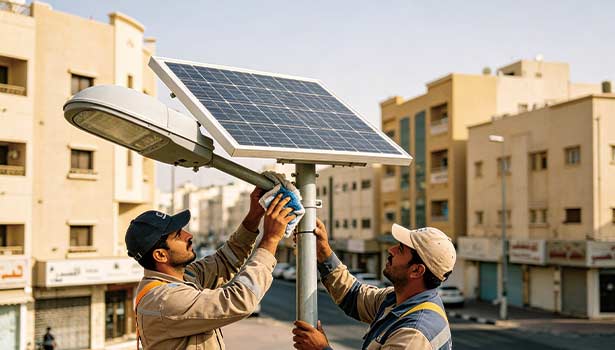
Based on the long-term operation experience of desert projects in the UAE, dust-proof solar street lights do not require frequent and high-frequency maintenance, but they need to follow standardized periodic inspections, taking into account stability and cost control. The specific maintenance periods are as follows:
|
Maintenance Project |
Recommended Maintenance Period |
|
Inspection of photovoltaic panel appearance and power generation status |
Once a month |
|
Deep cleaning of photovoltaic panels |
Once every 1–3 months |
|
Inspection of battery performance and wiring status |
Once every 6 months |
|
Inspection of light post structure and foundation stability |
Once a year |
|
Special inspection after sandstorms |
Immediately after the sandstorm ends |
Cleaning Solar Panels After Sandstorms
After a sandstorm, a large amount of fine sand and dust will evenly cover the surface of the photovoltaic panels, causing a sudden drop in power generation efficiency within a short period of time.
Therefore, immediate inspection and cleaning after the sandstorm is crucial for maintenance. It is necessary to remove the dust and sand deposits on the panels as soon as possible, check if there are any scratches or damages on the panel surface, and quickly restore the light absorption efficiency of the photovoltaic panels to avoid power loss and equipment aging caused by long-term accumulation of dust.
Checking Seals and Cable Connections
The alternating environment of long-term sandstorms and high temperatures will accelerate the aging of equipment seals and loosen the interfaces, becoming the core hidden dangers for sand and dust intrusion.
During daily operation and maintenance, it is necessary to focus on checking rubber sealing strips, line connectors, waterproof connection terminals and other components. Replace the aged and deformed seals in time, tighten the loose interfaces, and prevent fine sand and salt fog from invading the equipment interior through the gaps, ensuring the dust-proof and water-proof performance of the entire machine.
Real-World Solutions Being Used in UAE and Middle East Projects
Self-Cleaning Solar Lighting Systems
To address the problems of high costs and low efficiency in artificial cleaning of deserts, large-scale municipal and park projects in countries such as the UAE, Saudi Arabia, and Qatar have widely adopted intelligent self-cleaning lighting systems.
The mainstream solutions include automatic scrubbing systems, waterless dust removal cleaning technologies, and intelligent sensor cleaning equipment. There is no need for manual visits. The cleaning of the panel surfaces can be automatically completed based on the degree of dust accumulation and weather conditions, significantly reducing long-term manual operation and maintenance costs, and being suitable for remote and large-scale lighting projects.
Smart Monitoring Systems
The intelligent remote monitoring system is the standard upgrade solution for the solar street lighting project in the Middle East deserts, completely changing the traditional manual inspection mode.
This system can remotely monitor real-time core data such as battery power, charging efficiency, equipment operating temperature, and lighting status. It also has an automatic fault warning function. Maintenance personnel can remotely grasp the equipment's condition, accurately locate the fault points, reduce ineffective manual inspections, and significantly improve the maintenance efficiency.
Sandstorm-Resistant Structural Design
In response to the severe sandstorms and strong winds in the Middle East, all the on-site projects have adopted enhanced anti-sand structure designs to comprehensively improve the stability of the equipment.
The core optimizations include: thickening and reinforcing the galvanized steel light poles, using high-strength alloy fixed supports, and deepening the concrete fixed bases. From three aspects - the body, accessories, and foundation fixation - the equipment is strengthened to resist the impact of strong winds and sandstorms, and to prevent problems such as equipment tilting, collapsing, and falling off.
Cost Comparison: Dust-Proof vs Standard Solar Street Lights
Most customers are concerned about the initial investment cost of dust-proof solar street lights. However, when considering the total life cycle cost, the dust-proof model offers much better value for money compared to the ordinary conventional model, making it suitable for long-term implementation in the UAE. The detailed cost and performance comparison is as follows:
|
Comparison Item |
Ordinary Solar Street Light |
Dust-Proof Solar Street Light |
|
Initial Purchase Cost |
Lower |
Higher |
|
Solar Panel Cleaning Frequency |
High; requires frequent manual cleaning |
Low; self-cleaning features and dust-resistant design reduce cleaning frequency |
|
Power Generation Efficiency Stability |
Lower; dust accumulation and high temperatures significantly reduce charging efficiency |
Higher; maintains stable and efficient power generation over the long term |
|
Equipment Lifespan |
Shorter; more susceptible to aging and failures within 3–5 years |
Longer; capable of stable operation for 8–10 years |
|
Total Lifecycle Maintenance Cost |
Higher; frequent repairs, component replacements, and labor-intensive cleaning increase costs |
Lower; fewer failures, reduced component wear, and less manual maintenance required |
|
Return on Investment (ROI) |
Moderate; initial cost savings may be offset by higher long-term expenses |
Better; long-term reliability and lower operating costs deliver greater overall returns |
How to Choose the Best Dust-Proof Solar Street Lights for UAE Projects
Look for IP66/IP67 Certification
The primary core criterion for selection is to ensure that the solar street light for UAE has the officially certified IP66/IP67 dustproof and waterproof rating. Reject devices without certification or with falsely labeled ratings, and ensure that the equipment can effectively resist sand and dust intrusion, salt spray corrosion, and extreme weather impacts, and be suitable for the harsh working conditions in the UAE.
Select LiFePO4 Battery Systems
The solar powered street lights are primarily equipped with industrial-grade lithium iron phosphate batteries. They abandon the lead-acid batteries which are prone to overheating and have short lifespan. By leveraging the high-temperature stability, long cycle life and high safety of lithium iron phosphate batteries, they are suitable for the year-round high-temperature environment in the UAE, thereby reducing the cost of battery replacement.
Verify Sandstorm Resistance Testing
When selecting the UAE solar street light, it is necessary to verify the professional testing qualifications of the product, and pay particular attention to checking the reports of wind load resistance tests and sand and dust aging tests. At the same time, preferentially choose products that have local implementation project cases in the UAE and the Middle East to verify the actual wind and sand resistance, as well as high-temperature resistance performance of the equipment, to avoid selection errors.
Consider Smart Monitoring and Self-Cleaning Features
For large-scale municipal, park and road projects in the desert countries of the Middle East such as the UAE, Saudi Arabia, Oman and Qatar, it is recommended to prioritize the adoption of solar street lights intelligent monitoring and self-cleaning functions.
These two functions can significantly reduce long-term labor costs for maintenance and improve the automation and intelligence of equipment operation. They are the mainstream upgrade trend for photovoltaic lighting projects in the Middle East and are suitable for long-term large-scale operation requirements.
Conclusion
The high temperatures and frequent sandstorms in the deserts of the UAE pose significant challenges for the application of solar street lights. Ordinary lighting equipment is unable to achieve long-term stable operation. The dust accumulation problem can result in a 40%-50% reduction in the power generation efficiency of solar panels, directly affecting the lighting effect of the street lights and the lifespan of the equipment.
High-quality dust-proof solar street lights suitable for the market in the UAE feature core standard configurations including IP66/IP67 high protection levels.