Can Commercial Solar Street Lights Work Normally in Winter?
Jan 22, 2026
I wonder if you have noticed that wherever we go, we can always see solar street lights. Especially in outdoor scenarios such as municipal projects, industrial parks, parking lots, etc., commercial solar street lights have become the preferred choice for outdoor lighting. However, in high-latitude regions and areas with long periods of low winter temperatures, people always worry about issues such as low winter temperatures, short sunlight duration, and snow accumulation. How much of an impact will these problems have on the stable operation of commercial solar street lights during winter?
Next, solar street light manufacturer NOKIN will comprehensively analyze the winter operation logic of commercial solar street lights from dimensions such as working principle, winter challenges, optimization solutions, and installation and maintenance, helping you thoroughly clarify the core questions.
Do Commercial Solar Street Lights Work in Winter?
This is the core question that purchasers and maintenance personnel are most concerned about - after all, the low temperatures and insufficient sunlight in winter can easily lead people to mistakenly believe that solar equipment will "break down".
Short conclusion: Yes, but only if the system has been optimized for winter. Solar street lights do not "stop working" due to low temperatures; their stability during winter operation mainly depends on the system design, not "whether there is sunlight".
Even in high-latitude, snowy and cold regions, as long as the solar street light system is optimized for winter scenarios during the design stage, stable lighting can be achieved without relying on grid power supplementation.
How Do Commercial Solar Street Lights Work During Winter?
Many people have misconceptions about solar street lights, believing that "low temperatures will affect power generation" and "there is no sunlight in winter, so the solar equipment cannot be used". In fact, their winter working principle is the same as in summer, but it pays more attention to targeted design in energy collection and storage.
Solar Energy Collection Under Winter Sunlight Conditions
The core of photovoltaic power generation is "light" rather than "heat" - it relies on absorbing photons in the sunlight to excite electrons inside the semiconductor and generate current, and has no direct correlation with environmental temperature.
Instead, in low-temperature environments, the theoretical photovoltaic conversion efficiency will not decrease, and even in moderate low temperatures, the stability of the components will be better (extreme low temperatures need to consider the material tolerance of the components).
Energy Generation, Storage, and Discharge Process
The core design of commercial solar street light systems is "energy storage adaptation" - especially for scenarios with insufficient sunlight in winter.
Professional commercial systems usually calculate energy based on the "worst winter sunlight" standard to ensure that even on the shortest and weakest days of the year, the solar panels can collect enough electricity to meet the lighting needs at night.
That is to say, the core function of the solar panels in winter is "energy storage", storing electricity in batteries rather than directly powering the street lamps.
The energy source for nighttime lighting in winter is entirely dependent on the electricity stored during the day, and the entire process is completed automatically by the system controller.
When the evening light dims (reaches the preset threshold), the controller will automatically switch to "lighting mode", releasing the electricity in the battery to drive the LED lights to light up; when the morning light brightens or the battery voltage drops below the preset value, the controller will automatically turn off the lighting and switch back to "charging mode".
It is worth noting that the low power consumption characteristic of LED lights is the foundation for the feasibility of commercial solar street lights in winter - compared to traditional sodium lamps, LED can save 50%-70% of energy, significantly reducing the energy storage pressure in winter.
What Are the Main Challenges for Solar Street Lights in Winter?
Although commercial solar street lights can operate normally in winter, environmental factors such as low temperatures and short daylight hours still bring a series of challenges to the system. These challenges are not impossible to solve; the key is to identify and respond to them in a targeted manner.
Reduced Sunlight Hours and Low Solar Irradiance
The most obvious problem in winter is the significant reduction in daylight hours – in high-latitude regions (such as North America and parts of Europe), the duration of daylight during winter may be less than 6 hours, far shorter than the 12 hours or more during summer.
At the same time, the solar altitude angle decreases, and the angle of sunlight penetration becomes more gentle, resulting in a reduction in the amount of solar radiation received by solar panels, directly affecting the daily electricity generation capacity.
Low Temperature Impact on Battery Performance
In the entire solar street lighting system, the battery is the component most affected by low temperatures – low temperatures reduce the effective capacity of some batteries, leading to a decrease in their charging and discharging efficiency.
For example, traditional lead-acid batteries may have an effective capacity of 60%-70% at -10℃; if the temperature drops further, the capacity will continue to decrease, and even lead to a situation where they cannot be charged and discharged.
Therefore, battery performance is the most critical variable for the stable operation of the system in winter.
Snow, Ice, and Dust Coverage on Solar Panels
Compared to low temperatures and short daylight hours, snow, ice, and pollutants have a more direct impact on solar street lighting, and even may cause the system to "break down" temporarily.
If the surface of the solar panel is covered with snow or ice, it will directly block the light, causing the solar panel to be unable to generate electricity; even a small amount of snow or dust will also reduce the power generation efficiency.
Industry practice shows that the problem of coverage is often more fatal than low temperatures themselves – many cases of "non-functioning" solar street lighting in winter are essentially due to snow covering the solar panels, rather than system failure.
How to Optimize Commercial Solar Street Light Systems for Winter Operation?
To address winter challenges, the core lies in "system optimization design" – every aspect, from component selection, battery configuration to control strategies, must take into account winter scenarios. Here are the core optimization solutions that have been verified through industry practice.
Choosing High-Efficiency Solar Panels for Low-Light Conditions
Winter has weak sunlight and short daylight hours, so the efficiency and low-light performance of solar components are particularly important.
In component selection, monocrystalline silicon components have an advantage over polycrystalline silicon components – their conversion efficiency is higher (up to 22%-25%), and their power generation performance in low-light and cloudy environments is better, allowing them to make better use of the limited sunlight resources in winter.
Selecting Batteries Suitable for Low-Temperature Environments
The low-temperature resistance of the battery directly determines the stability of the winter system. Currently, lithium batteries (especially lithium iron phosphate batteries LiFePO4) are the preferred choice for winter optimization of commercial solar street lighting.
Compared to traditional lead-acid batteries, lithium batteries have better stability at low temperatures – in -20℃ environments, the effective capacity of lithium iron phosphate batteries can still maintain more than 80% of the rated capacity, and their charging and discharging efficiency is not affected, and the lifespan is longer (up to 10-15 years).
|
Battery Type |
Effective Capacity at -10°C |
Effective Capacity at -20°C |
Winter Compatibility |
|
Lithium Iron Phosphate Batteries (LiFePO4) |
85%–90% |
80% or less |
Excellent |
|
Traditional Lead-Acid Batteries |
60%–70% |
50% or less |
Poor |
Increasing Battery Capacity for Multi-Day Autonomy
Winter may experience consecutive cloudy days and rainy or snowy weather, causing the solar panel to be unable to generate electricity normally. Therefore, commercial solar street lighting systems need to design "multi-day autonomy" – even without sunlight, they can rely on stored electricity to maintain normal lighting.
Industry standards show that commercial solar street lighting systems usually design 3-5 days of no-sunlight operation capability; for high-latitude and snowy regions, it can be optimized to 7 days to ensure the stability of lighting during extreme winter weather.
Using Intelligent Controllers for Energy Management
Winter energy is tight, and intelligent control strategies are key to reducing energy consumption and extending lighting time. Currently, the mainstream intelligent optimization solutions for commercial solar street lighting include:
Time-sharing dimming: According to the changes in the number of people and vehicles at night, the brightness of the streetlights can be automatically adjusted (such as turning on the lights in the early morning and dimming them to 50%-70% in the late night), significantly reducing energy consumption;
Human body sensing / Vehicle sensing: When a human body or vehicle passes by, the lights will automatically turn on; when there is no sensing, they will remain in a low-brightness standby mode, further saving electricity.
In fact, intelligent control is more relied upon in winter than in summer - a reasonable dimming strategy can extend the lighting time in winter by more than 30%, while avoiding excessive battery discharge.
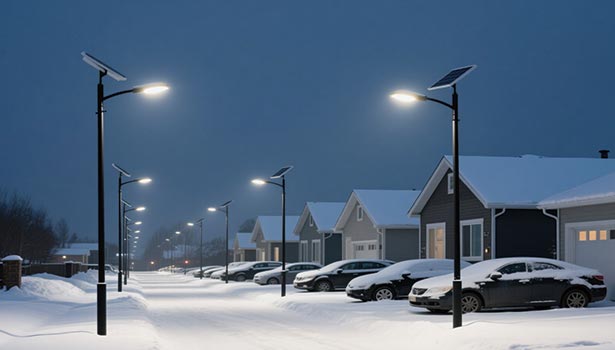
Installation Considerations for Solar Street Lights in Winter Regions
In addition to the optimization of the system itself, the installation method will also directly affect the power generation efficiency and stability of solar street lights in winter. Correct installation can effectively solve problems such as insufficient sunlight and snow cover.
Optimal Installation Angle for Winter Sunlight
The inclination angle of the solar panel directly determines its efficiency in receiving solar radiation. In winter, when the solar altitude angle is low, the inclination angle needs to be adjusted to maximize the reception of sunlight.
Industry recommended standard: Inclination angle of solar panel = local latitude + 10°–15°.
For example, if the local latitude is 40°, the inclination angle of the solar panel in winter can be adjusted to 50°–55°, which can not only better receive low-angle sunlight but also reduce the accumulation of snow on the panel (the larger the inclination angle, the easier the snow slides off).
Avoiding Shading and Snow Accumulation
In winter, when the solar altitude angle is low, the shadow range of trees and buildings will be significantly larger than in summer - even a small shadow covering the solar panel will significantly reduce the power generation efficiency (the "hot spot effect" of photovoltaic modules can cause local damage, affecting the overall power generation).
Therefore, when installing, avoid areas prone to shadows in winter:
Stay away from tall trees and buildings to ensure that the solar panel is not blocked during the winter day (9:00-15:00);
If it is impossible to avoid, you can appropriately raise the installation height of the solar panel or adjust the installation position to reduce the shadow impact.
Winter Maintenance Tips for Commercial Solar Street Lights
Even if the system has been optimized for winter, reasonable maintenance can further improve stability and extend the system's service life. The focus of winter maintenance is on "clearing obstructions and inspecting components", with simple and effective operations.
Cleaning Snow and Dust to Maintain Charging Efficiency
Snow and ice are the biggest obstacles to solar panel power generation in winter, so regular cleaning is the core of maintenance.
Cleaning suggestions:
Choose a sunny noon (relatively high temperature) for cleaning to avoid damage to the panel caused by forced cleaning in low temperatures;
Use a soft brush or cloth to gently wipe, avoid using hard objects (such as shovels) to scrape the panel, to prevent scratching the coating;
For frozen panels, spray warm water (not exceeding 40°C) to melt first, then clean, to avoid damage to the components due to sudden cooling.
Simple cleaning maintenance can restore the solar panel to normal power generation efficiency, avoiding system failure due to snow cover.
Regular Inspection of Solar Panels and Batteries
In winter, due to low temperatures and large temperature differences between day and night, problems such as condensation water, cable aging, and waterproof sealing failure are prone to occur, and regular checks are required:
Battery: Check if the battery terminals are loose or corroded, if so, wipe them clean with a dry cloth and apply anti-rust agent;
Cables: Check if the cables are damaged or aging, and if the connection is firm, to avoid power loss or system short circuit due to cable failure;
Waterproof sealing: Check if the controller and battery box's waterproof sealing is intact to prevent condensation water from entering the equipment and damaging electronic components.
FAQ About Commercial Solar Street Lights in Winter
Here are the most common problems encountered by purchasers and maintenance personnel when using commercial solar street lights in winter and professional solutions to help you quickly solve doubts.
Can Solar Street Lights Work Normally in Snowy Weather?
Yes, provided that the system has sufficient energy storage capacity and the solar panel is not covered by snow for a long time.
If the snow is light and melts quickly, the solar panels can generate electricity normally; if there is a lot of snow, clear it up in time and the system will return to normal operation. It is recommended to choose a system with 3-5 days of autonomous capability to cope with continuous snowfall weather.
Will Continuous Cloudy Days in Winter Cause Solar Street Lights to Turn Off?
No. Professional commercial solar street light systems are usually designed based on the "worst winter sunlight" conditions and have 3-7 days of autonomous ability without sunlight.
That is to say, even if it is cloudy for 3-7 days and there is no sunlight, the system can rely on the electricity stored in the battery to maintain normal night lighting and will not go out.
What Is the Minimum Operating Temperature for Commercial Solar Street Lights?
After winter optimization, commercial solar street light systems can operate normally at -20°C or even lower temperatures.
The key lies in component selection: using low-temperature-resistant lithium iron phosphate batteries, efficient monocrystalline solar panels, and intelligent control strategies can ensure the stability of the system in extreme low temperatures. Some systems specifically designed for cold regions can withstand -40°C.
Are Commercial Solar Street Lights Suitable for High-Latitude Countries?
Yes, but a targeted system design is required.
In high-latitude countries, the winter sunlight duration is short and the temperature is low. As long as the component efficiency is optimized during the design stage, the battery capacity is increased, the installation inclination is adjusted, and winter maintenance is done well, commercial solar street lights can operate stably and significantly reduce the cost of grid power supply.
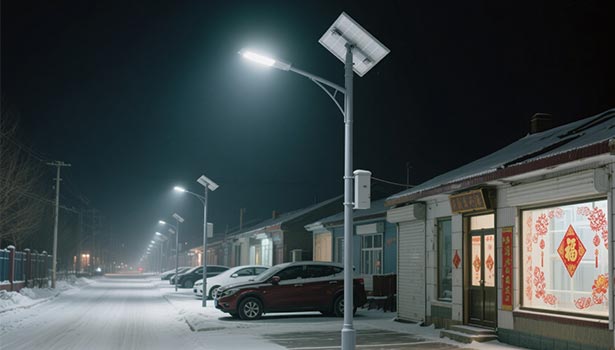
Is it worth choosing commercial solar street lights in winter?
After reading this article, you should have a clear answer: Commercial solar street lights can work normally in winter. The core is not "is there sunlight in winter", but "whether the system has been designed for winter optimization".
The challenges of short winter sunlight, low temperatures, and snow accumulation in winter can all be solved by "selecting efficient components, using low-temperature-resistant batteries, designing intelligent control, optimizing installation methods, and doing regular maintenance".
For commercial and municipal projects, winter optimization ability is the core standard for measuring a commercial solar street light system's professionalism - choosing a system that has been optimized for winter can not only ensure stable lighting in winter, but also save energy and maintenance costs for a long time, achieving true "green energy saving, worry-free efficiency".