150W Solar Street Light Applications for Highways and Main Roads
Jun 03, 2026
Main roads and highways, as the core carriers of the transportation network, bear the demands of high-speed and large-volume traffic flow, and have strict standards for the brightness, uniformity, and stability of night lighting. Ordinary low-power solar street lights have insufficient brightness, limited coverage, and poor durability, and are completely unable to adapt to large-scale road traffic lighting scenarios.
In this context, 150W solar street lights, with their high lumen output, strong durability, and wide coverage, have become the mainstream choice for municipal roads and highway projects, and are also the core solution for commercial high-power solar road lighting. This article will combine the standards of the road lighting industry and practical engineering experience to comprehensively analyze the applicable scenarios, core technical parameters, and selection points of 150W high-power solar street lights, avoiding purchasing misunderstandings, and helping engineering contractors and municipal procurement parties accurately match the solutions for highway solar lighting and main road solar road lighting projects.
Why Highways Need 150W Solar Street Lights
High-Speed Roads Require Higher Visibility
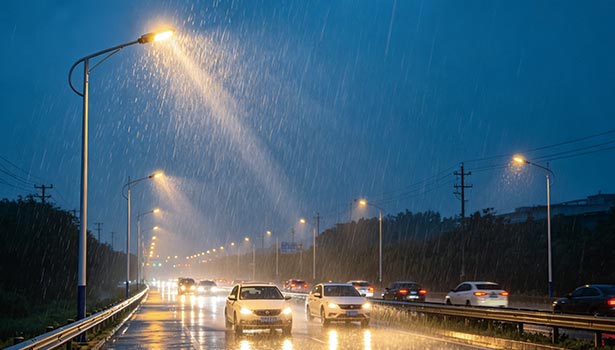
Highway and main road vehicles travel at high speeds, and the emergency reaction time of drivers is significantly shortened. Compared to ordinary municipal roads, these scenarios require a longer and clearer night visibility range.
During night driving, drivers need to accurately identify lane lines, road obstacles, traffic signs, and road bends, etc. If the lighting is insufficient and the light is dim, it is very likely to cause visual blind spots, significantly increasing the risk of rear-end collisions, skidding, and lane deviation.
Low-power solar street lights have limited illumination and short illumination distance, cannot meet the safety lighting requirements for high-speed driving, while high-lumen solar street lights can effectively extend the visibility range and ensure the safety of high-speed travel.
Wide Roads Need Larger Lighting Coverage
Main roads and highways are mostly four-lane or wider two-way roads, and a single light needs to cover a much larger road area than community roads and secondary roads.
Such large-scale road lighting projects are generally equipped with 10-12-meter-high light poles, which have higher requirements for the light distribution angle, illumination breadth, and lumen output of the lights. Low-power lights paired with high light poles will have uneven road illumination and many dark spots.
150W solar street lights are specifically designed for high-pole, wide-road surfaces, are compatible with 10-12-meter standard light poles, and can achieve large-span, no-cornered road lighting coverage, perfectly matching the lighting needs of multi-lane main roads and expressways.
Municipal Roads Require Stable Night Lighting
Highway and main road lighting belong to core municipal projects and have public safety attributes, requiring stable and uninterrupted night lighting throughout the year, unaffected by rainy, cloudy weather.
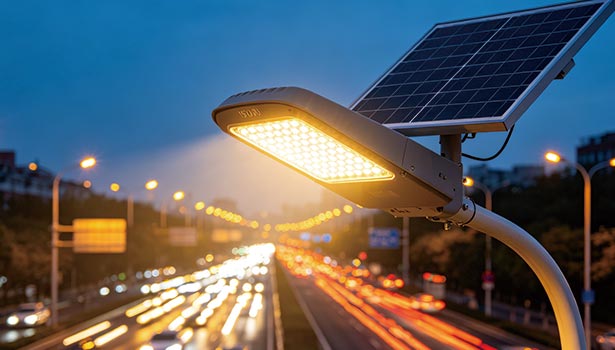
The high-power 150W solar street light system is fully upgraded in configuration, different from ordinary low-power lights, equipped with a large-capacity lithium iron phosphate battery, an efficient MPPT intelligent controller, and high-conversion-rate monocrystalline solar panels.
This core configuration can effectively cope with continuous rainy weather and insufficient lighting conditions, ensuring long-term stable night lighting output and meeting the high standards of municipal road project acceptance requirements.
What Is a 150W Solar Street Light System?
Core Components of a 150W Solar Lighting System
The complete 150W LED solar street light is not a single light, but an integrated intelligent lighting system. The coordinated work of each component determines the overall lighting effect and service life. The core components are divided into five modules.
|
Core Component |
Function |
|
LED High-Brightness Module |
Provides the core light source with high light transmittance and low lumen depreciation, ensuring stable high-brightness output. |
|
Efficient Solar Panel |
Absorbs solar energy during the daytime, converts it into electrical energy, and powers the system for energy storage. |
|
LiFePO4 Lithium Iron Phosphate Battery |
Stores electrical energy to ensure stable lighting during nighttime and rainy weather conditions. |
|
Intelligent MPPT Controller |
Automatically regulates charging, discharging, and dimming modes to improve overall energy utilization efficiency. |
|
Light Pole and Fixed Support |
Designed for high-pole installation, providing stable load-bearing capacity and suitability for complex outdoor environments. |
Standard Lumen Output of 150W Solar Street Lights
When purchasing commercial solar street lights, do not merely focus on power values. The core criterion for judging brightness is lumen output. Some inferior lights falsely label power values, with high wattage but low brightness, unable to meet engineering requirements.
High-quality 150W solar street lights in the industry have undergone professional optical adjustment, with standard lumen output capable of stabilizing at 17,000–25,000 lumens, sufficient to support high-brightness lighting needs for wide roads and expressways.
Why Lumens Matter More Than Wattage
Many purchasers have misconceptions, believing that the higher the wattage, the better the brightness. In fact, wattage is only a power consumption parameter and does not represent the lighting brightness.
Some inferior high-wattage lights have backward optical distribution design, resulting in the "zebra effect" of alternating light and darkness on the road surface, with extremely poor illumination uniformity. This not only affects the driving experience but also fails to pass municipal engineering acceptance.
For large-scale road projects, lights are required to provide IES professional light distribution files, with core acceptance criteria being lumen values, light distribution angles, and illumination uniformity, rather than simply referring to wattage.
Best Applications for 150W Solar Street Lights
Urban Main Roads
Urban main roads have heavy traffic and high speeds, including straight main roads, large intersections, and connection sections of transportation hubs. The lighting load is high and the safety standards are high.
150W high-power solar street lights with high brightness and wide coverage can perfectly adapt to the all-day lighting needs of main roads, ensuring safe traffic during daytime and peak traffic hours, making them an ideal solution for road renewal and renovation in cities.
Highways and Expressways
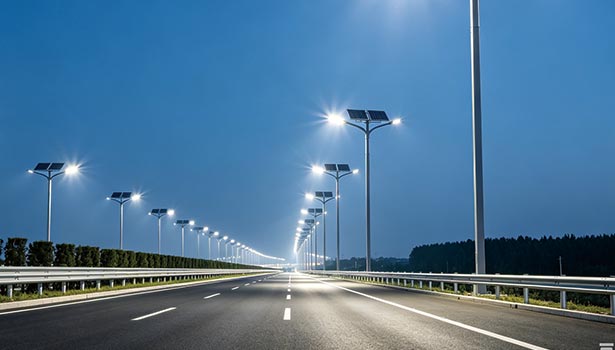
Highways and urban expressways are the core application scenarios for 150W solar street lights. They are mainly adapted to expressway main roads, central divider strips, expressway entrances and exits, ramps, and long-distance suburban expressway sections.
These scenarios have no power supply coverage and high maintenance difficulty. 150W solar street lights do not require wiring, have autonomous energy storage, and have stable power supply, able to meet the long-distance, unmanned-attended highway lighting needs.
Industrial and Logistics Parks
Large industrial parks, storage logistics centers, container terminals, with spacious grounds, wide roads, and frequent passage of freight vehicles, have high requirements for brightness during night operations and passage.
150W commercial solar street lights can achieve full-area, no-corner lighting, adapting to the 24-hour regular operation needs of the park, and significantly reducing the power consumption and maintenance costs of municipal electricity lighting in the park.
Airports and Transportation Hubs
Airports, surrounding roads, coastal ports, large transportation hubs, belong to high-security lighting scenarios. These places require lighting equipment to work continuously for a long time, have stable brightness, and be resistant to wind and rain corrosion.
150W high-lumen solar street lights have the advantages of waterproof, lightning protection, long battery life, and sufficient brightness, fully meeting the high-standard lighting and safety requirements of transportation hubs.
Technical Specifications to Consider
Pole Height and Installation Spacing
150W solar street lights are high-pole, high-power lights, most suitable for 10-12 meter standard light poles, which are also common specifications for highways and main roads.
Installation spacing directly determines the uniformity of road illumination. For highway lighting, professional optical calculations need to be made based on road width, vehicle speed, and illumination standards. In conventional projects, a 10-12 meter light pole combined with 150W lights has a standard installation spacing of 30-40 meters, avoiding lighting blind spots.
Battery Capacity and Rainy-Day Backup
The greatest challenge for outdoor road lighting is continuous rainy and low-light weather conditions. Battery life is the core indicator for evaluating the quality of high-power solar street lights.
Engineering selection recommendations should prioritize 150W solar street light systems that support 2-4 days of rainy battery life. Standard LiFePO4 lithium iron phosphate batteries are equipped, which have advantages such as long cycle life, stable deep-cycle discharge, and slow degradation, significantly reducing the costs of later replacement and maintenance.
Solar Panel Conversion Efficiency
Highways and main roads are mostly outdoor open spaces, but the lighting conditions vary greatly in different regions. To ensure energy storage efficiency, high-power lighting systems have higher requirements for solar panel conversion rates.
Industry-quality 150W solar street lights are uniformly equipped with 21%-23% high-conversion rate monocrystalline solar panels. They have faster daytime energy storage speed and can quickly replenish electricity even in low-light areas, ensuring stable lighting at night.
Smart Lighting Control Features
Modern municipal road lighting is no longer a single constant-brightness mode. Intelligent control is a standard feature. The 150W high-end solar street lights are equipped with multiple intelligent control functions, suitable for the needs of engineering precision management.
Core functions include: radar human/vehicle sensing, time-based gradient dimming, remote cloud monitoring, intelligent energy-saving mode. It can automatically adjust brightness according to traffic volume, effectively reducing energy consumption, and supports remote fault detection, reducing the cost of manual inspection.
100W vs 150W vs 200W Solar Street Lights
The adaptability of different power solar street lights to scenarios is significantly different. Precise selection can balance the lighting effect and cost investment of the project. The following is a comparison of the three mainstream high-power lights.
|
Light Power |
Adapted Scenarios |
Core Advantages |
|
100W |
Urban secondary roads, small parking lots, community internal roads, rural main roads |
Lower cost, suitable brightness for medium- to low-traffic roads, high cost-performance ratio |
|
150W |
Highway main roads, standard expressways, main roads in large parks, auxiliary roads at transportation hubs |
Balanced lighting performance and cost, standard coverage range, suitable for most municipal large-road projects |
|
200W and Above |
Super-wide eight-lane highways, highway toll stations, large ports, high-mast plazas, airport main roads |
High lumen output, suitable for ultra-wide roads and high-brightness applications |
Common Mistakes When Buying High-Power Solar Street Lights
Only Focusing on Wattage
There are a large number of "false high wattage" marketing scams in the market. Some merchants mark 500W or 300W ultra-high power, but the actual lumens output is extremely low, just a gimmick.
The core purchase misunderstanding is only looking at the wattage number, ignoring the lumens parameter and light distribution design. Engineering selection must be based on actual lumens, uniform illumination, and light distribution effect as the core standards, rather than simply pursuing high wattage.
Ignoring Local Climate Conditions
The duration of sunlight, rainy days, temperature and humidity in different regions vary greatly, directly affecting the performance of solar street lights.
In rainy and cloudy southern regions, battery capacity needs to be increased to enhance rainy battery life; in high-latitude, low-light northern regions, higher-conversion-rate solar panels need to be paired to ensure energy storage efficiency. Ignoring climate adaptability is likely to cause problems such as nighttime power failure and insufficient battery life.
Choosing Low-Quality Batteries
The battery is the core energy storage component of solar street lights and is also the most easily worn-out part. Some purchases aim to compress initial costs and choose inferior ordinary batteries.
These batteries have short cycle life and rapid degradation, and will experience a sharp decline in battery life and charging/discharging faults within 1-2 years. Frequent battery replacements will significantly increase the later maintenance costs, which is not worth it.
How to Choose the Right 150W Solar Street Light
Based on Road Width
Road width is the basic indicator for selection. Main roads with two to four lanes, road width of 12-20 meters, expressways, 150W lights can perfectly cover them; A secondary road with a width of less than 10 meters can be adequately illuminated by a 100W light.
Based on Pole Height
The height of the light pole is directly proportional to the power of the light. For poles 10-12 meters high, a light with a power of 150W or higher is required; for low poles 8 meters or less, no high-power configuration is necessary to avoid waste of brightness and redundant costs.
Based on Traffic Volume
For core traffic roads with high daily traffic volume and fast driving speed, higher requirements are placed on brightness and stability. 150W solar street lights are preferred; for suburban roads and rural roads with low traffic volume, low-power lights can be selected.
Based on EN13201 Lighting Standards
The internationally recognized EN13201 road lighting standard has clear regulations for different levels of road illumination. For highways and urban first-class main roads, the average illumination requirement is 25-30 lux, and the uniformity of the road surface brightness should not be lower than 0.4, with the increment of the glare threshold not exceeding 10%.
150W high-quality solar street lights can easily meet this standard and meet the requirements of international engineering and municipal acceptance, making it a compliant and preferred solution for high-speed road lighting.
Future Trends in Solar Highway Lighting
Smart Integrated Lighting Systems
Traditional solar street lights only support basic lighting functions. In the future, municipal road lighting will be fully upgraded to an intelligent integrated system. It integrates automatic dimming, fault warning, and energy consumption statistics to achieve unmanned intelligent operation.
AI-Based Remote Monitoring
Based on AI intelligent algorithms, lights can automatically adjust brightness and power consumption according to real-time weather, traffic flow, and time periods. Combined with a cloud-based remote monitoring platform, it can monitor the working status, remaining power, and fault information of each light in real time, significantly reducing labor costs for operation and maintenance.
High-Efficiency Solar Panels
Solar panel technology is continuously evolving, and in the future, 25% or higher ultra-high conversion rate panels will be widely used. Within a limited installation area, it can improve energy storage efficiency and be adapted to more low-light area high-speed lighting projects.
Smart Traffic Monitoring Integration
In the future, solar street lights will no longer be a single lighting device. They will integrate vehicle flow monitoring, road condition capture, fault warning, and environmental monitoring, becoming the core terminal equipment of the intelligent transportation network.
Conclusion
The 150W solar street light is not a universal lighting product. Instead, it is a high-power lighting solution specifically designed for main roads, highways, large commercial areas, and transportation hubs. It is not suitable for low-demand scenarios such as small community roads and rural paths.
In the process of engineering procurement and selection, the misconception of "only considering wattage" must be abandoned. The six core factors of lumen output, optical distribution, battery endurance, pole height, road grade, and local climate should be comprehensively considered.
Compared to blindly choosing ultra-high-power lights or low-cost low-power lights, the 150W solar street light can achieve the optimal balance of lighting effect, project quality, and investment cost. It is the preferred cost-effective solution for current municipal high-speed solar lighting projects.
FAQ About 150W Solar Street Lights
Are 150W solar street lights sufficient for highway lighting?
Absolutely. High-quality 150W solar street lights can have a luminance ranging from 17,000 to 25,000 lumens, meeting the EN13201 standard for highway illumination of 25-30 lux. They are suitable for main roads, ramps, entrances and exits, etc., and can meet the requirements for highway safety and engineering acceptance.
How many lumens can 150W solar street lights output?
Industry-standard products have a stable luminance output of 17,000-25,000 lumens. Product quality, optical distribution design, and LED chip quality can slightly affect the lumens value. When purchasing, it is necessary to focus on verifying the actual lumens parameters rather than the falsely labeled power.
What height of light pole can 150W solar street lights be adapted to?
Standardly, they can be adapted to light poles of 10-12 meters. This is also the common light pole specification for highways and urban main roads in China. Combined with an installation spacing of 30-40 meters, it can achieve the best lighting uniformity and coverage effect.
How long can 150W solar street lights last in rainy weather?
The engineering-grade standard version can achieve 2-4 days of continuous rainy weather endurance. In rainy areas, a customized version with an increased battery capacity can be provided to further enhance the endurance capability and eliminate the problem of lights going out in rainy weather.
Which battery is best for high-power solar street lights?
The LiFePO4 phosphate iron battery is the preferred choice. Compared with traditional lead-acid batteries, it has longer cycle life, more stable charging and discharging performance, stronger anti-degradation ability, better resistance to high and low temperatures, and is suitable for long-term complex outdoor road conditions, significantly reducing the later maintenance and replacement costs.