The Future of Solar Street Lights: Trends and Innovations You Need to Know
Feb 04, 2026
As the global energy transition accelerates and sustainable development becomes deeply ingrained, solar street lights have emerged as a key choice for municipal construction and commercial infrastructure due to their energy-saving, eco-friendly, and convenient advantages. While a complete industrial chain has now formed, challenges such as product homogenization and insufficient technological innovation are driving the industry toward higher quality and greater innovation. This article dissects future trends and core innovations, providing valuable industry insights for relevant stakeholders.
Current State of Solar Street Lights: Advantages, Pain Points, and Market Scale
Core Components and Existing Advantages
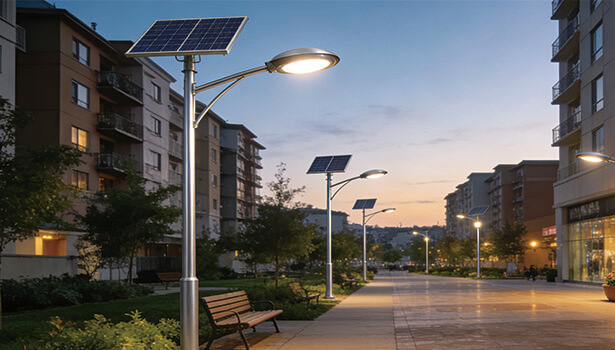
Solar street lights consist of four core components: solar panels, controllers, batteries, and LED fixtures, each ensuring stable operation. Compared to traditional grid-connected street lights, they eliminate the need for cable laying, incur zero electricity costs, and offer environmental benefits with zero pollution. They are well-suited for remote areas without grid access, boasting advantages in installation and maintenance costs alongside greater application flexibility.
Core Industry Challenges
The sector currently faces several development constraints: severe product homogenization, with most companies relying on low-price competition; slow performance improvements in core components, struggling to meet complex application demands; short lifespan of traditional lead-acid batteries, increasing operational costs; and inadequate maintenance systems, making fault diagnosis difficult in remote areas. Additionally, intense price competition squeezes R&D investment.
Global Market Size and Growth Potential
The global solar street light market continues to expand, reaching $5.2–6.23 billion in 2024, driven primarily by municipal demand in the Asia-Pacific region. It is projected to reach approximately $14.3 billion by 2032–2034, with a compound annual growth rate (CAGR) of 10.8%–10.96%. The Asia-Pacific region dominates the market, while emerging markets like Africa and Southeast Asia—where grid electricity coverage is insufficient—emerge as new growth engines.
Core Future Development Trends for Solar Street Lights
Intelligent Trend
Intelligent development represents a core trajectory. Leveraging IoT and AI technologies, solar street lights will transcend their traditional role as mere lighting fixtures. IoT + remote monitoring enables refined management, reduces manual maintenance costs, and facilitates deep integration with smart cities. By linking functions like traffic control and environmental monitoring, they become pivotal nodes in infrastructure networks.
High-Efficiency Trend
Advanced energy conversion and storage technologies will address industry pain points. Crystalline silicon cells continue efficiency breakthroughs, while thin-film cells expand applications due to lightweight adaptability. Lithium-ion batteries will replace traditional lead-acid batteries, delivering extended lifespan and reduced energy loss. Integrated distributed storage with street lights enables energy complementarity, solving endurance issues during cloudy or rainy weather.
Diversification Trend
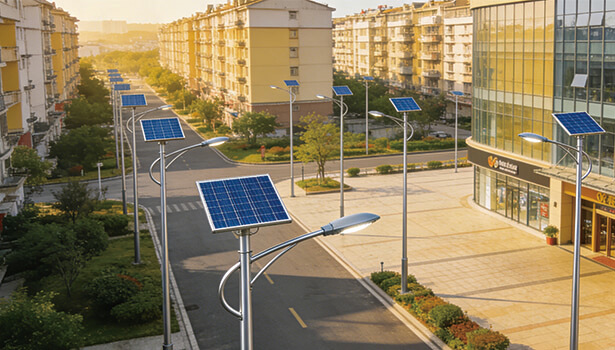
As technology matures and costs decrease, solar street light applications will expand beyond roads and parks to rural areas, remote mountain regions, and industrial parks. Product design will trend toward standardization and modularization, simplifying installation and maintenance while enabling individual component replacement. Simultaneously, designs will balance lightweight construction with durability to withstand diverse regional climates.
Marketization Trend
The global market will continue expanding, with the Asia-Pacific region solidifying its core position while emerging markets become new growth engines. Industry competition will shift from low-price battles to brand and differentiation strategies, intensifying supply chain integration as leading enterprises drive sector development. Government subsidies, tax incentives, and other policies will provide robust support for the solar street light industry.
Environmental Sustainability Trend
Guided by carbon neutrality goals, environmental sustainability permeates the entire lifecycle of solar street lights. Companies will adopt eco-friendly materials and optimize production processes to reduce carbon emissions. Establishing recycling systems for end-of-life components will enable resource circularity. From manufacturing and installation to operation and recycling, energy consumption will be minimized throughout the entire process. This commitment to sustainable development practices will foster the creation of green, environmentally friendly products.
Key Technological Innovations in Solar Street Lights
Panel Technology Innovations
Advanced solar panel technology will significantly boost power generation efficiency. High-efficiency heterojunction (HJT) panels achieve conversion efficiencies exceeding 26%, delivering stable power output even in low-light conditions. Flexible panels offer bendability and lightweight design, adapting to special scenarios like non-standard lamp posts. Self-cleaning panels utilize nano-coatings for automatic dust removal, reducing maintenance frequency and lowering operational costs.
Battery Innovations
Battery technology focuses on extended lifespan and enhanced safety. Solid-state lithium batteries will gradually replace traditional products, offering greater capacity, over 10,000 charge cycles, and superior safety. Low-temperature batteries operate reliably in extreme environments down to -40°C, making them suitable for high-latitude regions. Upgraded BMS systems optimize charging/discharging strategies to extend battery life.
Integrated Function Innovation
Integrated functional design adds value to solar street lights:
Lighting + charging station combo meets new energy mobility needs in communities and parking lots.
Lighting + environmental monitoring collects PM2.5, temperature, and humidity data for smart city development.
Integrated emergency lighting ensures public safety during emergencies.
Low-Cost Innovation
Cost-effective, low-maintenance technologies will drive industry-wide adoption. Modular component design allows for individual replacement of core parts, reducing maintenance costs and complexity. Standardized pre-fabricated installation kits minimize on-site construction time and labor expenses. Technical optimization and supply chain integration lower core component costs, enhancing solar street light cost-effectiveness and broadening application scenarios.
Challenges and Solutions for Solar Street Light Development
High R&D Costs
Current core technologies like HJT panels and solid-state batteries require substantial investment. Limited capital restricts small and medium-sized manufacturers from independent R&D, slowing industry innovation and perpetuating product homogenization.
Solution: Strengthen corporate-research collaborations, pursue policy subsidies, and have leading enterprises spearhead R&D for common technologies. Sharing R&D resources and distributing costs will lower innovation barriers for SME and drive industry-wide technological advancement.
Raw Material Price Volatility
Significant fluctuations in raw material prices, such as polysilicon and lithium ore, cause unstable production costs for enterprises. Core materials like polysilicon for solar panels and lithium ore for batteries experience frequent and substantial price swings influenced by market supply-demand dynamics and international geopolitics. This directly leads to fluctuating production costs, impacting pricing strategies and profitability. SME, with weaker risk resilience, are particularly vulnerable to such impacts.
Solution: Optimize supply chain management, diversify raw material sourcing, reduce material usage through technological improvements, and establish long-term agreements with core suppliers to lock in base procurement prices, thereby mitigating the impact of price volatility.
Shortage of Professional Talent
There is a significant lack of specialized personnel in R&D, marketing, and operations & maintenance (O&M), with a particularly acute shortage of high-end talent. The rapid growth of the solar street light industry has created a surging demand for professionals. However, the sector currently faces insufficient reserves of R&D talent, marketing professionals with expertise in overseas markets, and specialized O&M personnel. The gap in high-end, multi-skilled professionals who combine technical and managerial capabilities is especially pronounced, hindering technological innovation, market expansion, and improvements in O&M service quality.
Solution: Implement internal corporate training, establish targeted training programs through university-industry partnerships, and introduce preferential policies to attract high-end talent. Enhance the professional capabilities of existing employees, channel specialized talent to address gaps, and support the industry's high-quality development.
Product Quality Variability
Low-cost, substandard competition among small and medium-sized manufacturers has damaged the industry's reputation. Some solar street light producers, in their rush to capture market share, recklessly slash prices and use inferior core components, resulting in inconsistent product quality. Issues such as short battery life, frequent malfunctions, and reduced service life not only harm consumer interests but also tarnish the brand reputation of the entire solar street light industry and disrupt market competition order.
Solution: Establish industry quality standards, strengthen market oversight, enhance corporate quality control, and build premium brands. Define clear product quality metrics, crack down on substandard products, and guide enterprises toward quality-driven development.
With the energy transition and intelligent development, the solar street light industry faces significant opportunities, steadily advancing toward intelligence, efficiency, diversification, and environmental sustainability. Technological innovation will resolve industry pain points, while expanded application scenarios and policy support will grow the industry's scale. In the future, solar street lights will become the mainstream of public lighting and a core component of smart cities, contributing to the achievement of carbon neutrality and carbon peaking goals.