2026 Solar Street Lights for Sustainable Cities | NOKIN
Apr 17, 2026
When you drive through a certain community in Los Angeles at night, or jog on a trail in the suburbs of Nairobi - have you ever wondered: those brightly lit street lights are actually quietly burning through the city's budget, while also increasing carbon emissions? Traditional street lights are such a "hidden heavyweight". That's why from California to Lagos, more and more cities are starting to replace their traditional street lights with solar street lights. They are not just a pole and a board, but a mini energy system that can generate, store and light independently. Next, NOKIN will explain in a practical implementation perspective how solar street lights work, how much money they save, where they are most suitable for installation, and what technological changes will occur in the next three years in one go.
Why Solar Street Lights Are Critical for Sustainable Urban Development
The faster the urbanization process, the greater the energy pressure. You may not know: cities consume over 70% of the world's electricity, and public lighting accounts for 20% to 40% of electricity expenses in many cities.
Traditional street lights have two fatal flaws:
Expensive: Electricity costs are rising every year, and they will never stop.
Dirty: Most of the electricity comes from coal or natural gas, and a single ordinary street light can emit nearly 1.5 tons of carbon dioxide per year.
Solar street lights solve these two problems at the same time. It is not an "environmental decoration", but an economic account that can be calculated.
How Solar Street Lights Support Sustainable Energy Systems
Many people think that solar street lights are very complicated, but in fact, the principle is extremely simple. It is accomplished in four steps:
During the day, the photovoltaic panels on the light pole absorb sunlight.
The photovoltaic panels convert light through physical effects into direct current.
The electricity is stored in batteries (currently, lithium batteries are the mainstream).
At night, the controller automatically senses the decrease in light and allows the LED lights to draw electricity from the battery to light up.
The four core components are indispensable, Once this system is installed, it can operate independently of the power grid.
|
Component |
What It Does |
|
Solar Panels |
Generate electricity. Monocrystalline and polycrystalline panels are most common, with efficiency typically ranging from 22% to 28%. |
|
Batteries |
Store electricity. Lithium-ion batteries offer longer lifespan and higher energy density, largely replacing traditional lead-acid batteries. |
|
LED Lights |
Provide illumination. They are more than twice as energy-efficient as traditional sodium lights. |
|
Controllers |
Manage charging and discharging, prevent overcharging and over-discharging, and enable brightness adjustment and timing control. |
Key Sustainability Benefits of Solar Street Lights for Cities
Reducing Urban Energy Costs and Electricity Dependence
This is the most practical. A 30W LED solar street light can save approximately 1,460 kWh of electricity per year. At a cost of $0.12–$0.15 per kilowatt-hour, a single light can save $180–$220 per year. If a city installs 10,000 such lights, it can save $1.8 million–$2.2 million per year - this doesn't even take into account the increase in electricity prices.
Lowering Carbon Emissions and Supporting Carbon Neutrality
One solar street light can reduce approximately 1.5 tons of carbon dioxide per year. How much is that? It's equivalent to the carbon absorption of 85 bamboo trees in a year, or the equivalent of the emissions from a fuel-powered vehicle traveling from San Francisco to New York and back three times.
Enabling Off-Grid and Resilient Infrastructure
Coal and natural gas produce less and less, but the sun will rise tomorrow. Solar street lights help cities break free from reliance on fossil fuels, which is the most direct action on the path to carbon neutrality.
Minimizing Environmental Damage During Installation
This is particularly crucial in areas with unstable power grids. Remote rural areas, newly developed development zones, and even tourist trails on some small islands - if the power grid fails, the street lights will still be on. Public safety won't be paralyzed by a single power outage.
Simple installation, no need to dig trenches
The most annoying thing about traditional street lights is digging cable trenches: damaging the road surface, injuring the green belt, and possibly breaking water pipes. Solar street lights completely eliminate this step. The cost of installing one light is approximately $200–$300, which is 30%–40% cheaper than traditional street lights.
Reducing Maintenance and Resource Consumption
LED lights can last 50,000 to 100,000 hours, while lithium batteries need to be replaced every 5–8 years. Calculated per light, the annual maintenance cost is only $15–$25, while traditional street lights cost $50–$80 - because the bulbs and cables are more prone to failure.
Enhancing Public Safety Through Reliable Lighting
This is not just empty talk. In some crime-prone back alleys of Oakland, California, after installing solar street lights, violent crimes dropped by 21%, and residents' satisfaction with community safety increased by 34%. Lighting itself is the best low-cost security measure.
Supporting Smart City Development (IoT Integration)
Nowadays, solar street lights are no longer "dumb lights". With an IoT module, the background can remotely monitor the battery voltage, brightness, and fault status of each light. Even automatically adjusting the brightness based on traffic volume - further saving electricity.
Improving Energy Efficiency with LED Technology
The luminous efficiency of LED is 120–150 lumens/watt, while traditional sodium lights only have 60–80. For the same brightness, LED saves more than half of the electricity. This is crucial for solar systems.
Strengthening a City's Green and Sustainable Image
This is often overlooked but very important. When enterprises choose a location or high-end talents settle, they increasingly value a city's sustainability index. Installing solar street lights means telling the outside world: This city is seriously investing in green infrastructure.
Best Urban Scenarios for Solar Street Light Deployment
There is no specific requirement, but there are several scenarios that work particularly well:
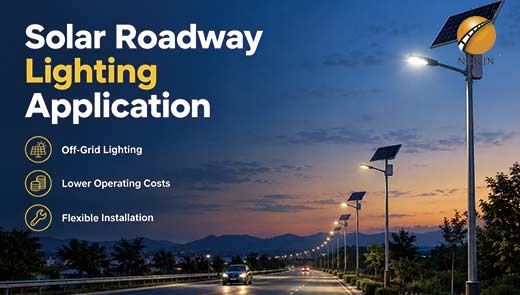
Urban main roads and secondary roads: The most common application, saving electricity and stability.
Parks and riverside walkways: No need to damage the green belt to lay cables, and the installation flexibility is high.
Parking lots: Whether it's a commercial ground-level parking lot or an internal park, 24-hour lighting costs are extremely low.
Rural areas and off-grid regions: Many villages don't want to install street lights because the cable laying is too expensive. Solar street lights are the only reasonable solution.
Real-World Case: Solar Street Lights Driving Sustainable Growth in Kenya
In Kitui County, Kenya, the government, through a World Bank-funded project, installed over 3,000 solar street lights. Previously, there was almost no nighttime lighting, and robberies and traffic accidents were frequent. After one year of installation, nighttime commercial activities increased by 40%, and students' safe return home after evening study classes was also ensured.
Solar Street Lights vs Traditional Lighting: A Sustainability and Cost Perspective
|
Comparison Item |
Solar Street Lights |
Traditional Street Lights |
|
Initial Cost |
$300 – $800 per light |
$200 – $500 per light (excluding trenching and wiring) |
|
Annual Operating Cost |
$15 – $25 (maintenance only, no electricity cost) |
$65 – $105 (electricity + maintenance) |
|
Carbon Emissions |
Zero |
High (mainly from thermal power generation) |
|
Installation Time |
1 – 2 days per light, no excavation required |
3 – 5 days per light, requires trenching and cabling |
|
Grid Dependence |
Independent (operates during power outages) |
Fully dependent (blackouts result in no lighting) |
|
Annual Failure Rate |
≤ 5% |
≥ 15% (due to cable aging and bulb degradation) |
At a glance: Solar streetlights are slightly more expensive upfront, but within two years, the savings on electricity bills can recoup the difference, and thereafter, it's all net gains.
Future Trends: Smarter and More Sustainable Solar Street Lighting Systems
Advancements in Solar Panel Efficiency
New battery technologies such as perovskite and heterojunction are being commercialized. By 2027, the conversion efficiency is expected to increase from the current 22% to 28%. The same-sized panel will generate more electricity.
Next-Generation Battery Storage Technologies
Lithium batteries are still reducing costs by 5% - 8% annually, and energy density is also increasing. Even if there are three or four cloudy days in a row, the streetlights can still hold up.
AI-Driven Smart Lighting Systems
AI can automatically adjust brightness based on weather predictions, real-time traffic, and vehicle flow. In the late night when there are few vehicles or people, it automatically dims to 30% brightness, and it brightens up instantly when someone or a vehicle passes by - this model is already in trial operation in the Poblenou district of Barcelona, Spain. According to municipal data, energy consumption has been reduced by an additional 18%.
Multi-Functional Smart Poles for Urban Infrastructure
It will become a node in a smart city. It can hang 5G base stations, air quality sensors, and even security cameras. One pole, multiple uses. Singapore has deployed such intelligent solar streetlight poles in the Jurong Lake District, integrating environmental monitoring and free Wi-Fi hotspots.
Conclusion: Solar Street Lights as a Foundation of Sustainable Cities
Solar street light is a cost-effective decision.
Economically: Save on electricity bills, maintenance costs, and trenching costs.
Environmentally: Zero carbon, renewable.
Safely: Not afraid of power outages, and the crime rate drops at night (the Auckland case is conclusive evidence).
In the future: Naturally suitable for smart city integration.
If you are evaluating the lighting solution for a park, a new road, a village, or even a new city, solar streetlights should no longer be considered as an "alternative" - it is becoming the default option.
FAQ: Solar Street Lights in Sustainable Urban Applications
How long can solar street lights operate during cloudy days?
It depends on the battery capacity and design. Standard products are designed to last "for 3 to 5 consecutive rainy days" and won't turn off as soon as they light up.
Do solar street lights perform well in winter conditions?
It will have a slight effect, but during the design process, the panels and batteries will be configured based on the worst monthly sunlight data in the local area. In Alaska and Florida, the configurations are different.
How secure are solar street light systems against theft?
The current mainstream designs come with anti-theft brackets and anti-theft screws. The batteries are hidden inside or at the top of the light pole and cannot be easily removed.
What is the lifecycle of a solar street lighting system?
The LED light core can last for 5 to 8 years without any problem. The solar panel can be used for over 20 years. The battery needs to be replaced every 5 to 8 years. The overall lifespan is far longer than the payback period.