Solar-powered Street Lighting: Paving the Way for Safer and More Sustainable Cities
Jan 29, 2026
In the global pursuit of sustainable urban development and low-carbon transformation, pressing challenges in city lighting—including grid dependency, excessive energy consumption, and illumination blind spots—demand urgent solutions. As an off-grid lighting solution, solar street lights harness solar energy to deliver both safe illumination and ecological sustainability, emerging as an optimal choice for urban advancement. This article analyzes their enabling value for sustainable urban development from multiple dimensions: principles, advantages, challenges, and prospects.
Solar Street Lights Fundamentals: Deconstructing the Working Principle
What are Solar Street Lights?
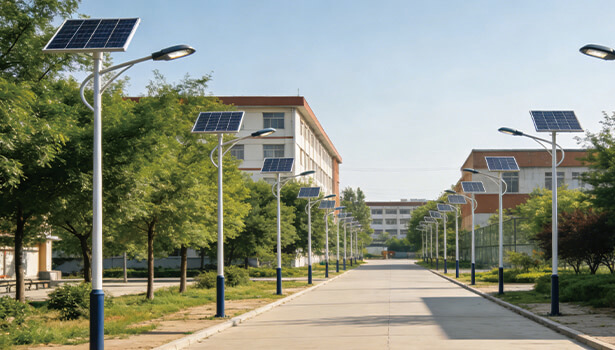
Solar street lights are essentially off-grid lighting systems. Their core feature is operating without connection to traditional city grids, relying entirely on solar energy for collection, storage, and utilization. Widely applicable to urban main roads, secondary roads, remote sections, parks, residential areas, and rural roads, it forms a complete solar lighting system. This solution not only addresses the coverage gaps of traditional streetlights but also effectively reduces energy consumption and environmental pressure in urban lighting, representing a practical and eco-friendly new outdoor lighting approach.
Workflow
The solar streetlight's workflow is streamlined and efficient, comprising three core steps that achieve complete conversion from solar energy to electricity and ultimately to illumination energy—all while maintaining a green, pollution-free process.The photovoltaic (PV) panel atop the unit serves as the central energy-harvesting component. It directly converts solar energy into electricity via the photovoltaic effect, providing the system's initial power. This panel efficiently captures sunlight even during overcast conditions. The converted electricity is transmitted to the battery for solar energy storage. Different models offer varying storage capacities; high-performance models can support continuous illumination for up to 100 hours, easily handling scenarios like consecutive rainy days with no sunlight. When external light intensity drops below a preset threshold, the streetlight automatically activates its illumination mode, releasing stored battery power. Illumination duration and brightness can be adjusted according to the scenario, ensuring efficient energy utilization.
Core Technology Support and Factors Affecting Endurance
The efficient operation of modern solar streetlights relies on two core technologies and is influenced by three key factors affecting illumination endurance, collectively ensuring stable device performance. Currently, solar streetlights predominantly utilize LED light sources, offering the core advantages of “high brightness and low energy consumption.” Compared to traditional high-pressure sodium lamps, they achieve 50%-70% energy savings and boast a lifespan of 5-10 years, perfectly aligning with solar energy storage requirements.
Smart solar streetlights also incorporate specialized sensors for intelligent lighting control. These sensors automatically detect ambient light levels and detect pedestrian/vehicle movement, enabling automatic activation at dusk and intelligent brightness adjustment throughout the night. This further enhances energy efficiency and aligns with sustainable urban development principles. The illumination duration of solar streetlights is primarily influenced by three factors: battery capacity, photovoltaic panel size, and light source type. Specific comparisons are outlined below:
|
Influencing Factor |
Description |
Impact on Lighting Duration |
|
Battery Capacity |
Larger battery capacity allows more energy to be stored |
Longer continuous lighting time |
|
Solar Panel Size |
Larger panels collect solar energy more efficiently |
Faster charging, indirectly extending operating time |
|
Light Source Type |
Modern LED light sources consume far less power than traditional lighting |
Lower energy consumption enables longer lighting duration with the same battery capacity |
Advantages of Solar Street Lighting for Urban Safety and Ecology
Empowering Urban Safety
Adequate and stable nighttime illumination forms the foundation of urban safety. Leveraging their off-grid advantage, solar street lights establish a comprehensive urban safety lighting system, holistically enhancing nighttime security levels and ensuring citizen safety during travel. Independent of the power grid, they can be flexibly deployed in remote road sections, urban villages, park paths, and other areas traditionally difficult for conventional streetlights to cover, achieving seamless illumination without blind spots and reducing high-risk zones for safety hazards.
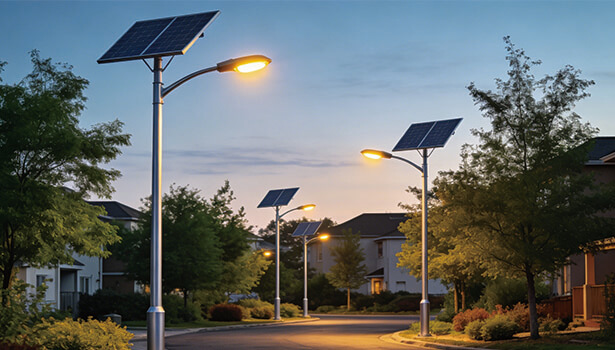
Powered by battery storage, high-performance solar street lights provide continuous illumination for up to 100 hours, remaining unaffected by grid outages or line failures. This ensures uninterrupted nighttime lighting, mitigates safety risks from sudden darkness, and reduces traffic accident rates. They thus support urban governance while enhancing citizens' sense of security during travel.
Supporting Ecological Sustainability
Powered by clean, renewable solar energy, these lights eliminate the need for traditional thermal power generation, achieving “zero carbon emissions.” As exemplary low-carbon lighting infrastructure, they directly reduce greenhouse gas and pollutant emissions, aiding cities in reaching carbon peak and carbon neutrality goals. Their operation produces no exhaust gases, wastewater, or noise pollution. Core components are recyclable, and the absence of cable installation minimizes damage to roads and vegetation, aligning with eco-city development principles.
Furthermore, their low-energy LED light sources combined with sensor-based smart controls make them energy-efficient lighting products. Eliminating electricity bills, they generate significant long-term savings in municipal lighting expenses while reducing energy and environmental management costs.
Reduced Operational Costs
Compared to traditional streetlights, solar street lights offer significant advantages in maintenance and adaptability, particularly aligning with the practical needs of B2B procurement entities. Their long-term cost-effectiveness is notably superior. The off-grid design eliminates the need for power grid maintenance, while the extended lifespan of core components minimizes servicing frequency, making them low-maintenance lighting solutions. Certain smart models feature fault warning capabilities, further reducing labor and material costs.
Installation is convenient and flexible, allowing adjustments to location and quantity based on urban planning. Lighting brightness and duration can be customized as needed, making them suitable for various scenarios such as main roads, parks, and rural areas. No large-scale infrastructure upgrades are required, and they perform effectively in rural lighting and campus lighting applications.
Challenges and Solutions in Implementing Solar Street Lighting
Core Implementation Challenges
The first challenge is the relatively high initial investment cost. The procurement cost of solar street light core components is elevated, posing a primary concern for purchasers in regions with limited budgets and increasing implementation difficulty. The second challenge is limited environmental adaptability. Energy collection relies on sunlight, and extreme weather or areas with poor sunlight can affect lighting stability. The third challenge is insufficient maintenance expertise. Solar street lights integrate multiple technologies requiring specialized personnel for post-installation operation and maintenance. However, small and medium-sized cities and rural areas often lack such professionals, making rapid fault resolution difficult.
Targeted Solutions
To address the initial investment cost issue, leverage national and local low-carbon subsidy policies to assist purchasers in applying for subsidies. Simultaneously, emphasize the long-term value of zero electricity costs and low maintenance expenses, offsetting initial investment with long-term benefits to highlight its high cost-effectiveness. To address environmental adaptability concerns, technological upgrades can enhance photovoltaic panel efficiency in low-light conditions and improve battery resistance to extreme temperatures.
Integrating intelligent monitoring and adjustment systems ensures stable lighting under harsh conditions, further refining the overall system's adaptability. To address the lack of operational expertise, equipment suppliers can offer comprehensive maintenance services, including professional training and on-site repairs. Establishing an intelligent maintenance platform for fault prediction lowers technical barriers, making solar streetlight implementation more accessible.
The Future of Urban Lighting: The Potential and Prospects of Solar Technology
Trends in Technological Advancement
Intelligent upgrades represent a key direction. Future solar streetlights will integrate IoT, big data, and artificial intelligence technologies, deeply incorporating smart sensor control to achieve interconnectivity and remote management. Lighting modes will be optimized based on traffic and pedestrian flow, supporting the development of smart city lighting systems.
Efficiency upgrades will accelerate further. Breakthroughs in photovoltaic and energy storage technologies will enhance panel conversion efficiency and battery capacity while reducing production costs, enabling solar streetlights to gradually replace traditional ones for widespread adoption. Diversification will also become mainstream, as solar streetlights transcend basic lighting to integrate charging stations, surveillance, environmental monitoring, and WiFi hotspots. They will evolve into comprehensive low-carbon urban infrastructure, boosting overall utility value.
Long-Term Value for Sustainable Cities
The widespread adoption of solar streetlights will significantly reduce carbon emissions in urban lighting, promote the greening of urban energy structures, and support the achievement of carbon peak and carbon neutrality goals. This makes low-carbon lighting a crucial driver for urban low-carbon transformation. Their proliferation will also improve urban infrastructure by eliminating lighting blind spots, achieving comprehensive coverage without dead zones, enhancing nighttime safety and landscape quality, and creating modern cities that are “safe, convenient, green, and smart.” This will boost citizen well-being and refine sustainable urban lighting systems.
Simultaneously, solar street lights will drive the low-carbon and intelligent transformation of the traditional lighting industry, spurring development across related industrial chains such as photovoltaics, energy storage, and LED technology. This will generate new industrial value and job opportunities, supporting high-quality economic development and positioning solar street lights as a green engine for urban progress.
With their zero-carbon, intelligent, and convenient characteristics, solar streetlights perfectly balance urban safety and ecological sustainability, positioning them as core low-carbon infrastructure for modern city building. Their mature technology and significant advantages, coupled with solutions for various implementation challenges, have enabled their gradual large-scale adoption. As technology advances, solar streetlights will continue to empower low-carbon urban lighting systems and smart city illumination projects, injecting green momentum into urban development to make cities safer, more sustainable, and more beautiful.