Why Are Malaysian Cities Increasingly Switching To Solar Street Lights?
Mar 16, 2026
From the bustling streets of Kuala Lumpur to the waterfront areas of Penang, and on to the town centres of Johor, a ‘green revolution’ in street lighting is sweeping across Malaysia’s cities. Traditional municipal street lights are gradually being replaced by solar-powered alternatives, marking a new trend in urban development. As a tropical nation, Malaysia enjoys abundant sunshine, providing a natural foundation for the promotion of solar street lighting.
However, this transition is by no means merely a matter of ‘jumping on the green bandwagon’. it is underpinned by multiple considerations, including municipal budgets, infrastructure, policy direction and technological suitability. This article will provide an in-depth analysis of the key reasons behind Malaysia’s shift towards solar street lighting, combining local policies and technological advantages to offer comprehensive guidance for municipal administrators, engineering contractors and green energy professionals.
The Current State of Urban Lighting in Malaysia
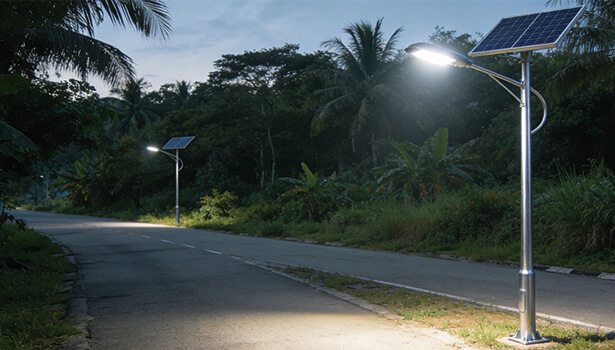
For a long time, municipal lighting in Malaysia has relied on traditional grid-powered systems. However, as cities develop and environmental conditions change, two core challenges have become increasingly apparent, serving as the direct driving force behind the transition to solar street lighting.
Rising Electricity Costs and the Pressure on Municipal Budgets
In recent years, commercial and industrial electricity tariffs in Malaysia have fluctuated continuously, placing significant pressure on municipal finances. From July 2025, the electricity tariff in Malaysia was adjusted to 45.40 sen per kilowatt-hour, further exacerbating the burden on municipal expenditure. As a fundamental municipal service, street lighting accounts for 10–20% of total municipal electricity expenditure. For local councils, limited budgets force them to make difficult trade-offs between ‘ensuring the safety of public lighting’ and ‘investing in other public services’.
Of particular concern is the fact that nearly 80% of street lights in Malaysia still do not utilise energy-efficient LEDs. the high energy consumption of traditional light sources further exacerbates the pressure on electricity costs.
Aging Infrastructure and the “Copper Theft” Challenge
Traditional street lights in Malaysia rely on underground cables for power, yet the ageing electricity network has long been unable to cope with the load. During the monsoon season, the humid climate often causes underground cables to become damp and short-circuit, leading to street light failures and even posing safety hazards on the ground. Even more of a headache is the problem of copper cable theft in suburban and remote areas. this is a long-standing issue that is difficult to eradicate. Once copper cables are stolen, not only do the street lights in that area remain off for extended periods, but rewiring also requires significant investment in labour and materials, causing considerable difficulties for municipal authorities.
The installation and maintenance of traditional street lights require significant manpower. Complex cabling works are not only time-consuming but also disrupt urban traffic and residents’ journeys, rendering them ill-suited to the rapid development of Malaysian cities.
Four Key Reasons for Malaysia’s Adoption of Solar Street Lights
Economic Drivers: Controllable Costs and Attractive Return on Investment
For municipal administrators and engineering contractors, the core appeal of solar street lights lies in their long-term economic value. Although the initial investment is higher than that of traditional grid-connected HID or LED lights, the Total Cost of Ownership (TCO) offers significant advantages in the long run.
Comparison of ROI and TCO Advantages
Taking into account local electricity prices and maintenance frequency in Malaysia, the payback period for solar street lights is typically 24–36 months. Compared to traditional street lights, their total cost of ownership over a five-year period can be reduced by 30%–50%, as illustrated in the table below (based on 100 street lights with a brightness of 100W, over a five-year period):
|
Comparison Item |
Solar Street Lights |
Traditional Grid-Powered Street Lights |
Advantage Explanation |
|
Initial Investment (Including Installation) |
Higher cost per unit, but no additional wiring required |
Lower base unit cost, but requires additional investment in cables, transformers, and infrastructure |
Traditional street lights require extra materials and construction costs for wiring |
|
5-Year Electricity Cost |
0 |
Continuous high electricity expenses |
Solar street lights eliminate electricity costs and avoid electricity price fluctuations |
|
5-Year Maintenance Cost |
Only occasional battery replacement required |
Requires light source replacement, cable repairs, and other maintenance |
Solar street lights reduce maintenance costs by 60%–80% |
|
5-Year Total Cost |
Significantly lower than traditional street lights |
Overall cost remains high |
Solar street lights reduce total cost by about 14.7% |
Advantages in Installation and Labour Costs
Solar street lights operate on a ‘plug-and-play’ basis, eliminating the need for trenching and cabling. Installation time is reduced by 70% compared to traditional street lights. This not only minimises the impact of construction work on urban traffic but also significantly reduces labour costs. Furthermore, the copper-free design completely eliminates the problem of copper theft, thereby avoiding the repeated repairs and financial losses caused by stolen cables, and further reducing the hidden costs of municipal management.
Government Incentive Policies
Through the Sustainable Energy Development Board, the Malaysian government has introduced a number of incentive policies to promote the adoption of solar street lights. These include the 2026 Energy Audit Subsidy Scheme, which provides subsidies for solar project audits to local authorities and businesses to reduce initial assessment costs. A 100% tax deduction for green asset investments allows businesses and local authorities to benefit from a full tax deduction on investments in green assets such as solar street lights. Furthermore, from 1 August 2025, businesses procuring green electricity through designated channels will be exempt from the 1.6% Renewable Energy Fund levy, thereby further reducing operational costs.
Policy and Environmental Drivers
Significant Emissions Reduction
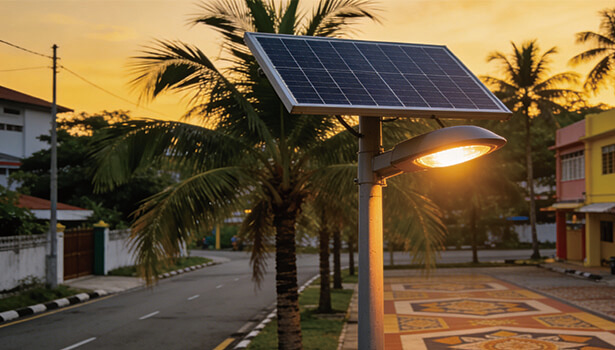
Data indicates that installing 100 solar street lights can reduce CO₂ emissions by approximately 25 tonnes annually. this figure holds significant appeal for local authorities seeking to meet emissions reduction targets. With Malaysia set to introduce a carbon tax on the steel and energy sectors in 2026, the emission-reduction value of solar street lights will become even more prominent, serving as a key means for businesses and local authorities to mitigate carbon tax costs.
Alignment with the National Green Transition Strategy
Malaysia’s 2026 Budget explicitly identifies green technology development as a priority, including the Solar Accelerated Transition Action Plan. The promotion of solar street lights represents not only an upgrade to municipal lighting but also a concrete manifestation of the national green transition strategy. It contributes to Malaysia’s efforts to establish itself as a regional green energy hub and enhance the country’s green competitiveness. As of June 2025, Malaysia’s cumulative solar installed capacity had exceeded 3 gigawatts, with solar energy becoming the primary driver of renewable energy growth in the country.
Technology-Driven: Adapted to Malaysia’s Tropical Climate
Core Components
Lithium iron phosphate (LiFePO4) batteries are selected and paired with a Battery Management System (BMS). This type of battery is heat-resistant and can operate stably in environments exceeding 40°C, with a cycle life of up to several thousand cycles—40% longer than traditional lead-acid batteries. The BMS system also protects the batteries and enhances operational efficiency.Monocrystalline silicon solar panels are utilised, with an efficiency of 18–22%, which is higher than that of polycrystalline panels. This enables maximum utilisation of sunlight under Malaysia’s cloudy conditions, thereby improving charging efficiency.
The luminaires must meet an IP65 or higher protection rating. The lamp posts are made of galvanised steel or powder-coated aluminium alloy, capable of withstanding heavy rain and dust erosion, offering excellent corrosion resistance. They are well-suited to Malaysia’s monsoon climate, thereby extending the overall service life.The control system is equipped with ALS 2.4 adaptive lighting, motion sensors and dimming functions, automatically adjusting power output based on battery charge and ambient light levels. It can operate normally even during 9–13 consecutive days of rain, effectively optimising energy consumption.
Natural Advantages
Malaysia’s frequent rainfall naturally cleans the solar panels, reducing the costs and labour involved in manual cleaning. This feature further lowers the maintenance costs of solar street lights in Malaysia, making them particularly suitable for remote roads and rural areas. In these regions, where deploying aerial work platforms is difficult and costly, the low-maintenance nature of solar street lights is of paramount importance.
Key Factors for Choosing the Best Solar Street Lights in Malaysia
Battery Selection
The battery is the ‘heart’ of a solar street light, directly determining its service life and operational stability. In Malaysia, lithium iron phosphate (LiFePO4) batteries should be prioritised over traditional lead-acid batteries. When selecting a battery, attention must be paid to its cycle life and the Battery Management System (BMS) to ensure long-term, stable operation in high-temperature and high-humidity environments, thereby avoiding the costs associated with frequent replacements caused by rapid battery degradation.
Solar Panels
Although Malaysia enjoys ample sunshine, cloudy weather is also common. therefore, the efficiency of solar panels is crucial. It is recommended to choose monocrystalline silicon panels, as their efficiency (18–22%) is higher than that of polycrystalline silicon panels, enabling maximum power generation under limited sunlight conditions. At the same time, the size of the panels should be selected in accordance with the installation context, balancing efficiency with compactness to suit the installation requirements of different settings such as urban roads, parks and suburban areas.
LED Light Sources
LED light sources are the ‘core lighting’ of solar street lights.The LED light source is the ‘core lighting component’ of solar street lights, directly affecting both the quality of night-time illumination and the product’s service life. When selecting a light source, opt for chips from well-known brands such as Philips, Cree and Osram to ensure high lumen output (8,800–15,400 lm is required for road lighting), maintain a colour temperature of 5,000–6,000K to ensure clear night-time illumination, whilst the service life should reach 50,000–100,000 hours to minimise replacement frequency.
Protection and Structure
Given the frequent monsoon rains in Malaysia, the protective performance of luminaires and lamp posts is of paramount importance. Luminaires must meet an IP65 or higher protection rating to withstand heavy rain and dust erosion, whilst lamp posts should preferably be made of galvanised steel or powder-coated aluminium alloy to ensure excellent corrosion resistance. Furthermore, solar street lights with a modular design are easier to maintain, minimising the inconvenience caused by road closures and reducing labour and time costs associated with maintenance.
Smart Features
It is recommended to select solar street lights with smart control functions, including motion sensors, dimming capabilities and scheduled lighting. These features allow power output to be adjusted according to actual lighting requirements, optimising energy consumption and extending battery life, whilst simultaneously enhancing the intelligence of night-time lighting.
Beware of Low-Cost, Substandard Products
Some low-cost solar street lights on the market often utilise substandard batteries and panels, which are prone to failure in Malaysia’s high-temperature, high-humidity environment, thereby increasing long-term maintenance costs. When procuring, particular attention should be paid to the quality of the batteries and panels, prioritising solar street lights with brand guarantees and comprehensive after-sales support to avoid long-term losses resulting from short-term cost savings.
The promotion of solar street lights across Malaysian cities is an inevitable choice resulting from the combined effects of abundant solar resources, optimisation of municipal costs, policy direction and technological suitability. This approach not only resolves the energy consumption and maintenance challenges associated with traditional street lights but also aligns with the nation’s long-term strategy for green transition. With continuous technological advancements and ongoing policy support, solar street lights will gradually extend their coverage to more urban areas across Malaysia, emerging as a new option for municipal lighting that combines economic efficiency, environmental sustainability and practicality.