How to Evaluate the Overall Performance of Solar Street Lights?
Dec 09, 2025
Amid the global trend toward energy conservation and emissions reduction, solar street lights have become the core lighting choice for urban infrastructure, rural roads, industrial parks, and other scenarios due to their energy efficiency, low maintenance, and environmental benefits. However, not all solar street lights deliver the expected performance. Neglecting performance evaluation may lead to issues like insufficient illumination, frequent malfunctions, high replacement costs, and even safety hazards. This article provides a scientific solar street light performance evaluation system for procurement personnel, project managers, and operations teams—covering core metrics, advanced testing methods, and practical techniques—to help you accurately select cost-effective products.
Understanding the Importance of Solar Street Light Performance
The Core Value of Solar Street Lights in Sustainable Infrastructure
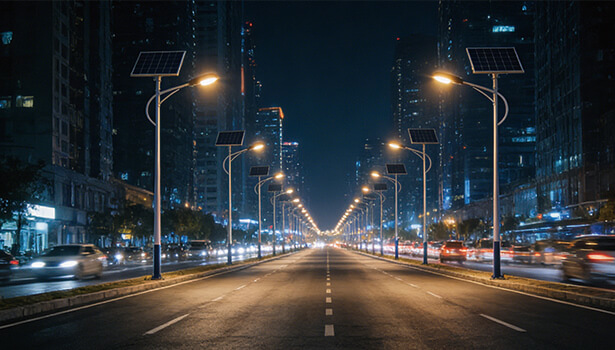
Solar street lights operate independently of the grid, converting sunlight into electricity via photovoltaic panels and storing it in batteries to illuminate roads at night. Their core value manifests in three key areas: First, energy conservation and carbon reduction, with zero electricity costs and no carbon emissions. Second, low maintenance expenses, featuring long component lifespans that minimize manual inspection frequency. Third, flexible installation, eliminating the need for cable laying and making them suitable for remote areas or complex terrains.
Potential Risks of Neglecting Performance Evaluation
Purchasing solar street lights without performance testing may lead to multiple issues: poor illumination resulting in dark spots or insufficient brightness, compromising pedestrian and vehicle safety. Short battery life failing to sustain overnight lighting, especially prone to “shutdown” during rainy or cloudy weather. Insufficient durability causing rapid aging under sun and wind exposure, leading to higher-than-expected replacement costs. Failed smart functions, such as sluggish motion sensor responses or uncontrolled adaptive lighting.
Core Testing Metrics for Solar Street Lights
Photovoltaic Panel Efficiency
As the power generation core, panel efficiency directly determines charging capacity—critical during low-light conditions like overcast days or winter. Efficiency measures solar-to-electric conversion ratio, impacting charging speed, rainy-day endurance, and winter supply stability.
Testing involves three steps: measuring peak irradiance with a pyranometer, measuring actual power output with a wattmeter, and comparing results against the supplier's rated efficiency to prevent misrepresentation. Recommended benchmarks: monocrystalline silicon ≥18%, polycrystalline silicon ≥15%. High-efficiency products can exceed 22%; prioritize these if budget permits.
Battery Performance and Storage Capacity
Batteries store electricity, directly determining the nighttime illumination duration and product lifespan of solar LED street lights. Core parameters include capacity (Ah), discharge rate, and cycle life.
Testing requires two steps: Simulate local nighttime duration to measure continuous illumination time at standard brightness after full charge. After 500-1000 charge-discharge cycles, test capacity decay rate.
Recommendations: Design capacity based on local nighttime duration + 20% redundancy (e.g., ≥100Ah battery for 10-hour lighting). Add an extra +30% capacity in regions with frequent rain or cloudy conditions. Prioritize lithium batteries with ≥1500 cycles over lead-acid batteries with ≤500 cycles.
Lighting Output (Lumens)
Lumens measure a light source's total luminous flux, directly indicating solar street light brightness. Select appropriate lumen values based on application scenarios to avoid overbrightness waste or underperformance.
For residential roads, a minimum of 3000 lumens is recommended. During testing, measure actual brightness at 5m and 10m using an illuminance meter while checking illumination uniformity to ensure no significant dark zones. For main and secondary roads, a minimum of 8000 lumens is recommended. Ensure illuminance does not fall below 20 lux within a 15-meter radius, and that the beam spread angle aligns with the road width. For parking lots and campus roads, a minimum lumen output of 5000 lumens is recommended. Key areas (such as entrances/exits and passageways) must achieve an illuminance of 15 lux or higher, while avoiding glare that impairs visibility. Rural paths should prioritize basic lighting while considering energy efficiency; a minimum lumen output of 2000 lumens is sufficient.
Battery Life and Endurance
Solar street lights must meet dual requirements: providing illumination throughout the night and ensuring stable operation over multiple years. These metrics directly impact long-term operating costs.
Operating Duration Assessment
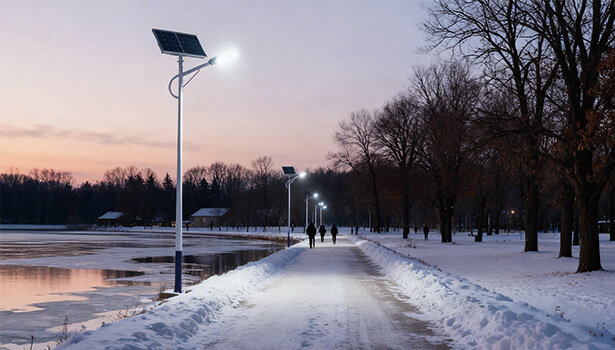
Can the LED street light maintain illumination at standard brightness from full charge until dawn the following day?
Testing methods simulate worst-case lighting conditions, such as three consecutive overcast days. Record daily illumination duration changes and observe battery discharge stability. The qualifying standard requires at least meeting the region's longest nighttime duration—e.g., approximately 12 hours during summer nights and 14 hours during winter nights—adjusted based on local conditions.
Battery Life Assessment
How many years does it take for battery capacity to degrade below 80%?
Testing employs accelerated aging trials to simulate annual charge-discharge cycles, predicting actual lifespan. Qualifying standards require lithium batteries to last no less than 5 years and lead-acid batteries no less than 3 years. Actual lifespan varies based on usage environment (e.g., temperature, charge-discharge frequency).
Durability and Weather Resistance
Solar street lights endure prolonged outdoor exposure to harsh conditions including rain, snow, extreme heat, freezing temperatures, and dust. Their durability directly determines maintenance costs.
|
Evaluation Dimension |
Specific Requirements |
Testing Method |
|
IP Rating |
General environments ≥ IP65; coastal / rainy / dusty areas ≥ IP67 |
Review product certification report; simulate spray and dust tests |
|
Material Quality |
Lamp body made of aluminum alloy / stainless steel (corrosion-resistant); lampshade made of PC material (impact-resistant) |
Check material inspection report; observe coating uniformity |
|
Extreme Weather Resistance |
High-temperature resistance (≥65℃); low-temperature resistance (≤-20℃); wind resistance (≥ Level 12) |
Simulated high-/low-temperature tests; test pole compression strength |
|
Corrosion Resistance |
Coastal areas require salt-spray corrosion protection |
72-hour salt-spray test with no significant corrosion |
Smart Features and Integration
An increasing number of solar street lights incorporate smart features to enhance energy efficiency and management effectiveness, necessitating rigorous verification of their performance stability. For human motion detection capabilities, key evaluation criteria include response time (≤0.5 seconds), detection range (≥8 meters), and detection angle (≥120°). Testing should simulate real-world pedestrian and vehicle movements to verify whether sensitivity meets specifications.
Adaptive lighting functionality must verify whether the street light can automatically adjust brightness based on ambient light levels and pedestrian traffic, such as reducing to 30% brightness when unoccupied. Test the accuracy of brightness adjustment across different scenarios.
Advanced Testing Methods and Techniques for Solar Street Lights
Real-World Field Testing
Field testing provides the most realistic assessment method, effectively identifying issues overlooked in laboratory testing. Implementation involves installing 1-3 solar street light samples at the target installation site for continuous monitoring over 1-3 months.
Data collection must record key metrics daily, including: - Daily sunlight duration - PV panel charging capacity - Battery remaining power - Lighting effectiveness - Number of malfunctions The core value lies in verifying product adaptability to local climate, topography, and illumination conditions—such as the impact of tree shade or building obstructions on charging—which cannot be fully replicated in laboratories.
Software Simulation Performance Testing
Utilize specialized software to simulate diverse environmental conditions, preemptively identifying potential product issues and mitigating post-installation risks. Common tools include PVsyst, HOMER, and DIALux. Simulable scenarios encompass low-sunlight days, prolonged rainy periods, extreme temperatures, and improper installation angles.
The core value lies in optimizing solar LED street light installation plans in advance—such as adjusting panel angles—while avoiding selection errors. For instance, if battery capacity insufficiency is detected, adjustments can be made before procurement.
Remote Monitoring System Testing
For large-scale projects, remote monitoring systems enable real-time management of solar street lights, making their stability a key testing focus. System components include data acquisition modules (monitoring PV output, battery status, and illumination brightness), transmission modules, and platform modules.
Key testing points include data collection frequency (≥1 time/hour), data accuracy (error ≤5%), and alarm response speed (alert within ≤10 minutes after anomaly detection). The core value lies in enabling unmanned management, promptly identifying performance degradation (e.g., reduced panel efficiency, battery faults), and reducing maintenance costs and manual inspection burdens.
Practical Techniques for Comprehensive Evaluation
Multi-Brand Comparison
Don't rely solely on LED solar street light supplier brochures. Request third-party test reports to ensure data authenticity and reliability. Focus on comparing the difference between “rated parameters” and “actual measured parameters” (e.g., solar panel efficiency, battery capacity). The difference rate should be ≤10%; exceed this threshold, and exercise caution in selection. Prioritize brands with strong market reputation and extensive case studies. Refer to usage feedback from similar projects to understand real-world performance.
Adjust Evaluation Standards Based on Local Environment
In low-sunlight regions, prioritize evaluating photovoltaic panel efficiency and battery redundancy capacity to address insufficient illumination. In high-temperature areas, focus on testing solar street light battery heat resistance and heat dissipation to prevent lifespan reduction due to extreme heat.
In coastal regions, strengthen assessments of salt fog corrosion resistance and typhoon resilience for light poles to adapt to marine climates. In cold regions, emphasize battery low-temperature discharge efficiency (capacity retention ≥70% at -20°C) to ensure reliable winter operation.
Emphasis on After-Sales Service and Technical Support
Require suppliers to provide a minimum 2-year warranty, with core components like photovoltaic panels and batteries warrantied for ≥5 years to reduce long-term maintenance costs. Confirm availability of solar street light installation guidance, commissioning services, and regular inspection plans—professional technical support is critical, especially for large-scale projects. Verify after-sales response times and repair parts supply cycles to prevent prolonged outages due to unresolved failures.
Prioritize Products with Authoritative Certifications
Authoritative certifications serve as crucial safeguards for product quality. When procuring, verify the following certifications. International certifications include CE and RoHS, applicable for export-bound projects or those with stringent quality requirements. Specialized certifications encompass TÜV certification for photovoltaic panels and UN38.3 certification for batteries (safety certification), focusing on the quality and safety of core components.
Scientific solar street light performance evaluation is key to balancing lighting effectiveness, operational costs, and long-term stability. Only through precise testing of core metrics, field-based validation in real-world scenarios, and comprehensive consideration of local environmental factors and after-sales support can one select truly cost-effective solar street lights that meet specific requirements.