All-in-One Solar Street Light Installation: Tips and Tricks for a Successful System
Feb 11, 2026
In the field of outdoor lighting, green energy efficiency and convenient installation have become core requirements. All-in-one solar street lights, with their unique advantages, are gradually replacing traditional street lights as the preferred solution for municipal areas, residential communities, parks, and other settings. Compared to traditional street lights, all-in-one solar street lights eliminate the need for complex wiring, offering efficient installation and easy maintenance while balancing energy savings with smart features to suit diverse outdoor environments. This article comprehensively breaks down the selection and installation process for all-in-one solar street lights, sharing practical techniques to help readers achieve efficient, stable system installation while reducing construction costs and post-installation failure rates.
Understanding All-in-One Solar Street Lights
Core Definition of All-in-One Solar Street Lights
The fundamental difference between all-in-one solar street lights and traditional lights lies in their “integrated design.” All core components—solar panels, energy storage batteries, controllers, and LED lamp beads—are consolidated into a single unit, eliminating the need for additional dispersed parts. This integrated design not only creates a more compact structure but also resolves the pain points of complex wiring and cumbersome component coordination found in traditional solar street lights, significantly reducing installation difficulty and long-term maintenance costs.
Core Characteristics of Integrated Solar Street Lights
The widespread adoption of integrated solar street lights stems from three key features: First, ease of installation—no specialized electrical wiring teams are required, as ordinary construction personnel can complete the setup, drastically shortening the construction timeline. Second, low maintenance—the integrated structure minimizes potential faults like component loosening or wiring aging, requiring only simple cleaning and routine inspections afterward. Third, intelligence: Most models feature automatic on/off and motion-sensing capabilities, adjusting illumination based on ambient light levels and human activity for efficient energy savings.
Applications of Integrated Solar Street Lights
Leveraging their compact design, energy efficiency, and ease of installation, integrated solar street lights serve diverse scenarios:
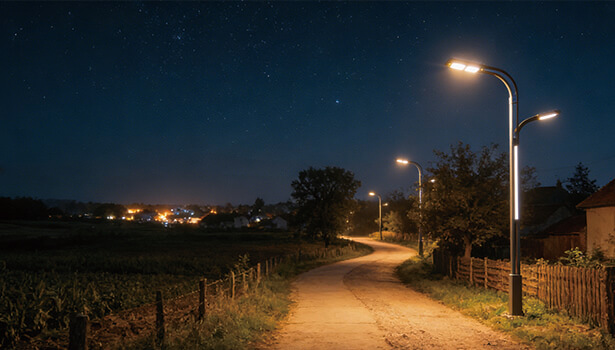
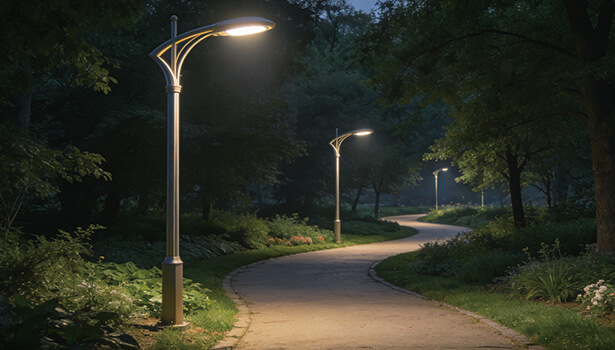
Municipal: Main thoroughfares, sidewalks, street greenery, urban parks. Residential applications include residential alleyways, villa courtyards, and community parking lots. Public applications cover campus roads, park pathways, scenic area lighting, and rural roads. Commercial applications extend to industrial parks, logistics zones, and small commercial plaza parking lots.
Choosing the Right Solar Street Light
The installation effectiveness of integrated solar street lights hinges on proper product selection. Choosing the right product avoids future rework and ensures long-term system stability. Below are precise selection techniques based on five core dimensions.
LED Lighting Performance
LED chips are the core illumination components of integrated solar street lights, with their brightness directly determining lighting effectiveness. The core of selection is “scenario matching.” High-traffic scenarios like highways, municipal thoroughfares, and large parks require ample lighting due to heavy pedestrian and vehicular flow. We recommend 3000–12000 lumens. For low-traffic areas like residential alleys, gardens, and small parking lots with moderate lighting needs, prioritize energy efficiency and basic illumination with 1500–3000 lumens.
Solar Panel Efficiency
Solar panels serve as the energy source for integrated solar street lights, directly influencing charging speed and battery endurance. Higher efficiency enables faster charging under identical sunlight conditions, extending operational hours. Monocrystalline silicon panels maintain at least 20% efficiency and charge reliably in low-light conditions, making them suitable for areas with insufficient sunlight or frequent rainfall.
Polycrystalline silicon panels offer efficiency between 17%–19%, providing better cost-effectiveness for well-lit environments like open roads, suburbs, and rural areas. Important note: The installation angle of solar panels also impacts charging efficiency. Plan the mounting location in advance to avoid shading from trees or buildings during peak sunlight hours .
Battery Type and Capacity
The battery serves as the energy storage core of integrated solar street lights. Its type and capacity directly determine endurance and lifespan. When selecting, prioritize longevity and operational stability over price alone. LiFePO4 lithium iron phosphate batteries offer a lifespan of at least 8 years, featuring high stability, heat resistance, and safety. They are suitable for long-term applications in municipal and campus settings. Lithium batteries have a lifespan of 5–8 years, offering compact size, light weight, and high cost-effectiveness, making them ideal for residential communities, parks, and other standard scenarios.
Lead-acid batteries have a lifespan of approximately 2 years and are inexpensive, making them suitable only for temporary use. They are not recommended for long-term operation. Capacity selection should be based on local sunlight duration and the solar street light's preset operating hours to ensure sufficient battery capacity, preventing insufficient runtime during cloudy or rainy days.
Operating Hours and Light Sensor Function
The intelligence of integrated solar street lights primarily manifests in operating hour adjustment and light sensor functionality. For high-traffic areas like sidewalks, campuses, and main municipal roads, a 12–14 hour operating cycle is recommended to ensure full nighttime illumination. In low-traffic settings such as remote alleys or small courtyards, opt for shorter 8–10 hour cycles or automatic dimming. This feature reduces brightness during periods of no activity and restores high brightness upon detecting movement, significantly lowering energy consumption.
Light-sensing technology automatically activates lights at dusk and deactivates them at dawn based on ambient brightness, eliminating manual intervention. When selecting models, verify adjustable light-sensing sensitivity. Some premium solar street lights also support scheduling functions for enhanced flexibility.
Weather Resistance and Durability
Integrated solar street lights endure harsh outdoor conditions like wind, rain, dust, and UV exposure. Weather resistance and durability are critical selection factors. Outdoor installations require minimum IP65 protection rating. IP65 provides complete dustproofing and protection against water jets, suitable for general outdoor settings; IP66 withstands powerful water jets, ideal for industrial zones with heavy rainfall or dust.
IP67 allows brief immersion and suits coastal salt spray, frequent heavy rain, or water-prone areas. For the housing, aluminum alloy or stainless steel is recommended. Aluminum alloy is lightweight and corrosion-resistant, suitable for most environments; stainless steel offers high hardness and durability, ideal for harsh conditions like coastal salt spray or industrial zones.
Installation Process
Pre-Installation Preparation
Preparatory work is crucial to avoid construction interruptions and ensure installation safety. Preparation should cover tools, personnel, and safety. Basic tools include wrenches, screwdrivers, tape measures, spirit levels, and markers. Fixing tools include concrete, shovels, and compactors. Auxiliary tools include aerial work platforms, gloves, hard hats, and flashlights.
For standard 3–5 meter poles, 2–3 personnel are recommended. Poles ≥6 meters or high-altitude work requires certified professionals with on-site supervision. Always wear hard hats and safety harnesses during elevated work, avoid power lines, and suspend operations during rain or high winds.
Site Selection
Installation location directly impacts integrated solar street light charging efficiency and illumination performance. Core principles are “unobstructed, high sunlight exposure, stable foundation.” Ensure solar panels receive unobstructed, ample direct sunlight; position near target illumination areas to minimize light wastage; select firm ground avoiding soft or waterlogged areas to prevent pole tilting, sinking, or electrical short circuits.
Light Pole Assembly
Assemble the light pole strictly following the manual sequence, prioritizing structural integrity. Inspect all components for damage or deformation. Connect pole sections sequentially and tighten screws. Secure the bracket to the pole top, leaving room for angle adjustment. Avoid forceful impacts during assembly to prevent pole deformation or coating damage, ensuring overall structural stability.
Luminaire Installation
The core principles for integrated luminaire installation are “secure fixation and optimal angle.” Inspect the luminaire exterior, solar panel, and LED chips for integrity, and verify proper circuit connections. Secure the luminaire to the bracket, adjust the angle to eliminate illumination blind spots, and avoid direct glare toward pedestrians or vehicles. Conduct repeated checks to ensure no wobbling. During installation, prevent collisions or scratches to the luminaire and solar panel, protecting the housing and panel coatings to extend the integrated solar street light's service life.
Light Pole Installation
Securing the light pole is critical for the long-term stable operation of integrated solar street lights. Dig a foundation pit according to the pole height, place the base in the center, and adjust for levelness and verticality. Pour concrete and compact it thoroughly. Wait 24–48 hours for complete curing before proceeding with subsequent operations. Reserve drainage holes during pouring to prevent rainwater corrosion at the pole base.
System Testing
Conduct comprehensive system testing after installation. Verify LED brightness, illumination coverage, and dimming functionality. Test responsiveness of smart features like auto-switching, motion sensors, and timers. After sufficient daylight charging, evaluate battery endurance and charging status.
Address anomalies promptly: Check circuits and batteries for non-illuminated fixtures; inspect charging efficiency and panel angle for insufficient brightness; examine light sensors and controllers for failed smart functions. Ensure solar street lights operate reliably upon deployment.
Maintenance and Troubleshooting
Daily Maintenance Tips
Routine maintenance focuses on cleaning, inspection, and calibration, performed monthly. Clean solar panels 1–2 times monthly with a soft cloth and water, avoiding abrasive materials or water ingress into fixtures. Increase frequency in dusty or coastal environments. Monitor battery voltage quarterly, clean terminals of dust/corrosion, and replace aged batteries promptly. Monthly inspections should cover the lamp post, brackets, fixture housing, and light sensor probe. Address any loosening, corrosion, obstruction, or damage promptly to ensure stable operation of the solar street light.
Common Troubleshooting
If the fixture fails to illuminate or exhibits insufficient brightness, first check for panel obstruction, battery degradation, or issues with the LED chips and circuitry. For abnormal charging, inspect solar panel efficiency and angle, the charge controller, and battery condition. Perform targeted cleaning, adjustments, or replacements as needed. Smart function failures are often caused by obstructed or damaged light sensors or controller malfunctions. Cleaning, replacement, or repair will restore functionality, enabling the integrated solar street light to resume normal operation quickly.
Maintenance Precautions
Avoid disassembling fixtures yourself to prevent circuit damage and void warranty coverage. After severe weather, promptly inspect and clear accumulated water or snow, and verify component safety. Calibrate smart functions periodically as required. Implement safety precautions during maintenance, adhere to high-altitude work protocols, and ensure operational safety for solar street lights.
The core principles for installing and maintaining stable operation of integrated solar street lights are: “Select the right product, install according to standards, and perform regular maintenance.” Following these scientific methods ensures efficient installation and long-term stable operation of the solar lighting system. This maximizes its energy-saving, eco-friendly, and low-cost advantages, providing reliable lighting solutions for diverse outdoor environments.