Solar Street Lights: Illuminating the Future of Urban Lighting
Dec 05, 2025
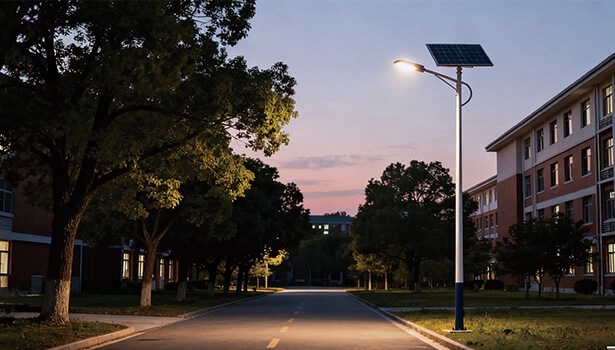
Urban lighting is a vital component of infrastructure, yet it has long been constrained by the limitations of traditional street lights. Conventional street lights rely on grid power, resulting in high energy consumption and indirectly exacerbating greenhouse gas emissions. Their installation requires extensive trenching, leading to lengthy construction periods, high costs, and damage to roads and green belts.
Solar street lights have emerged as a core solution to these challenges, leveraging advantages such as renewable energy utilization and flexible deployment. This article analyzes their application value from dimensions including core advantages, primary types, key selection criteria, and solutions to challenges, providing reference for relevant stakeholders.
The Advantages of Solar Street Lights
Environmental Sustainability
Solar street lights utilize solar energy as their sole power source, eliminating the need for grid electricity and reducing reliance on fossil fuels at the source. Data indicates that a single 60W solar street light can reduce annual carbon dioxide emissions by approximately 120kg. Additionally, mainstream solar street lights comply with international standards, utilizing directional LED light sources and anti-glare designs to minimize skyward light dispersion. This enhances lighting efficiency while protecting the ecosystem.
Cost Savings
While solar street lights have a slightly higher initial purchase cost than traditional lights, their cost advantage becomes evident over an 8-12 year lifecycle. With no ongoing electricity bills and annual maintenance costs averaging only about one-third of traditional lights—requiring only simple battery checks and solar panel cleaning—the cumulative savings over long-term use are substantial for municipal bulk purchases.
Energy Independence
Solar street lights employ an off-grid design combining photovoltaic panels with energy storage batteries, eliminating dependence on the power grid. Even during extreme events like typhoons, heavy rains, or grid failures, they maintain normal illumination through stored battery power. This feature makes them particularly suitable for critical infrastructure scenarios such as highway emergency lanes and remote medical facilities, ensuring emergency needs are met.
Improved Safety and Accessibility
Solar street lights utilize high-brightness LED sources, significantly outshining traditional sodium lamps. They clearly illuminate road surfaces and pedestrian details, dramatically enhancing nighttime visibility. Police statistics reveal that after installing solar street lights, nighttime theft and robbery rates in older residential areas decreased by 32% year-over-year, while nighttime traffic accident rates on rural roads dropped by 28%. They also boost residents' willingness to travel at night, supporting the nighttime economy.
Rapid and Flexible Installation
Traditional street light installation requires trenching, cable laying, and road restoration, with each fixture taking 3-5 days to install while disrupting traffic and damaging roads. Solar street lights, however, feature a modular design requiring no cable connections. Installation involves only securing the pole foundation and assembling the equipment, taking just 4-6 hours per unit. This makes them ideal for new urban developments, renovations of older neighborhoods, and temporary post-disaster shelters.
Types of Solar Street Lights
Standalone Solar Street Lights
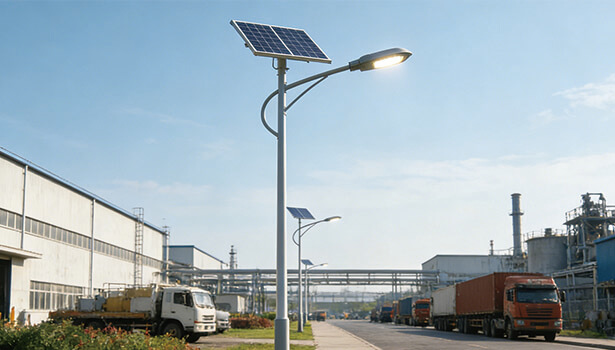
Standalone solar street lights integrate photovoltaic panels, energy storage batteries (lithium-ion/lead-acid, 50-200Ah capacity), LED light sources (30-120W), and controllers into a single unit, eliminating additional wiring. Ideal for rural roads and remote scenic trails without existing power infrastructure, they offer 3-7 days of operation during cloudy/rainy periods with moderate energy efficiency.
Solar Street Light with Grid Backup
The grid-backup solar street light builds upon the standalone system by adding a grid interface and switching controller, creating a dual-energy mode where “solar power takes priority, with grid power providing backup.” It is suitable for southern cities and high-latitude regions with frequent rainy weather and short daylight hours, as well as scenarios requiring high continuity like urban main roads. Its energy efficiency surpasses standalone models, balancing stability and energy savings.
Solar Street Light with Motion Sensors
Human-sensing solar street lights incorporate built-in infrared or microwave sensors paired with smart controllers. They operate at low power (20%-30% brightness) during periods of no activity and automatically illuminate at full power when detecting motion. Ideal for low-traffic areas like residential pathways and park trails, it delivers 7-15 days of operation during cloudy or rainy weather, offering the highest energy efficiency among three categories of street lights.
Factors to Consider when Choosing Solar Street Lights
Sunlight Conditions Compatibility
Determine the “annual equivalent sunshine hours” for the installation site before selecting the corresponding solar panel power rating. Regions with high sunlight intensity (approx. 3000-3600 hours) can use 60W panels. In rainy areas with only 1200-1800 hours, 80-100W panels are required to ensure sufficient power generation.
Battery Performance and Lifespan
Batteries are critical for solar street light endurance and longevity. Prioritize lithium iron phosphate batteries, which offer a lifespan of 5-8 years and excellent low-temperature performance, maintaining over 80% capacity retention at -10°C. Avoid substandard lead-acid batteries, as their lifespan is only 2-3 years and they require cumbersome maintenance. Additionally, battery capacity must meet nighttime lighting demands with a 20% margin. For instance, a 10-hour nighttime lighting requirement (60W power) necessitates a 60Ah battery.
Lighting Requirements Matching
Select appropriate LED power and luminaire optical designs based on road width, pedestrian traffic, and vehicle flow at the installation site. For urban main roads and highway service roads (8-12m width), select 80-120W LEDs with “batwing” distribution for uniform coverage.For residential roads and rural highways (3-6m width), choose 30-60W LEDs with narrow distribution to avoid light waste. For park walkways and courtyards with low foot traffic, select 10-30W LEDs paired with 2700K-3000K warm light to create ambiance.
Durability
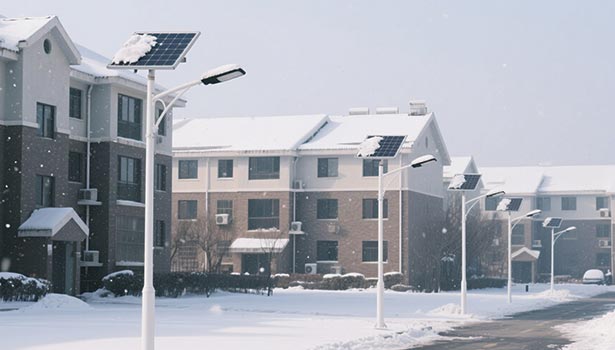
Solar street lights endure prolonged outdoor exposure, requiring robust resilience and durability. Luminaire protection must meet IP65 standards, ensuring dustproofing and resistance to water jets. The battery box should meet IP67 standards, allowing brief submersion to ensure operation during rain and dusty conditions. The pole's wind resistance must match local climate: coastal areas require resistance to 12-level winds (pole thickness ≥4mm), while inland areas need 10-level wind resistance. Core components should support operating temperatures from -30°C to 60°C to prevent extreme temperature impacts.
Brand and After-Sales Support
Quality varies significantly among core components of solar street lights. Prioritize brands with certifications like CE, ROHS, and CQC to ensure compliance with safety and environmental standards. Warranty policies are critical: photovoltaic panels require ≥10 years, lithium batteries ≥5 years, and the entire light ≥2 years. Additionally, ensure the brand maintains local service centers capable of 24-hour response and on-site repairs within 48 hours to prevent service delays from affecting usage.
Challenges and Solutions in Solar Street Lighting
Insufficient Sunlight Issues
In high-latitude regions, rainy areas, or zones with tall building obstructions, solar street lights may experience reduced runtime or even “lighting interruptions” due to inadequate power generation. To address this, moncrystalline silicon photovoltaic panels with conversion efficiency ≥23% can be selected, offering 3-5 percentage points higher power generation efficiency than standard polycrystalline silicon panels.
Alternatively, a hybrid system combining “photovoltaic panels + grid backup” can be deployed, automatically switching to grid power during cloudy or rainy days. Additionally, optimizing the installation angle of photovoltaic panels based on local solar altitude angles and avoiding obstructions like trees or tall buildings can enhance performance.
Battery Performance Degradation
Some low-quality batteries experience significant capacity decline after 1-2 years of use, resulting in reduced runtime, frequent replacements, and increased maintenance costs. To address this, prioritize battery quality from the source by selecting lithium iron phosphate batteries with a cycle life ≥2000 cycles—3-4 times that of traditional lead-acid batteries.
During daily use, regularly clean the battery box to prevent high-temperature impacts. Perform annual battery charge-discharge calibration to prevent “memory effect.” Additionally, pair with controllers featuring overcharge, over-discharge, and over-temperature protection to prevent battery damage from extreme operating conditions.
Vandalism and Theft
In densely populated urban villages and remote rural areas, solar street lights' photovoltaic panels and batteries may face deliberate damage or theft. Security can be enhanced through hardware protection: securing photovoltaic panels to lamp posts with tamper-resistant screws, and using battery boxes made of ≥2mm thick steel plates with anti-theft locks.
As a key enabler of urban green transformation, solar street lights leverage core advantages like environmental friendliness, cost-effectiveness, and flexibility to gradually address numerous pain points of traditional lighting. They provide sustainable illumination solutions for urban and rural roads, park pathways, and similar settings.