Key Design Considerations for a 300W Solar Street Light
Dec 31, 2025
300W solar street light, as a representative of medium and high power solar street light, is widely used in outdoor scenarios such as urban main roads, industrial parks and other outdoor scenes by virtue of the core advantages of energy saving, environmental protection, pollution-free, independent operation from the grid and etc. For 300W solar street light, a reasonable design scheme directly determines its lighting performance, energy utilization efficiency, service life and long-term operational stability. For 300W solar street light, a reasonable design scheme directly determines its lighting performance, energy utilization efficiency, service life and long-term operational stability. Poor design may lead to insufficient lighting brightness, interrupted range in rainy weather, premature damage to the components and other problems, significantly increasing the maintenance costs.
In this paper, we will systematically sort out the core design considerations for a 300W solar street light, and discuss the optimization strategies used by engineers to achieve high efficiency and stability of high efficiency solar street lights, so as to provide professional references for related design, selection and application.
Key Design Considerations For A 300W Solar Street Light?
Solar Panel Efficiency and Size
Solar panel is the energy core of a 300W solar street light, responsible for converting solar energy into electricity, and matching the efficiency and size of the solar panel is especially critical. High-efficiency solar panels can improve the energy conversion efficiency per unit area and realize higher power generation in limited installation space. High-efficiency monocrystalline silicon solar panels can effectively reduce energy loss to meet the demand of 300W power and 30,000 lumens lighting.
Mainstream high-efficiency panels are mainly monocrystalline silicon, with a conversion efficiency of 22%-24%, while polycrystalline silicon is 18%-20%, and both have their own advantages and disadvantages in terms of application scenarios and costs. The size of the panel array should be accurately calculated in combination with the local light conditions, seasonal changes and lighting hours, which is the basis for the optimization of PV panel energy collection for solar street lights. Two 300W monocrystalline silicon panels can be used in strong light areas, while three panels are needed in low light areas to ensure that sufficient power can be accumulated even on cloudy or rainy days.
|
Solar Panel Type |
Conversion Efficiency |
Suitable Scenarios |
Advantages |
Disadvantages |
|
Monocrystalline |
22%–24% |
Areas with moderate sunlight and limited space |
High efficiency, strong stability, long service life |
Higher cost |
|
Polycrystalline |
18%–20% |
Areas with abundant sunlight and sufficient space |
Lower cost, mature manufacturing process |
Lower efficiency, more sensitive to temperature |
Battery Capacity and Lifespan
Battery is responsible for storing electricity during daytime and supplying electricity at night, the capacity and lifespan of solar street light battery directly determine the system life and cost. Battery capacity needs to be matched with 300W power consumption, and at the same time, considering the duration of cloudy and rainy weather, the daily power consumption is about 2.4kWh, combined with the longest number of cloudy and rainy days to calculate the required capacity.
For example, 5 days of cloudy and rainy area needs not less than 12kWh capacity, after reserving 20% safety margin should be not less than 14.4kWh. At present, the mainstream use of lithium iron phosphate batteries, its cycle life, energy density and charging and discharging efficiency are better than lithium-ion batteries and traditional lead-acid batteries, and basically maintenance-free. Advanced solar street light battery management system (BMS) can optimize the charging and discharging cycle, which is the key to optimize the solar street light energy storage system.
|
Battery Type |
Cycle Life (Cycles) |
Energy Density |
Charge & Discharge Efficiency |
Maintenance Requirement |
|
LiFePO₄ Battery (Lithium Iron Phosphate) |
3,000–5,000 |
High |
Above 90% |
Low; virtually maintenance-free |
|
Lithium-ion Battery |
2,000–3,000 |
Relatively high |
85%–90% |
Low |
|
Lead-acid Battery |
500–1,000 |
Low |
70%–80% |
High; requires regular maintenance |
LED Lamps
LED lamps are the core of lighting, its efficiency and light distribution design directly determines the lighting effect, is the core target of solar street light LED lamps to improve efficiency. High-efficiency LED light source needs to have a high lumen / watt ratio, high-quality chip luminous efficacy of up to 150-180lm / W, can reduce energy consumption in the 30,000 lumens LED solar street lights.
At the same time need to pay attention to the color rendering index, road lighting LED color rendering index should not be less than 70, to ensure that pedestrians and vehicles clearly identify the object color. Through the rational design of optical lenses and reflectors, the light propagation direction and range can be controlled to achieve uniform road lighting. Batwing light distribution curve is suitable for urban main roads, and the light distribution range can be adjusted for rural highways, taking into account the lighting width and brightness.
Intelligent Lighting Control and Monitoring System
The integrated intelligent control and monitoring system can greatly improve the functionality and efficiency of the street light, which is the core content of the intelligent control system design for solar street light. The core functions include light control, human body sensing and programmable dimming, light control to realize dusk on, dawn off, human body sensing can be adjusted according to the brightness of pedestrian and vehicle, which is in line with the needs of energy-saving solar street light design.
For example, a rural highway can be set to dim to 50% power after 10:00 p.m. at night, which ensures the lighting and extends the life span at the same time. Remote monitoring solar street light system through the Internet of Things technology, real-time collection of operating parameters, to achieve early warning of failures and accurate operation and maintenance, reduce the cost of manual inspection, reduce equipment downtime.
Weatherproof and Robust Enclosure Design
300W solar street light is in the outdoor for a long time, waterproof enclosure design and structural robustness is crucial. Shell is recommended to use aluminum alloy or stainless steel, corrosion resistance, impact resistance and good thermal conductivity, anodic oxidation treatment of aluminum alloy shell is more adaptable to the seashore, industrial zones and other special environments, to meet the needs of industrial parks, solar street lights.
Shell protection level should not be lower than IP65/IP67 solar street light shell standard, IP65 can completely prevent dust intrusion, resist any direction of low-pressure water jet, rainy and dusty areas can choose IP67 level. The heat dissipation design of the solar street light is also critical, through the heat dissipation fins and ventilation structure to improve efficiency, to ensure stable operation of the equipment in extreme temperatures of - 40 ℃ to 60 ℃.
Total Life Cycle Cost And Operation And Maintenance Of 300W Solar Street Light
Initial Cost Control
Initial cost control needs to maximize the cost-effectiveness of component selection and scheme design under the premise of guaranteeing the performance of solar street light. In terms of component selection, the choice can be differentiated according to application scenarios. Urban main roads require high lighting stability, prioritizing the use of high-efficiency monocrystalline silicon panels and lithium iron phosphate batteries. Rural highways and other budget-sensitive scenarios, can be selected after verification of lighting conditions polycrystalline silicon panels, with more cost-effective lithium-ion batteries.
Program design, through the accurate calculation of the capacity of the battery panels and batteries, to avoid over-configuration of the cost of waste. For example, in areas where the average annual sunshine hours are ≥4 hours, there is no need to blindly increase the panel array. In areas where the maximum number of cloudy and rainy days is ≤3 days, the battery capacity redundancy can be appropriately reduced to minimize the initial investment. At the same time, the installation structure design is simplified and modularized components are adopted to reduce installation and construction costs.
Operation and Maintenance Cost Optimization
The core of operation and maintenance cost optimization is to reduce the frequency and difficulty of maintenance in the later stage, and the key lies in the improvement of component reliability and the design of operation and maintenance convenience. In terms of component selection, priority is given to long-life, maintenance-free solar street lights, such as lithium iron phosphate batteries with a cycle life of more than 3,000 times and LED chips with a light decay of ≤3%/10,000 hours, so as to reduce the frequency of component replacement.
In terms of structural design, the use of quickly removable housing and modularized interfaces is convenient for operation and maintenance personnel to overhaul and replace components. The battery and controller are integrated and mounted in a location that is easy to operate, avoiding the risk of overhead operation. At the same time, with the help of remote monitoring of the solar street light system, it realizes accurate fault location, reduces the time and labor cost of manual inspection, and turns passive maintenance into active warning, further reducing the operation and maintenance expenditure.
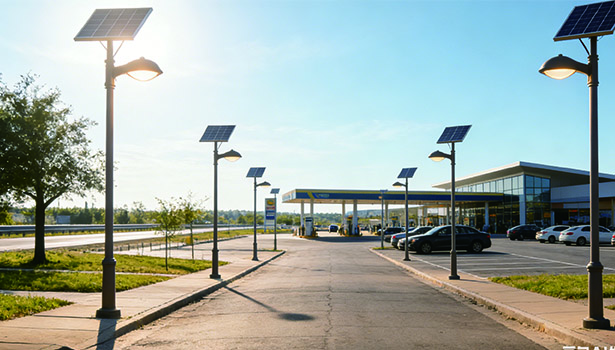
How Do Engineers Optimize the Design to Achieve Maximum Efficiency and Performance Of 300w Led Solar Street Lights Outdoor?
Utilizing High-Efficiency LED Technology
Engineers need to use high-efficiency LED chips as the core components in the design, and prioritize the use of rigorously tested and verified chips. By optimizing the LED encapsulation process, it can improve the luminous efficiency and heat dissipation performance, reduce the light decay, and help optimize the performance of 300W solar street lights.
At the same time, the constant-current drive power supply is adopted to ensure the stable current of the LED light source, avoiding changes in brightness and shortening of life caused by current fluctuations. The conversion efficiency of high-quality constant-current drive power supply should be no less than 90%, further reducing energy loss.
Optimization Of Photovoltaic Panels
In order to maximize the efficiency of solar energy collection, engineers need to accurately optimize the installation angle and orientation of the panels to deepen the optimization effect of solar street light photovoltaic panel energy collection. In the northern hemisphere, the panels are recommended to be oriented in the south direction, with the tilt angle equal to the local latitude (±5°), to ensure that sufficient light can be obtained even on the winter solstice (the shortest sunshine time).
In addition, the conversion efficiency and low-light performance of the panels can be improved through the use of advanced PV technologies such as half-cells and PERC, allowing the panels to generate electricity efficiently even in low-light environments such as early morning and evening.
High-Efficiency Energy Storage System Configuration
In terms of energy storage system optimization, engineers need to accurately match the capacity and type of battery according to the system power and usage scenarios, so as to improve the optimization plan of solar street light energy storage system. For 300W streetlights, priority is given to lithium iron phosphate batteries, which have a long cycle life and high safety and are suitable for long-term outdoor use of outdoor solar streetlights.
At the same time, the stability of the energy storage system is improved by optimizing the series-parallel connection of the battery pack. For example, equalization charging technology is used to ensure that the voltage of each individual battery in the battery pack is consistent, avoiding the overall performance degradation caused by the imbalance of individual batteries.
Intelligent Control System Algorithm Optimization
By optimizing the intelligent control algorithm, engineers can achieve precise adaptation of the lighting strategy and advance the optimization of the intelligent algorithm for solar street lights. For example, combined with local sunshine data and traffic flow, machine learning algorithms are used to automatically adjust the dimming mode and lighting duration to optimize energy consumption.
At the same time, the detection accuracy and response speed of the sensors are optimized to reduce false triggers and delays and improve user experience. For example, the detection distance of the human body sensor can be optimized to 15-20 meters, and the response time can be controlled within 0.5 seconds.
Strengthen Structure and Environmental Adaptability
In terms of structural optimization, the mechanical structure of the housing is optimized, and the wind resistance level is upgraded to create a wind-resistant solar street light. The wind resistance level of the 300W solar street light should be no less than 12, ensuring that it does not fall over or become damaged in strong typhoon weather.
In addition, for different climatic regions, targeted solar street light environmental adaptability design optimization. For example, in cold regions, the selection of low-temperature performance of the battery, increase the insulation layer inside the shell. In high-temperature areas, further optimize the heat dissipation structure to enhance the efficiency of heat dissipation.