Causes and Solutions for Excessively Dim Solar Street Lights
Dec 19, 2025
Solar street lights, with their advantages of clean and eco-friendly operation, energy efficiency, and easy installation, have been widely adopted in various outdoor lighting scenarios such as urban roads, rural streets, and scenic trails. They serve as a vital vehicle for advancing green lighting development, and their lighting stability directly impacts the practical value of solar street lights.
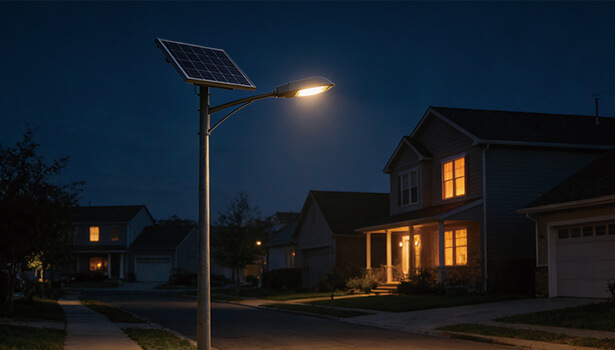
However, during actual operation, some solar street lights exhibit insufficient brightness. This not only compromises visibility for nighttime travelers, increasing traffic safety risks, but also diminishes the sense of security in illuminated areas. It undermines the practical value of solar street lights and delivers a poor user experience. Therefore, addressing the issue of insufficient brightness is crucial.
Causes of Insufficient Brightness in Solar Street Lights
Insufficient Battery Power
Solar street lights rely on solar panels for power generation and energy storage. If the panel capacity is too low, it directly results in inadequate battery storage. During operation, when power consumption exceeds the battery's supply capacity, brightness diminishes. This is a common cause of insufficient battery power in solar street lights.
Battery Degradation or Damage Over time, batteries naturally degrade. Physical damage or environmental corrosion can also cause malfunctions. Degraded or damaged batteries significantly reduce output current, failing to provide sufficient power to the street light and resulting in dim illumination. Visual inspections and performance tests can identify such issues.
Poor Battery Sealing: Solar street light batteries are often installed underground. If poorly sealed battery boxes are used during installation, or if the box is damaged later due to impact or aging, soil moisture and impurities can infiltrate the battery. This accelerates battery degradation, potentially causing failure, which in turn affects energy storage and supply, leading to insufficient brightness.
Improper Controller Configuration
The controller serves as the “brain” of the solar street light system, coordinating core functions like panel charging, battery discharge, and light switching. Its configuration directly determines the system's operational efficiency and stability.If controllers are not configured according to local conditions—particularly in regions with frequent rainfall or unstable sunlight—brightness issues are highly likely to occur. This is a primary manifestation of improper controller settings. For instance, when consecutive cloudy or rainy days exceed the controller's preset threshold, it places excessive strain on the battery. This accelerates battery degradation and wear, not only shortening its lifespan but also causing a persistent decline in lamp brightness. Additionally, mismatched controller settings with local daylight hours can compromise power supply stability, resulting in insufficient brightness.
LED Chip Issues
LED chips serve as the core lighting component of solar street lights, with their efficiency directly determining illumination brightness. Low-efficiency LED chips fail to achieve optimal lighting effects even with adequate power supply, manifesting as noticeable brightness deficiencies.
High-quality LED chips boast extended lifespans and slow decay rates. However, inferior chips or those exposed to harsh environments may experience accelerated decay. LED chip decay is a primary cause of dimming in solar street lights. As decay intensifies, the chips' luminous efficiency diminishes progressively, causing the street light brightness to fade.
Environmental and Installation Factors
Light Source Obstruction: Solar panels require ample sunlight for efficient power generation. If tall trees, buildings, or other obstructions block sunlight in the installation area, the panels cannot absorb sufficient solar energy. This leads to inadequate battery storage, causing the street light to dim. This is the core reason for insufficient brightness due to solar panel obstruction.
Improper Solar Panel Orientation and Angle: If solar panels are not facing the sun or are tilted at an unreasonable angle, power generation efficiency will be significantly reduced. For example, installing panels on the north side of tall buildings or failing to set the south-facing tilt angle according to specifications will result in insufficient light collection.
Weather Impact
Solar street lights derive their energy from sunlight. During overcast, rainy, or hazy weather conditions, insufficient solar radiation causes a significant drop in the power generation efficiency of solar panels, preventing adequate battery charging. This demonstrates the direct impact of weather on the brightness of solar street lights. As stored battery power gradually depletes, the brightness of the street lights diminishes, potentially leading to failure to illuminate properly.
In cold and rainy conditions, not only is sunlight insufficient, but low temperatures also impair the battery's energy storage capacity and discharge efficiency, further exacerbating the issue of insufficient brightness. During such periods, street lights often exhibit shorter illumination times and noticeably dimmer brightness.
Practical Solutions for Addressing Dim Solar Street Light Brightness
Optimize Battery Management
Regularly monitor battery charge levels. If insufficient charge is detected, promptly recharge using an external power source or other methods. Replace batteries confirmed to be aged or damaged promptly to ensure adequate energy storage and power supply capacity. This is a fundamental measure for optimizing solar street light battery management.
Enhance Battery Sealing Protection: When installing batteries underground, always use battery boxes with excellent sealing properties. Regularly inspect the condition of the battery box. If damage or seal failure is detected, repair or replace it promptly to prevent moisture and impurities from entering the battery, thereby slowing battery aging.
Scientifically Adjust Controller Settings
Adjust controller parameters such as charge protection, discharge protection, and illumination duration based on local climate conditions (e.g., average annual rainy days, fog frequency) and actual sunlight hours. This is the core principle of solar street light controller parameter tuning. For instance, in rainy regions, appropriately adjust the battery under-voltage protection threshold to prevent brightness reduction caused by frequent under-voltage events. In foggy areas, adjust street light on/off times according to actual daylight periods.
Upgrade LED Lamp Beads
To address issues of low efficiency and rapid degradation in lamp beads, directly replacing them with high-efficiency, premium-quality LED lamp beads is a common upgrade solution for solar street lights. High-efficiency LED lamp beads deliver higher brightness under identical power supply conditions while offering extended lifespan and slower degradation rates, fundamentally improving lighting performance.
Optimize Installation and Environment
Properly adjust the orientation and angle of solar panels, setting the tilt angle according to local latitude to maximize sunlight absorption. This is the core technique for optimizing solar panel installation angles. In areas where foggy days exceed one-third of the year but weather clears from afternoon to evening, tilt panels slightly westward.
Select optimal locations before installing solar street lights, avoiding tall trees, buildings, and other obstructions. For existing installations where shading is detected, promptly trim tree branches, relocate the light, or use taller poles to ensure sufficient sunlight reaches the panels.
Appropriately Adjusting Light Output Power
If testing confirms that core components such as batteries, controllers, and LED bulbs are functioning normally, yet insufficient brightness persists, professional technicians may appropriately increase the light output power based on the actual operating conditions of the system. This represents an applicable scenario for adjusting solar street light output power.

Key Brightness Optimization Focuses for Different Scenarios
Urban Road Scenarios
Urban roads require ensuring nighttime driving and pedestrian safety by providing stable, high-brightness illumination covering the entire nighttime travel period. Brightness optimization for urban solar street lights should prioritize high-power, high-efficiency LED bulbs and large-capacity batteries. Controllers should be configured to match urban daylight hours, and installation locations should avoid high-rise obstructions to ensure optimal sunlight exposure for solar panels. Regular inspections and maintenance of battery and bulb performance are also essential.
Rural Street and Alley Scenarios
Rural street and alley scenarios require basic lighting while balancing energy efficiency, cost control, and adaptation to open environments with potential tree obstructions. Optimization focuses on: Rationally adjusting solar panel orientation and tilt angles. Clearing surrounding tree obstructions. Selecting cost-effective, high-quality batteries and LEDs. Configuring controllers for rural light conditions. Using underground sealed battery boxes to enhance environmental interference resistance.
Scenic Trail Lighting Scenario
Scenic trail lighting must balance illumination with landscape harmony, ensuring moderate brightness while avoiding glare and adapting to complex environments featuring mountainous terrain and frequent fog. Brightness adjustment for solar-powered trail lights should utilize low-glare, high-efficiency LED chips with adjustable brightness levels based on foot traffic. For foggy or forested obstructed environments, optimize solar panel installation angles (e.g., appropriate westward tilt) to enhance light capture efficiency. Configure controllers to adapt to the scenic area's unique climate, ensuring stable illumination during overcast and rainy conditions.
Cold, Rainy / Foggy Special Climate Scenarios
Cold, rainy/foggy climates demand resilience against low temperatures, humidity, and insufficient sunlight to maintain lighting stability. Solar street light optimization in cold, rainy regions and foggy areas requires low-temperature-resistant, highly sealed batteries. Panels should feature anti-fog and snow-resistant designs with adjusted angles to maximize light capture. Controller settings should specifically adjust under-voltage protection thresholds and lighting duration to prevent excessive battery depletion.
The issue of insufficient brightness in solar street lights stems not from a single factor but from the combined effects of battery-related problems, improper controller settings, defective LED bulbs, environmental and installation deviations, and weather impacts. Corresponding solutions must be implemented with precision. By appropriately applying these maintenance and optimization measures for solar street lights, most brightness deficiency issues can be effectively resolved.